Comprehensive Guide to Unit 1: Limits and Continuity
Defining Limits and Notation
The Intuitive Concept of a Limit
At its core, calculus is the study of change. Before determining instantaneous change (derivatives), we must understand how functions behave as they approach specific values.
A Limit describes the value that a function $f(x)$ approaches as the input value $x$ gets closer and closer to some number $c$. Crucially, limits do not care what happens AT the point x = c, only what happens around it.
The Formal Notation
We write the limit as:
This is read as: "The limit of $f(x)$ as $x$ approaches $c$ equals $L$."
One-Sided Limits and Existence
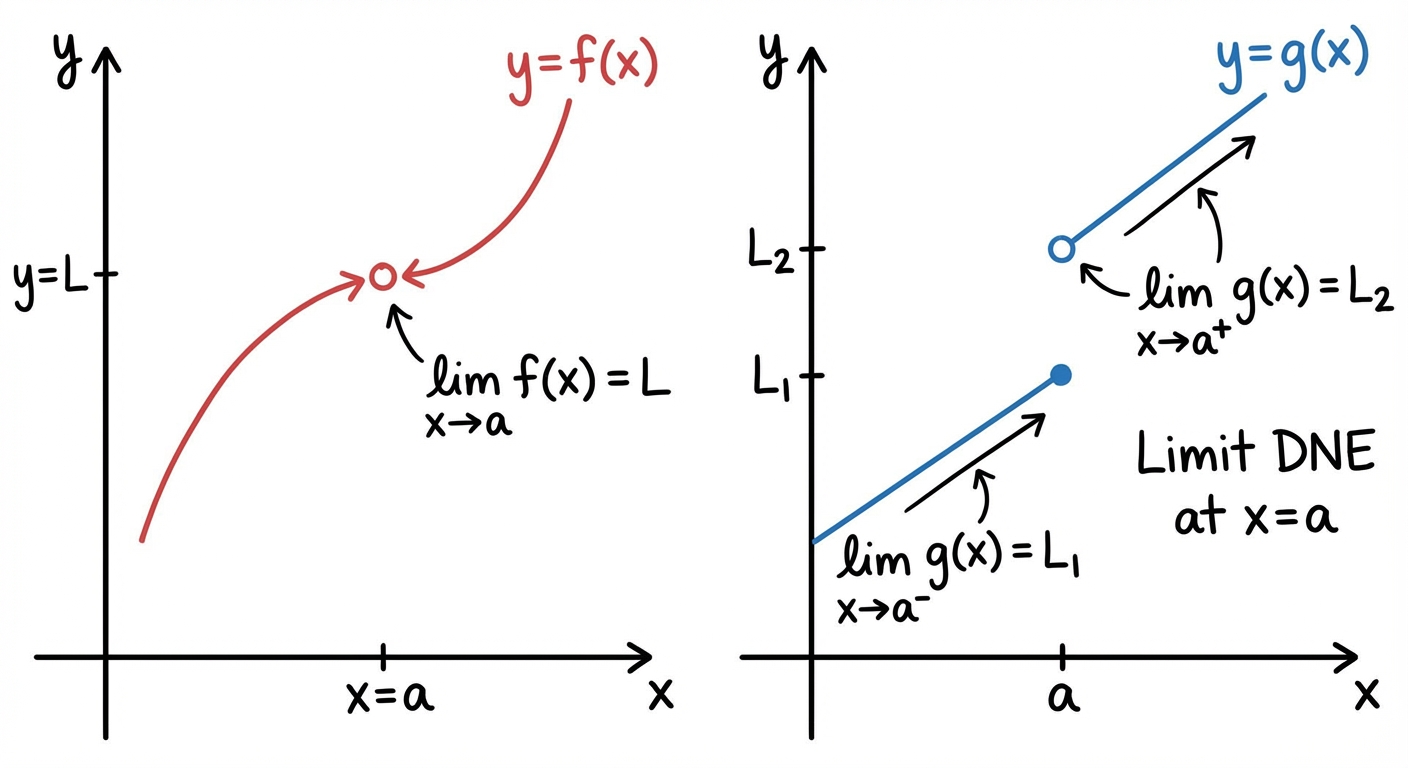
For a general limit to exist, the function must approach the same height from both the left and the right sides.
- Left-Hand Limit: Approaching $c$ from values smaller than $c$. Notation: $\lim_{x \to c^-} f(x)$
- Right-Hand Limit: Approaching $c$ from values larger than $c$. Notation: $\lim_{x \to c^+} f(x)$
The General Limit Existence Theorem:
$\lim{x \to c} f(x) = L$ if and only if:
If the left and right approaches do not match, the limit Does Not Exist (DNE).
Estimating Limits Graphically and Numerically
Graphical Estimation
When given a graph, trace the function with your finger approaching the x-value in question from both sides.
- Holes: If the graph has a holes at $x=c$, the limit is the y-value of the hole.
- Jumps: If the graph breaks, the limit DNE.
- Vertical Asymptotes: If the graph shoots up or down infinitely, the limit is $\infty$, $-\infty$, or DNE (depending on direction).
Numerical Estimation (Tables)
To estimate $\lim_{x \to 2} f(x)$, plug in x-values increasingly close to 2 from both sides:
| x (Left) | 1.9 | 1.99 | 1.999 | … | 2.001 | 2.01 | 2.1 | x (Right) |
|---|---|---|---|---|---|---|---|---|
| f(x) | 3.8 | 3.98 | 3.998 | … | 4.002 | 4.02 | 4.2 |
In this table, it is clear that as x approaches 2, f(x) approaches 4.
Determining Limits Algebraically
1. Direct Substitution (The First Step)
Always try to plug the number $c$ into the function first.
- If you get a real number (e.g., $5$, $0$, $1/2$), that is your answer.
- If you get $\frac{k}{0}$ (where $k \neq 0$), a vertical asymptote exists (limit is $\pm\infty$ or DNE).
- If you get $\frac{0}{0}$, this is an Indeterminate Form. It means a hole likely exists, and you must use algebraic manipulation to find the true value.
2. Solving Indeterminate Forms ($0/0$)
When direct substitution yields $\frac{0}{0}$, use these techniques:
A. Factoring and Canceling
Useful for polynomials. Factor the numerator and denominator, cancel the common factor (the removable discontinuity), then retry substitution.
Example: Find $\lim{x \to 3} \frac{x^2 - 9}{x - 3}$
B. Rationalization (Conjugates)
Useful for square roots. Multiply the numerator and denominator by the conjugate of the expression containing the root.
Example: $\lim_{x \to 0} \frac{\sqrt{x+4}-2}{x}$
Multiplied by conjugate $\frac{\sqrt{x+4}+2}{\sqrt{x+4}+2}$ simplifies to $\frac{1}{2+2} = \frac{1}{4}$.
C. Complex Fractions
If the function contains fractions within fractions, find a common denominator to combine them into a single numerator/denominator structure.
3. Special Trigonometric Limits
Memorize these two standard limits as $x \to 0$:
Generalization for coefficients: $\lim_{x \to 0} \frac{\sin(ax)}{bx} = \frac{a}{b}$
The Squeeze Theorem (Sandwich Theorem)
If you cannot evaluate a limit directly, you may be able to "squeeze" it between two known functions.
Theorem Statement:
If $g(x) \leq f(x) \leq h(x)$ for all $x$ in an open interval containing $c$ (except possibly at $c$), and:
Then:
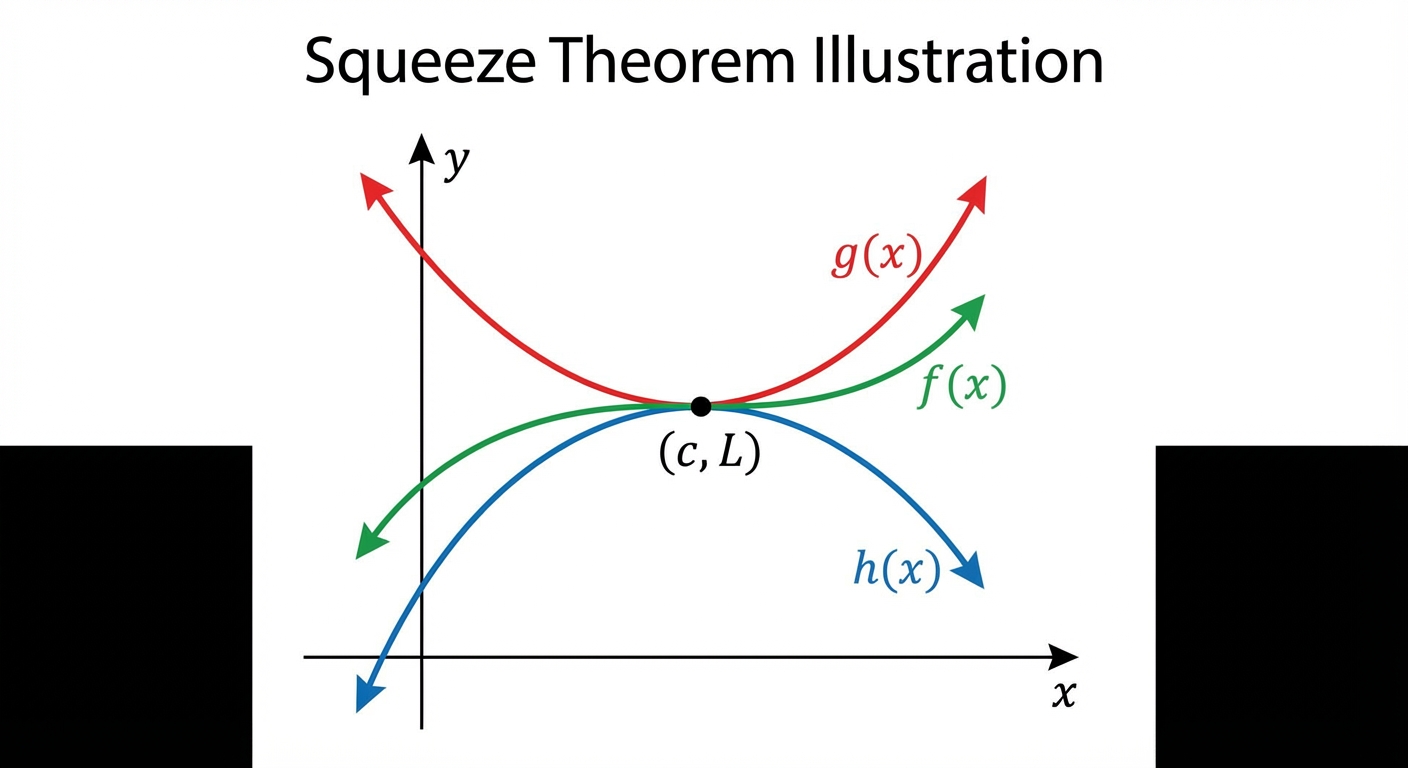
Common Application: Limits involving $\sin(\frac{1}{x})$ or $\cos(\frac{1}{x})$, which oscillate wildly.
Example: $\lim_{x \to 0} x^2 \sin(\frac{1}{x}) = 0$ because $-x^2 \le x^2 \sin(\frac{1}{x}) \le x^2$.
Continuity
Continuity is one of the most frequently tested concepts on the AP exam. A function includes no breaks, jumps, or holes.
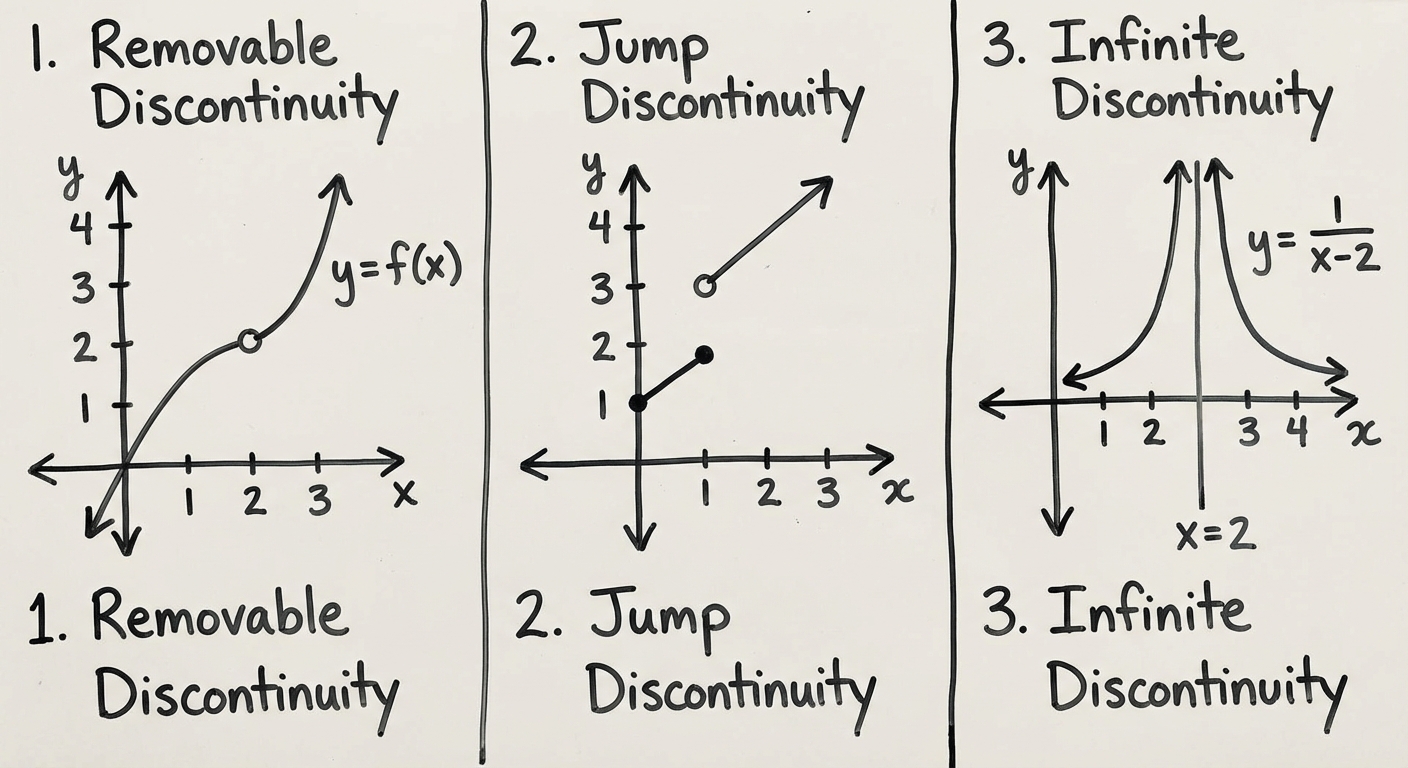
Types of Discontinuities
- Removable Discontinuity (Hole): The limit exists, but $f(c)$ is either undefined or practically different from the limit. Algebraically, these occur when factors cancel.
- Jump Discontinuity: $\lim{x \to c^-} f(x) \neq \lim{x \to c^+} f(x)$. Common in piecewise functions or step functions (e.g., $|x|/x$).
- Infinite Discontinuity (Vertical Asymptote): One or both one-sided limits go to $\pm\infty$.
The Definition of Continuity (The 3-Step Test)
For a function $f(x)$ to be continuous at a point $x=c$, ALL three conditions must be met:
- $f(c)$ is defined (The point exists).
- $\lim_{x \to c} f(x)$ exists (Left limit = Right limit).
- $\lim_{x \to c} f(x) = f(c)$ (The limit equals the function value).
If a question asks you to "Prove continuity," you must explicitly show all three steps.
Removing Discontinuities
Simplifying a rational function by canceling terms creates a new function that is continuous at the "hole." This is often called the Extended Function.
Asymptotes and Limits at Infinity
Vertical Asymptotes (Infinite Limits)
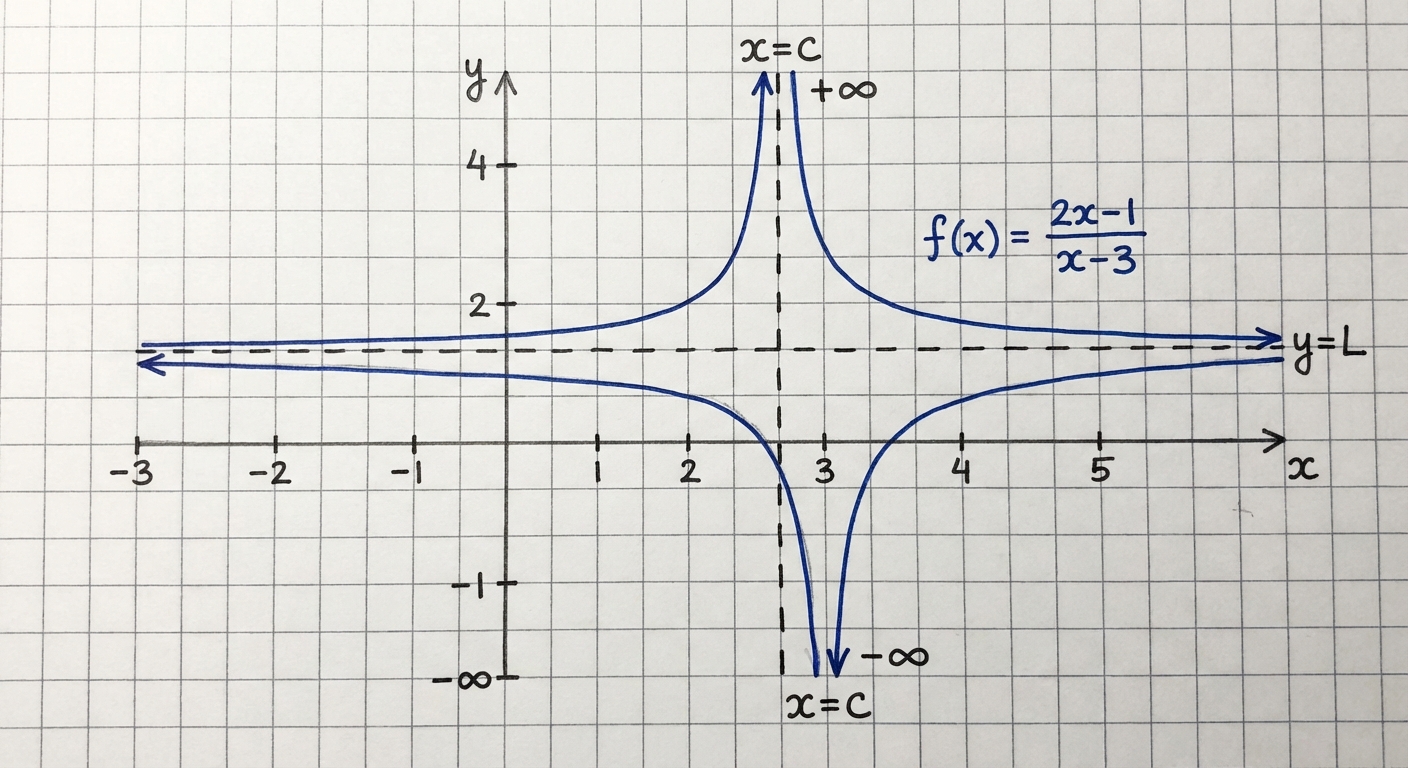
A line $x = c$ is a vertical asymptote if $\lim_{x \to c} f(x) = \pm\infty$.
- This occurs when the denominator is 0 but the numerator is not.
- Note: Infinite limits strictly rarely "exist" as a real number, but on the AP exam, we describe the behavior as $\infty$ or $-\infty$.
Horizontal Asymptotes (Limits at Infinity)
A line $y = L$ is a horizontal asymptote if:
These limits describe the End Behavior of the function.
Rules for Rational Functions: $\frac{P(x)}{Q(x)}$
Compare the degree (highest exponent) of the numerator ($N$) and denominator ($D$).
- Bottom Heavy ($N < D$): Limit is 0. (Horizontal Asymptote: $y=0$)
- Ex: $\lim_{x \to \infty} \frac{3x}{x^2+1} = 0$
- Equations ($N = D$): Limit is the Ratio of Leading Coefficients.
- Ex: $\lim_{x \to \infty} \frac{4x^3 - 1}{2x^3 + 5} = \frac{4}{2} = 2$. (HA: $y=2$)
- Top Heavy ($N > D$): Limit is $\pm\infty$ (DNE). There is no horizontal asymptote (often a slant asymptote).
Note on Exponentials:
Remember that $e^x$ grows faster than any polynomial.
- $\lim_{x \to \infty} \frac{x^{100}}{e^x} = 0$
Intermediate Value Theorem (IVT)
The IVT is an "Existence Theorem." It doesn't tell you what the value is or where it is, only that it exists.
Conditions:
- $f(x)$ is continuous on the closed interval $[a, b]$.
Conclusion:
If $k$ is any number between $f(a)$ and $f(b)$, then there exists at least one number $c$ in $(a, b)$ such that $f(c) = k$.
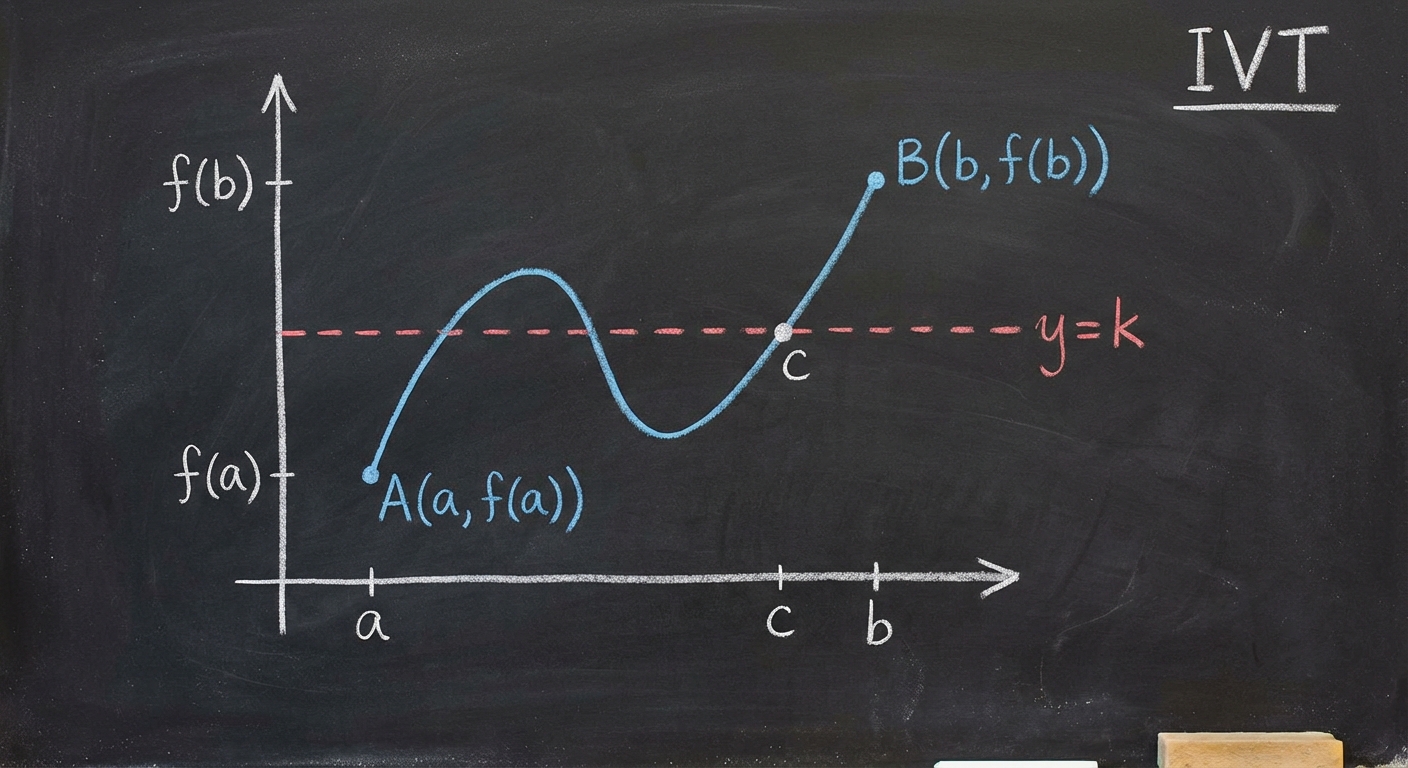
Real World Analogy: If you were 3 feet tall at age 5, and 5 feet tall at age 12, there must have been a moment when you were exactly 4 feet tall (assuming growth is continuous).
Typical Exam Problem: "Show that $f(x) = x^3 + x - 1$ has a zero on the interval $[0, 1]$."
- Check continuity (Polynomials are continuous everywhere).
- Find $f(0) = -1$.
- Find $f(1) = 1$.
- Since $-1 < 0 < 1$, by IVT, there is a $c$ where $f(c) = 0$.
Common Mistakes & Pitfalls
- The "0/0" Answer: Never write "0/0" as a final answer. It is an instruction to do more work (factor, conjugate, etc.).
- Confusing Limit Value vs. Function Value: A limit is about the journey (approach); the function value is the destination. A limit can exist even if the function is undefined at that point (a hole).
- Mismatched Indices in One-Sided Limits: Notation matters. $\lim{x \to 2^-}$ is NOT the same as $\lim{x \to -2}$. The minus sign in superscript means "from the left."
- Forgetting Conditions for IVT: You cannot apply the Intermediate Value Theorem unless you state that the function is continuous on the interval.
- Substituting Infinity: Infinity is not a number. Do not write arithmetic like $\frac{1}{\infty}$. Instead, reason that "1 divided by a huge number approaches 0."