Unit 1: La Época Medieval and The Golden Age Transition
Introduction to Medieval Spain and the Reconquista
The Medieval period in Spanish literature (Unit 1) is deeply rooted in the historical context of the Reconquista—the nearly 800-year period (711–1492) where Christian kingdoms sought to regain control of the Iberian Peninsula from Muslim rule. This era is defined by the coexistence (and conflict) of three cultures: Christians, Muslims, and Jews.
Key characteristics of literature from this period include:
- Oral Tradition: Many works were transmitted verbally before being written down.
- Didacticism: Literature intended to teach a moral, religious, or practical lesson (enseñar deleitando).
- Teocentrism: God as the center of the universe (though this begins to shift toward Anthropocentrism by the end of the period).
El Conde Lucanor (Exemplo XXXV)
Context and Structure
Written by Don Juan Manuel in the 14th Century, this work is a masterpiece of didactic prose fiction. Don Juan Manuel was the nephew of King Alfonso X (El Sabio) and the first Spanish author deeply concerned with preserving his copyright and legacy.
Key Term: Meta-fiction / Cajas Chinas
The structure of the book relies on a framing device (cuento enmarcado) often compared to Russian dolls or "Chinese boxes."
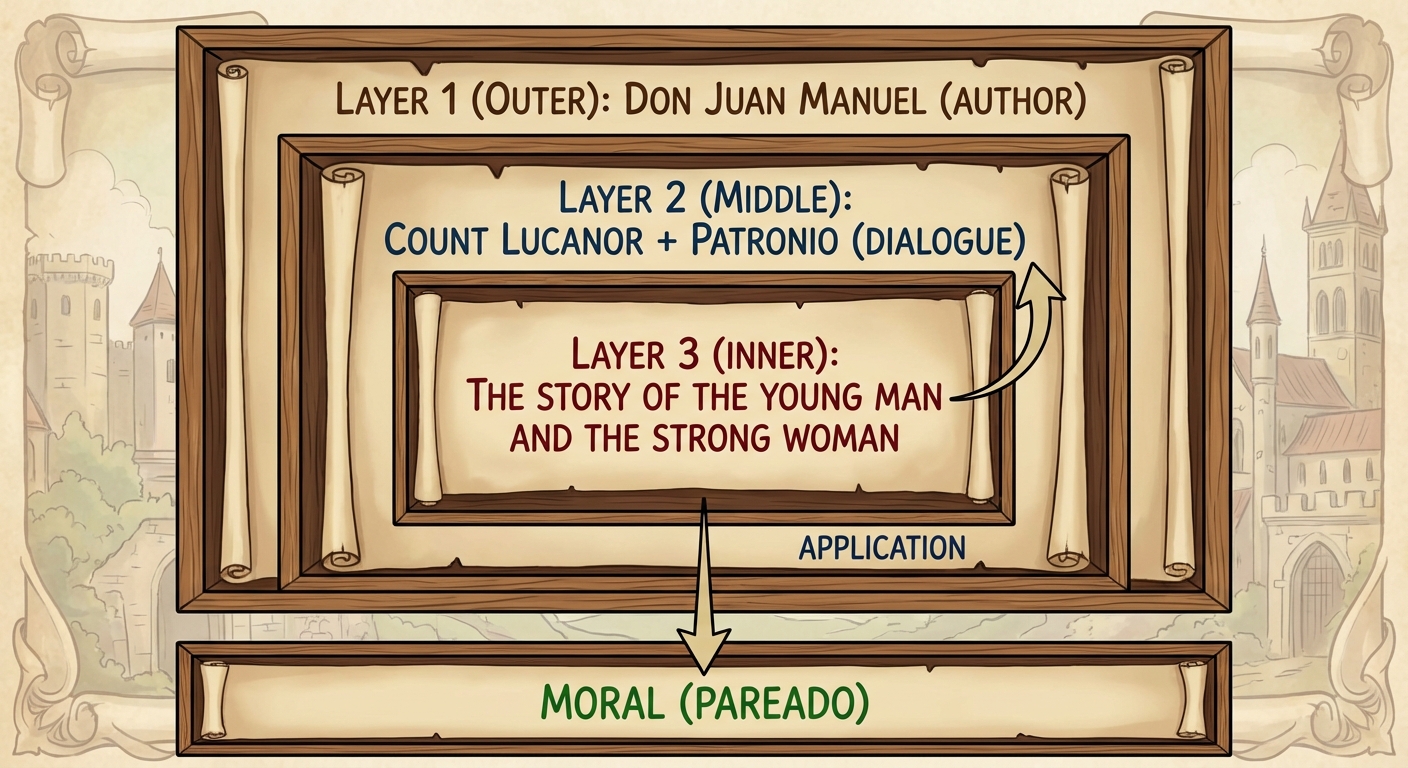
- Outer Layer: Don Juan Manuel (the author) presents the book.
- Main Frame: Count Lucanor presents a problem to his advisor, Patronio.
- Inner Story (Exemplum): Patronio tells a story that parallels the Count's problem.
- Application: Patronio applies the lesson to the Count.
- Moral: The story concludes with a rhyming couplet (pareado) summarizing the lesson.
Analysis of "De lo que aconteció a un mozo que casó con una mujer muy fuerte y muy brava"
This specific story (Example 35) addresses the theme of Construction of Gender and Interpersonal Relationships.
- Plot: A poor young man marries a rich but aggressive woman. On their wedding night, he violently commands animals (a dog, cat, and horse) to bring him water. When they "refuse," he kills them brutally. The wife, terrified, obeys him perfectly. Later, his father-in-law tries the same trick but fails because his wife already knows his true nature.
- Theme: First Impressions. The importance of establishing authority/reputation at the very beginning of a relationship.
- Literary Devices:
- Hyperbole: The excessive violence against the animals is exaggerated to create fear.
- Dialogue: Drives the action and reveals the power dynamic.
The Moral (Pareado):
"Si al comienzo no muestras quién eres, / nunca podrás después cuando quisieres."
(If you do not show who you are at the start, you will never be able to later when you wish.)
Romance de la pérdida de Alhama
Context and Origins
This is an Anonymous work from the 15th Century. It belongs to the genre of Romances Fronterizos (Border Ballads), composed during the darker final years of the Reconquista.
It narrates the reaction of the Moorish King of Granada (Boabdil) upon hearing the news that the city of Alhama has fallen to the Catholic Monarchs (1482). This was a strategic devastation, foreshadowing the eventual fall of Granada in 1492.
Characteristics of the "Romance"
To identify a Romance on the AP exam, look for these specific traits:
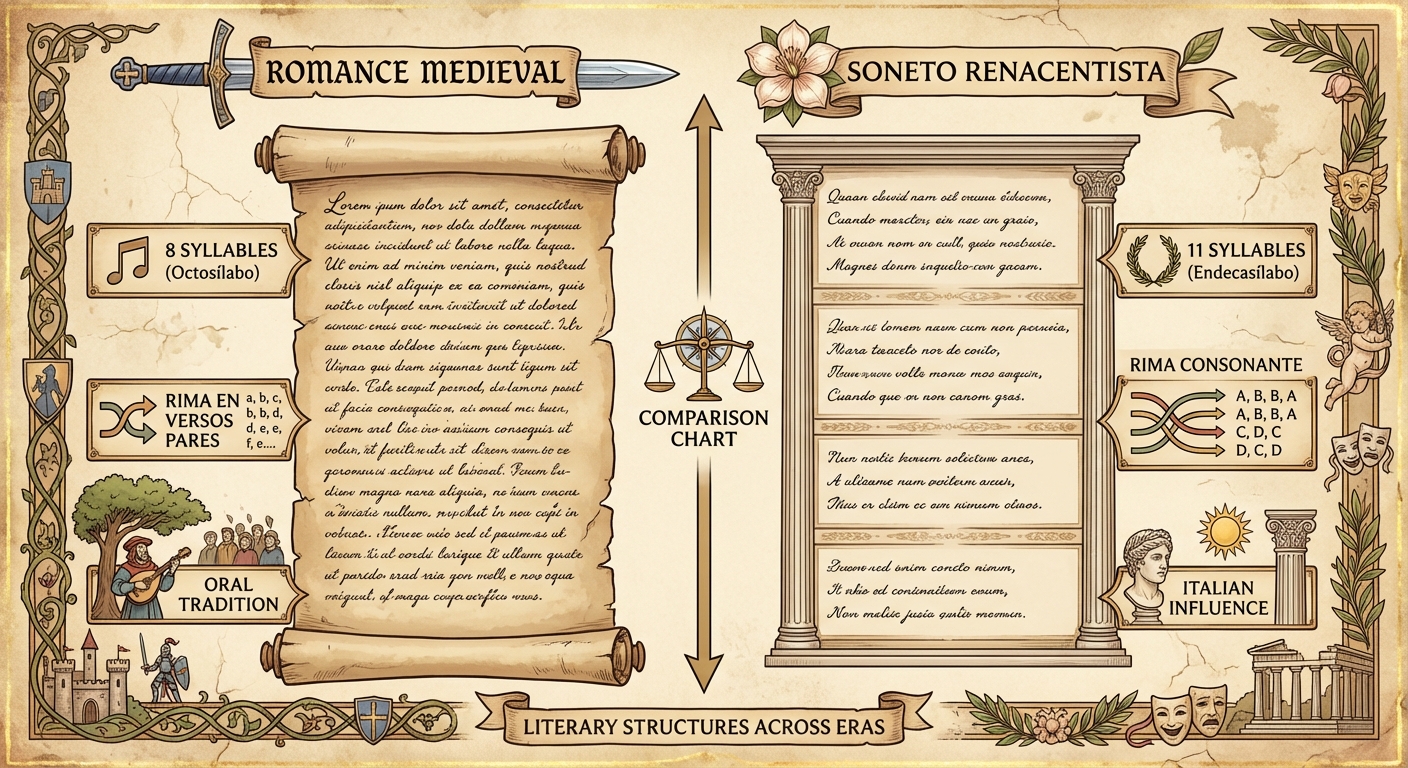
- Meter: Octosyllabic (8 syllables per line).
- Rhyme: Rima Asonante (Assonance rhyme) in even-numbered lines; odd lines are free.
- Structure: Starts In Media Res (in the middle of the action) without introduction.
- Narrative Flow: Focuses on a dramatic moment rather than a whole story.
Literary Analysis
- Estribillo (Refrain): The line "¡Ay de mi Alhama!" repeats throughout the poem. This creates a chorus-like effect, emphasizing collective grief and the permanence of the loss.
- Polyphony: The poem features multiple voices (the Narrator, the King, the Old Alfaquí, the people).
- Symbolism: The King riding a mule instead of a horse symbolizes a lack of nobility or impending defeat. Throwing the letters in the fire represents his denial of reality.
Key Quote:
"Mataste los Bencerrajes, / que eran la flor de Granada."
(The Alfaquí criticizes the King for killing the Bencerrajes clan, blaming the King's poor leadership for the city's fall.)
Transition to the Renaissance: Soneto XXIII
Note: While often grouped with early classics, Garcilaso de la Vega represents the shift from the Medieval (Unit 1) to the Golden Age (Unit 2). His work introduces Italian forms to Spain via the influence of Petrarca.
Context: Garcilaso de la Vega
Writing in the early 16th Century (reign of Charles V), Garcilaso adapted the Italian Sonnet into Spanish, replacing the medieval octosyllable with the Endecasílabo (11 syllables).
Analysis of "En tanto que de rosa y azucena"
This poem perfectly illustrates the Renaissance themes of Humanism and appreciation for earthly beauty.
Theme: Carpe Diem
"Seize the day." The poem urges a young woman to enjoy her youth before old age destroys it.
The Quatrains (First 8 lines): Description of current beauty.
- Metaphor/Chromatism: Rosa (red/passion) and Azucena (white/purity) describe her complexion.
- "Mirar ardiente, honesto": The paradox of passion versus chastity.
The Tercets (Last 6 lines): The consequence of time (Tempus Fugit).
- Nature Metaphor: Spring (primavera) represents youth; Winter (inverno) represents old age.
- Personification: "El tiempo airado" (The angry time) covers the mountain with snow (gray hair).
Key Stylistic Devices:
- Hyperbaton: Altering the logical order of words (e.g., "Marchitará la rosa el viento helado" instead of "El viento helado marchitará la rosa"). This mimics Latin syntax, typical of the Renaissance.
- Anaphora: Repetition of "En tanto que…" to build tension.
Comparison Table: Medieval vs. Renaissance
| Feature | Medieval (Conde Lucanor / Romance) | Renaissance (Soneto XXIII) |
|---|---|---|
| World View | Teocentrism (God-centered) | Anthropocentrism (Human-centered) |
| Purpose | Didactic (Teach a lesson) | Aesthetic (Create beauty/emotion) |
| Meter | Irregular or Octosyllabic (8) | Hendecasyllabic (11) and Heptasyllabic (7) |
| Theme Focus | Honor, History, Religion, Practical Wisdom | Love, Carpe Diem, Nature, Classical Myths |
Common Mistakes & Pitfalls
Confusing Author with Narrator in Conde Lucanor:
- Mistake: Saying "Don Juan Manuel tells the Count to…"
- Correction: Patronio advises the Count. Don Juan Manuel is the real-world author who wrote the book containing these characters.
Misidentifying the Rhyme in Romances:
- Mistake: Thinking it rhymes ABAB.
- Correction: Romances use assonance rhyme only in even lines (ø a ø a ø a…). The odd lines do not rhyme.
Misunderstanding the Tone of Soneto XXIII:
- Mistake: Thinking the poet is purely flattering the woman.
- Correction: The tone is urgent and inevitably tragic. It is a warning that time destroys everything, so she must act now.
Chronological Confusion:
- Mistake: Calling Garcilaso a "Medieval" author.
- Correction: Garcilaso is a Renaissance author (Siglo de Oro). We study him here to see the change from the medieval style, but he belongs to the 16th century.