Comprehensive Study Guide: Unit 4 Transoceanic Interconnections (c. 1450–1750)
Technological Innovations (c. 1450–1750)
Cross-Cultural Diffusion of Technology
Before European exploration could begin properly, Europeans had to adopt and adapt technology that originated in Asia and the Islamic World. This era is defined by the diffusion of knowledge.
- The Magnetic Compass: Originally invented in China; allowed sailors to determine direction without sight of land.
- The Astrolabe: Improved by Muslim navigators in the 12th century; allowed sailors to calculate their latitude (distance north/south of the equator) by measuring the position of stars/sun.
- Cartography: Maps became more accurate. Portolan Charts mapped harbors and coastlines specifically.
New Ship Designs
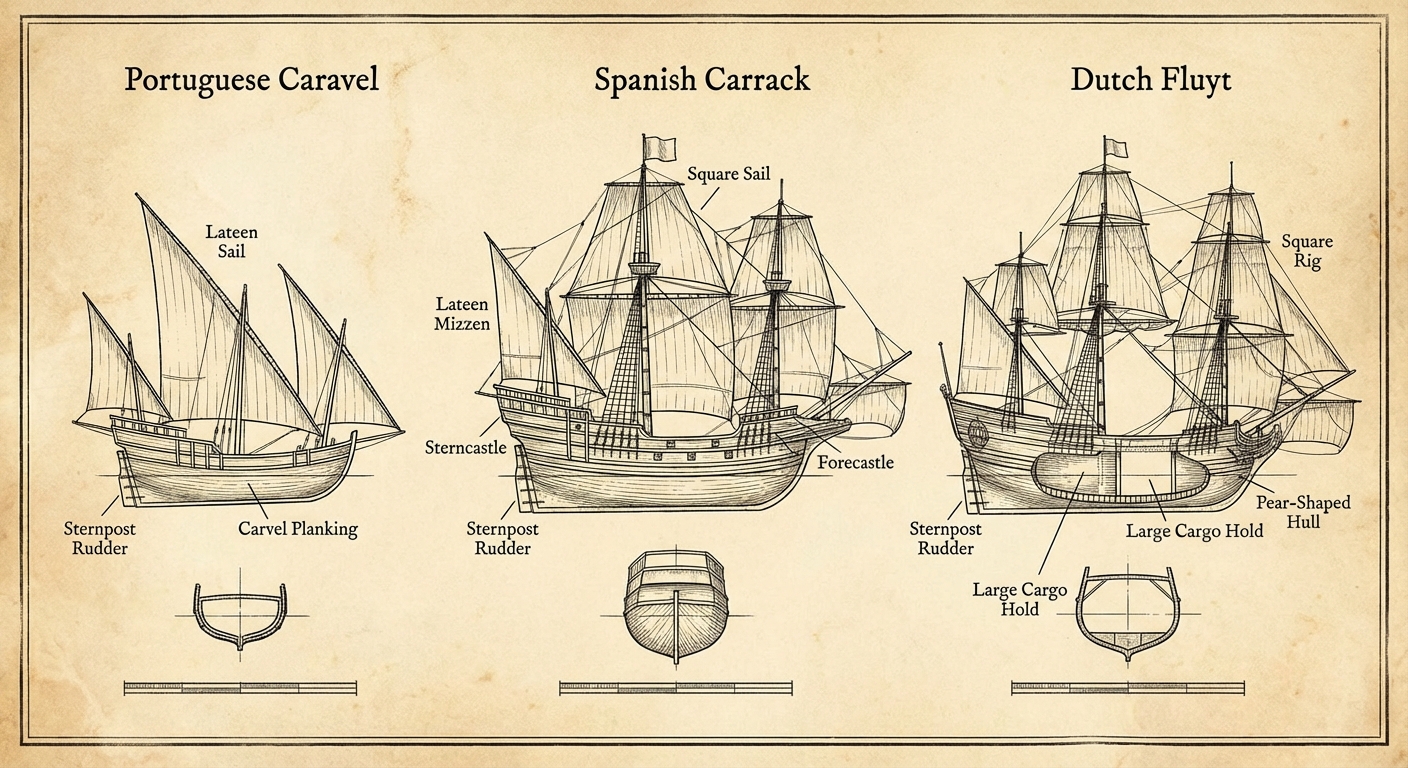
European shipbuilders combined local designs with foreign innovations to create vessels capable of transoceanic travel.
- Caraval (Portuguese): Small, highly navigable, fast. It used Lateen Sails (triangle sails adapted from Arab dhows) which allowed ships to sail against the wind.
- Carrack (Portuguese/Spanish): Larger than a caravel, built for trade and war (e.g., Columbus’s Santa Maria).
- Fluyt (Dutch): Distinctively designed for trade only. It had a large cargo hold and required a smaller crew, making Dutch shipping cheaper and more efficient than rivals.
Key Concept Impact: These ships utilized the Sternpost Rudder (from China) for better steering.
Knowledge of Winds
Understanding global wind patterns was just as vital as hardware.
- Volta do Mar ("Turn of the Sea"): A Portuguese maritime strategy. Instead of trying to fight head-winds, sailors learned to sail northwest into the open ocean to catch westerly winds that would bring them back home safely. This circular motion unlocked the Atlantic.
Causes and Events of Exploration
State Sponsorship (The 3 Gs)
Exploration was too expensive for individuals. Monarchs sponsored voyages for three primary reasons, known as the 3 Gs:
- Gold: The search for new trade routes to Asia to bypass the Italian and Venetian middlemen and Ottoman taxes; also, the direct search for material wealth (silver/gold).
- God: The desire to spread Christianity (missionary zeal), particularly to counter Islam.
- Glory: Individual fame for explorers and geopolitical dominance for the state.
The Portuguese Trading Post Empire
Portugal was the first to explore, led by Prince Henry the Navigator, who funded a navigation school and sponsored trips along the West Coast of Africa.
- Strategy: Instead of conquering vast territories inland, they set up valid Trading Post Empires—fortified bases at key harbors to control trade routes (e.g., Hormuz, Goa, Malacca).
- Vasco da Gama (1498): First European to reach India by sea, claiming territory for Portugal and securing the spice trade.
Spanish Establishments
Spain, united under Isabella and Ferdinand, funded Christopher Columbus (1492) to find a west-ward route to Asia. He "discovered" the Caribbean, leading to the Spanish conquest of the Americas.
- Ferdinand Magellan: His crew became the first to circumnavigate the globe (1519–1522), proving the earth was round and much larger than expected. Magellan died in the Philippines.
- Treaty of Tordesillas (1494): The Pope divided the world between Spain (West) and Portugal (East). This is why Brazil speaks Portuguese while the rest of Latin America speaks Spanish.
Northern Atlantic Crossings
Ignoring the Treaty of Tordesillas, Northern European powers sought a Northwest Passage to Asia.
- England: John Cabot explored North America; later Sir Francis Drake circumnavigated the globe and defeated the Spanish Armada (1588).
- France: Jacques Cartier and Samuel de Champlain claimed Canada, focusing on the fur trade rather than settlement.
- Netherlands: Henry Hudson explored the Hudson River/Bay, establishing New Amsterdam (NYC).
The Columbian Exchange
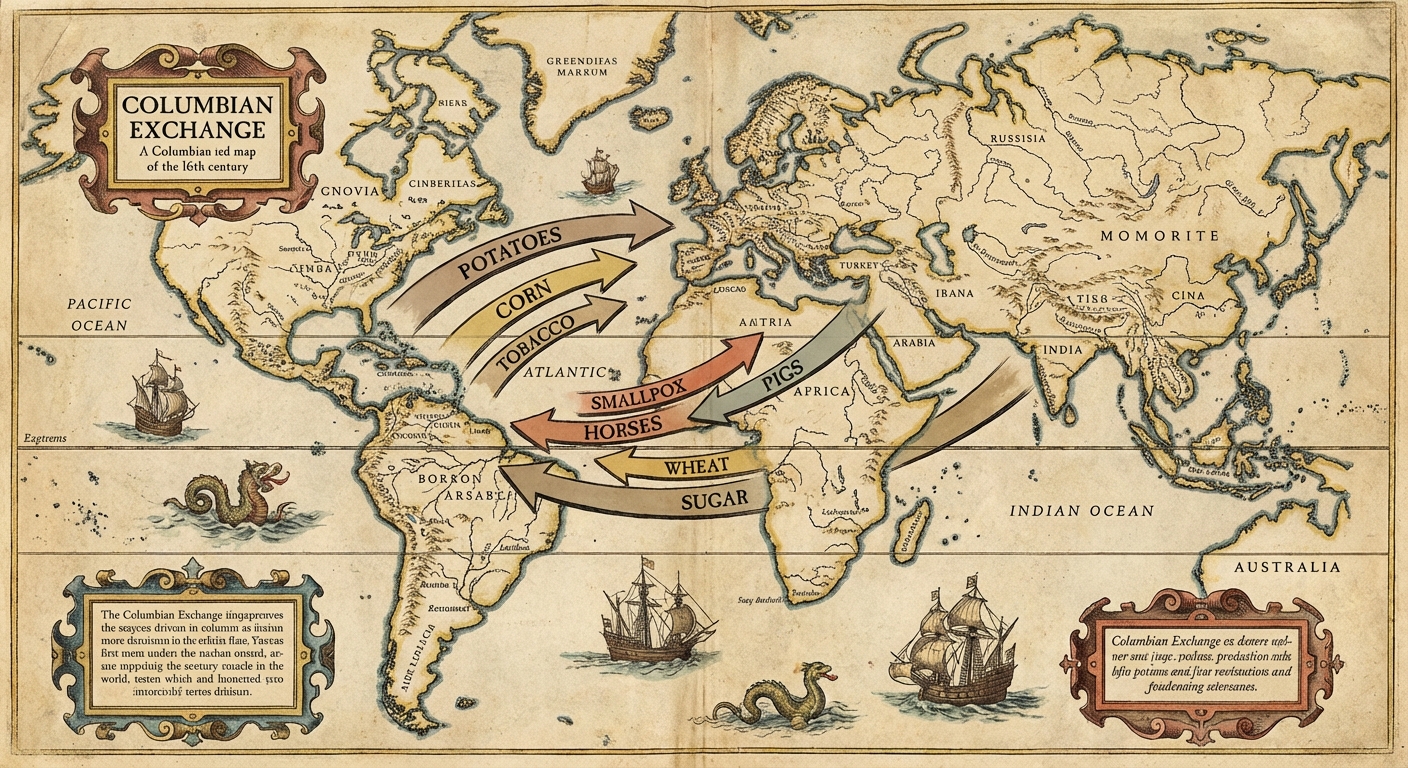
Definition: The Columbian Exchange was the global diffusion of crops, other plants, human beings, animals, and disease that took place after the European exploring voyages of the New World.
1. Diseases (The Great Dying)
Native Americans had no immunity to Afro-Eurasian diseases.
- Smallpox, measles, and influenza killed estimated 50-90% of the indigenous population.
- Impact: This demographic collapse made Spanish conquest easier (e.g., Pizarro conquering the Inca) and created a labor shortage that fueled the African slave trade.
- Counter-transfer: Syphilis likely traveled from the Americas to Europe.
2. Food and Animals
This is the most strictly tested part of the unit. Memorize these transfers:
| Origin | Items | Impact |
|---|---|---|
| Americas (New World) ➔ Afro-Eurasia | Potatoes, Maize (Corn), Manioc (Cassava), Tobacco, Cacao, Tomatoes | Global Population Boom. High-calorie foods like corn and potatoes caused population spikes in Europe, Africa, and China. Manioc became a staple in Africa. |
| Afro-Eurasia (Old World) ➔ Americas | Wheat, Rice, Sugarcane, Coffee, Okra | Changed American landscapes. Sugarcane fueled the demand for slave labor. |
| Afro-Eurasia (Animals) ➔ Americas | Horses, Pigs, Cattle, Sheep | Horses transformed Native American culture (especially in the Plains) into hunter-warrior societies. |
Maritime Empires: Systems of Labor and Economy
Mercantilism
Dominant economic theory of the time. The belief that there is a fixed amount of wealth (silver/gold) in the world.
- Goal: Maximize the amount of precious metals held by the state.
- Method: Exports must exceed imports (Favorable Balance of Trade).
- Role of Colonies: Colonies exist to provide raw materials to the Mother Country and buy back finished goods. They were forbidden from trading with competitors.
Maritime Empires and the Silver Trade
Explorers found massive silver deposits in the Americas (e.g., Potosí in Bolivia).
- Silver became the first truly global currency.
- The Manila Galleons transported silver from Mexico across the Pacific to Manila (Philippines), where it was traded for Chinese luxury goods (silk, porcelain).
- Impact on China: The Ming Dynasty required taxes to be paid in silver, causing a "silver drain" where most world silver ended up in China.
Coercive Labor Systems
To extract resources (sugar, silver, tobacco), Europeans needed massive labor forces. The death of indigenous people led to evolving systems.
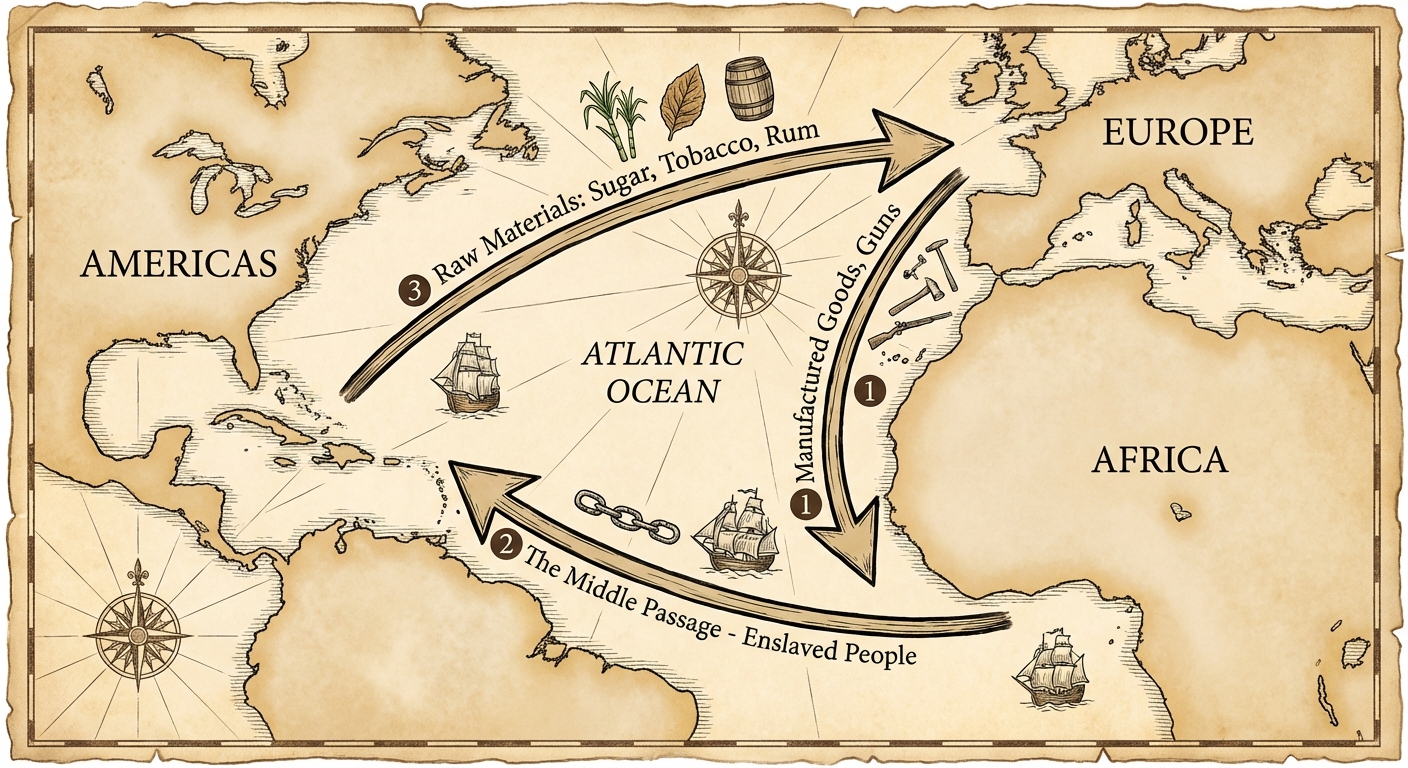
- Chattel Slavery: Humans owned as property. Primarily involved the Trans-Atlantic Slave Trade.
- Middle Passage: The brutal journey across the Atlantic (10–20% mortality rate).
- Demographic Impact: 12+ million Africans taken; gender imbalance in Africa (mostly men taken), rise of polygyny in Africa.
- Encomienda System: Spanish Crown granted settlers the right to demand labor/tribute from Natives in exchange for "protection" and Christian instruction. (Often resembled feudalism).
- Hacienda System: Large rural estates (plantations) developed in Spanish America, worked by indigenous people for low wages/debt.
- The Mita System: The Spanish adapted the traditional Incan mit'a (public service labor) into a harsh forced labor system for the silver mines (Potosí).
- Indentured Servitude: Mostly Europeans (and later Asians) who signed contracts to work for 5–7 years in exchange for passage to the New World.
Social Hierarchies and Cultural Changes
New Social Structures in the Americas
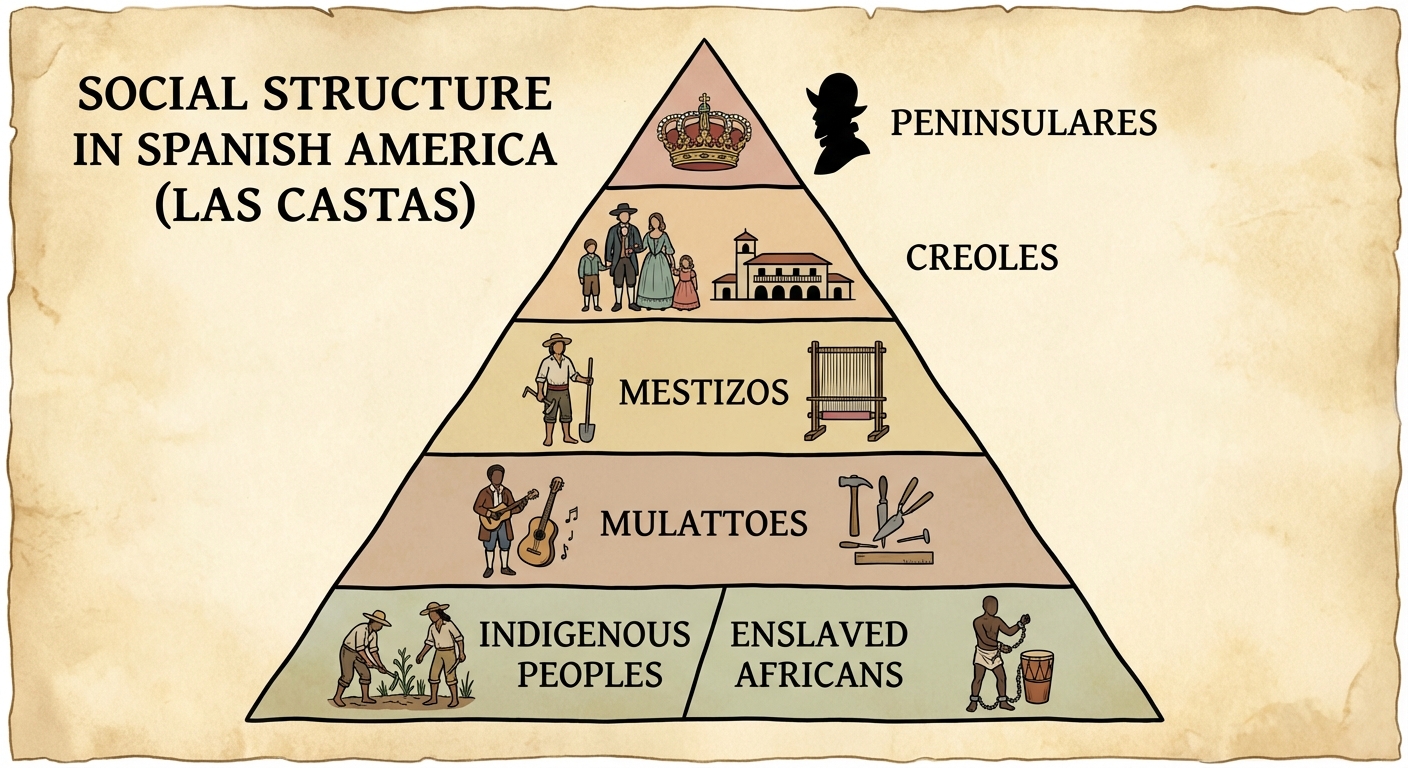
The mixing of people led to the Casta System in Spanish colonies—a race-based hierarchy fixed by law.
- Peninsulares: Born in Spain (held top govt/church jobs).
- Creoles (Criollos): Spaniards born in the Americas (wealthy, owned land, but looked down upon by Peninsulares).
- Mestizos: Mixed European and Indigenous ancestry.
- Mulattoes: Mixed European and African ancestry.
- Zambos/Indigenous/Africans: The bottom of the hierarchy.
Asian Isolationism
While the Americas were fully integrated, Asian powers restricted contact.
- Ming/Qing China: After the voyages of Zheng He (early 1400s), China turned inward. The Qing restricted European trade to the single port of Canton (Guangzhou).
- Tokugawa Japan: Initially welcoming, the Shogunate eventually banned Christianity and expelled all Europeans (except the Dutch at one specific island) to protect Japanese culture (Edict of 1635).
Cultural Syncretism
As religions spread, they blended with local beliefs.
- Vodun (Voodoo): Blend of West African beliefs and Catholicism in the Caribbean.
- Cult of Saints: In Latin America, indigenous saints were often identified with Catholic saints.
- Sikhism: In India, a blend of Hindu and Islamic beliefs (established by Guru Nanak).
Challenges to State Power (Resistance)
Not everyone accepted colonial rule. Resistance was fierce.
- Pueblo Revolt (1680): Indigenous groups in modern-day New Mexico rebelled against Spanish missionaries, driving the Spanish out for 10 years.
- Metacom’s War (King Philip’s War): The last major effort by the Native Americans of southern New England to drive out the English settlers.
- Maroon Societies: Communities of escaped slaves in the Caribbean and Brazil (e.g., Palmares) who lived independently and fought off heavy military attacks. Queen Nanny in Jamaica is a famous leader.
- Ana Nzinga: Ruler of Ndongo and Matamba (modern Angola). She allied with the Dutch and fought against the Portuguese slave trade and expansion for decades.
- Fronde (France) and Cossack Rebellions (Russia): Internal challenges to the growing power of absolute marachs.
Common Mistakes & Pitfalls
- Mistake 1: Confusing the "Three Gs" with the causes of migration.
- Correction: The 3 Gs (God, Gold, Glory) explain State Sponsorship of exploration. It does not explain why an average person moved. Average people moved for land, jobs, or religious freedom (Puritans),
- Mistake 2: Thinking the Columbian Exchange equals the Slave Trade.
- Correction: The Columbian Exchange is a biological exchange (plants/germs). Use "Triangular Trade" or "Atlantic System" when discussing the trade of goods and enslaved people.
- Mistake 3: Ignoring the Asian perspective.
- Correction: Do not just focus on Europe. Remember that China and India were still the world's economic powerhouses. Europeans were just trying to get a seat at their table.
- Mistake 4: Assuming all colonies were the same.
- Correction: Differentiate. Spain had direct control/conversion (Viceroys). England had settler colonies. Portugal had Trading Posts. The Dutch focused purely on commerce.