Mastering Convergence: Assessment Tools for Infinite Series
The Integral Test
The Integral Test bridges the gap between infinite series and improper integrals. It is particularly useful when the specific terms of a series $a_n$ can be modeled by a function $f(x)$ that is easy to integrate.
Conditions and Theorem
To apply the Integral Test, let $f$ be a function where $a_n = f(n)$. The function $f(x)$ must satisfy three conditions on the interval $[1, \infty)$:
- Positive ($f(x) > 0$)
- Continuous
- Decreasing (eventually)
If these conditions are met:
Either both converge or both diverge.
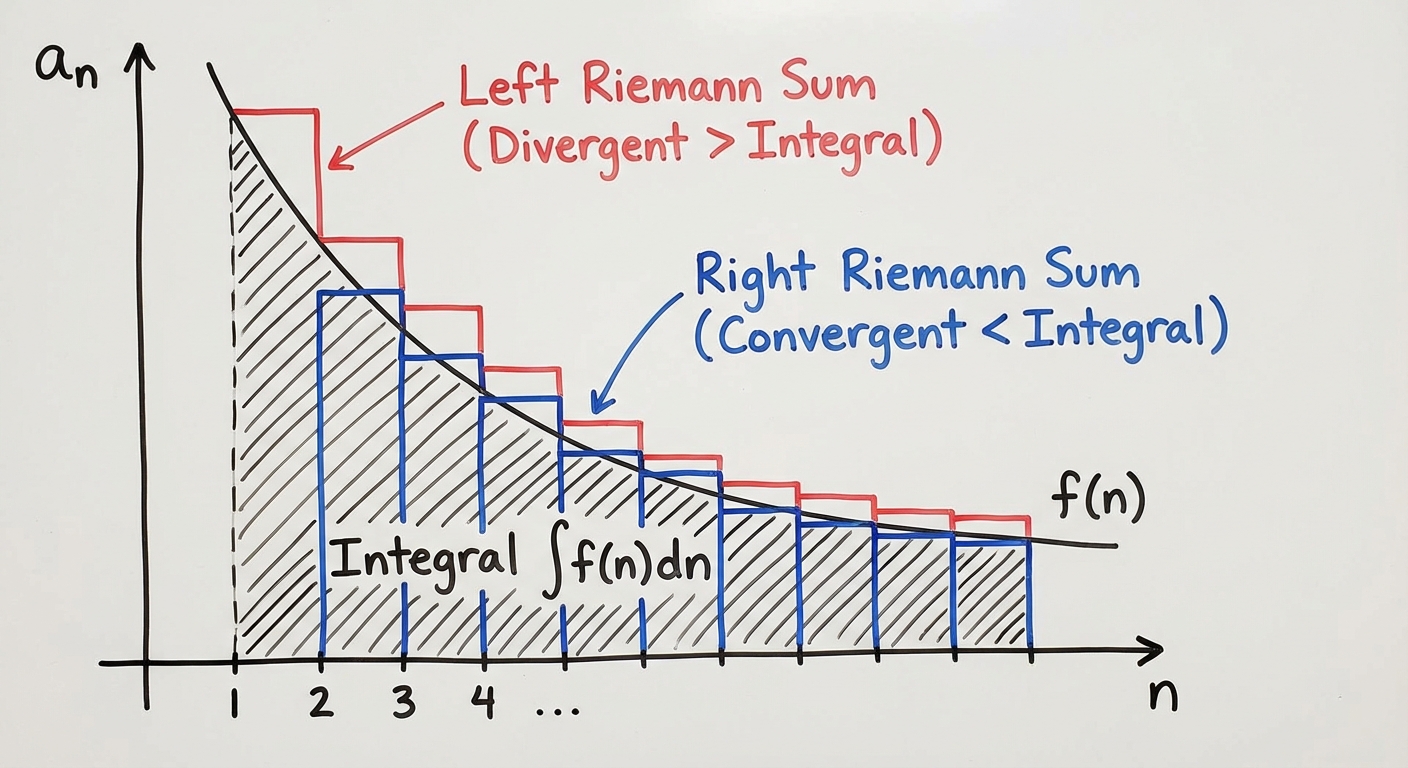
Note: The value of the integral is not the sum of the series. The integral merely tells you the behavior (convergence or divergence) of the series.
Example: The Harmonic Series
Consider $\sum_{n=1}^{\infty} \frac{1}{n}$. Let $f(x) = \frac{1}{x}$.
- Conditions: Positive for $x \ge 1$, continuous (no holes/asymptotes for $x \ge 1$), and decreasing ($f'(x) = -1/x^2 < 0$).
- Evaluate:
- Conclusion: Since the integral diverges, the series diverges.
Comparison Tests
When a series looks complicated, we compare it to a well-known benchmark series (usually a p-series like $\sum \frac{1}{n^p}$ or a geometric series like $\sum r^n$).
Direct Comparison Test (DCT)
Think of this as a "ceiling" and "floor" logic. Let $0 \le an \le bn$ for all $n$.
- Convergence: If the larger series $\sum bn$ converges, the smaller series $\sum an$ is "forced" to converge.
- Divergence: If the smaller series $\sum an$ diverges, the larger series $\sum bn$ is "forced" to diverge.
Mnemonic:
- If the "Ceiling" (bigger) falls down (converges), you are crushed (converge).
- If the "Floor" (smaller) rises up (diverges), you are pushed up (diverge).
Limit Comparison Test (LCT)
The LCT is often easier than the DCT because it does not require a strict inequality ($
Given two series with positive terms $\sum an$ and $\sum bn$, evaluate:
| Limit Value ($L$) | Conclusion |
|---|---|
| $0 < L < \infty$ | Both series behave the same (both converge or both diverge). |
| $L = 0$ | If $\sum bn$ converges, then $\sum an$ converges. |
| $L = \infty$ | If $\sum bn$ diverges, then $\sum an$ diverges. |
Strategy: Choose $bn$ by keeping only the dominant terms of $an$. For example, for $\sum \frac{n+5}{n^3-2}$, compare with $\frac{n}{n^3} = \frac{1}{n^2}$.
Alternating Series Test (AST)
Many series have terms that switch signs, typically containing a factor like $(-1)^n$ or $\cos(n\pi)$.
The Test
For an alternating series $\sum{n=1}^{\infty} (-1)^{n+1} bn$ (where $b_n > 0$), the series converges if two conditions form a valid argument:
- Limit is Zero: $\lim{n \to \infty} bn = 0$
- Decreasing Magnitude: $b{n+1} \le bn$ for all $n$ (terms get smaller in absolute value).
Correction Warning: If $\lim b_n \neq 0$, the series diverges by the nth Term Test for Divergence, not the AST.
Alternating Series Error Bound
If an alternating series converges to a sum $S$, we can estimate $S$ using a partial sum $Sn$. The error (remainder $Rn$) is the absolute difference between the true sum and the partial sum.
The Rule: The error is always less than or equal to the absolute value of the first unused term.
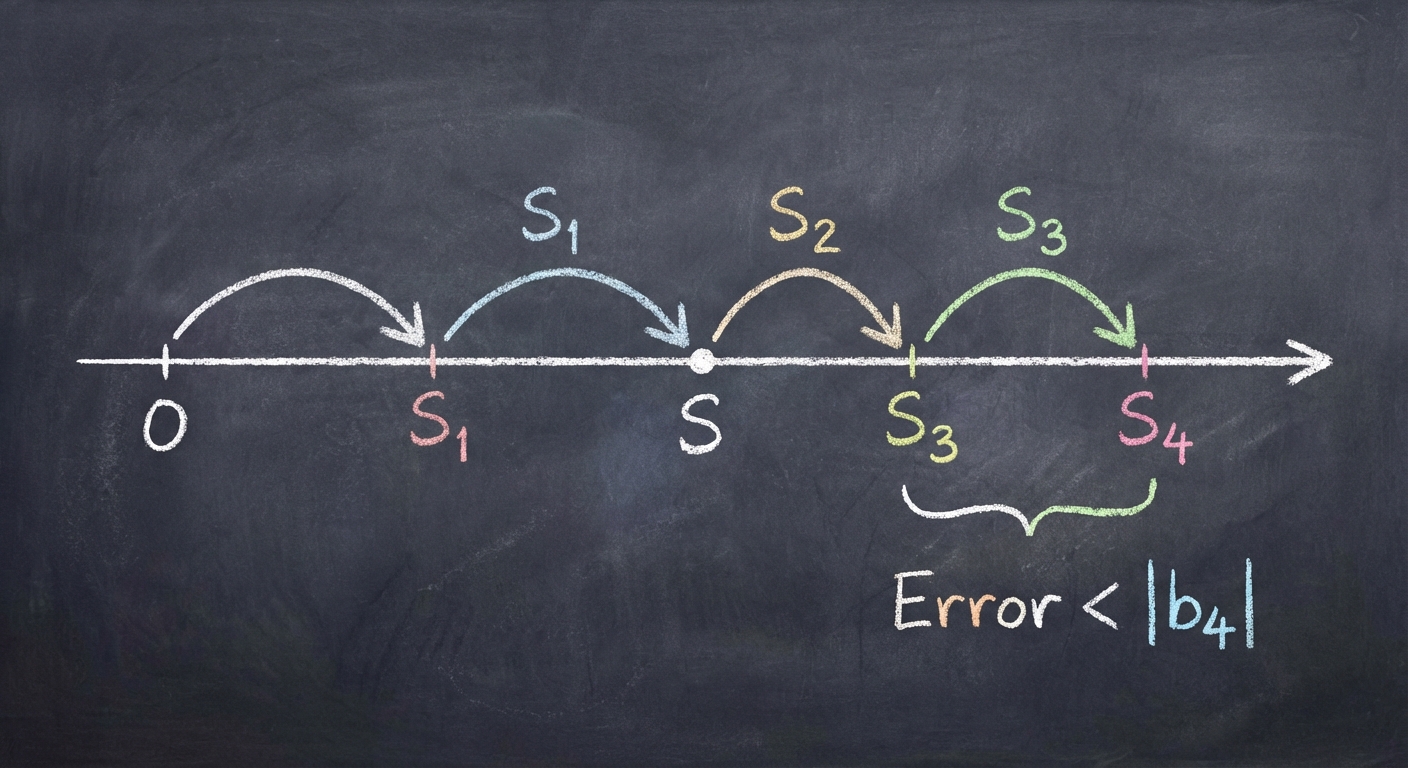
Example:
If $\sum_{n=1}^{\infty} \frac{(-1)^{n+1}}{n} = 1 - \frac{1}{2} + \frac{1}{3} - \frac{1}{4} + \dots$ is approximated by the first 3 terms ($1 - 1/2 + 1/3$), the error is no greater than the 4th term: $|\text{Error}| \le \frac{1}{4}$.
The Ratio Test
The Ratio Test is the most powerful tool for series involving factorials ($n!$) or exponentials ($c^n$).
The Formula
Let $\sum a_n$ be a series with non-zero terms. Evaluate the limit of the ratio of the "next term" to the "current term":
Interpreting the Result
- If $L < 1$: The series converges absolutely.
- If $L > 1$ (or $\infty$): The series diverges.
- If $L = 1$: The test is INCONCLUSIVE. (You must try a different test, usually p-series or comparison).
Worked Example
Determine convergence for $\sum_{n=1}^{\infty} \frac{n!}{3^n}$.
- Set up ratio: $\left| \frac{(n+1)!}{3^{n+1}} \cdot \frac{3^n}{n!} \right|$
- Simplify factorials: $(n+1)! = (n+1) \cdot n!$
- Simplify exponentials: $\frac{3^n}{3^{n+1}} = \frac{1}{3}$
- Limit:
- Since $\infty > 1$, the series diverges by the Ratio Test.
Summary: Selecting the Right Test
Choosing the correct test is half the battle. Use this flowchart mental model:
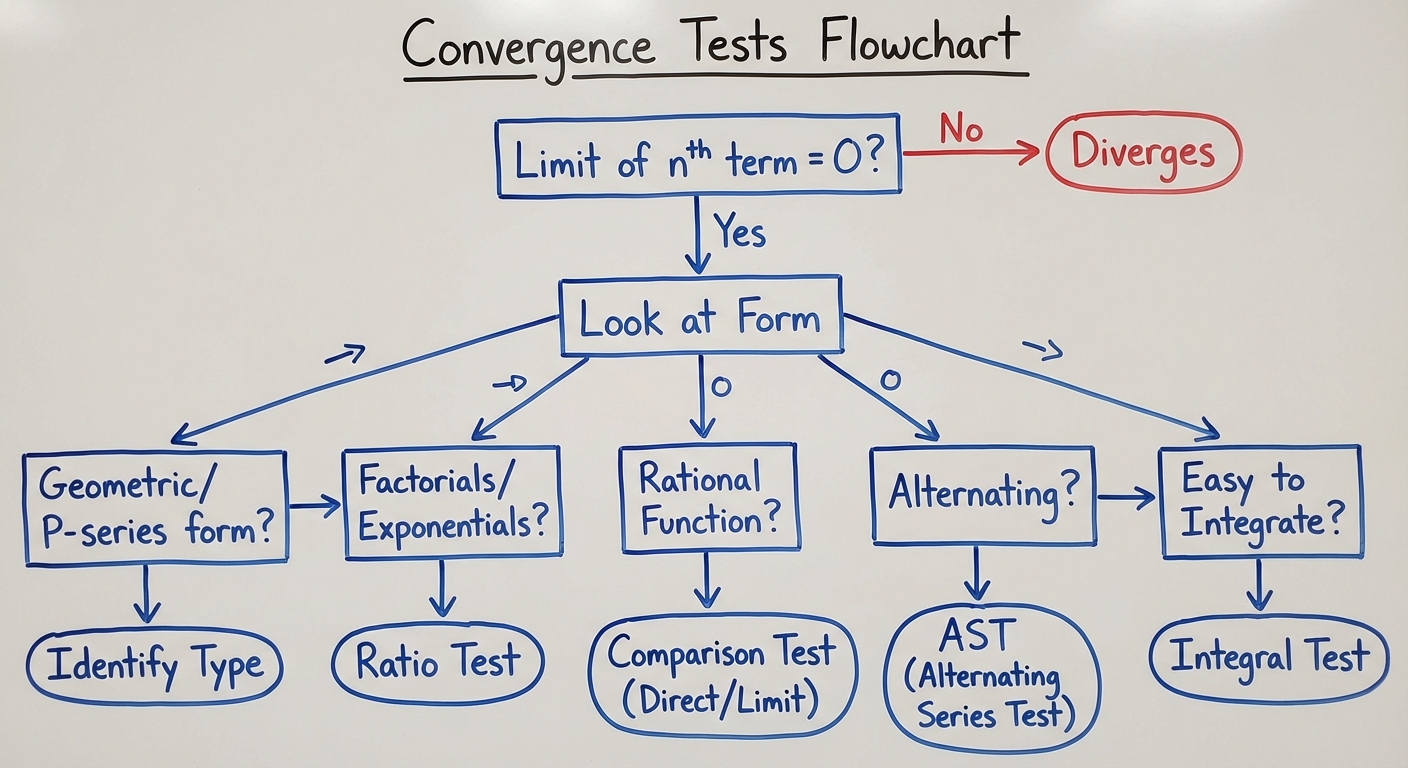
- Divergence Test: Is $\lim a_n \neq 0$? If yes, done (diverges).
- Special Forms: Is it geometric or p-series? Use those rules.
- Similar to Standard? Use Comparison (LCT is usually safer).
- Alternating? Use AST.
- Factorials/Exponentials? Use Ratio Test.
- Function Integration? Use Integral Test.
Common Mistakes & Pitfalls
- Ratio Test $L=1$ Error: Students often assume $L=1$ means convergence. It means you know nothing. (e.g., The harmonic series $\sum 1/n$ yields $L=1$ via Ratio Test, yet it diverges).
- Misusing Direct Comparison: You cannot prove convergence by showing a series is larger than a convergent series. You cannot prove divergence by showing a series is smaller than a diverging series.
- Forgetting Absolute Values: In the Ratio Test, the absolute value bars are mandatory. Without them, alternating series terms will mess up your limit calculation.
- Integral Test Conditions: Students often skip verify that the function is decreasing. If the function oscillates, the integral test cannot be applied directly.