Mastering SAT Standard English Conventions: A Comprehensive Review
Boundaries: Punctuation and Sentence Structure
The Boundaries domain in the Digital SAT Reading and Writing section tests your ability to recognize where one sentence or clause ends and another begins. This requires a strong command of punctuation rules and sentence logic. These questions ask you to edit text to ensure sentences are grammatically complete and properly linked.
The Building Blocks: Clauses
Before mastering punctuation, you must distinguish between the two types of clauses:
- Independent Clause: A group of words containing a subject and a verb that expresses a complete thought. It can stand alone as a sentence.
- Example: The experiment failed.
- Dependent (Subordinate) Clause: Contains a subject and a verb but begins with a subordinating conjunction (e.g., because, although, if, when) and cannot stand alone.
- Example: Because the experiment failed.
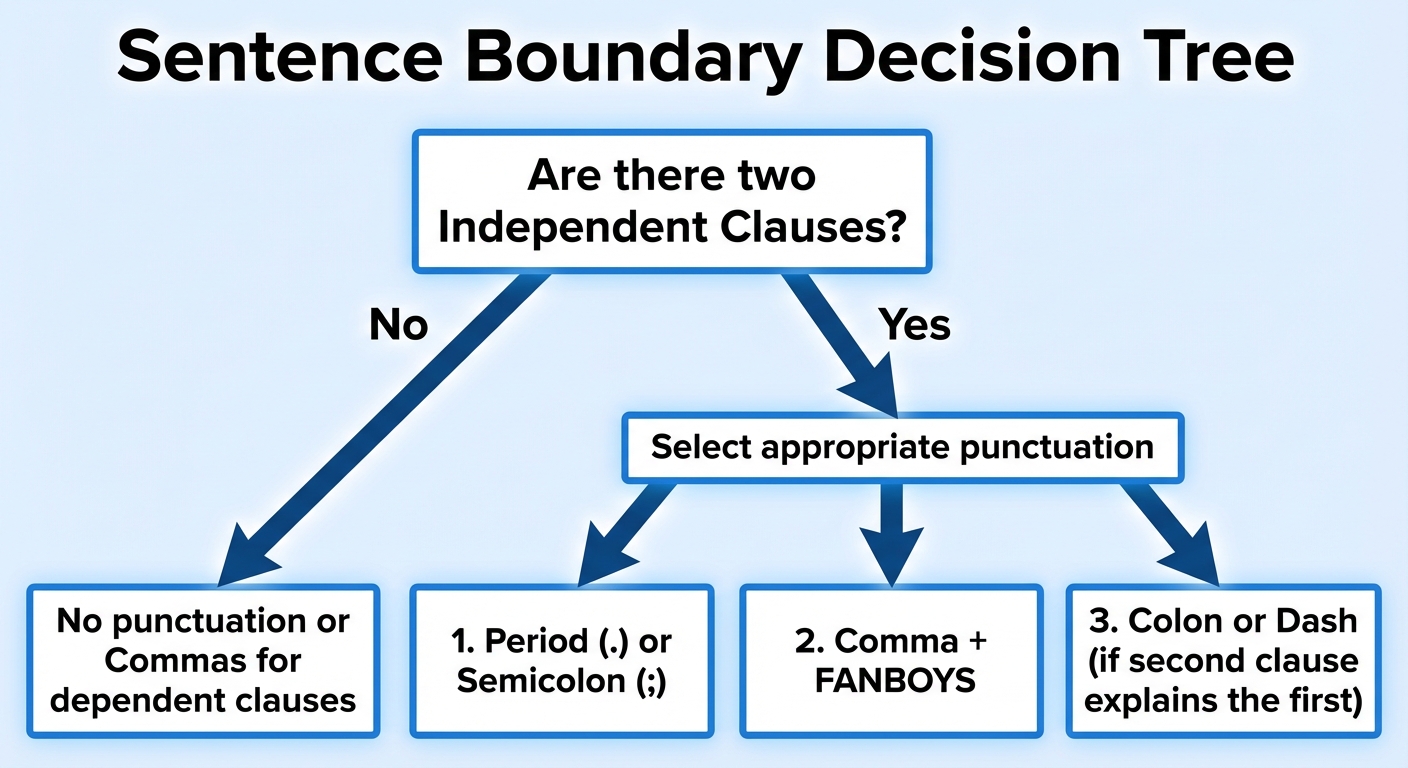
Linking Independent Clauses
One of the most frequent SAT questions involves connecting two independent clauses. You cannot just stick them together (run-on) or join them with only a comma (comma splice).
1. The "Hard Stop" Punctuation
These marks separate two complete sentences. On the SAT, a period (.) is grammatically identical to a semicolon (;). If you see both as answer choices and the text remains the same, both are likely incorrect.
- Period: The study was conclusive. It changed the field of physics.
- Semicolon: The study was conclusive; it changed the field of physics.
2. The Comma + FANBOYS
You can join two independent clauses using a comma followed immediately by a Coordinating Conjunction. Remember the acronym FANBOYS:
- For, And, Nor, But, Or, Yet, So.
- Correct: The data was robust, but the researchers remained skeptical.
- Incorrect: The data was robust, the researchers remained skeptical. (This is a Comma Splice)
Specialized Punctuation: Colons and Dashes
These marks often test the boundary between a main clause and an elaboration, list, or explanation.
| Punctuation | Rule & Condition | Example |
|---|---|---|
| Colon (:) | The clause before the colon must be independent (a complete thought). The part after can be a list, phrase, or clause that explains the first. | The chef needed one key ingredient: saffron. |
| Single Dash (—) | Functions similarly to a colon. Used for emphasis or explanation. The clause before must be independent. | The solution was obvious—electrolysis. |
| Double Dash (—…—) | Functions like parentheses to set off non-essential information in the middle of a sentence. | The candidate—an expert in economics—won easily. |
Non-Essential (Parenthetical) Elements
Many questions involve supplemental elements—phrases that add detail but aren't grammatical requirements. These must be separated from the main sentence boundaries.
- Rule: If you can remove the phrase and the sentence still makes grammatical sense, surround it with punctuation.
- Matching Concept: You must use the same punctuation mark to open and close the phrase. You cannot mix commas and dashes.
- Correct: The painting, usually hidden in the vault, was on display.
- Incorrect: The painting, usually hidden in the vault—was on display.
Form, Structure, and Sense
While "Boundaries" handles how sentences are connected, Form, Structure, and Sense deals with the logical and grammatical correctness of the words within those sentences. This includes agreement, tense, and logical comparisons.
Subject-Verb Agreement
The verb must match the subject in number (singular vs. plural). The SAT often creates difficulty by placing a meaningful distance between the subject and the verb.
1. Intervening Phrases
Ignore prepositional phrases or non-essential clauses between the subject and verb.
- Structure: Subject + [Prepositional Phrase] + Verb
- Example: The box [of old heavy tools] sits in the corner.
- Analysis: The subject is "box" (singular), so the verb is "sits" (singular), not "sit," despite the plural word "tools" being closer.
2. Inverted Sentences
Sometimes the verb comes before the subject. Reverse the sentence mentally to check agreement.
- Example: There are many reasons for the delay.
- Analysis: The subject is "reasons" (plural), so use "are."
Plurals and Possessives (Apostrophes)
This is a high-frequency topic. You must distinguish between plural nouns and possessive nouns.
- Singular Possessive: Add 's (e.g., the cat's toy — one cat).
- Plural Possessive: Add s' (e.g., the cats' toys — multiple cats).
- Plural Noun (No Possession): Add s (e.g., the cats played).
Common Trap: Possessive Pronouns never take apostrophes.
- Its = Possessive (belongs to it).
- It's = Contraction (It is).
- Their = Possessive (belongs to them).
- They're = Contraction (They are).
Pronoun-Antecedent Agreement
Pronouns must agree in number and gender with the noun they replace (the antecedent).
- Example: When the company expanded, it (not they) hired new staff.
- Note: In American Standard English (SAT standard), collective nouns like team, committee, company, group are Singular.
Verb Forms: Tense and Consistency
Verbs must align logically with the timeline of the text.
- Consistency: If a text is narrating past events, stay in the past tense unless there is a specific time marker indicating otherwise.
- Perfect Tenses:
- Present Perfect (has/have + verb): An action started in the past that continues to the present.
- Past Perfect (had + verb): An action completed before another past action.
- Example: By the time the police arrived (past), the thief had escaped (past perfect).
Parallel Structure
Items in a list or comparison must share the same grammatical form.
- Incorrect: She likes hiking, swimming, and to ride a bike.
- Correct: She likes hiking, swimming, and riding a bike.
This also applies to correlative conjunctions (Not only… but also, Either… or).
Common Mistakes and Pitfalls
The "Comma Splice" Trap: Students often choose a comma to connect two long, related sentences. If both sides are independent clauses, a comma alone is always wrong. You need a period, semicolon, or comma + FANBOYS.
"Its" vs. "It's":
- Strategy: Read the sentence with "it is." If it makes sense, choose "it's." If not, and it shows ownership, choose "its." "Its'" does not exist.
Misidentifying the Subject:
- Watch out for sentences starting with qualifiers like "Included in the report…"
- Example: "Included in the data were three errors." (Subject is errors, not data).
Redundancy: The SAT hates repetition. If a sentence says "annually," do not choose an answer that adds "every year." Conciseness is key in Standard English Conventions.
Assuming "Standard" means "Formal/Flowery": Do not pick an answer just because it uses complex vocabulary or sounds "fancy." The SAT prefers simple, grammatically rigorous options over wordy ones.