Mechanics of Individual Forces
Mechanics of Individual Forces
In AP Physics 1, understanding the specific behaviors of individual forces is the foundation for solving Newton's Second Law problems. While forces like tension and normal force arise from physical contact, gravity acts at a distance. This guide breaks down the specific rules for gravity, friction, and springs.
Gravitational Force: Weight and Mass
Although this unit focuses on contact forces, the Gravitational Force is ubiquitous in mechanics problems. It is a field force, meaning it acts over a distance without physical contact.
Definitions and Concepts
- Mass ($m$): A measure of an object's inertia (resistance to acceleration). It is a scalar quantity measured in kilograms (kg). Mass remains constant regardless of location (e.g., Earth vs. Moon).
- Weight ($F_g$ or $W$): The gravitational force exerted on an object by a massive body (like Earth). It is a vector quantity measured in Newtons (N).
Formulas
Near the surface of a planet, the gravitational force is calculated as:
Where:
- $m$ is the mass (kg)
- $g$ is the gravitational field strength (on Earth, $g \approx 9.8 \text{ m/s}^2$ or $\text{N/kg}$)
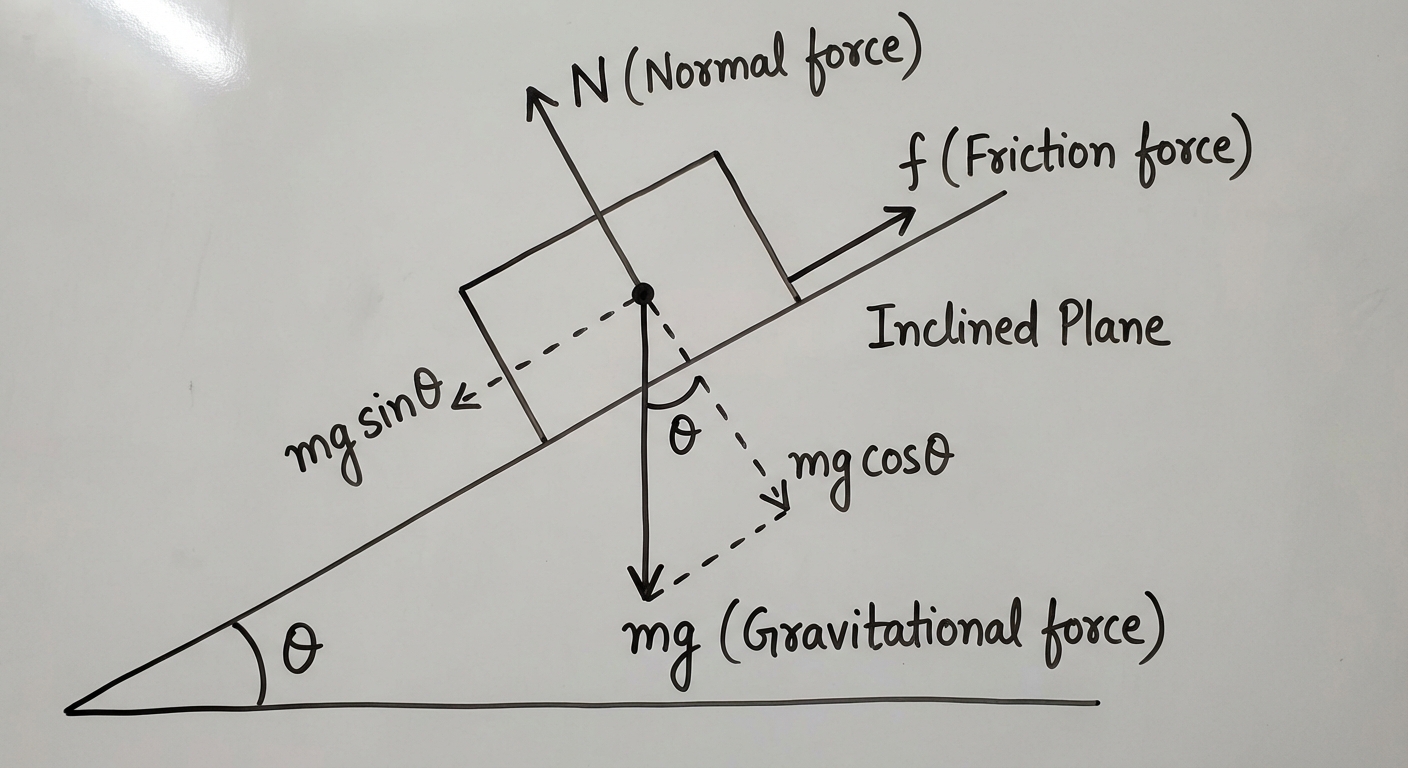
Note on Direction: $F_g$ always points toward the center of the massive body. On a flat surface or an incline, this means straight down (vertically), not perpendicular to the surface.
The Normal Force
Before discussing friction, you must understand the Normal Force ($F_N$ or $N$). The normal force is a contact force exerted by a surface on an object.
- Definition: The force perpendicular to the surface of contact that prevents an object from passing through the surface.
- "Normal" in mathematics means perpendicular.
Calculating $F_N$
The normal force is not always equal to $mg$. It is a reaction force that adjusts its magnitude to preserve the constraint that the object does not accelerate into the ground. You find it by summing forces perpendicular to the surface.
Common Scenarios:
- Flat surface, no other vertical forces: $F_N = mg$
- Object on an incline ($ heta$): $F_N = mg \cos(\theta)$
- Downward push ($F{push}$) adds to weight: $FN = mg + F_{push}$
Friction Forces
Friction ($F_f$) is a resistive contact force that acts parallel to the surface, opposing relative motion (or attempted relative motion) between two surfaces.
The Coefficient of Friction ($\mu$)
Friction depends on the roughness and material properties of the two interacting surfaces. This is represented by the unitless coefficient of friction, $\mu$ (mu).
- $\mu_s$ (Static coefficient): Used when surfaces are not sliding relative to each other.
- $\mu_k$ (Kinetic coefficient): Used when surfaces are sliding.
- General Rule: $\mus > \muk$. It is harder to start an object moving than to keep it moving.
Static Friction ($f_s$)
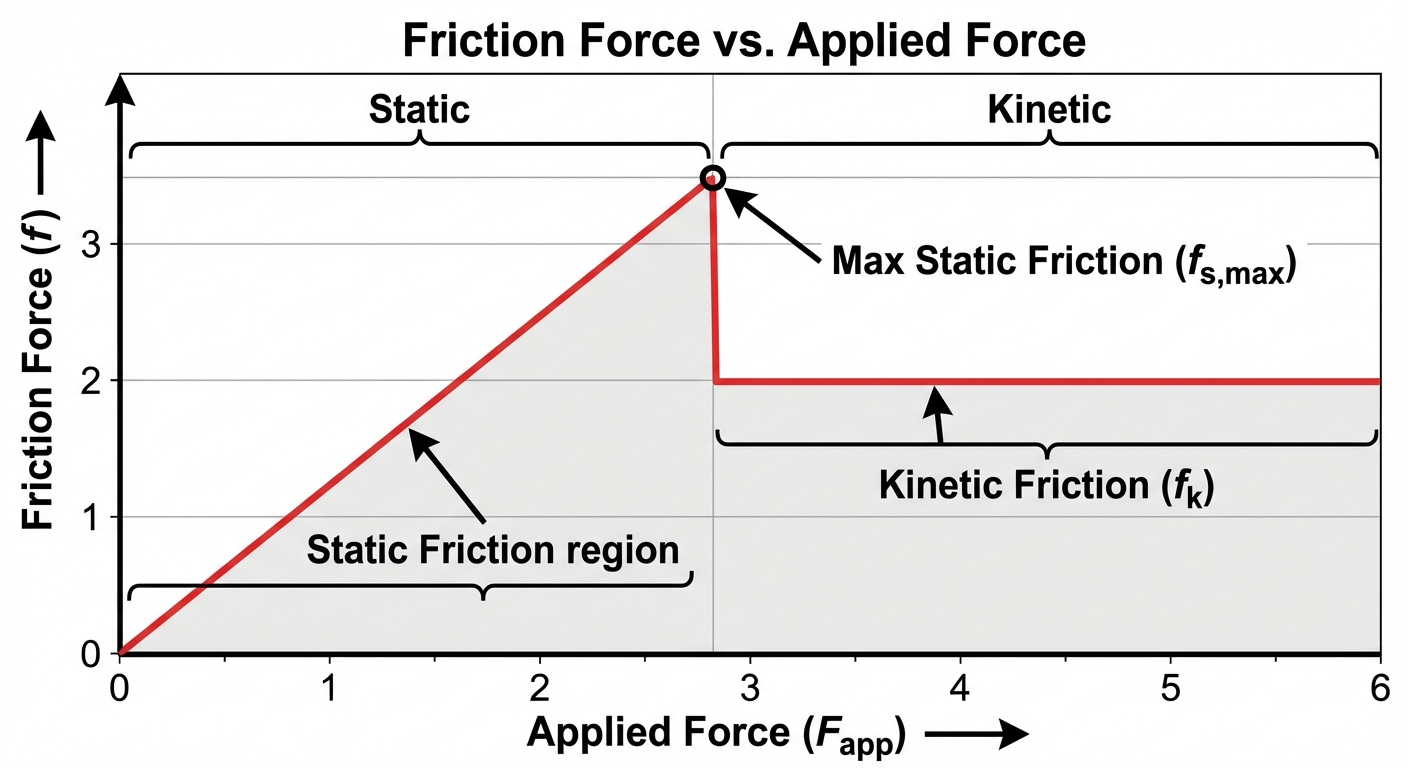
Static friction acts when an object is stationary but experiencing a force trying to move it.
- Inequality: Static friction is a "smart" force. It only exerts as much force as necessary to keep the object in equilibrium, up to a maximum limit.
- Maximum Static Friction: The threshold of motion (right before slipping) is described as:
Example: If a box has a max static friction of 20N, and you push with 5N, friction provides 5N back. If you push with 21N, the box slips, and static friction breaks.
Kinetic Friction ($f_k$)
Kinetic friction acts when two surfaces are sliding past one another.
- Constant Force: Unlike static friction, kinetic friction is generally considered constant regardless of the speed of sliding.
- Direction: Always opposite to the direction of velocity (relative to the surface).
Comparison Table
| Feature | Static Friction | Kinetic Friction |
|---|---|---|
| State of Motion | No relative sliding | Sliding occurs |
| Formula | $Ff \le \mus F_N$ | $Ff = \muk F_N$ |
| Magnitude | Variable (matches applied force) | Constant |
| Direction | Opposes attempted motion | Opposes actual sliding |
Spring Forces (Hooke's Law)
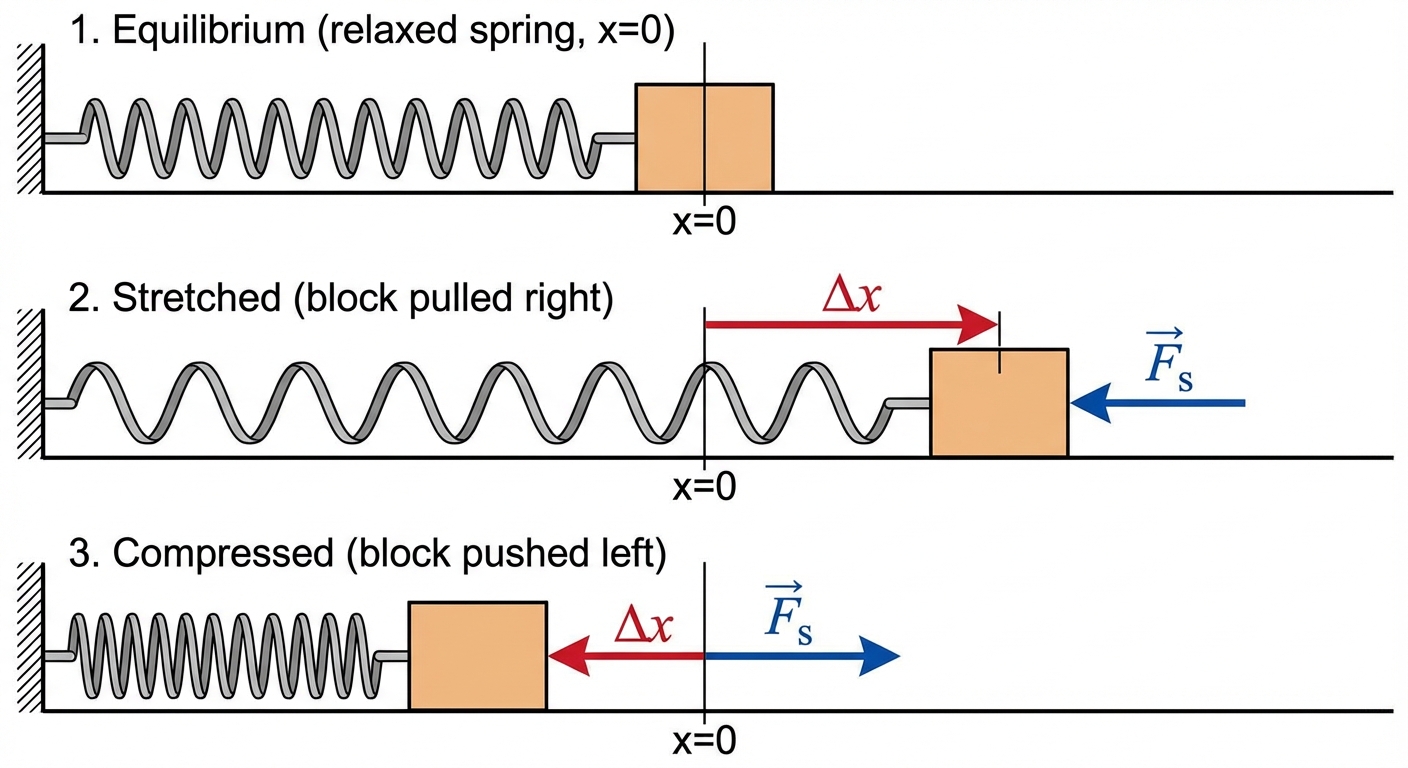
Springs exert a restoring force when compressed or stretched. For AP Physics 1, we assume "ideal" springs (massless and following Hooke's Law).
Hooke's Law
The force exerted by a spring is proportional to the distance it is stretched or compressed from its natural length.
OR (magnitude form):
Variable Breakdown
- $k$ (Spring Constant): Measured in N/m. This represents the "stiffness" of the spring. A higher $k$ means a stiffer spring.
- $\Delta x$ (Displacement): The distance (meters) the spring is deformed from its equilibrium position (natural length).
- The Negative Sign: Indicates the force is restoring. If you pull the spring right ($+x$), the force pulls left ($-F$).
Analyzing Spring Graphs
On a graph of Spring Force ($F_s$) vs. Displacement ($x$):
- The relationship is linear.
- The slope of the line represents the spring constant, $k$.
Common Mistakes & Pitfalls
Thinking Normal Force always equals Weight ($F_N = mg$):
- Correction: This is only true on a flat surface with no vertical acceleration or extra external forces. On inclines, $FN = mg\cos\theta$. Always sum forces in the perpendicular axis ($\,\Sigma F{\perp} = ma{\perp} = 0\,$) to solve for $FN$.
Using Static Friction as a constant ($Fs = \mu FN$):
- Correction: $Fs = \mus FN$ calculates only the maximum possible static friction. If the applied force is less than the max, the static friction equals the applied force. Use the inequality $Fs \le \mus FN$.
Confusing Mass and Weight:
- Correction: Mass ($kg$) is inertia; Weight ($N$) is the force of command gravity. If you go to Mars, your mass is the same, but your weight changes.
Misidentifying $\Delta x$ in Spring Problems:
- Correction: $\Delta x$ is not the total length of the spring. It is the change in length (Current Length - Equilibrium Length).
Friction Direction Vector Errors:
- Correction: Kinetic friction opposes sliding, not necessarily the applied force. If a box slides up a ramp, friction points down the ramp. If it slides down, friction points up.