Divine Light to Human Drama: Early Europe & Colonial Americas (200–1750 CE)
Unit 3: Early Europe and Colonial Americas (200–1750 CE)
This unit covers a massive span of time, transitioning from the decline of the Roman Empire through the intensely religious Middle Ages, the rebirth of Classical ideals in the Renaissance, and the theatricality of the Baroque. Crucially, it also includes the artistic output of the Spanish colonies in the Americas, usually referred to as New Spain.
1. Late Late Antiquity & The Byzantine Empire (c. 200–726 CE)
Core Concept: As the Roman Empire crumbled, art shifted away from Greek observations of nature (realism) toward a focus on the spiritual world. Figures became floating, frontal, and symbolic.
Early Christian Architecture & Art
When Constantine issued the Edict of Milan (313 CE), Christianity became legal. Art moved from hidden catacombs to imperial grandeur.
Catacomb of Priscilla (Rome, c. 200–400 CE):
- Context: Underground burial tunnels. Christians were persecuted and buried dead rather than cremating them.
- Key Frescoes: The Good Shepherd (Christ as a youthful protector, a motif adapted from Roman art) and the Orant (a figure with arms open in prayer).
- Style: Sketchy, painterly (Pompeian style), focusing on the message of salvation rather than anatomical accuracy.
Santa Sabina (Rome, c. 422–432 CE):
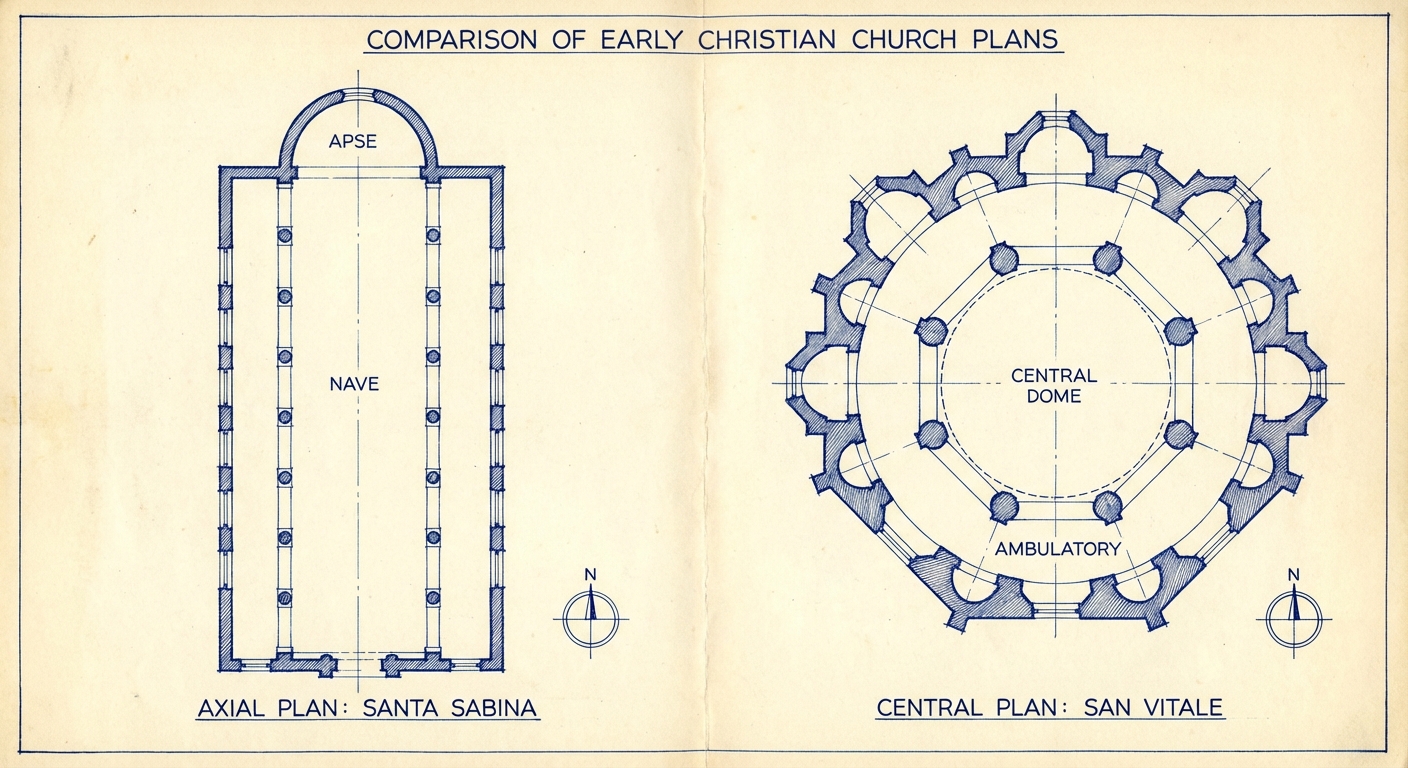
- Form: Needs to hold large crowds. Adapted the Roman Basilica plan (law court).
- Architecture: Axial plan (long nave focusing on the apse). Mild exterior (brick) vs. beautiful interior (soul metaphor). Uses Spolia (repurposed Roman columns).
- Significance: The prototype for Western Christian church architecture.
Byzantine Art: The Golden East
In the East (Constantinople), the empire survived. Art here was luxurious, gold-laden, and heavily tied to Imperial power.
Hagia Sophia (Constantinople/Istanbul, 532–537 CE):
- Architects: Anthemius of Tralles and Isidorus of Miletus (mathematicians).
- Innovation: The Pendentive. This triangular curving vault section allows a round dome to sit on a square base.
- Function: Cathedral $
ightarrow$ Mosque (minarets added) $
ightarrow$ Museum $
ightarrow$ Mosque. Symbol of "Holy Wisdom." - Experience: A "ring of fire" (windows) at the dome's base makes it look like it is suspended from heaven.
San Vitale (Ravenna, Italy, 526–547 CE):
- Form: Central Plan (octagonal). Defines the Byzantine style in Italy.
- Mosaics (Justinian & Theodora Panels):
- Power: Emperor Justinian and Empress Theodora are shown with halos (divine right to rule), holding Eucharistic elements (bread and wine).
- Style: Hieratic (rigid, frontal), gold backgrounds (timelessness), "floating feet" (rejection of earthly space).
Theotokos (Virgin) and Child between Saints Theodore and George (6th C.):
- Medium: Encaustic (pigment mixed with hot wax) on wood.
- Classic vs. Byzantine: The Virgin shows traces of spatial recession (Roman style), while the saints stare directly at the viewer (Byzantine icon style).
Historical Note: The Iconoclastic Controversy (726–843 CE) led to the destruction of many images (icons), as some Christians feared they led to idolatry. This explains why few early icons survive.
2. Early Medieval & Romanesque (c. 500–1150 CE)
Core Concept: Following Rome's fall, Europe fractured. Art became portable (migration period) and then monumental again as stability returned through the Church.
Migration and Hiberno-Saxon Art
Tribes were on the move. Art had to be small and precious.
Merovingian Looped Fibulae (Mid-6th C.):
- Object: Brooches for fastening garments.
- Technique: Cloisonné (metal compartments filled with colored glass/stones).
- Style: Zoomorphic (animal shapes) and geometric. No narrative, purely decorative status symbols.
Lindisfarne Gospels (c. 700 CE):
- Context: Made by a monk (Eadrith) in a monastery in Britain.
- St. Matthew, Cross-Carpet Page: A mesmerizing web of interlace (knotted lines) and serpentine animals. It creates a meditative state before reading the Bible.
- Portrait Page: Shows influence from Rome (the figure of Matthew writing), but flattened into linear patterns.
Romanesque: The Age of Pilgrimage
Around 1000 CE, fear of the apocalypse faded, and pilgrimage (religious tourism) boomed. Churches grew massive to hold relics.
Church of Sainte-Foy (France, c. 1050–1130):
- Function: A pilgrimage church on the route to Santiago de Compostela.
- Form: Stone mostly (fireproof). Cruciform plan. Ambulatory (walkway) allowed pilgrims to circle the relics without disturbing Mass.
- Reliquary of Sainte-Foy: A gold/gem-encrusted statue holding the skull of a child martyr. Critics called it an idol; pilgrims called it a miracle worker.
- Tympanum (The Last Judgment): Above the door. A "stone billboard" warning pilgrims: Jesus judges you. Left is Hell (chaos), Right is Heaven (order).
Bayeux Tapestry (c. 1066–1080):
- Not a tapestry: It is embroidery (wool on linen).
- Story: The Battle of Hastings. William the Conqueror (Norman) defeats Harold (English).
- Style: Secular historical narrative, similar to the Roman Column of Trajan. Flat figures, very long (230 ft).
3. Gothic Art (c. 1140–1400)
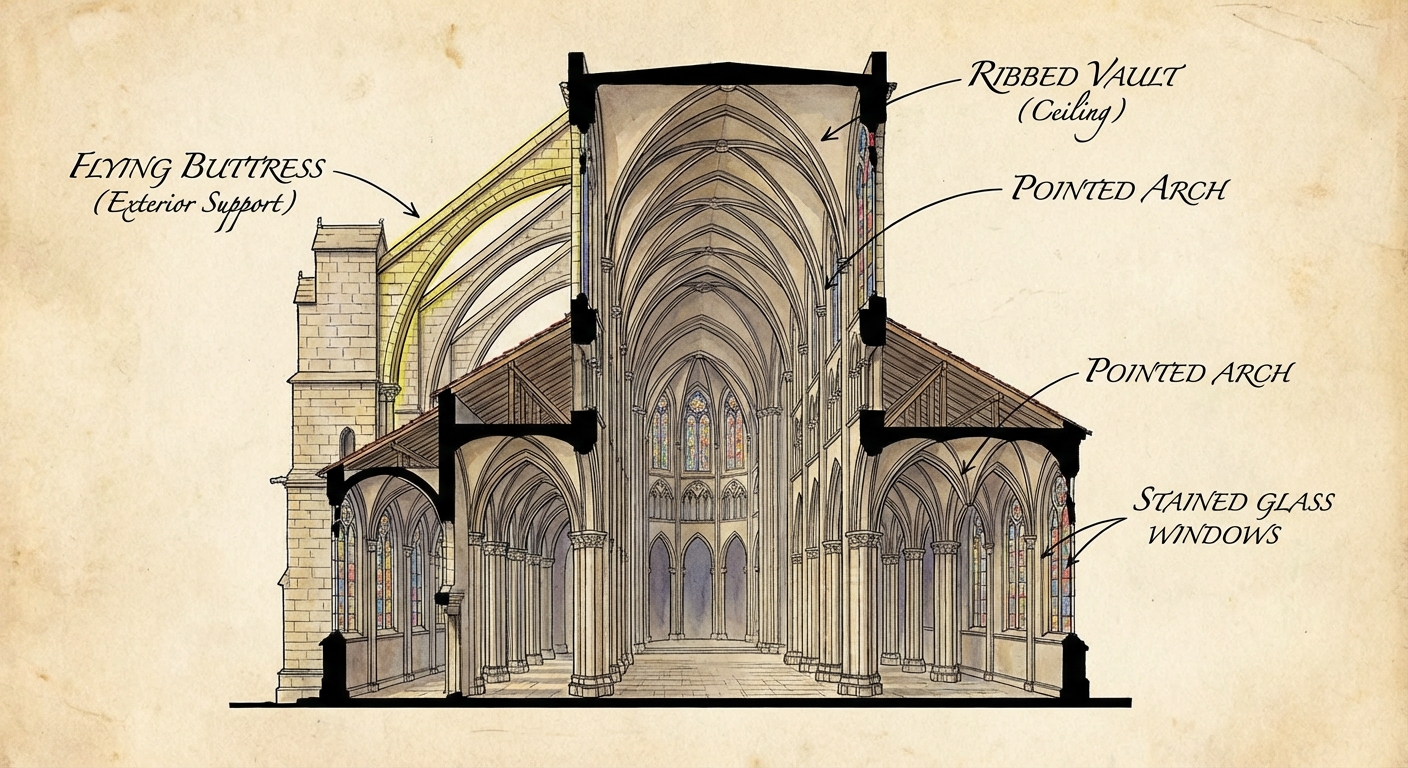
Core Concept: "Height and Light." Architects wanted to dissolve walls to let in divine light (Lux Nova).
| Feature | Romanesque | Gothic |
|---|---|---|
| Arches | Rounded | Pointed |
| Vaults | Barrel Vaults (Heavy) | Ribbed Vaults (Light) |
| Support | Thick Walls | Flying Buttresses |
| Windows | Small, dark | Huge Stained Glass |
| Mood | Fear of Judgment | Awe of Divine Light |
Key Works
- Chartres Cathedral (France):
- Transition: Facade is Early Gothic; the rest is High Gothic (rebuilt after 1194 fire).
- Relic: The Sancta Camisa (Mary's tunic).
- Stained Glass: Notre Dame de la Belle Verrière. Mary as "Throne of Wisdom."
- Royal Portal: Sculptures of Old Testament kings/queens on columns (Jamb figures). Early ones are stiff; later ones become more naturalistic.
Röttgen Pietà (c. 1300–1325):
- Shift in Tone: Late Gothic Germany. Wood sculpture.
- Emotion: Unlike the stoic early Christ, this is horrific. Christ is emaciated, bloodied. Mary looks terrified, not peaceful.
- Purpose: Andachtsbild (devotional image) meant to evoke empathy for Christ’s suffering.
Bible Moralisée (Blanche of Castile): A luxury illuminated manuscript for royalty. Uses "medallions" that mimic stained glass layouts.
Golden Haggadah (Spain, c. 1320):
- Significance: Jewish art in the Gothic style. Illustrates the Passover story. Shows that Jewish patrons adopted the dominant artistic style of the region (Gothic French influence) for their own holy texts.
4. The Renaissance (1400–1600)
Definition: A "rebirth" of Classical (Greek/Roman) learning, Humanism (focus on human potential/reason), and observation of the natural world.
Proto-Renaissance (The Bridge)
- Arena (Scrovegni) Chapel (Giotto, 1305):
- Revolutionary: Giotto abandoned the Byzantine "floating" style. Figures have weight and occupy real space.
- Lamentation Panel: Christ has been lowered from the cross. The diagonal rock leads the eye to Christ. Figures show grief with different body languages. The angels foreshortened in the sky writhe in agony.
Northern Renaissance of the 15th Century
While Italy focused on geometry and anatomy, the North (Flanders) focused on texture, symbolism, and oil paint.
Annunciation Triptych (Robert Campin):
- Setting: The Annunciation happens in a modern Flemish living room (bringing the divine into the home).
- Symbolism: Lilies (purity), pot (Mary as a vessel), mousetrap (Christ as bait for the Devil).
Arnolfini Portrait (Jan van Eyck, 1434):
- Technique: Masterful oil glazing creates glowing light.
- Meaning: Is it a wedding? A legal contract? A memorial? The mirror in the back reflects the artist ("Jan van Eyck was here").
- Symbols: Dog (fidelity), shoes off (holy ground), one candle (presence of God).
Early Italian Renaissance (Quattrocento)
- Pazzi Chapel (Brunelleschi): Revival of the Roman dome. Focus on perfect geometry (circles and squares) and greystone (pietra serena). Rational, not emotional.
- David (Donatello):
- Firsts: First freestanding male nude since antiquity.
- Tone: Bronze. Erotic, youthful, relaxed contrapposto. Symbol of Florence (the underdog) defeating Milan (Goliath).
- Birth of Venus (Botticelli):
- Neoplatonism: Physical beauty leads to divine love. A pagan goddess depicted with the reverence usually reserved for the Virgin Mary.
High Renaissance (c. 1495–1520)
The peak of balance, harmony, and technical mastery.
The Last Supper (Leonardo da Vinci):
- Composition: Christ is the anchor; the window acts as a halo. Apostles grouped in threes. Excellent diversity of emotion.
- Failure: Leonardo experimented with mixing oil and tempera on dry plaster; it began flaking almost immediately.
Sistine Chapel Ceiling (Michelangelo):
- Subject: Genesis (Creation to Noah). No Jesus (he is on the altar wall).
- Style: Sculptural, muscular figures (Ignudi). The creation of Adam shows the spark of soul passing from God to Man.
- The Flood: Crowded, desperate. (Early part of the ceiling work).
School of Athens (Raphael):
- Location: The Pope's library (Stanza della Segnatura).
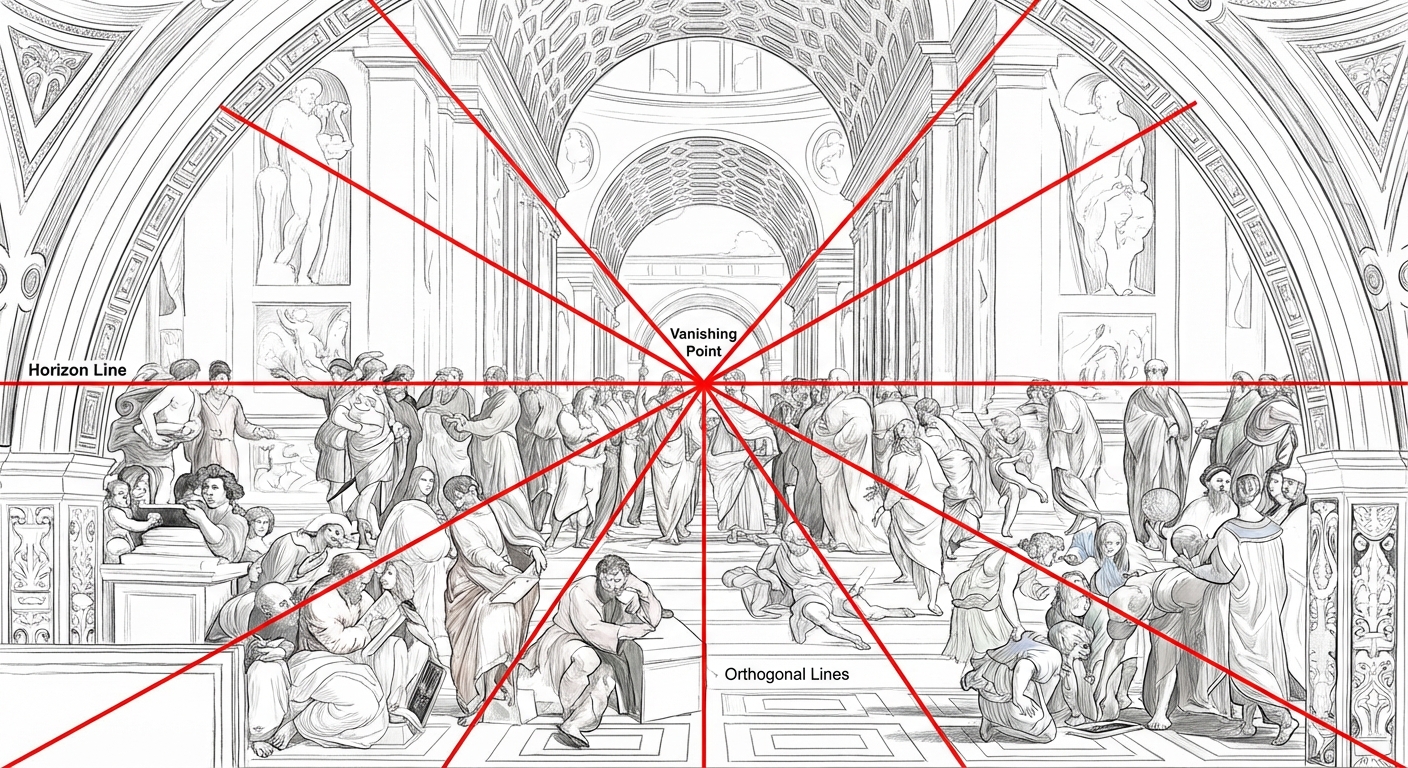
- Subject: Philosophy. Plato (points up/ideal) vs. Aristotle (palm down/real). Includes portraits of Michelangelo (brooding) and Raphael himself.
- Technique: One-point linear perspective par excellence.
- Venus of Urbino (Titian): Venetian art focused on Color (Colore) over Line (Disegno). Sensual, soft, glowing flesh. Established the tradition of the reclining female nude.
Mannerism (Late Renaissance)
After the perfection of the High Renaissance (and political turmoil), art broke the rules. Compositions became chaotic, colors acidic, bodies distorted.
- Entombment of Christ (Pontormo): No focal point, no ground line (figures float/tiptoe), pastel clashing colors, high anxiety.
5. The Reformation & The Baroque (1600–1750)
The Protestant Reformation's Impact
In 1517, Martin Luther challenged the Church. Northern Europe turned Protestant and banned religious imagery (Iconoclasm). Artists had to find new subjects (landscapes, still life, portraits).
- Allegory of Law and Grace (Lucas Cranach the Elder):
- Propaganda: A woodcut (easy to print and spread). Left side (Catholicism/Law) = Hell. Right side (Protestantism/Grace) = Salvation through faith alone.
- Hunters in the Snow (Pieter Bruegel):
- Genre Painting: Scenes of everyday life. No religious figures. Focus on the seasons and the brutal reality of winter.
Counter-Reformation & Baroque Italy/Spain
The Catholic Church struck back with the Council of Trent. Art must be dramatic, clear, and inspire awe to keep people Catholic.
Characteristics of Baroque: Diagonal lines, movement, Tenebrism (extreme light/dark contrast), theatricality.
Calling of Saint Matthew (Caravaggio):
- Christ points (like Michelangelo's Adam) at a tax collector in a dingy tavern. The light is the divine call. Dirty feet and realistic faces (shocking to the church).
Ecstasy of Saint Teresa (Bernini):
- Sculpture + Architecture + Light. Uses a hidden window to light gold rays. Teresa is in physical/spiritual rapture. Theater boxes on the side contain stone sculptures of the donor family watching.
San Carlo alle Quattro Fontane (Borromini): Architecture goes wavy. The facade undulates (concave/convex). A rejection of the flat, stable Renaissance facade.
Las Meninas (Velázquez):
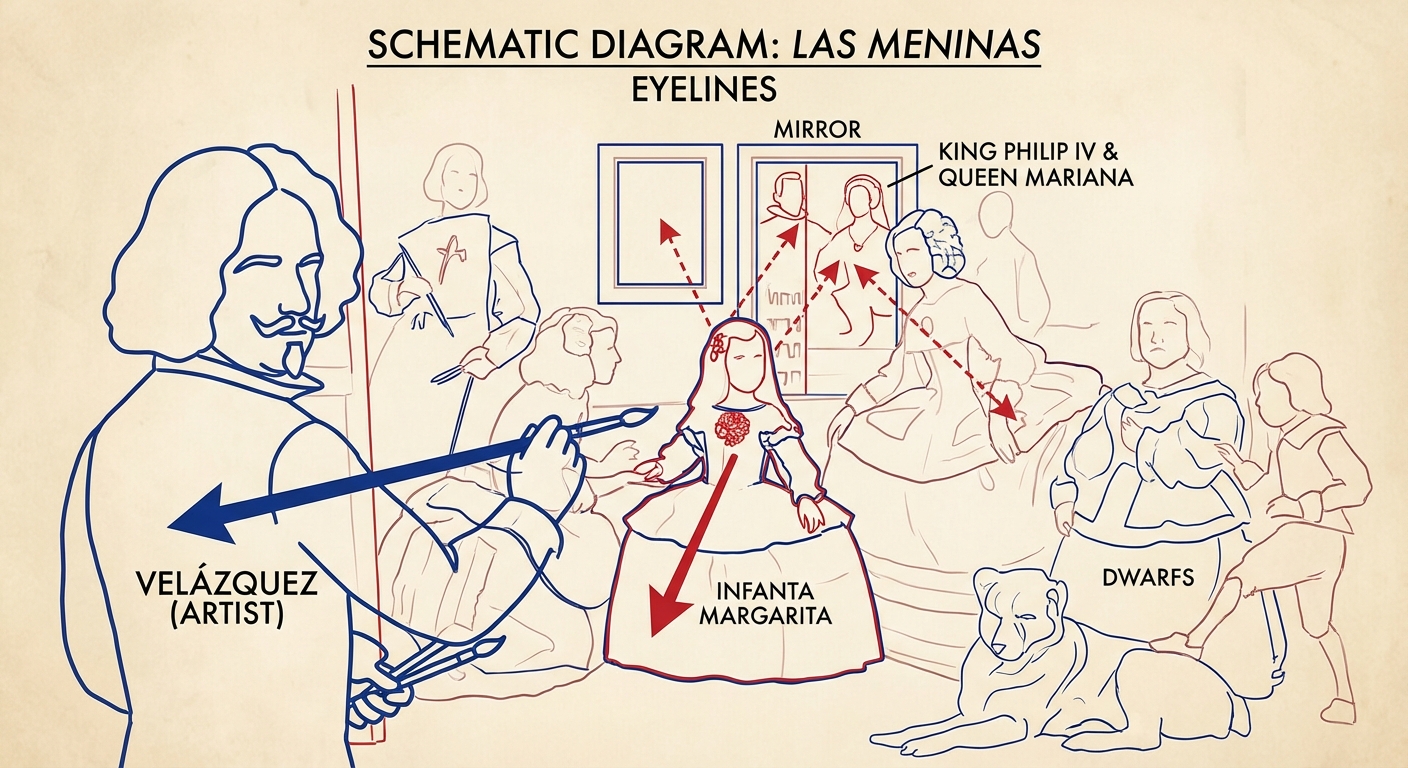
- The Intellectual Baroque: A painting about painting. The Infanta is central, but Velázquez looks at us. The mirror shows the King and Queen (are we them?).
- Style: Loose brushstrokes (painterly) that resolve into images from a distance.
Northern Baroque (Dutch/Flemish)
- Henry IV Receives the Portrait of Marie de’ Medici (Rubens):
- Flemish: Rubens combined Italian drama with Northern detail. Political propaganda to glorify a boring queen. Mythological gods applaud her marriage.
- Self-Portrait with Saskia (Rembrandt): Etching. Personal, intimate, psychological depth.
- Woman Holding a Balance (Vermeer):
- Dutch: Quiet, domestic interior. Light enters from the left.
- Meaning: Last Judgment painting in the background. She holds an empty scale. A meditation on wealth vs. spirituality.
- Fruit and Insects (Rachel Ruysch): Still life. Wealthy Dutch merchants loved these. Vanitas theme: flowers die, fruit rots—life is short.
6. Colonial Americas: New Spain (c. 1521–1800)
Core Concept: When Spain conquered the Americas, European styles merged with Indigenous techniques and subjects. This is called Syncretism.
Frontispiece of the Codex Mendoza (c. 1541):
- Context: Commissioned by the Spanish Viceroy towards Aztec artists to send to the King of Spain.
- Content: History of Tenochtitlan (eagle on cactus). Uses Aztec glyphs but European paper/format.
Angel with Arquebus, Asiel Timor Dei (Master of Calamarca):
- Location: Peru/Bolivia.
- Syncretism: A Christian angel dressed like a Spanish aristocrat holds a harquebus (gun). Connects ancient Andean obsession with celestial warriors/thunder to Catholic angels.
Screen with the Siege of Belgrade (Circle of the González Family):
- Form: A Biombo (folding screen), inspired by Japanese imports to Mexico.
- Sides: One side is a chaotic battle (for the Viceroy's political guests); the other is a peaceful hunting scene (for the women sitting in the domestic space).
- Technique: Enconchado (Mother-of-pearl inlay) – an Asian technique adapted in Mexico.
The Virgin of Guadalupe (Miguel González):
- Icon: The patron saint of Mexico. Mary appeared to an indigenous man, Juan Diego.
- Style: Generally Byzantine/static, but sits atop the Mexican eagle/cactus symbol. Symbol of "Creole" (Mexican-born) identity.
Spaniard and Indian Produce Mestizo (Juan Rodríguez Juárez):
- Genre: Casta Painting. Displays the racial mixing (Miscegenation) of the colonies. Artificial hierarchy: White is top, darker is lower. Reminds the viewer that the Spanish bloodline is the "civilized" one.
Portrait of Sor Juana Inés de la Cruz (Miguel Cabrera):
- Subject: The first feminist of the Americas. A nun and scholar.
- Portrayal: Painted like a male scholar (surrounded by books, not just prayer beads). She looks directly at the viewer, asserting her intellect.
Common Mistakes & Pitfalls
- Confusing Romanesque and Gothic: Remember that Romanesque = Dark, Heavy, Rounded Arches (like Rome). Gothic = Light, Tall, Pointed Arches, Flying Buttresses.
- Misunderstanding "New Spain": Students often forget the Colonial Americas section. Remember that European art didn't stay in Europe; it traveled to Mexico and Peru and changed. Look for the Enconchado (shell inlay) or Biombos (screens) to identify colonial works.
- The "Is it Renaissance?" Trap: Not all Italian art is Renaissance. If it is distorted, chaotic, or has acid colors, it is likely Mannerist (Pontormo). If it is hyper-dramatic with extreme lighting, it is Baroque (Caravaggio).
- Northern vs. Italian Renaissance:
- Italy: Anatomy, Perspective, Tempera/Fresco, Idealism.
- North: Texture, Detail, Oil Paint, Realism (even if ugly).
- Iconoclasm: Remember the Protestant Reformation destroyed art. If you see a stark woodcut about the Bible (Cranach) or a painting of just snow and dogs (Bruegel), it’s likely influenced by the Protestant ban on religious icons.