Comprehensive Guide to Rational Functions in AP Precalculus
Rational Functions: Definitions and Domain
A Rational Function is a ratio of two polynomial functions. It is generally defined as:
Where $p(x)$ and $q(x)$ are polynomials, and $q(x) \neq 0$. The behavior of rational functions is dictated entirely by the interaction between the numerator (top) and the denominator (bottom).
Determining the Domain
The domain of a rational function consists of all real numbers except those that cause the denominator to equal zero. These excluded values result in discontinuities.
- To find the domain, solve $q(x) = 0$.
- The values obtained are strictly determining where the graph breaks (either a vertical asymptote or a hole).
Discontinuities: Vertical Asymptotes and Holes
There are two disjoint types of discontinuities in rational functions. Understanding the difference is crucial for exam questions involving limits.
1. Removable Discontinuities (Holes)
A Hole occurs at an $x$-value if a factor containing that $x$ exists in both the numerator and the denominator and can be mathematically canceled out.
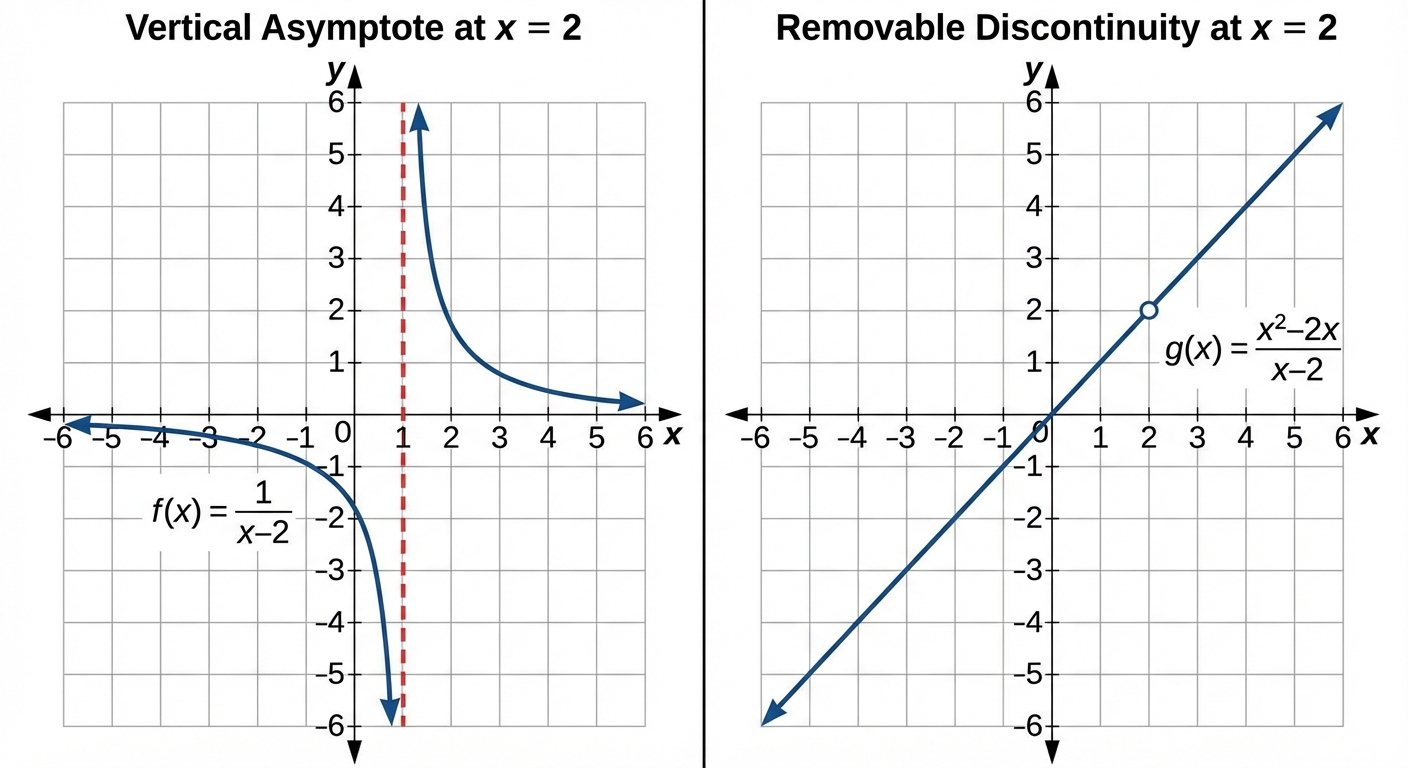
Key Characteristics:
- It represents a single point where the function is undefined.
- Limit Behavior: The limit exists as $x$ approaches the hole, even though $f(c)$ is undefined.
- How to find the coordinate:
- Factor the numerator and denominator completely.
- Cancel common factors.
- Plug the $x$-value of the cancelled factor into the simplified version of the function to find the $y$-coordinate.
Example:
Given
- Factor:
- Cancel $(x-2)$. The simplified function is $y = x + 2$.
- The discontinuity is at $x=2$. Plug 2 into $x+2$. The hole is at coordinate $(2, 4)$.
2. Infinite Discontinuities (Vertical Asymptotes)
A Vertical Asymptote (VA) occurs at $x$-values that make the denominator zero but do not cancel with the numerator.
Key Characteristics:
- The graph shoots towards positive or negative infinity.
- Limit Behavior: The limit does not exist (DNE) or is described as $\pm \infty$. Notationally:
- To determine the direction of the curve near the asymptote, test values very close to the asymptote (e.g., $2.99$ and $3.01$).
End Behavior: Horizontal and Slant Asymptotes
End behavior describes how $f(x)$ behaves as $x \to \infty$ or $x o -\infty$. This is determined by comparing the degree of the numerator ($n$) and the degree of the denominator ($m$).
The Three Cases of Horizontal Asymptotes (HA)
Bottom Heavy ($n < m$):
- The denominator grows faster than the numerator.
- HA:
Balanced Degrees ($n = m$):
- The growth rates form a constant ratio.
- HA: Ratio of leading coefficients.
Top Heavy ($n > m$):
- The numerator grows faster.
- HA: None. The graph goes to $\infty$ or $-\infty$.
Slant (Oblique) Asymptotes
A special case of "Top Heavy" functions. If the degree of the numerator is exactly one greater than the degree of the denominator ($n = m + 1$), the function has a Slant Asymptote.
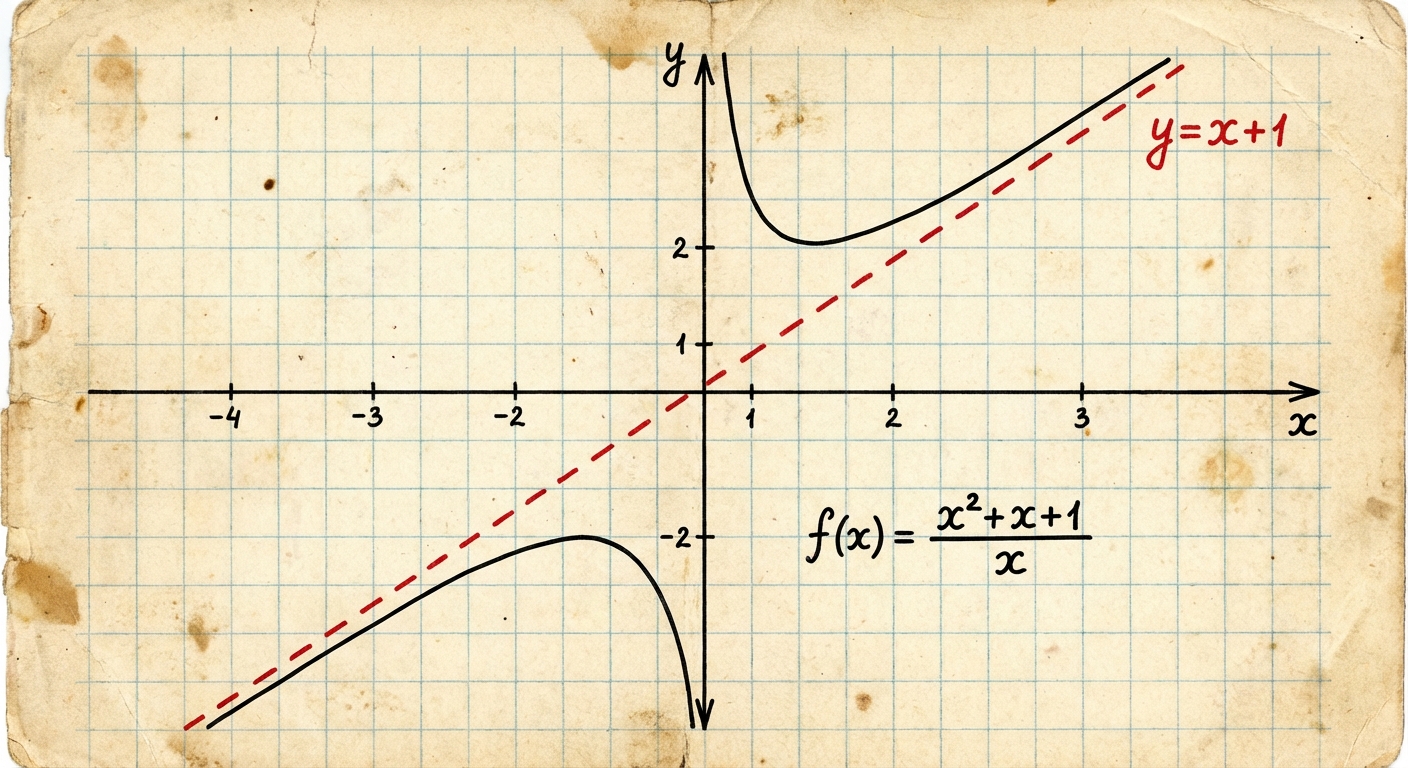
How to find it:
Use Polynomial Long Division or Synthetic Division (if applicable).
- The equation of the slant asymptote is $y = \text{Quotient}$ (ignore the remainder).
- As $x \to \infty$, the remainder term approaches 0, so the graph merges with the line.
Example:
Performing division: $(x^2 + 3x + 1) \div (x - 1) = x + 4$ with a remainder.
Slant Asymptote: $y = x + 4$.
Zeros and Intercepts
- $y$-intercept: Evaluate $f(0)$. If 0 is not in the domain, there is no $y$-intercept.
- $x$-intercepts (Zeros): Set the numerator equal to zero (after canceling holes) and solve for $x$.
- Note: If a value makes the numerator zero but is also a hole, it is not an intercept.
Solving Rational Equations and Inequalities
Rational Equations
To solve $\frac{A(x)}{B(x)} = \frac{C(x)}{D(x)}$:
- Multiply both sides by the Least Common Denominator (LCD) to eliminate fractions.
- Solve the resulting polynomial equation.
- CRITICAL STEP: check for Extraneous Solutions. Verify that your solutions do not cause any denominator in the original equation to verify zero.
Rational Inequalities
Inequalities (e.g., $\frac{x-1}{x+3} \ge 0$) require a Sign Chart (or Test Interval) method.
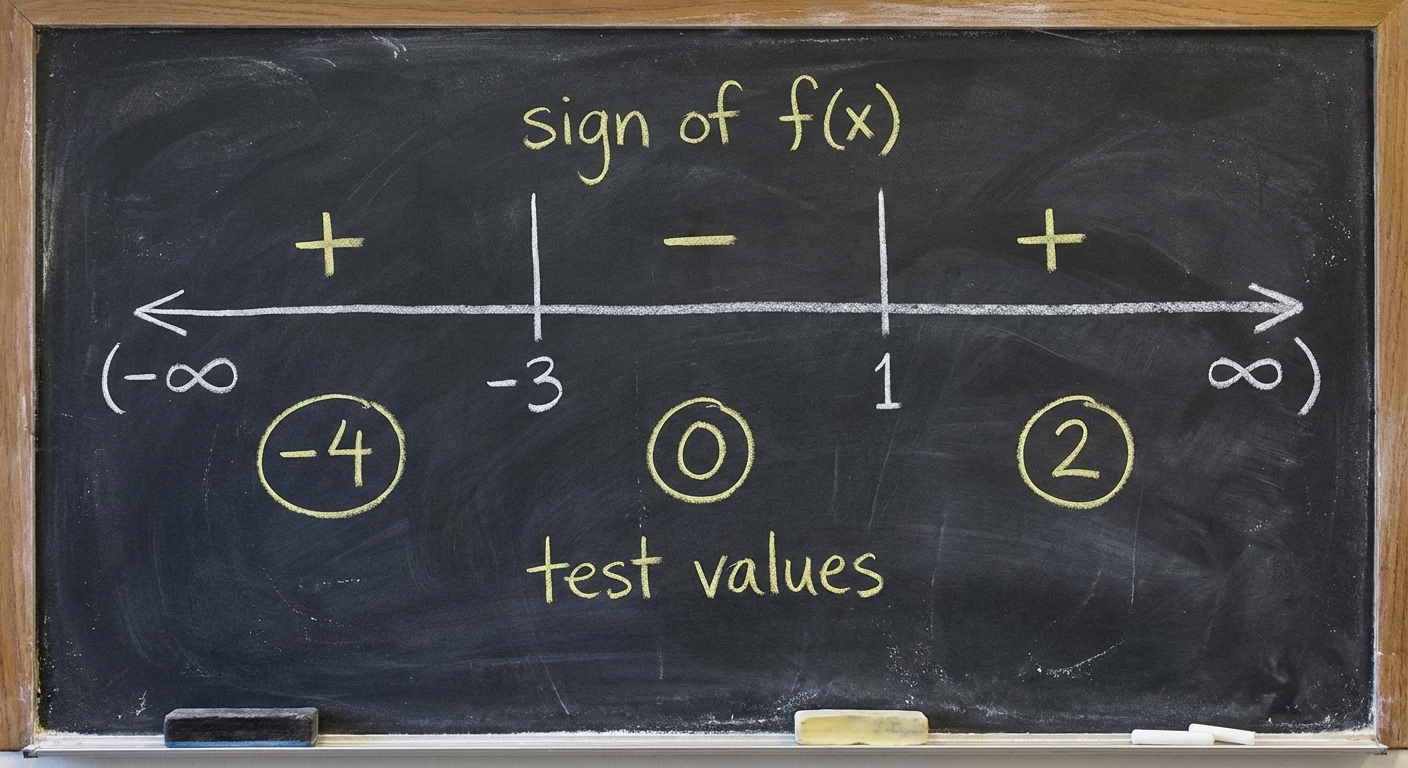
Step-by-Step:
- Move all terms to one side so the inequality compares to zero.
- Combine terms into a single rational expression.
- Find Critical Values:
- Zeros of the numerator (potential solutions).
- Zeros of the denominator (vertical asymptotes/undefined points).
- Place these values on a number line.
- Test an $x$-value in each interval to see if the function is positive or negative.
- Notation Rule:
- Numerator zeros use brackets $[ ]$ (if $\ge$ or $\le$).
- Denominator zeros always use parentheses $( )$ because the function is undefined there.
Common Mistakes & Pitfalls
- Ignoring Domain Restrictions: Students often solve $r(x) = 0$ and forget to check if that $x$ makes the denominator zero. Always validate your answers.
- Confusing Holes and VAs: Just because the denominator is zero doesn't mean it's a vertical asymptote. If the factor cancels, it's a hole.
- Cross-Multiplying Inequalities: Never cross-multiply an inequality by an expression containing $x$ unless you know the sign of $x$. Multiplying by a negative flips the inequality; since $x$ varies, you don't know when to flip. Always use the sign chart method instead.
- Horizontal Asymptote Rigidity: Remember that a function can cross its horizontal asymptote (usually in the middle of the graph). It cannot cross a vertical asymptote.
Summary Table: Asymptote Rules
| Case | Condition | Result |
|---|---|---|
| Vertical Asymptote | Denom = 0 (no cancel) | $x = c$ |
| Hole | Denom = 0 (cancels) | $(c, y)$ |
| Horizontal Asymptote | Degree Top < Bottom | $y = 0$ |
| Horizontal Asymptote | Degree Top = Bottom | $y = \text{ratio of coeffs}$ |
| Slant Asymptote | Degree Top = Bottom + 1 | $y = \text{quotient of division}$ |