Global Imperialism and Migration (c. 1750–1900)
Unit 6: Consequences of Industrialization
1. Rationales for Imperialism
Imperialism refers to the policy of extending a country's power and influence through diplomacy or military force. While European nations had established colonies in the Americas during the previous era (1450–1750), the period from 1750 to 1900 saw a new wave of expansion fueled by the Industrial Revolution. This section covers why they did it.
Cultural and Ideological Justifications
Europeans rarely admitted they were conquering merely for profit; they developed ideologies to justify their dominance.
- Social Darwinism: A misapplication of Charles Darwin’s theory of biological evolution by Herbert Spencer and others. They argued that "survival of the fittest" applied to human societies. They claimed white Europeans were biologically superior and had a right to dominate "weaker" races.
- The Civilizing Mission: Europeans believed they had a moral obligation to bring "civilization" (Christianity, Western education, medicine, and monoculture agriculture) to the rest of the world.
- Rudyard Kipling’s poem "The White Man’s Burden" is the most famous expression of this, portraying imperialism as a noble, thankless task.
- Nationalism: Empire building became a competition. Taking colonies wasn't just about resources; it was about prestige. Britain, France, and Germany raced to see who could claim the most territory.
Religious Motives
- Missionaries: Protestant and Catholic missionaries flocked to Africa and Asia to convert indigenous populations. While often complicit in imperialism, they also set up schools and hospitals and helped abolish the slave trade in certain regions (like David Livingstone).
Economic Motives
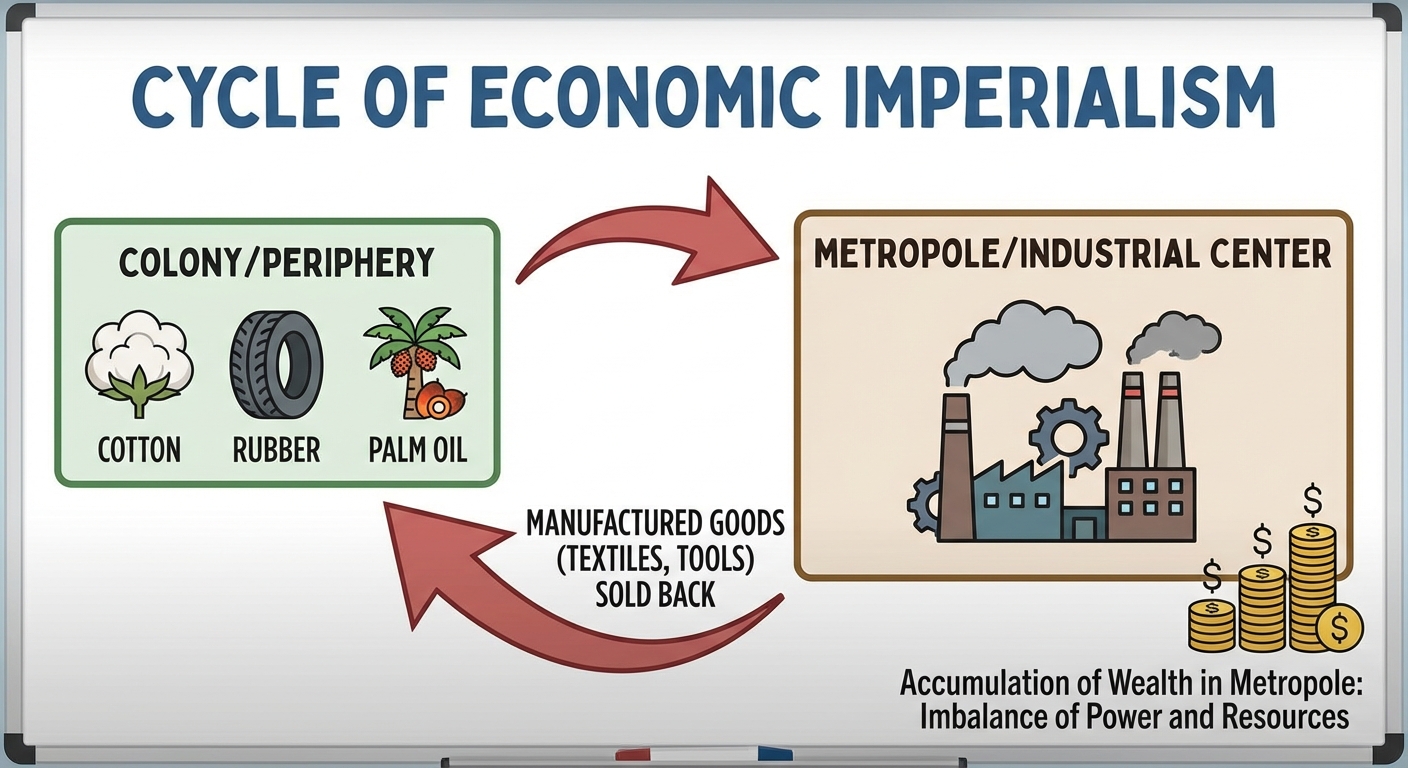
- Raw Materials: Industrial factories needed raw materials that Europe could not produce in sufficient quantities (rubber, cotton, palm oil, diamonds).
- New Markets: Industrialized nations produced more goods than their own populations could buy. Colonies served as captive markets where European goods could be sold without competition.
2. State Expansion: The Scramble for Territory
This era saw a shift from private/company rule to direct state control.
The Shift to Direct Rule
- The Congo Free State: Originally the personal colony of King Leopold II of Belgium. He exploited the region for rubber using brutal forced labor (severing hands of workers who missed quotas). The abuses were so horrific that the Belgian government was forced to take it over as a regular colony in 1908.
- Indonesia: The Dutch government took direct control from the Dutch East India Company (VOC) after the company went bankrupt due to corruption.
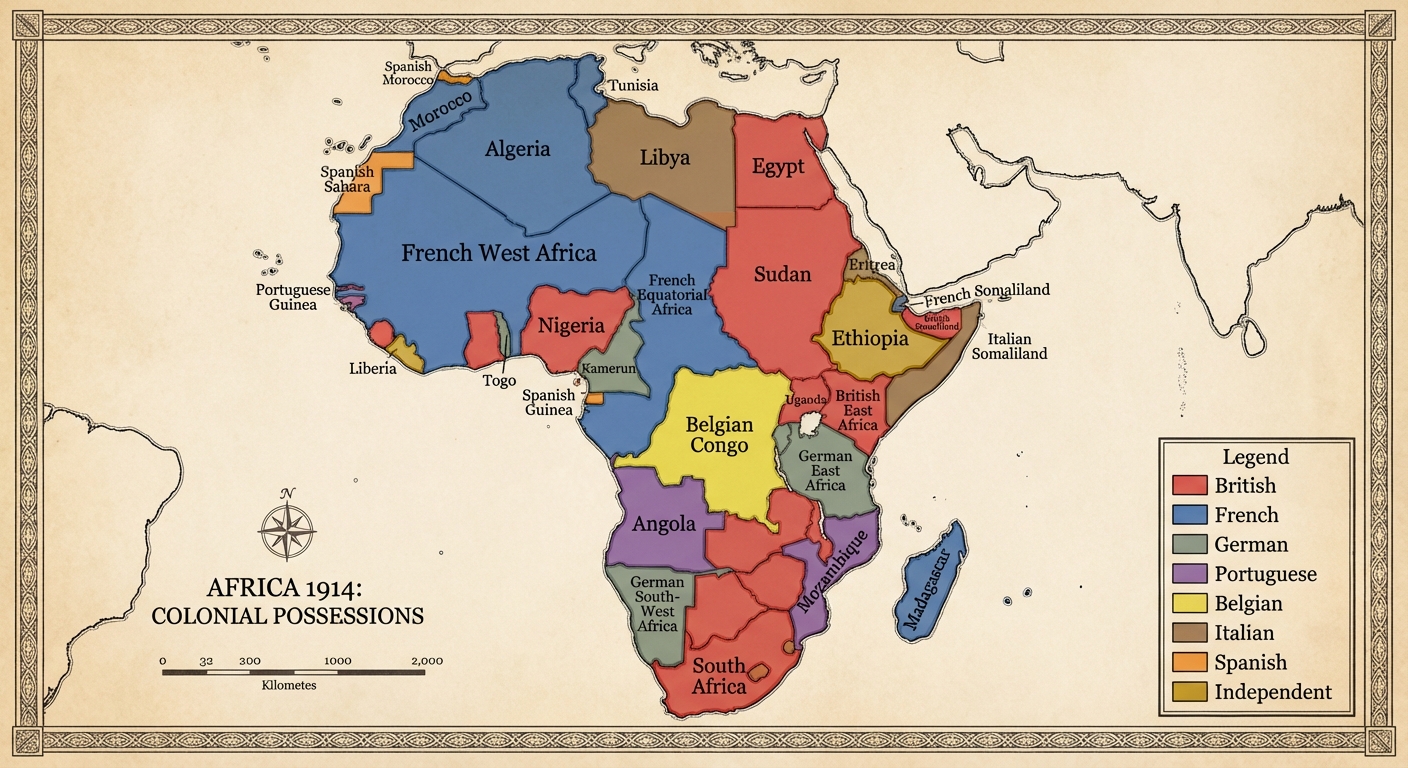
The Scramble for Africa
Until the late 1800s, Europeans were mostly restricted to coastal Africa due to malaria and difficult terrain. Quinine (medicine) and steamships changed this.
- Berlin Conference (1884–1885): Organized by Otto von Bismarck of Germany. European powers met to divide Africa peacefully among themselves to avoid war.
- The Impact: They drew borders that ignored long-standing tribal, linguistic, and cultural boundaries. Enemies were grouped together; families were split apart.
- By 1914, only Ethiopia and Liberia remained independent.
Imperialism in Asia
British in India:
- Initially controlled by the British East India Company (EIC), a transnational joint-stock company with its own private army.
- Following the Indian Rebellion of 1857 (Sepoy Mutiny), the British government disbanded the EIC and established direct rule, known as the British Raj.
- Queen Victoria was named Empress of India.
China:
- Never fully colonized, but carved into Spheres of Influence (areas where foreign nations held exclusive trading rights).
- Opium Wars: Britain fought China to force them to continue importing opium. The British victory led to the Treaty of Nanjing, the first of many "unequal treaties" which ceded Hong Kong to Britain and opened ports.
Non-European Imperialism
It wasn't just Europe; fully industrialized non-European nations also expanded:
- United States: Expanded west (Manifest Destiny), then overseas. Won the Spanish-American War (1898), acquiring the Philippines, Guam, and Puerto Rico. Issued the Roosevelt Corollary, claiming the right to intervene in Latin American economic affairs.
- Japan: After the Meiji Restoration, Japan industrialized rapidly to avoid being colonized. They then became colonizers themselves, defeating China in the Sino-Japanese War (taking Taiwan/Korea influence) and Russia in the Russo-Japanese War (1905).
3. Indigenous Responses to State Expansion
Indigenous peoples did not strictly accept rule; they resisted through direct warfare and religious movements.
Direct Resistance
- Túpac Amaru II (Peru): Led a massive indigenous revolt against Spanish rule in 1780. Though captured and executed, he became a symbol of Latin American independence.
- Samory Touré (West Africa): Led a powerful kingdom in West Africa that fought the French for decades before finally being defeated.
- Yaa Asantewaa War (West Africa): The Queen Mother of the Ashanti Empire (modern Ghana) led a war against the British to protect the Golden Stool (a sacred symbol of power).
- 1857 Indian Rebellion (Sepoy Mutiny): Sepoys (Indian soldiers employed by the British) revolted due to cultural insensitivity (gun grease rumors involving pig/cow fat). The rebellion failed but ended company rule.
- Battle of Adwa (Ethiopia): One of the few success stories. Emperor Menelik II defeated the Italian army, keeping Ethiopia independent.
Religious Resistance Movements
These movements often believed that spiritual purity or ritual would drive out the invaders.
- Ghost Dance (USA): Native Americans in the western US performed dances hoping to drive away white settlers and restore the buffalo. It culminated in the massacre at Wounded Knee.
- Xhosa Cattle Killing Movement (South Africa): Interaction with the British led to a prophecy that killing all cattle would resurrect spirits to drive the British out. The result was massive famine.
- Mahdist Revolt (Sudan): An Islamic movement led by Muhammad Ahmad (the Mahdi) against British/Egyptian rule. They temporarily defeated the British troops.
4. Global Economic Development
Industrialization turned colonies into Export Economies—specialized in extracting raw materials to ship to the industrial center.
Natural Resources
| Resource | Use | Major Production Region |
|---|---|---|
| Rubber | Tires, hoses, gaskets | Congo, Amazon, Malaya |
| Cotton | Textiles | India, Egypt, Southern US |
| Palm Oil | Lubricant for machines | West Africa |
| Guano | Fertilizer (bat/bird droppings) | Peru, Chile |
| Diamonds | Luxury/Industrial | South Africa (led by Cecil Rhodes) |
Economic Imperialism
This describes a situation where foreign business interests have great economic power or influence, developed into a form of neocolonialism.
- Latin America: The United States and Britain invested heavily in Latin American infrastructure (railways, ports) to extract resources.
- Banana Republics: Central American countries (like Honduras) where US corporations (United Fruit Company) had so much power they essentially controlled the government.
- China: The Open Door Policy proposed by the US aimed to keep Chinese trade open to all nations (preventing total partition), but effectively managed China's economy for foreign benefit.
5. Migration in an Interconnected World
Unit 6 is not just about war; it implies massive movement of people. Industrial transportation (steamships) made this possible.
Causes of Migration (Push/Pull Factors)
- Push Factors: Poverty, famine (Irish Potato Famine), political unrest (Taiping Rebellion in China).
- Pull Factors: Employment opportunities (Gold Rushes in California/Australia), availability of land.
Types of Labor
With the abolition of slavery (Britain in 1833, USA in 1865, Brazil in 1888), a new labor source was needed.
- Indentured Servitude: A contractual system where workers agreed to work for a set number of years in exchange for passage.
- Indians migrated to the Caribbean (Trinidad), Africa (Mauritius/South Africa), and Fiji to work on sugar plantations.
- Chinese migrated to the Americas and Southeast Asia.
- Convict Labor: Britain transformed Australia into a penal colony. Convicts performed hard labor for free settlers.
Effects of Migration
- Ethnic Enclaves: Migrants formed communities in new lands (e.g., Chinatowns in San Francisco/NYC, districts in Singapore). They transplanted their culture, food, and religion.
- Prejudice and Regulation: Receiving societies often reacted with xenophobia.
- Chinese Exclusion Act (1882): The US banned Chinese laborers.
- White Australia Policy: Various laws effectively curbed non-European immigration to Australia.
6. Common Mistakes & Pitfalls
- Confusing Time Periods: Do not confuse the "Old Imperialism" (1450–1750, focused on the Americas, Gold/God/Glory, Mercantilism) with "New Imperialism" (1750–1900, focused on Africa/Asia, Industrial Capitalism, Social Darwinism).
- Misunderstanding Social Darwinism: Students often mistake this for a biological fact. It was a pseudoscience used as a justification. It is distinct from actual Darwinian biology.
- Ignoring Non-European Imperialists: Don't forget that Japan and the US were major imperial powers in this era. It wasn't just Britain and France.
- Overlooking Migration: Essays on the "Consequences of Industrialization" often focus only on colonies. You must discuss the mass movement of people (Indian indentured servants, etc.) to get full credit.
- Economic Imperialism Definition: Remember that Economic Imperialism usually refers to independent nations being controlled by foreign companies (like the Banana Republics) rather than direct political ownership.
7. Key Terms Table
| Term | Definition |
|---|---|
| Sepoy | Indian soldier acting under British orders. |
| Sphere of Influence | Area where a foreign power claims exclusive trade rights. |
| Berlin Conference | 1884 meeting regulating European colonization of Africa. |
| Meiji Restoration | Japanese state-sponsored industrialization and westernization. |
| Transnational Business | Describe companies like Unilever or HSBC that operated internationally. |
| Boxer Rebellion | Anti-imperialist upheaval in China (1900). |