Unit 5: Heredity & The Mendelian Model
Fundamental Concepts of Inheritance
Mendelian genetics forms the bedrock of our understanding of how traits are passed from parents to offspring. Discovered by Gregor Mendel—an Austrian monk working with garden peas (Pisum sativum) in the 1860s—these principles provided the mathematical framework for heredity long before DNA and chromosomes were visualized.
Key Terminology
To master this unit, you must distinguish between the genetic code and the physical expression of traits.
- Gene: A discrete unit of hereditary information consisting of a specific nucleotide sequence in DNA (or RNA, in some viruses).
- Locus: The specific physical location of a gene on a chromosome.
- Allele: Alternative versions of a gene that may produce distinguishable phenotypic effects (e.g., the gene for flower color has a purple allele and a white allele).
- Genotype: The genetic makeup, or set of alleles, of an organism (e.g., $PP$, $Pp$, or $pp$).
- Phenotype: The observable physical and physiological traits of an organism, determined by its genetic makeup (e.g., Purple flowers).
Types of Organisms & Crosses
- Homonzygous (True-Breeding): Having two identical alleles for a given gene ($PP$ or $pp$).
- Heterozygous (Hybrid): Having two different alleles for a given gene ($Pp$).
- P Generation: The parental generation (usually true-breeding).
- F$_1$ Generation: The first filial, hybrid (heterozygous) offspring arising from a P generation cross.
- F$2$ Generation: The offspring resulting from interbreeding (or self-pollination) of the hybrid F$1$ generation.
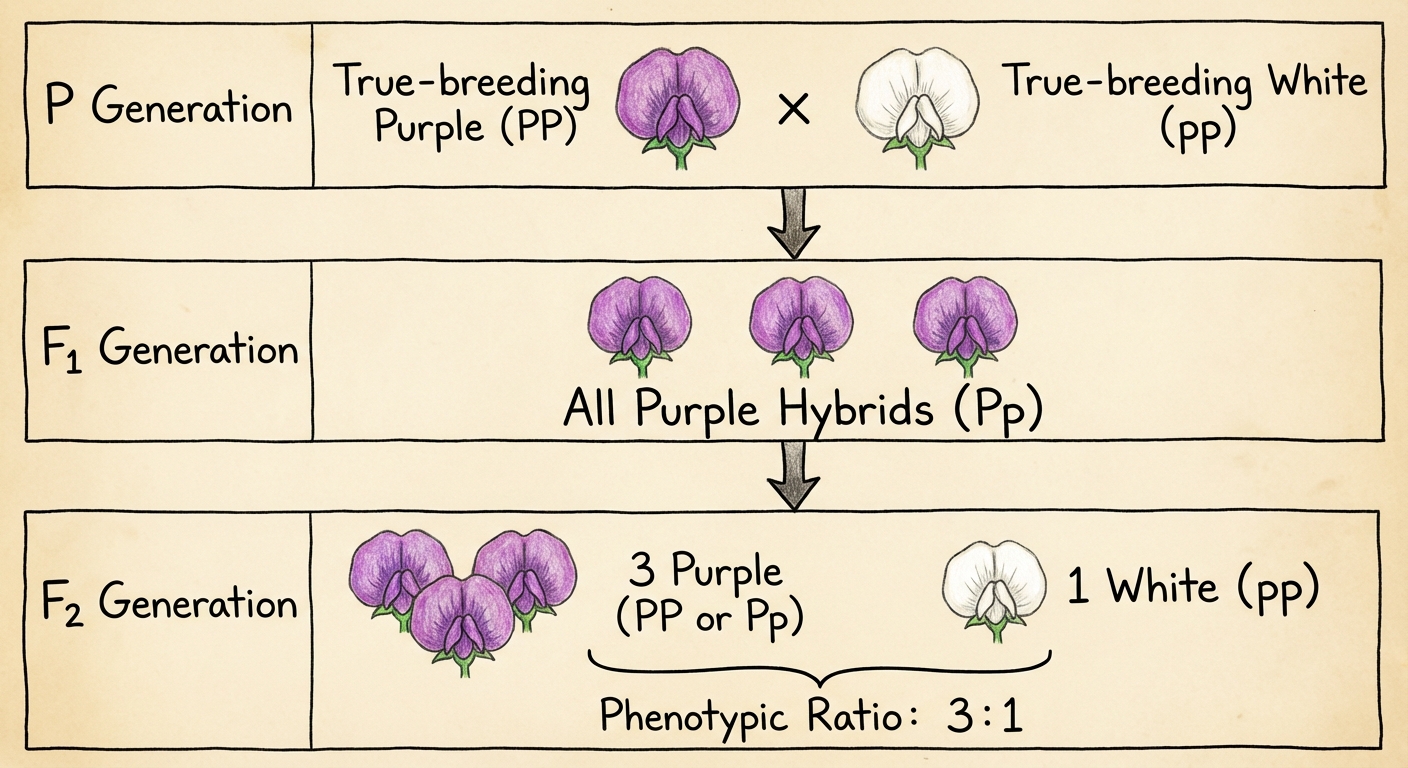
Mendel's First Law: The Law of Segregation
The Law of Segregation states that the two alleles for a heritable character segregate (separate) during gamete formation and end up in different gametes.
The Biological Mechanism
This law corresponds directly to Anaphase I of Meiosis. When homologous chromosomes separate, the alleles residing on them are pulled into different daughter cells.
- An egg or a sperm gets only one of the two alleles that are present in the somatic cells of the organism.
- If an organism is homozygous, all gametes receive the same allele.
- If an organism is heterozygous, 50% of the gametes receive the dominant allele, and 50% receive the recessive allele.
The Monohybrid Cross
A cross between heterozygotes for a single character (e.g., Flower Color: $Pp \times Pp$) is called a monohybrid cross.
Typical Ratio: $3:1$ Phenotypic, $1:2:1$ Genotypic.
| P (Purple) | p (White) | |
|---|---|---|
| P (Purple) | PP (Purple) | Pp (Purple) |
| p (White) | Pp (Purple) | pp (White) |
Probability in Genetics
Rather than drawing massive Punnett squares for complex crosses, AP Biology encourages the use of probability rules. These rules are essential when dealing with multiple genes.
1. The Multiplication Rule (The "AND" Rule)
Used to determine the probability that two or more independent events will occur together in a specific combination.
Concept: Probability of Event A AND Event B = $P(A) \times P(B)$.
- Example: In a cross $Rr \times Rr$, what is the chance of obtaining an offspring that is homozygous recessive ($rr$)?
- Probability of receiving $r$ from Dad: $1/2$
- Probability of receiving $r$ from Mom: $1/2$
- Total Probability: $1/2 \times 1/2 = 1/4$
2. The Addition Rule (The "OR" Rule)
Used to determine the probability that any one of two or more mutually exclusive events will occur.
Concept: Probability of Event A OR Event B = $P(A) + P(B)$.
- Example: In a cross $Rr \times Rr$, what is the probability of a heterozygote ($Rr$)?
- It can happen two ways: Dominant from Dad/Recessive from Mom ($1/4$) OR Recessive from Dad/Dominant from Mom ($1/4$).
- Total Probability: $1/4 + 1/4 = 1/2$
Mendel's Second Law: Independent Assortment
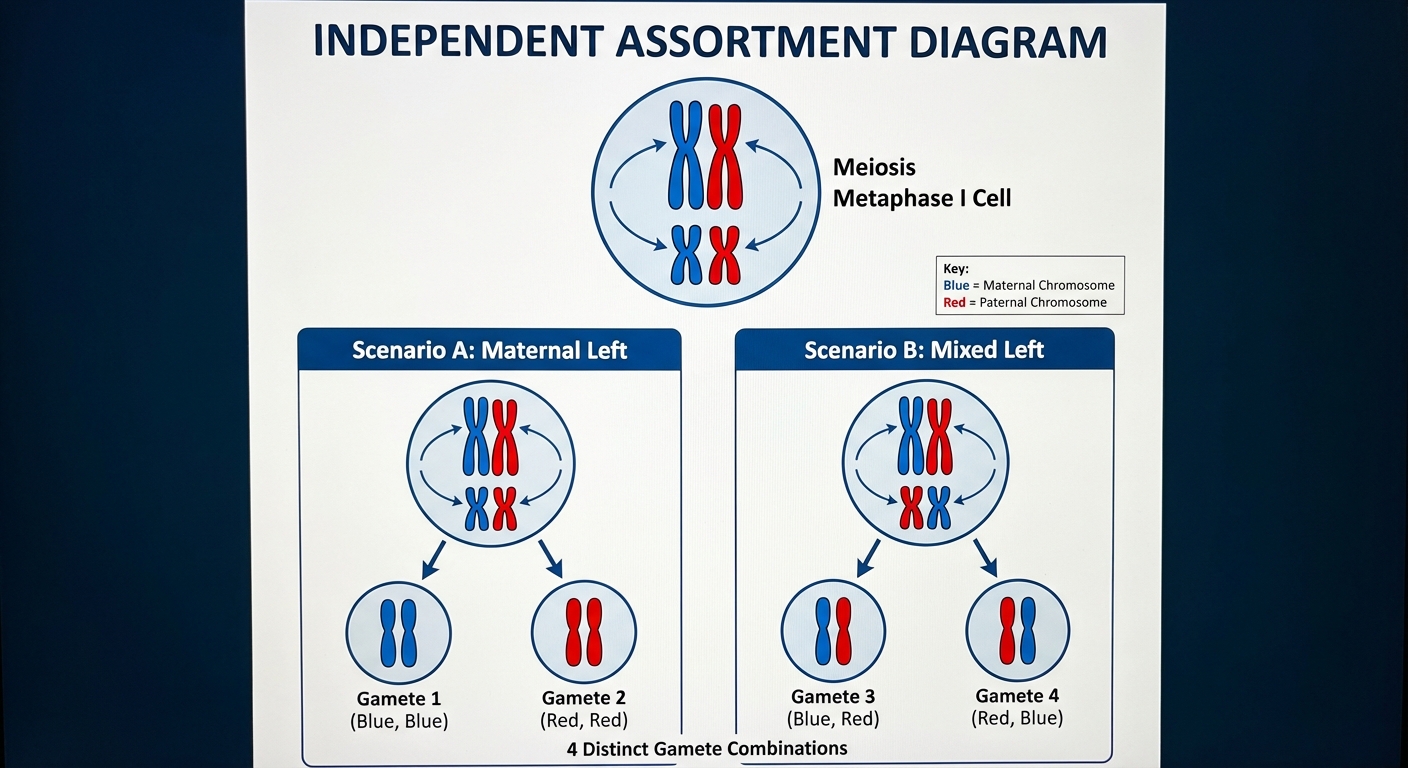
The Law of Independent Assortment states that each pair of alleles segregates independently of each other pair of alleles during gamete formation.
- Condition: This law applies only to genes on different, non-homologous chromosomes (or those far apart on the same chromosome).
- Biological Mechanism: This corresponds to the random alignment of homologous pairs at the metaphase plate during Metaphase I of Meiosis.
The Dihybrid Cross
A cross between individuals heterozygous for two characters (e.g., $YyRr \times YyRr$).
- Possible Gametes: $YR$, $Yr$, $yR$, $yr$ (each with $1/4$ probability).
- Phenotypic Ratio: $9:3:3:1$
- 9 Dominant/Dominant
- 3 Dominant/Recessive
- 3 Recessive/Dominant
- 1 Recessive/Recessive
Statistical Analysis: The Chi-Square Test ()
In genetics, real-world data rarely matches the predicted ratios perfectly due to chance. The Chi-Square Goodness of Fit Test is used to determine if the deviation between observed data and expected data is statistically significant or just due to random chance.
The Formula
Where:
- $o$ = Observed number (actual data)
- $e$ = Expected number (calculated based on Mendel's ratios)
- $\sum$ = Sum of values for all categories
Steps for Analysis
- Determine the Null Hypothesis ($H_0$): Usually states that "There is no significant difference between observed and expected frequencies; any difference is due to chance."
- Calculate Expected Values: If you crossed $Pp \times Pp$ and got 100 offspring, you expect 75 Purple and 25 White.
- Compute $\chi^2$: Apply the formula for each category and sum them.
- Determine Degrees of Freedom ($df$):
- Compare to Critical Value: Use the Chi-Square distribution table (usually provided, $p=0.05$ row).
- If $\chi^2 <$ Critical Value: Fail to reject $H_0$. The data fits the Mendelian model.
- If $\chi^2 >$ Critical Value: Reject $H_0$. Something else is happening (linkage, lethal alleles, error, etc.).
Common Mistakes & Pitfalls
- Confusing Segregation with Independent Assortment:
- Segregation is about one gene (alleles separate).
- Assortment is about two or more genes (how Gene A moves relative to Gene B).
- Misidentifying Dominance:
- Dominant does not mean "better," "stronger," or "more common" in a population. It simply means the allele masks the recessive allele in a heterozygote. For example, the allele for Polydactyly (extra fingers) is dominant, but very rare.
- Chi-Square Errors:
- Students often use percentages or ratios in the formula. You MUST use the raw counts (actual number of organisms).
- Assuming Independent Assortment Always Applies:
- If genes are on the same chromosome (linked), they typically do not assort independently. This is a common "trick" question in Unit 5.