AP Biology Unit 8: Organismal Ecology & Behavioral Adaptations
Energy Strategies and Thermoregulation
Organismal ecology focuses on how an individual organism's structure, physiology, and behavior meet the challenges posed by its environment. A central theme is the acquisition and use of energy to maintain homeostasis.
Endotherms vs. Ectotherms
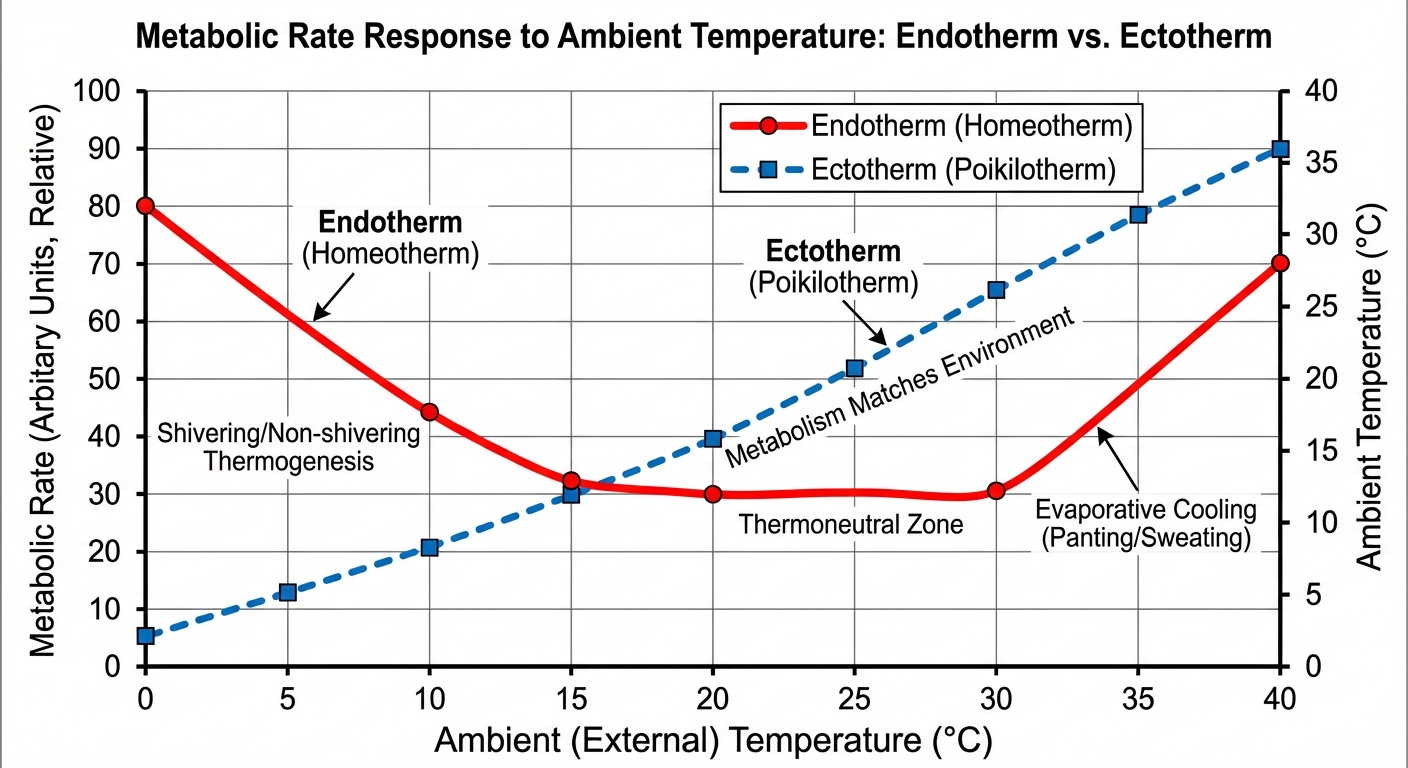
Organisms use different strategies to regulate body temperature and metabolism. This classification depends on the source of thermal energy.
- Endotherms (Birds, Mammals): Generate heat by metabolism. They maintain a stable internal temperature despite external fluctuations.
- Cost: Energetically expensive; requires high food consumption.
- Benefit: Can remain active in varied environmental temperatures.
- Ectotherms (Reptiles, Amphibians, Fish, Invertebrates): Gain heat from external sources (the sun, warm rocks). Their internal temperature generally conforms to the ambient temperature.
- Cost: Activity levels are restricted by environmental temperature.
- Benefit: Energetically "cheap"; they can survive on much less food than endotherms of the same size.
Metabolic Rate and Body Size
There is a crucial inverse relationship between body size and metabolic rate per unit mass.
- The Rule: Smaller organisms have a higher metabolic rate per gram than larger organisms.
- The Reason: Smaller organisms have a higher surface-area-to-volume ratio (), leading to faster heat loss. To maintain homeostasis, they must burn energy more rapidly.
- Consequence: A shrew (tiny mammal) must eat constantly to survive, whereas an elephant eats a small percentage of its body weight daily.
Energy Conservation Strategies
When environmental conditions become extreme, organisms utilize physiological adaptations to conserve energy:
- Torpor: A physiological state of decreased activity and metabolism.
- Hibernation: Long-term torpor during winter cold.
- Estivation: Summer torpor to survive high temperatures and low water availability.
Behavioral Responses to Environmental Cues
Behavior is an action carried out by muscles or glands under control of the nervous system in response to a stimulus. Natural selection favors behaviors that increase survival and reproductive fitness.
Innate vs. Learned Behaviors
- Innate Behaviors: Developmentally fixed and under strong genetic control. All individuals in a population exhibit the behavior purely by instinct (e.g., a spider spinning a web).
- Fixed Action Pattern (FAP): A sequence of unlearned acts directly linked to a simple stimulus (sign stimulus). Once initiated, it is usually carried to completion.
- Example: Male stickleback fish attacking anything with a red underside.
- Learned Behaviors: Modified based on specific experiences (e.g., habituation, imprinting, spatial learning).
Movement: Taxis and Kinesis
Animals move to obtain nutrients or avoid stressful conditions. You must distinguish between these two specific types of movement:
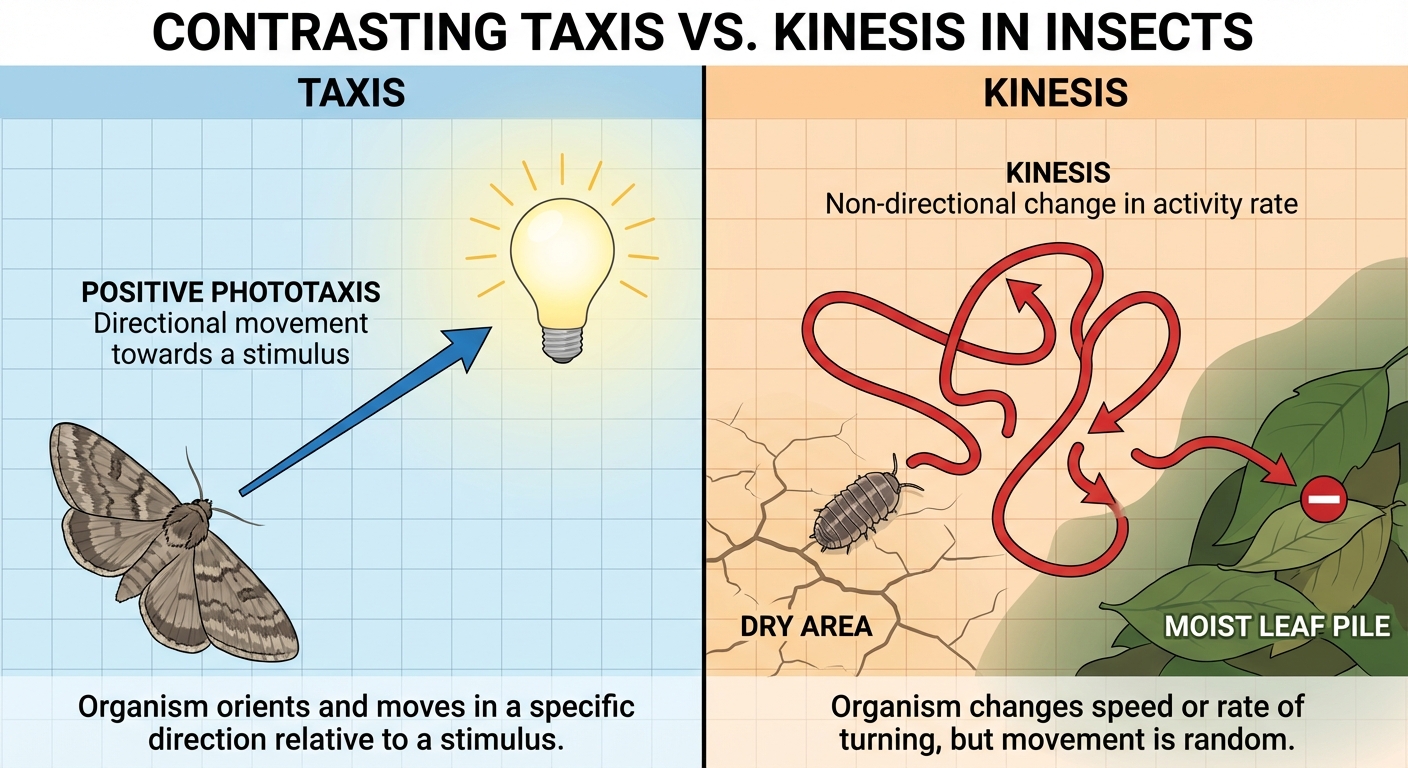
- Taxis: A directional movement toward (positive) or away from (negative) a stimulus.
- Example: Chemotaxis (movement toward a chemical scent) or Phototaxis (moths flying toward a light).
- Memory Aid: When you take a Taxi, you give the driver a specific direction.
- Kinesis: A non-directional (random) change in activity or turning rate in response to a stimulus.
- Example: Pill bugs (isopods) move more actively in dry areas to increase the chance of finding a moist area. Once in a moist area, they slow down to stay there.
- Memory Aid: Kinesis is like Kinetic energy—random chaotic movement.
Plant Responses to the Environment
Plants cannot move, so they rely heavily on signal transduction pathways and hormones to respond to stimuli.
Phototropism
Phototropism is the growth of a shoot toward or away from light.
- Mechanism: The hormone auxin moves to the shaded side of the stem.
- Action: Auxin causes cell elongation on the shaded side, pushing the stem to bend toward the light.
Photoperiodism
Photoperiodism is a physiological response to the specific relative lengths of night and day (photoperiod). It regulates flowering and preparation for winter.
- Critical Concept: Plants actually measure the length of the night, not the day.
- Short-day plants (Long-night): Flower when the night exceeds a critical length (usually late summer/fall).
- Long-day plants (Short-night): Flower when the night is shorter than a critical length (usually late spring/summer).
- Phytochrome: The photoreceptor pigment responsible for tracking day/night length. It switches between two forms ( and ) based on light exposure.
Communication and Social Behavior
Communication involves the transmission and reception of signals between organisms. These signals can be visual, auditory, tactile, or chemical.
Types of Signals
| Type | Description | Example |
|---|---|---|
| Chemical | Pheromones used for long-distance signaling | Ants following a scent trail; female moths attracting males |
| Visual | Displays used often in courtship or aggression | Peacock fanning tail feathers; wolves baring teeth |
| Auditory | Sounds used to communicate over distance or in dark | Bird songs; whale calls; crickets chirping |
| Tactile | Touch-based communication | Honeybee waggle dance |
The Honeybee Waggle Dance
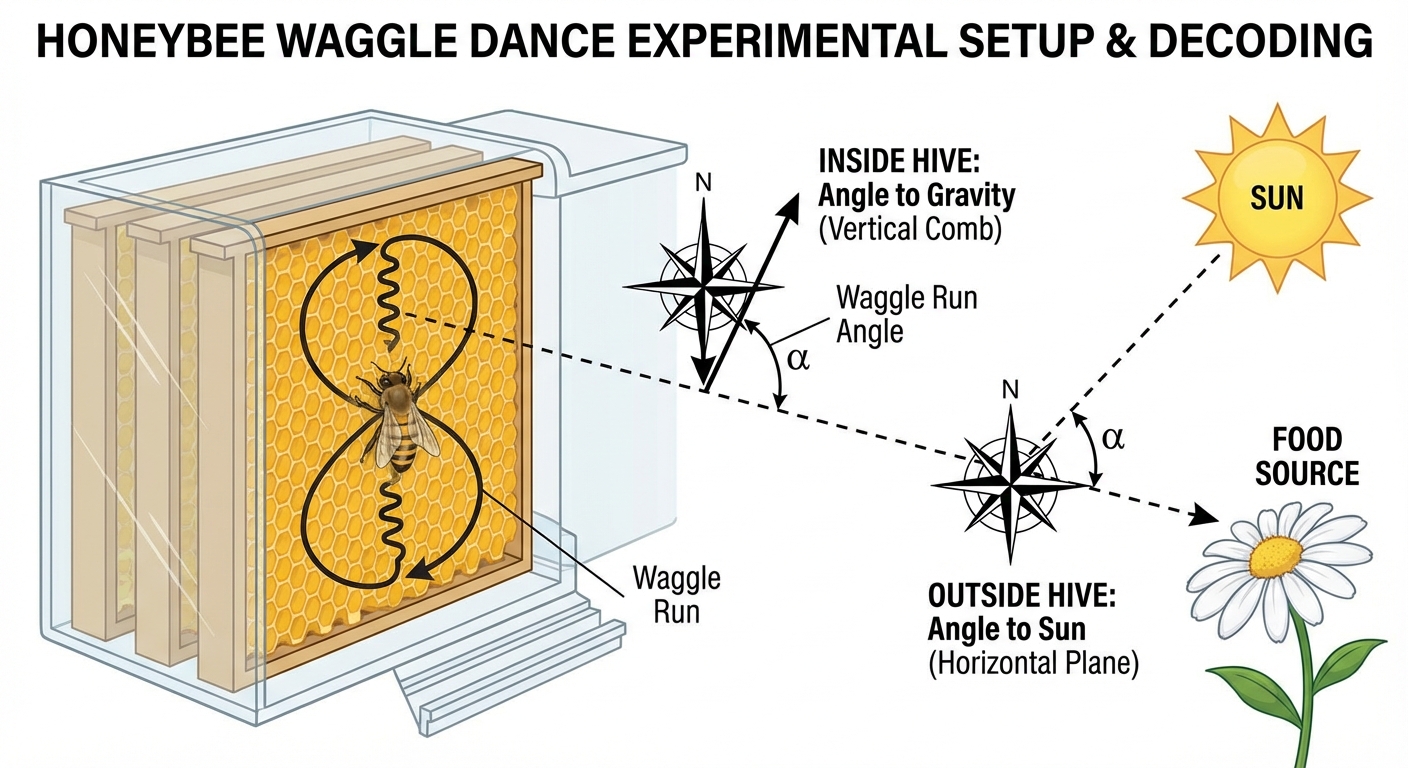
This is a classic exam example of complex insect communication. A returning forager performs a "dance" to inform the hive about the distance and direction of food.
- Round dance: Food is near.
- Waggle dance: Food is distant. The angle of the run relative to the vertical surface of the hive indicates the angle of the food relative to the sun.
Altruism and Kin Selection
Sometimes, an organism behaves in a way that reduces its own individual fitness but increases the fitness of other individuals in the population. This is altruism.
- Why does evolution allow this? If the beneficiaries are close relatives, the altruist is still passing on its genes indirectly.
- Inclusive Fitness: The total effect an individual has on proliferating its genes by producing its own offspring AND by providing aid that enables other close relatives to increase the production of their offspring.
- Hamilton's Rule: Natural selection favors altruism if rB > C
- = Coefficient of relatedness (fraction of shared genes)
- = Benefit to the recipient (how many more offspring they produce)
- = Cost to the altruist
Common Mistakes & Pitfalls
Confusing Proximate and Ultimate Causation:
- Proximate: "How" a behavior occurs (mechanics, hormones, genetics). Ex: A bird migrates because changing daylight triggers a hormonal shift.
- Ultimate: "Why" a behavior evolved (evolutionary significance). Ex: A bird migrates to find better food sources and increase survival.
- Tip: If the question asks "why," think Evolution. If it asks "how," think Physiology.
Misunderstanding "Fitness":
- It is not about physical strength. In biology, fitness strictly refers to the ability to survive and reproduce. If you are strong but sterile, your evolutionary fitness is zero.
Taxis vs. Kinesis:
- Students often describe random movement as taxis. If the animal is not moving in a straight line toward/away from the source, it is likely kinesis.
Anthropomorphizing Plants:
- Avoid saying plants "want" to grow toward the light. Plants do not have desires; they have hormonal responses (auxin redistribution) driven by chemical physics.