Unit 10 Guide: Power, Taylor, and Maclaurin Series for AP Calculus BC
Taylor Polynomial Approximations
Before exploring infinite series, it is essential to understand Taylor Polynomials. These are finite polynomials used to approximate non-polynomial functions (like $e^x$, $\sin x$, or $\ln x$) near a specific point.
Definition and Formula
If $f$ has $n$ derivatives at $x=c$, then the $n$th-degree Taylor Polynomial for $f$ centered at $c$ is:
In summation notation:
- Center ($c$): The $x$-value where the approximation is exact.
- Degree ($n$): The highest power of $(x-c)$ in the polynomial.
- Linear Approximation: Notice that $P_1(x) = f(c) + f'(c)(x-c)$ is simply the equation of the tangent line (linearization).
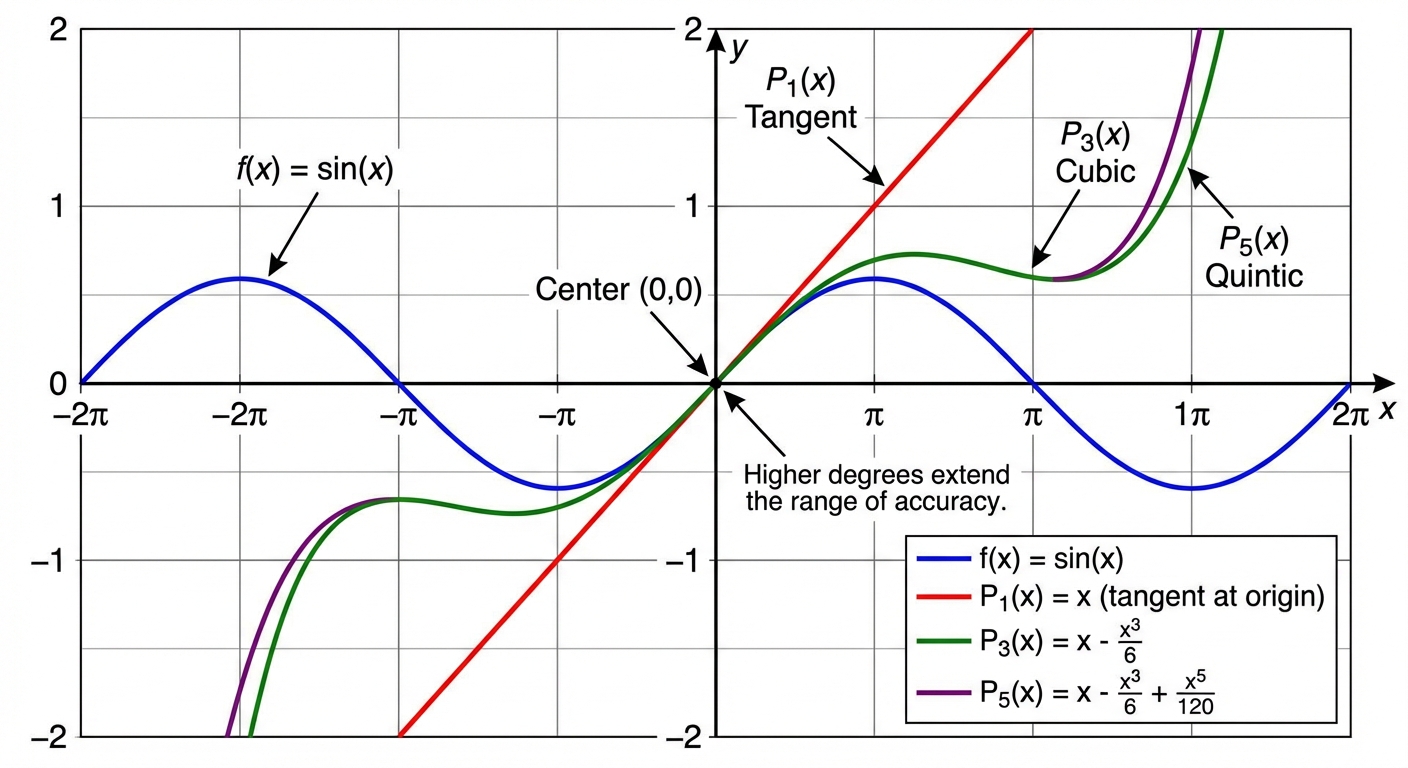
General Concept: Local Linearity to Local Non-Linearity
As you increase the degree $n$, the polynomial "hugs" the original function curve more closely around the center $c$. $P1$ matches the slope; $P2$ matches the concavity; $P_n$ matches the $n$-th derivative.
Finding Taylor and Maclaurin Series
While a polynomial is finite, a Series is infinite. If the limit of the Taylor Polynomial as $n \to \infty$ exists, we get the Taylor Series.
Maclaurin Series
A Maclaurin Series is simply a Taylor Series centered at $c=0$.
The "Big Four" Series to Memorize
On the AP Calculus BC exam, you are expected to memorize specific Maclaurin series expansions. Do not derive these from scratch on the test; know them by heart.
| Function | Maclaurin Series Expansion | Summation Notation | Interval of Convergence |
|---|---|---|---|
Memory Aids
- $\sin x$ is Odd: Sine is an odd function (symmetric about origin), so its series contains only odd powers ($x^1, x^3, x^5$) and odd factorials.
- $\cos x$ is Even: Cosine is an even function (symmetric about y-axis), so its series contains only even powers ($1=x^0, x^2, x^4$) and even factorials.
Representing Functions as Power Series
Instead of calculating derivatives from scratch using the Taylor formula, we often manipulate known series to find new ones. This is usually faster and less prone to arithmetic error.
Substitution
To find the series for $f(x) = e^{-x^2}$, replace every instance of $x$ in the standard $e^x$ series with $(-x^2)$:
Differentiation and Integration
Power series can be differentiated or integrated term-by-term within their radius of convergence.
Example: Find the series for $\frac{1}{(1-x)^2}$.
- Recall geometric series: $\frac{1}{1-x} = 1 + x + x^2 + x^3 + \dots$
- Differentiate both sides with respect to $x$:
Radius and Interval of Convergence
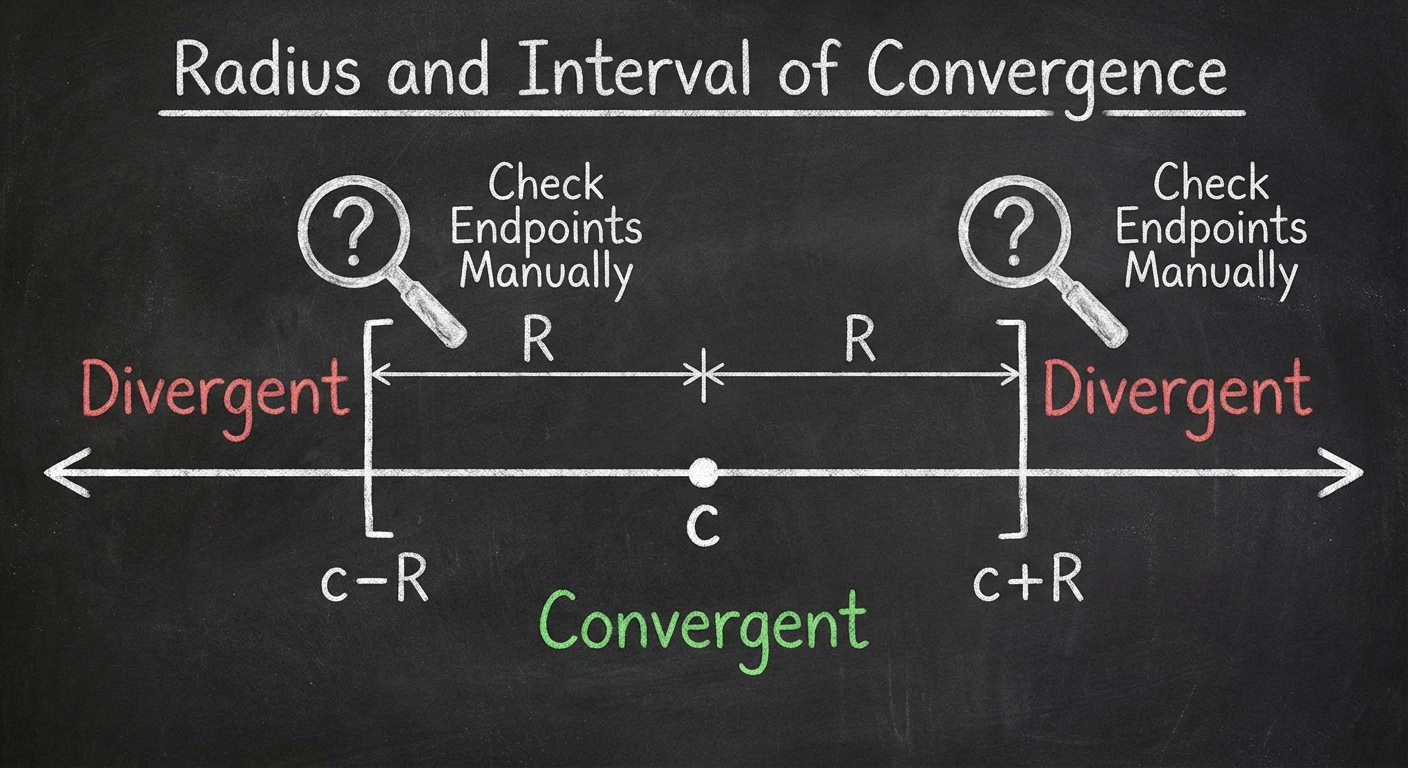
A power series may not converge for all $x$. The set of all $x$ values for which the series converges is the Interval of Convergence (IOC).
Finding the Radius ($R$)
Use the Ratio Test to determine convergence.
\lim{n \to \infty} \left| \frac{a{n+1}}{a_n} \right| = L < 1
Set up the limit, simplify, and solve the inequality $|x-c| < R$. The number $R$ is the Radius of Convergence.
Checking Endpoints
The Ratio Test is inconclusive ($L=1$) at the endpoints of the interval $(c-R, c+R)$. You must test these endpoints individually by plugging them back into original series and using convergence tests (Alternating Series Test, p-Series, Harmonic, output of Geometric).
Steps Summary:
- Apply Ratio Test: $\lim{n \to \infty} |\frac{u{n+1}}{u_n}| < 1$.
- Isolate $|x-c| < R$.
- Identify the open interval: $(c-R, c+R)$.
- Check $x = c-R$ and $x = c+R$ manually.
- Write final interval using $[$ or $]$ where appropriate.
Lagrange Error Bound
When we use a Taylor Polynomial $Pn(x)$ to approximate a function $f(x)$, there is a remainder (error), $Rn(x)$. The Lagrange Error Bound tells us the worst-case scenario for this error.
The Formula
If $P_n(x)$ is the $n$th-degree Taylor polynomial centered at $c$, the error satisfies:
Where:
- $n$ is the degree of the polynomial used.
- $x$ is the point where we are approximating.
- $c$ is the center.
- $M$ is the maximum value of the absolute value of the $(n+1)^{th}$ derivative ($|f^{(n+1)}(z)|$) on the interval between $c$ and $x$.
Strategy for Finding $M$
- Find the $(n+1)^{th}$ derivative of $f$.
- Analyze $|f^{(n+1)}(z)|$ on the interval between $c$ and $x$.
- Pick a value $M$ that is greater than or equal to this derivative everywhere on that interval. (Often, if the derivative is increasing, evaluate at the far endpoint; if decreasing, evaluate at the closer endpoint. For sin/cos, $M$ is always 1).
Alternating Series Error Bound
Note: If the specific series is an Alternating Series satisfying the requirements of the AST (terms decrease in magnitude to 0), you can use the simpler Alternating Series Remainder:
Common Mistakes & Pitfalls
- Forgetting the Factorial: Students frequently forget the $n!$ in the denominator, especially when writing out the first few terms (e.g., writing $\frac{f''(c)}{2}$ instead of $\frac{f''(c)}{2!}$ is okay, but $\frac{f'''(c)}{3}$ is wrong; it must be 6).
- Confusing $n$ and $n+1$ in Lagrange: The Error Bound uses the $(n+1)^{th}$ derivative and the $(n+1)!$. If you used a 3rd degree polynomial, you look at the 4th derivative.
- Ignoring Endpoints: Finding the radius $R$ is not enough for the Interval of Convergence. You must prove convergence or divergence at the endpoints.
- Center Confusion: For Taylor series centered at $c \neq 0$, the terms must contain $(x-c)^n$. Do not write $x^n$ unless $c=0$ (Maclaurin).
- Chain Rule Errors: When substituting into a known series (e.g., $\sin(2x)$), remember to apply the power to the entire argument: $(2x)^3 = 8x^3$, not $2x^3$.