Unit 2: Identity and Expression in Japanese Culture
Unit 2: The Influence of Language and Culture on Identity
This unit explores how language, aesthetics, and lifestyle shape the identity of Japanese people, both as individuals and as a nation. For the AP Exam, it is crucial to understand the 3 Ps: Products (what is created), Practices (what is done), and Perspectives (why it is done).
2.1 Language as the Foundation of Identity
Language (日本語: Nihongo) is the primary tool for constructing identity in Japan. It is not just a means of communication but a reflection of social hierarchy, gender roles, and regional pride.
The Uchi-Soto (内-外) Dynamic in Speech
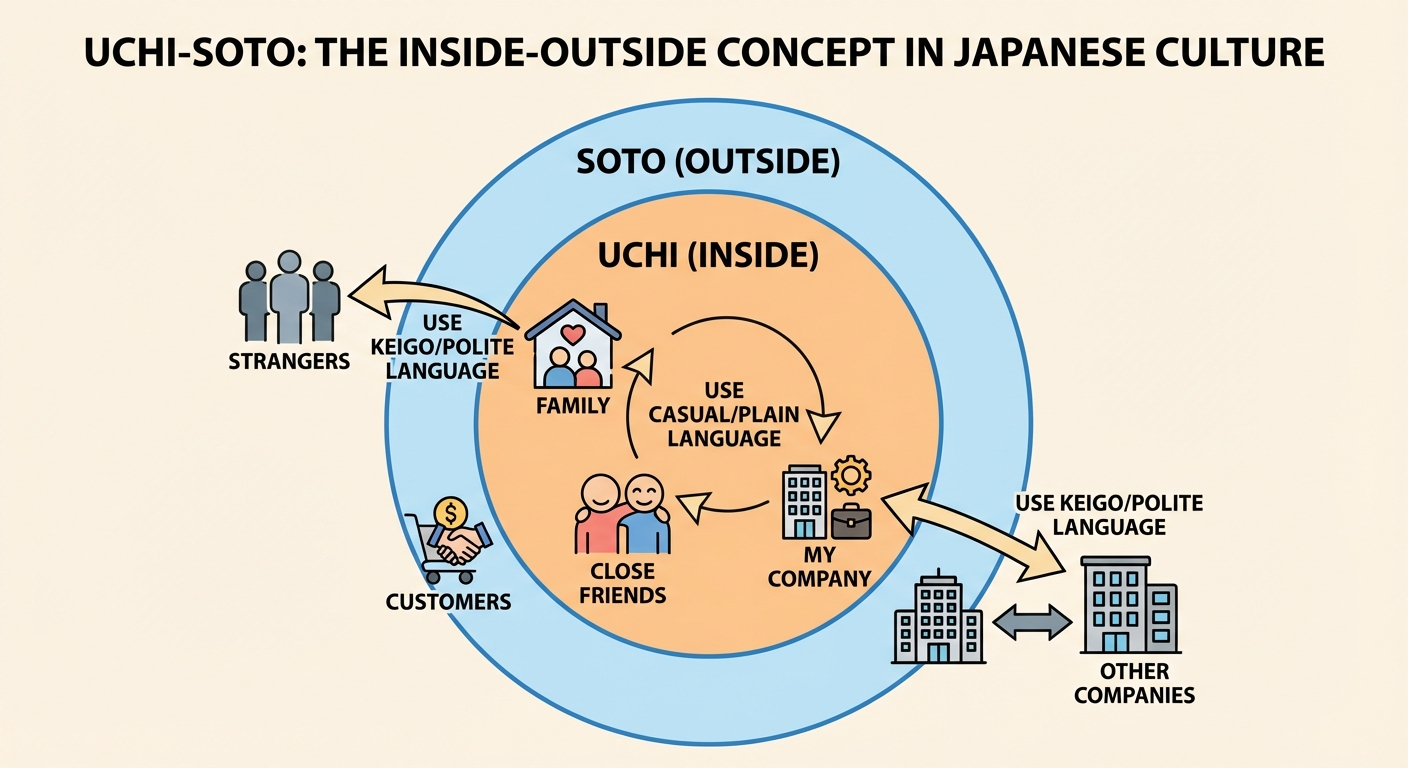
A fundamental perspective in Japanese culture is the distinction between Uchi (内) (inside/in-group) and Soto (外) (outside/out-group). This concept dictates which language style is used, directly influencing public identity.
- Uchi (In-group): Family, close friends, or one's own company. Informal speech or humble language is used.
- Soto (Out-group): Strangers, customers, or superiors. Polite or honorific language is used.
Keigo (敬語): Politeness as Public Identity
Proficiency in Keigo (honorifics) signals social maturity and full integration into adult society (社会人: shakaijin).
- Sonkeigo (尊敬語 - Respectful Language): Elevates the listener ($Listener \uparrow$). specific verbs like irasshaimasu (to go/come/be).
- Kenjougo (謙譲語 - Humble Language): Lowers the speaker to show respect ($Speaker \downarrow$). Specific verbs like mairimasu (to go/come).
- Teineigo (丁寧語 - Polite Language): Standard polite forms ending in desu/masu.
Gendered Speech and Changing Roles
Traditional grammar structures often reflect gender binaries, though this is evolving in modern Japan.
- Onna-kotoba (女言葉 - Women's Language): Characterized by soft particles (wa, no), higher pitch, and more frequent use of polite prefixes (o-, go-). Historically linked to the ideal of Yamato Nadeshiko (ideal Japanese woman).
- Otoko-kotoba (男言葉 - Men's Language): Characterized by assertive sentence endors (ze, zo, na) and direct verb forms.
- Modern Shift: Younger generations are moving toward Neutral Speech, minimizing strong gender markers to reflect modern views on gender equality.
Self-Reference and Identity
Unlike English (which uses "I"), Japanese offers multiple pronouns that define the speaker's identity relative to the listener:
- Watashi (私): Standard/Formal.
- Boku (僕): Masculine/Soft (often used by boys/young men).
- Ore (俺): Masculine/Rough (informal, used with close friends).
- Atashi (あたし): Feminine/Casual.
Regional Identity: Dialects (Hōgen)
While Standard Japanese (標準語: Hyōjungo) is the language of media and education (based on Tokyo speech), Dialects (方言: Hōgen) constitute a strong part of local identity.
- Kansai-ben (関西弁): Spoken in Osaka/Kyoto (e.g., Ookini instead of Arigatou). Associated with comedy and friendliness.
- Code-Switching: Many Japanese people switch between Hōgen (at home/local community) and Hyōjungo (at work/school), maintaining a dual identity.
2.2 The Writing System: Visual Identity
The complexity of the Japanese writing system is a source of national pride and a barrier to entry that strengthens group identity.
Three Scripts, One Language
| Script | Japanese | Function | Example |
|---|---|---|---|
| Kanji | 漢字 | Logograms for meaning (nouns, stems). Adopted from China but adapted. | 食べる (To eat) |
| Hiragana | ひらがな | Phonetic; grammar particles, verb endings, native words. Soft, curved aesthetics. | 食べる |
| Katakana | カタカナ | Phonetic; loanwords (Gairaigo), emphasis, scientific terms. angular aesthetics. | ハンバーガー |
- Literacy: Japan has one of the highest literacy rates in the world, largely due to the rigorous primary education focusing on these scripts.
- Calligraphy (書道: Shodō): Writing is elevated to an art form, emphasizing mental focus and spiritual discipline (Zen).
2.3 Beauty and Aesthetics (美意識)
Japanese aesthetic concepts permeate daily life, from traditional gardens to modern web design.
Types of Beauty
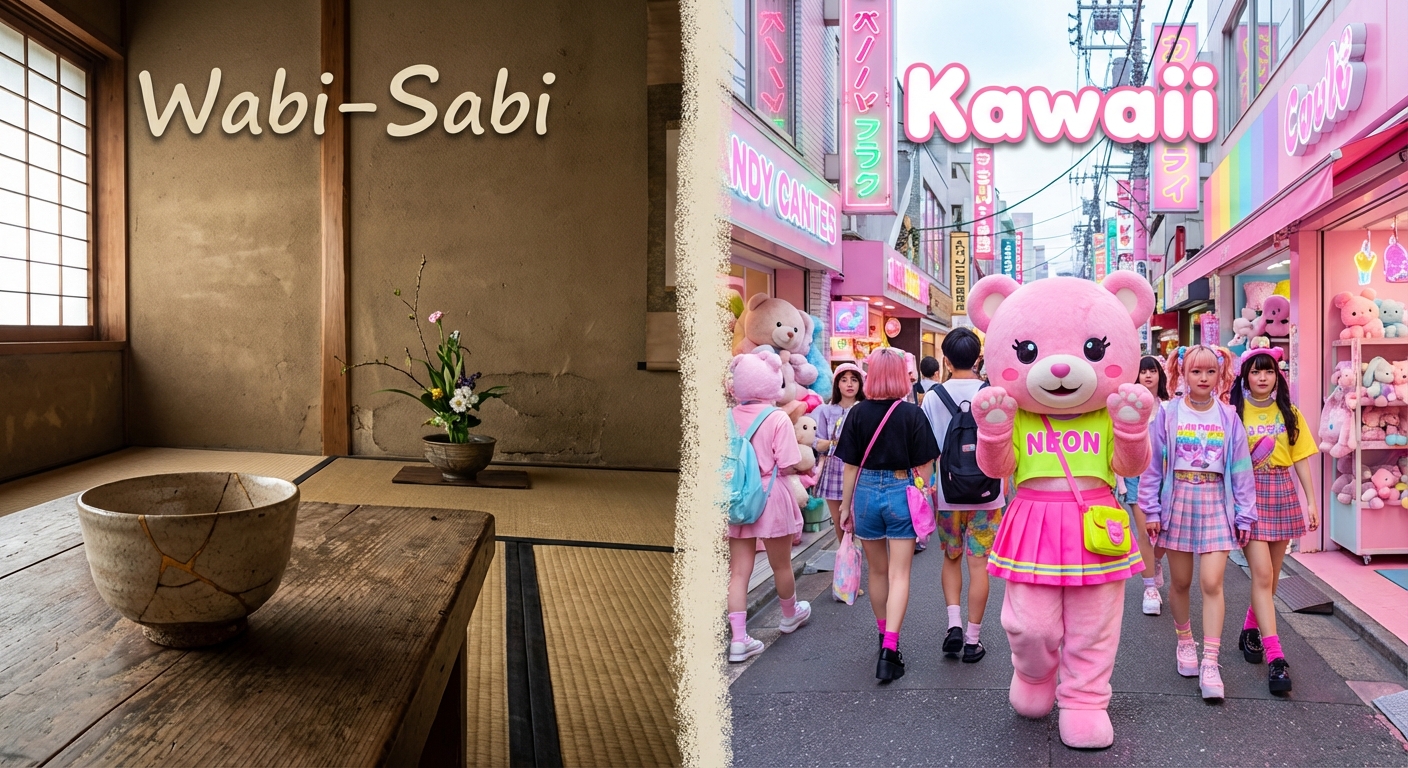
- Wabi-Sabi (侘び寂び): The acceptance of transience and imperfection.
- Wabi: Rustic simplicity, freshness, quietness.
- Sabi: Beauty that comes with age (patina, wear).
- Example: A cracked tea bowl repaired with gold (Kintsugi).
- Mono no Aware (物の哀れ): a bittersweet empathy toward the impermanence of things (e.g., falling cherry blossoms effectively symbolize this).
- Ma (間): Negative space. The silence between notes or the empty space in a room is as important as the object itself.
- Kawaii (可愛い): The modern aesthetic of "cuteness." It implies vulnerability, approachability, and childlike innocence (e.g., Hello Kitty, Yuru-chara mascots). Kawaii is often seen as a reaction against the rigidity of traditional culture.
Architecture and Living Space
- Traditional: Uses wood, paper (Shoji screens), and Tatami mats. Integrates nature via Engawa (veranda).
- Modern: Japan is famous for maximizing small spaces (Kyosho-jutaku - micro-homes) using the concept of Ma to avoid clutter.
Literature as Cultural Memory
- The Tale of Genji (源氏物語): Written by Murasaki Shikibu in the Heian period. It established the aesthetic of Mono no Aware.
- Haiku (俳句): 5-7-5 syllable structure featuring a Kigo (季語) or seasonal word. Matsuo Basho is the most famous poet. It focuses on capturing a singular moment in nature.
- Contemporary: Authors like Haruki Murakami blend Japanese isolation with Western surrealism, reflecting the modern Japanese identity crisis.
2.4 Contemporary Life: Entertainment and Society
Traditional Arts (Dentō Geinō)
These arts are protected by the government as "Living National Treasures."
- Kabuki (歌舞伎): Stylized drama, elaborate makeup (Kumadori), all-male actors (Onnagata play female roles).
- Noh (能): Masked drama, slow movements, spiritual/ghostly themes. Represents Yūgen (mysterious beauty).
- Bunraku (文楽): Puppet theater.
Pop Culture: "Cool Japan"
Since the 2000s, the government has promoted Cool Japan (soft power) to export Japanese identity globally.
- Anime/Manga: Covers all genres/ages. A major medium for social commentary.
- Otaku Culture: Originally negative, identifying as an Otaku (obsessive fan of anime/tech) is now a recognized subculture centered in Akihabara.
Food Culture (Washoku)
Washoku (和食) was designated a UNESCO Intangible Cultural Heritage in 2013. It is defined by:
- Respect for Nature: Using fresh, seasonal ingredients (Shun - the peak season for a food).
- Nutritional Balance: Based on "Ichiju-Sansai" (一汁三菜): One soup, three sides, plus rice and pickles.
- $Rice + Soup + Main (Fish/Meat) + Side 1 (Veg) + Side 2.$
- Umami: Low fat, using dashi (broth) to enhance flavor.
- Events: Food is tied to the calendar (e.g., Osechi for New Year, Ehomaki for Setsubun).
Regional Specialties (Meibutsu)
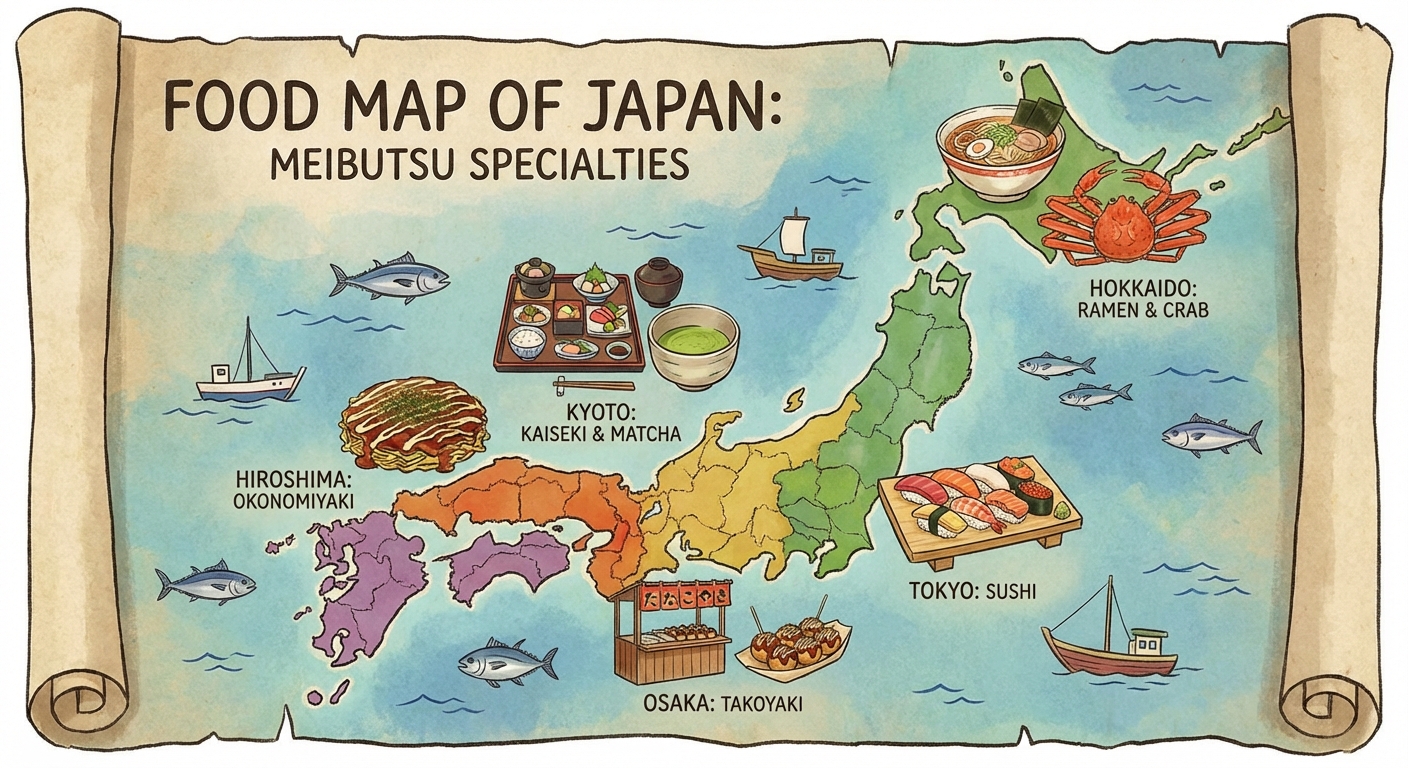
Travel in Japan is linked to food. Giving Omiyage (souvenirs, usually food) from a specific region is a mandatory social practice to maintain harmony.
- Osaka: Takoyaki, Okonomiyaki (Kuidaore culture – "eat 'til you drop").
- Kyoto: Kaiseki Ryori (refined, vegetarian influences).
- Hokkaido: Dairy, Seafood, Ramen.
2.5 Sports and Martial Arts
Budō (Martial Arts)
Modern martial arts usually end in -dō (the way), implying a spiritual path of self-perfection, not just combat.
- Judo (柔道): "The Gentle Way." Focus on using opponent's strength against them.
- Kendo (剣道): "The Way of the Sword." Derived from Samurai swordsmanship.
- Kyudo (弓道): Archery. Highly meditative.
Modern Sports
- Baseball (Yakyū): The most popular sport. High School Baseball (Koshien) is a cultural phenomenon representing youth, purity, and sacrifice.
- Group Harmony (Wa): Even in Western sports, Japanese teams emphasize collective effort (Dantai kōdō) over individual stars.
Common Mistakes & Pitfalls
Confusing "Keigo" types:
- Mistake: Using Sonkeigo (respectful) for yourself.
- Correction: Never elevate yourself. Use Kenjougo (humble) for your actions when speaking to superiors, and Sonkeigo for the superior's actions.
Misunderstanding "Kawaii":
- Mistake: Thinking Kawaii just means "cute" (childish).
- Correction: In Japan, Kawaii is a massive commercial and aesthetic powerhouse that applies to fashion, government warnings, and even military mascots. It is a tool for softening communication.
Regional Stereotypes:
- Mistake: Assuming everyone speaks Tokyo standard Japanese at all times.
- Correction: Be aware that dialects exist and are a source of pride; knowing a few words of Kansai-ben shows cultural depth.
Omiyage vs. Gift:
- Mistake: Thinking Omiyage is a birthday gift.
- Correction: Omiyage is specifically a souvenir brought back from a trip for co-workers/family to share the experience and apologize for the absence. It acts as a social lubricant.