AP Biology Unit 7: Mechanisms of Evolution
The Foundations of Natural Selection
Evolution is the central unifying concept of biology. While "evolution" refers to the change in the genetic makeup of a population over time, Natural Selection is the major mechanism that drives this change. Understanding this distinction is crucial for the AP exam; evolution is the pattern, and natural selection is the process.
Darwin's Theory and Context
Charles Darwin (and independently, Alfred Russel Wallace) proposed natural selection as the driving force of evolution. This theory challenged the prevailing view that species were immutable (unchanging).
Darwin built his arguments on several key observations:
- Variation: Individuals within a population exhibit differences in traits.
- Heritability: These traits can be passed from parents to offspring.
- Overproduction: Populations produce more offspring than the environment can support.
- Competition: Because resources (food, space, mates) are finite, there is a struggle for existence.
Natural Selection: The Mechanism
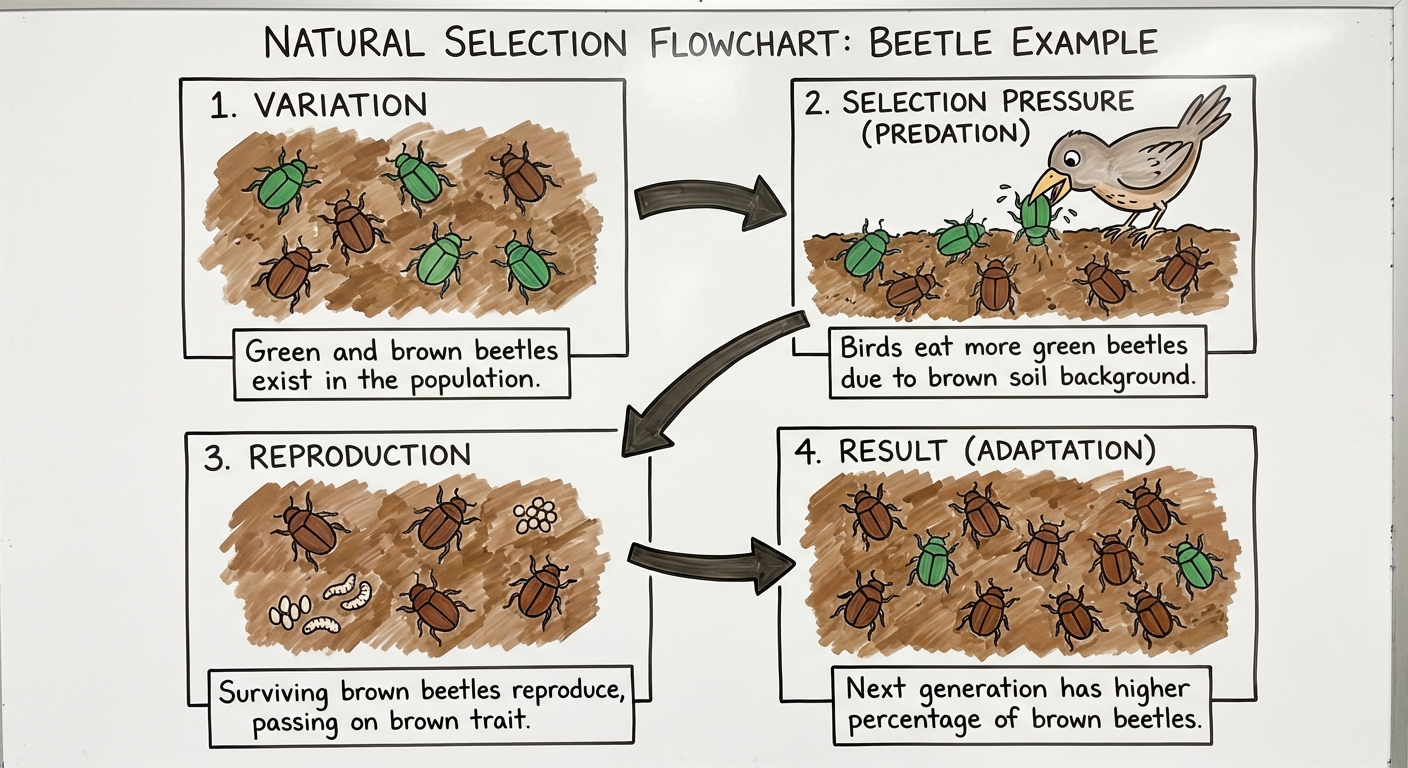
Natural selection is the process by which individuals with phenotypes better suited to their environment survive and reproduce more successfully than individuals with less suitable phenotypes. It acts on the phenotype (physical traits), not directly on the genotype, though the genotype determines the phenotype.
Major Selection Pressures
Environments are not static. The factors that influence survival are called selection pressures. These can be:
- Abiotic factors: Non-living components like temperature, water availability, sunlight, and terrain.
- Biotic factors: Living components like predators, prey, pathogens, and competitors.
The Concept of Evolutionary Fitness
In AP Biology, the term fitness does not refer to physical strength. It is strictly defined as an organism's ability to survive and reproduce in a specific environment.
- Evolutionary Fitness: Measured by the number of fertile offspring an organism contributes to the next generation.
- Differential Reproductive Success: This is the core engine of natural selection. If Organism A has a trait that allows it to leave 10 offspring, and Organism B lacks that trait and leaves only 2, the alleles of Organism A will become more frequent in the future gene pool.
Types of Selection
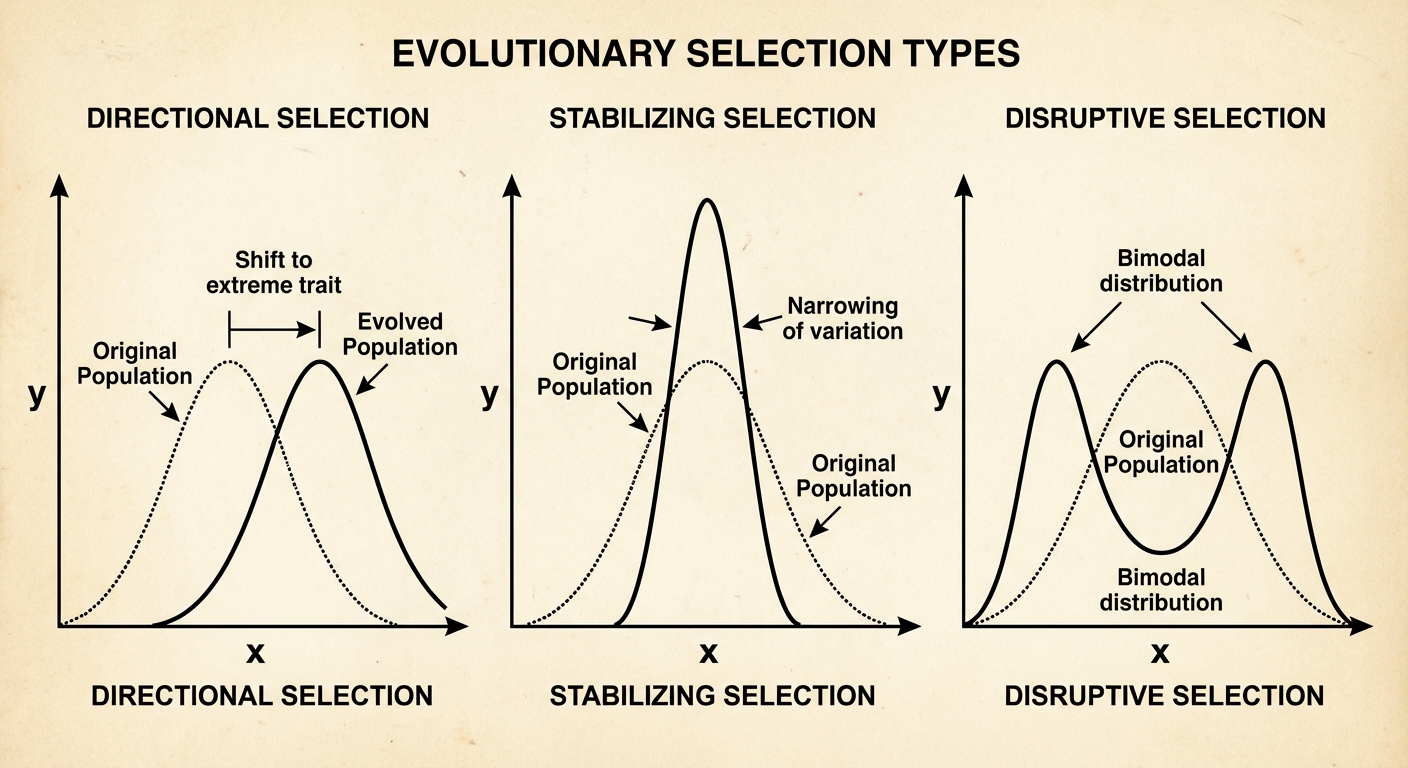
Natural selection can shift the phenotypic distribution of a population in three distinct ways:
- Directional Selection: Conditions favor individuals at one extreme of a phenotypic range.
- Example: Darker moths surviving better in soot-covered forests (Industrial Melanism).
- Disruptive (Diversifying) Selection: Conditions favor individuals at both extremes of a phenotypic range over individuals with intermediate phenotypes.
- Example: Bird beaks that are either very large (for hard seeds) or very small (for soft seeds), while medium beaks fail at both.
- Stabilizing Selection: Conditions favor intermediate variants and act against extreme phenotypes.
- Example: Human birth weights; babies that are too small or too large have higher mortality rates.
Variable Environments and Stability
The stability of a population depends on the environment:
- Stable Environments: Tend to result in little evolutionary change (often stabilizing selection).
- Fluctuating Environments: drive rapid evolution. For example, the beak depth of Galápagos finches changes noticeably between wet years (abundant soft seeds) and drought years (only hard seeds remain).
Artificial Selection
Artificial Selection occurs when humans, rather than nature, act as the selection pressure. Humans intentionally breed individuals with desired traits to modify a population over generations.
Comparison with Natural Selection
| Feature | Natural Selection | Artificial Selection |
|---|---|---|
| Driving Force | Environmental pressures (Nature) | Human preference |
| Goal | Adaptation to environment (Survival/Reproduction) | Utility or aesthetic for humans |
| Rate of Change | Generally slow (thousands/millions of years) | Can be very rapid (decades/centuries) |
| Outcome | Increased biodiversity | Often decreases genetic diversity |
Common Examples
- Domestication of Animals: Dogs evolved from wolves through humans selecting for docility and specific physical traits.
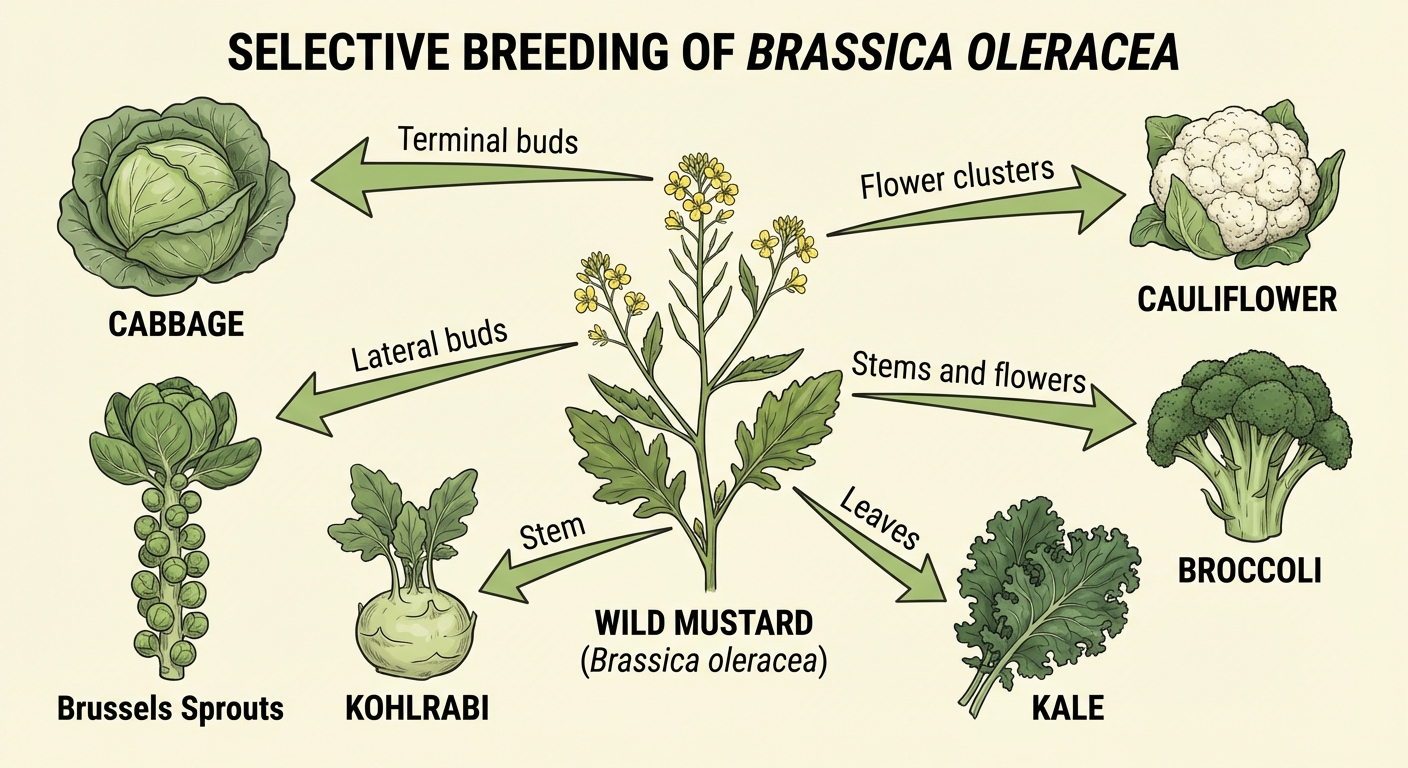
- Agriculture: The wild mustard plant (Brassica oleracea) was selectively bred to create vastly different vegetables:
- Selecting for leaves $\rightarrow$ Kale
- Selecting for flower buds $\rightarrow$ Broccoli/Cauliflower
- Selecting for lateral leaf buds $\rightarrow$ Brussels Sprouts
Unintended Consequences
Artificial selection can lead to convergent evolution, where different species develop similar traits because they are being selected for the same purpose (e.g., streamlined bodies in different aquatic animals). However, a major risk of artificial selection is the loss of genetic diversity. Monocultures (farming one crop variety) are highly susceptible to disease because the population lacks the variation required to survive a new pathogen.
Memory Aid: VISTA
To explain Natural Selection on a Free Response Question (FRQ), remember VISTA:
- Variation (There are differences in the population)
- Inheritance (Traits are passed down genetically)
- Selection (Environmental pressure favors certain traits)
- Time (Over generations…)
- Adaptation (The population becomes better suited to the environment)
Common Mistakes & Pitfalls
Lamarckian Fallacy (Crucial!):
- Mistake: Thinking that organisms "need" to evolve or develop traits during their lifetime to survive.
- Correction: Evolution has no goal. Individuals cannot change their DNA to suit the environment. They either have the favorable trait or they don't. Natural selection acts on existing variation.
Individuals vs. Populations:
- Mistake: Saying "The individual evolved."
- Correction: Individuals survive or die; populations evolve. Evolution is a change in allele frequency in a group over time.
"Survival of the Fittest":
- Mistake: Thinking "fittest" means strongest or fastest.
- Correction: Fitness is solely about reproductive success. A physically weak animal that hides well and has 20 offspring is more "fit" than a strong animal that fights well but has 0 offspring.
Adaptation vs. Acclimatization:
- Mistake: Confusing temporary physiological changes with evolutionary adaptation.
- Correction: Getting a tan in the summer is acclimatization (temporary). Being born with darker skin due to genetics is an adaptation.