Unit 7: Advanced Argumentation & Complexity
1. Defining Successful vs. Unsuccessful Arguments
In AP English Language and Composition, moving from a basic argument to a successful, sophisticated argument requires shifting from merely specificying a side to navigating the tension between differing viewpoints.
A Successful Argument is characterized by nuance. It situates a claim within a broader context, acknowledges the validity of opposing views, and uses precise language to limit the scope of the claim so it is defensible.
An Unsuccessful Argument is often characterized by absolutism. It relies on binary (black-and-white) thinking, ignores context, fails to address counterarguments, or uses sweeping generalizations that are easily disproven.
The Hierarchy of Argumentation
- Simplistic (Low Score): "X is good, Y is bad." (Binary)
- Developed (Mid Score): "X is good because of A, B, and C." (Evidence-based but one-sided)
- Sophisticated (High Score): "While Y offers valid concerns regarding economy, X remains the superior approach for societal health, particularly when implemented with specific regulations." (Nuanced, qualified, contextual)
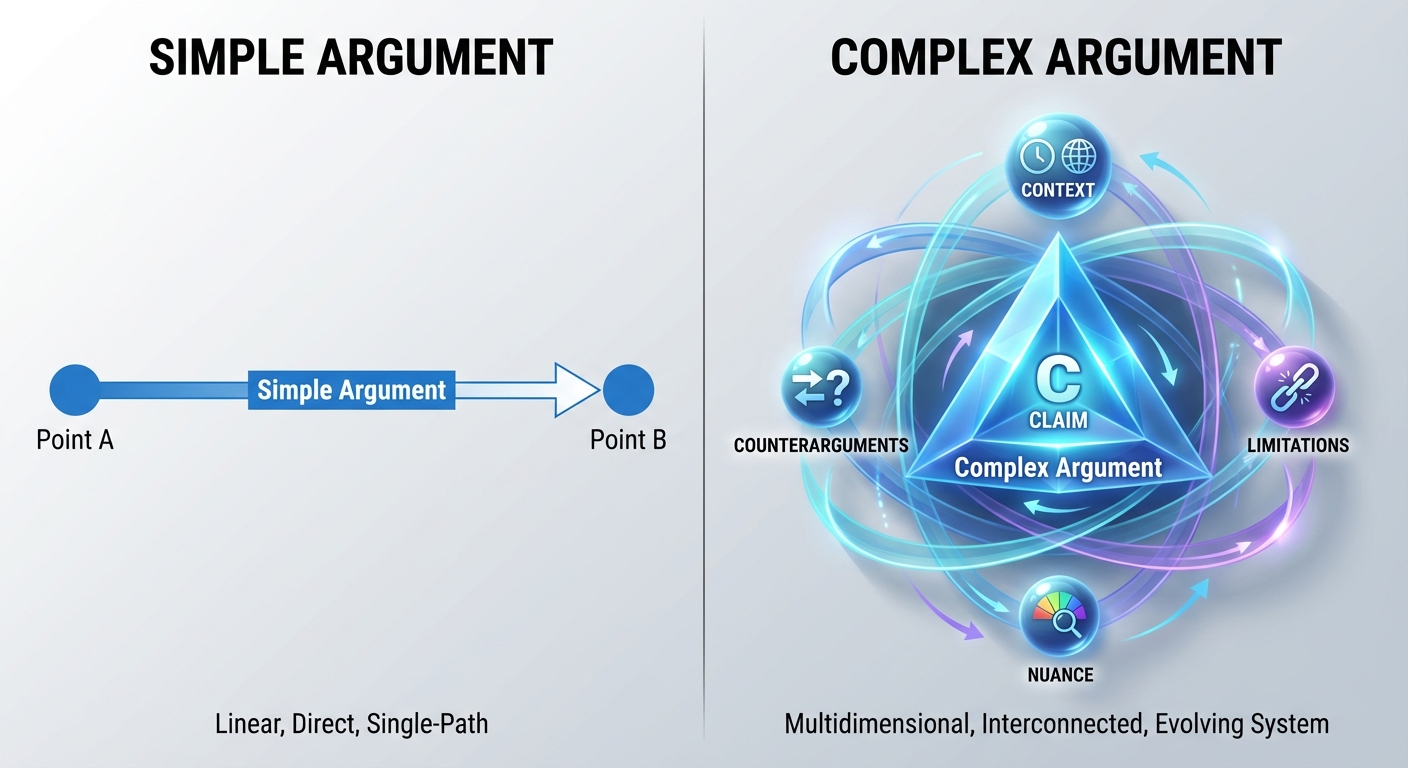
2. Examining Complexities in Issues
Complexity refers to the understanding that most rhetorical situations are not one-dimensional. To write a successful argument, you must identify the tensions or contradictions inherent in the topic.
Strategies for Finding Complexity
- The "Gray Area": Instead of looking for a correct answer, look for the conditions under which an answer is correct.
- Contextualization: How does the argument change depending on the historical, social, or economic context?
- Divergent Perspectives: Recognize that rational people can disagree on an issue for valid reasons.
Use of Generalizations vs. Context
Unsuccessful Approach (Broad Generalization):
*"Technology destroys human connection."
Successful Approach (Contextualized):
*"While social media platforms facilitate rapid information exchange, they often substitute superficial digital interactions for the deeper emotional reciprocity found in face-to-face communication."
Why the improvement?
The second example specifies which technology (social media), what kind of connection (superficial vs. deep), and how it happens.
3. Qualifying Arguments (Modifying and Limiting)
One of the most defining characteristics of a sophisticated argument is the use of qualifiers. A qualifier is a word or phrase that limits the scope of a claim to make it more precise and defensible.
The Logic of Qualification
Absolute claims are brittle; they can be shattered by a single exception. Qualified claims are flexible and robust.
Formula for Robust Claims:
| Type | Keywords (Avoid/limit) | Keywords (Use for precision) |
|---|---|---|
| Frequency | Always, Never, Every time | Often, Frequently, Rarely, Occasionally, Usually |
| Quantity | All, None, Everyone, Nobody | Many, Most, Some, A majority of, A specific demographic |
| Certainty | Definitely, Undeniably, Proven | Suggests, Indicates, Plausibly, Likely, Arguably |
Visualizing Scope
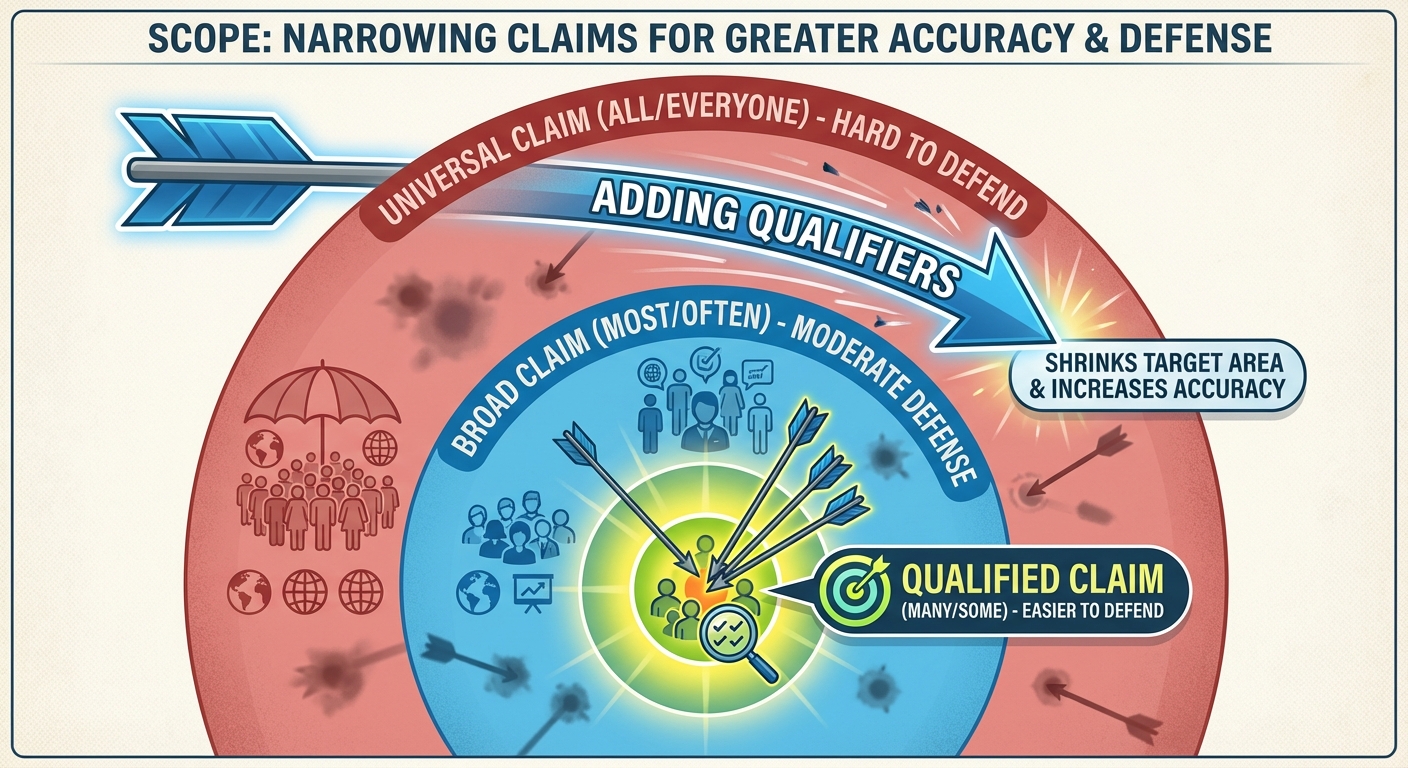
Example of Scope Reduction:
- Absolute (Weak): "Standardized tests are useless and measure nothing."
- Critique: If they measure even one thing (like memorization), the argument fails.
- Qualified (Strong): "For students with non-traditional learning styles, standardized tests often fail to strictly measure intelligence, frequently prioritizing rote memorization over critical thinking."
Common Mistakes
- The "Wishy-Washy" Error: Over-qualifying to the point where you have no opinion ("It might be possible that sometimes…"). You must still take a stance.
- The "Universal" Error: Using words like "Since the dawn of time" or "Everyone knows." These are almost always historically inaccurate.
4. Alternate Perspectives: Counterargument, Concession, Refutation
Success in Unit 7 depends on how you engage with the "conversation." You must show that you have listened to the other side before you disagree with them.
Key Concepts
- Counterargument: Introducing an opposing view. This builds Ethos (credibility) by showing you are knowledgeable and fair.
- Concession: Admitting that part of the opposing view is valid or true. This disarms the audience and makes you appear reasonable.
- Refutation (Rebuttal): Explaining why, despite the concession, your argument is still stronger or more valid in this specific context.
The "Steel Man" vs. "Straw Man"
- Straw Man Fallacy (Unsuccessful): Misrepresenting the opposing view as weak or silly so it is easy to knock down.
- Example: "Opponents of school uniforms just want kids to dress like slobs."
- Steel Man Technique (Successful): Presenting the strongest possible version of the opponent's argument before refuting it.
- Example: "Opponents argue that school uniforms suppress individual expression, a vital component of adolescent development…"
Structuring the Engagement
A common sentence frame for this is the “Yes, but” structure:
"While it is true that [Concession Point], it is important to remember that [Refutation/Re-assertion of claim]."
Worked Example:
"Admittedly, nuclear energy poses significant risks regarding waste disposal and potential containment failures. However, given the immediate and irreversible threat of carbon-based climate change, nuclear power remains the only viable zero-emission option capable of meeting current global energy demands."
5. Rhetorical Style: Sentence Development
Your syntax (sentence structure) should mirror the complexity of your thinking. Unit 7 emphasizes using grammar to establish relationships between ideas.
Subordination vs. Coordination
The way you connect clauses tells the reader which idea is more important.
Coordination (Fanboys: For, And, Nor, But, Or, Yet, So)
- Connects two equal ideas.
- Effect: Balance, equality.
- Example: "The policy is expensive, but it is necessary."
Subordination (Although, Because, Since, While, If)
- Connects an unequal idea (dependent clause) to a main idea (independent clause).
- Effect: Rank. The independent clause carries the main weight; the dependent clause provides context or concession.
- Strategy: Put the counterargument in the subordinate clause and your claim in the independent clause.
Visualizing Syntax Flow: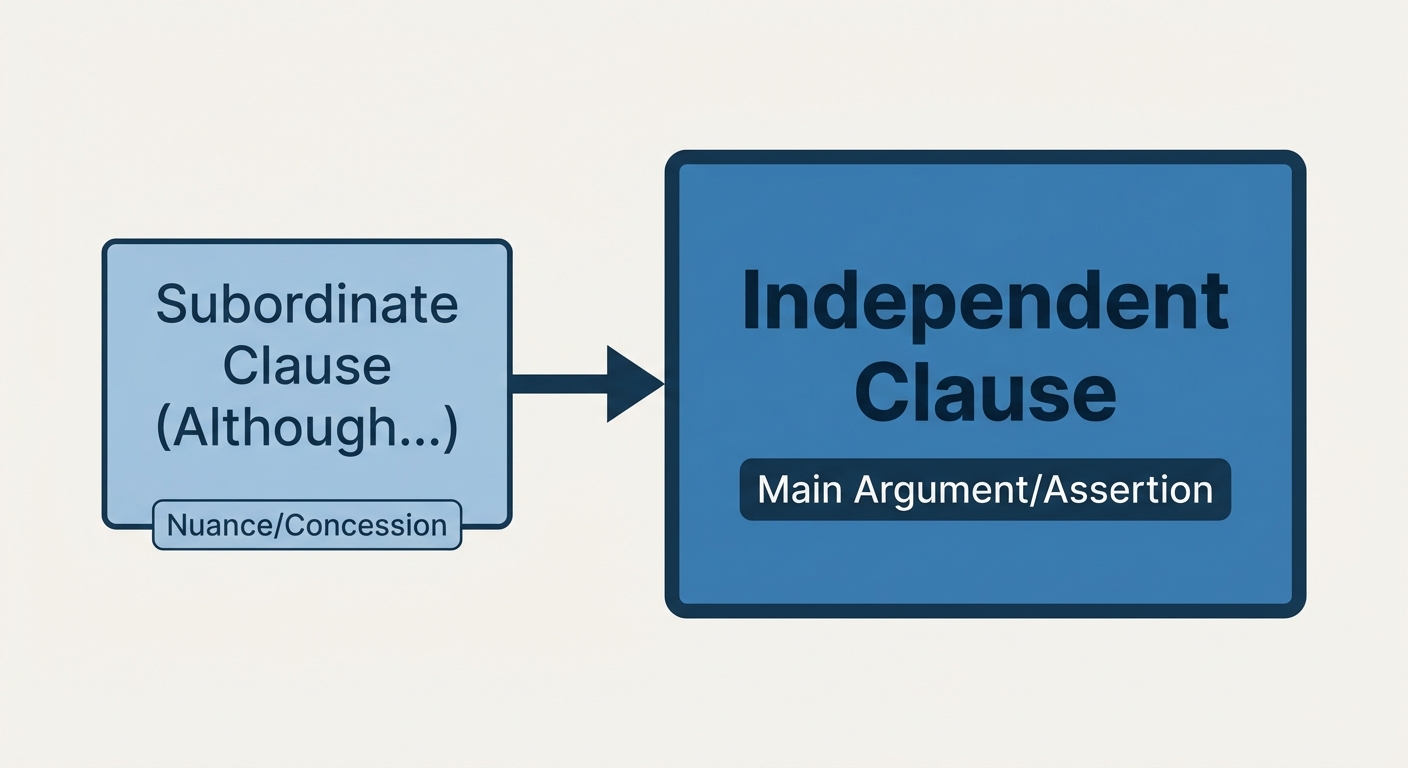
Example:
- Weak Syntax: "Some people like the book. I typically dislike it."
- Strong Syntax (Subordination): "Although the book successfully captures the dialect of the era [Subordinate/Concession], its narrative structure remains disjointed and confusing [Independent/Claim]."
Note how the grammar forces the reader to move past the praise and land on the critique.
6. Common Unsuccessful Argument Patterns (Pitfalls)
1. The "Absolute" Pitfall
- Mistake: Using "all," "always," or "never."
- Why it fails: It invites the reader to find just one exception to prove you wrong.
- Fix: Switch to "most," "frequently," or "in many cases."
2. The "Ad Hominem" Attack
- Mistake: Attacking the person making the argument rather than the argument itself.
- Why it fails: It destroys your Ethos and makes you look emotional rather than logical.
- Fix: Attack the ideas, data, or logic—never the person.
3. The "Circular Reasoning" Loop
- Mistake: Supporting a claim with the claim itself.
- Example: "Required reading is boring because the books aren't interesting."
- Fix: Provide external evidence or distinct reasons (e.g., "Required reading engages students less because the topics often feel disconnected from modern adolescent experiences.").
4. False Dilemma (Binary Thinking)
- Mistake: Presenting only two options when more exist.
- Example: "We must ban cars or destroy the planet."
- Fix: Acknowledge the spectrum of solutions (e.g., hybrid vehicles, public transit improvement, urban planning).
Summary Checklist for Unit 7
| Component | Objective |
|---|---|
| Thesis | Does it include a counterargument or nuance? Does it avoid being a simple list? |
| Evidence | Is the evidence specific? Does it support the exact claim made? |
| Commentary | Does it explain how the evidence proves the claim? |
| Nuance | Do you use qualifiers (some, many, arguably)? |
| Counterargument | Do you concede valid points before refuting? |
| Syntax | Do you use subordination to rank your ideas logically? |