Unit 9: The Rise of the New Right and the Post-Cold War Era
Period 9: 1980–Present — The Conservative Resurgence
The Reagan Revolution and Conservatism
The Conservative Resurgence refers to the political realignment in the United States starting in the late 1970s and solidifying in the 1980s. This period shifted away from the New Deal/Great Society liberalism that had dominated American politics for decades, moving toward a philosophy of limited government, deregulation, and traditional social values.
The Rise of the "New Right"
By 1980, a coalition known as the New Right had coalesced, driven by frustration with the stagflation of the 1970s, the perceived weakness of American foreign policy (e.g., the Iran Hostage Crisis), and opposition to cultural changes from the 1960s.
- The Moral Majority: Founded by Reverend Jerry Falwell, this was a political action group composed of evangelical Christians. They mobilized voters to support conservative candidates who championed "family values" and opposed abortion (Roe v. Wade), the Equal Rights Amendment (ERA), and gay rights.
- Demographic Shifts: The population shift from the Rust Belt (industrial North) to the Sun Belt (South and West) favored conservatives, as these growing regions were traditionally more hostile to high taxes and labor unions.
- Neoconservatism: A group of intellectuals (many former liberals) who turned rightward, arguing that government social programs were counterproductive and advocating for an aggressive anti-Soviet foreign policy.
The Election of 1980
The 1980 election was a landslide victory for Ronald Reagan over incumbent Jimmy Carter. Reagan asked voters, "Are you better off than you were four years ago?" The answer—due to high inflation and the hostage crisis—was a resounding "no."
- The Reagan Coalition: This election united free-market economic conservatives, social conservatives (religious right), cold war hawks, and white working-class voters (sometimes called "Reagan Democrats"), fundamentally shifting the electoral map.
Reaganomics (Supply-Side Economics)
At the core of Reagan's domestic policy was Supply-Side Economics, famously dubbed "Reaganomics."
Concept Concept: Unlike Keynesian economics (which relies on government spending to stimulate demand), supply-side theory argues that cutting taxes on the wealthy and corporations encourages investment. This investment creates jobs and increases production (supply), which eventually benefits everyone.
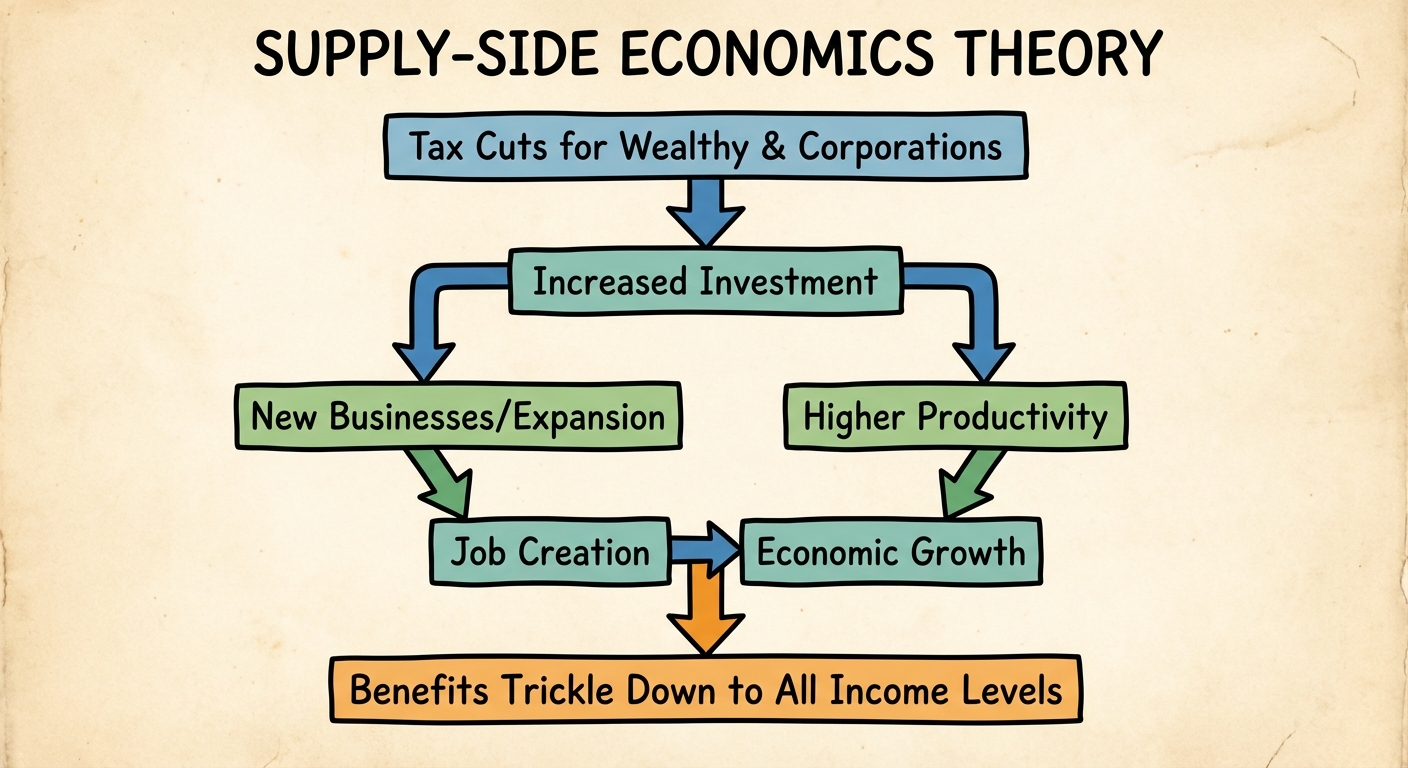
Key Pillars of Reaganomics:
- Tax Cuts: The Economic Recovery Tax Act of 1981 significantly lowered income tax rates, particularly for top earners (dropping from 70% to 50%, and eventually 28% by 1986).
- Budget Cuts: Reagan reduced funding for social welfare programs, including food stamps and urban mass transit, arguing they fostered dependency.
- Deregulation: The administration reduced federal regulations on businesses, the environment, and banking (contributing to the Savings and Loan Crisis later).
Results:
- Successes: Inflation dropped dramatically (from 13% to under 4%), and the economy entered a long period of growth by 1983.
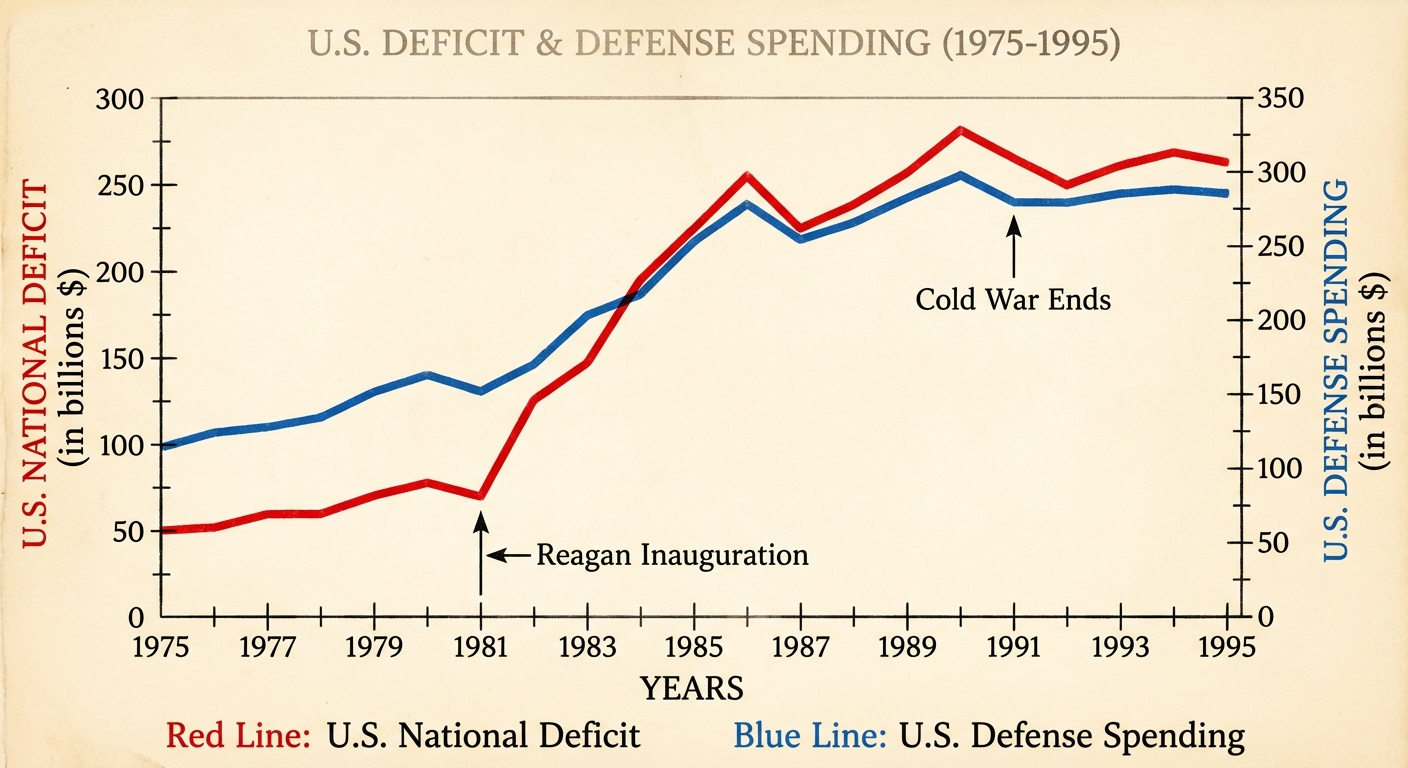
- Criticisms: The national debt tripled (from ~$900 billion to ~$2.7 trillion) due to the combination of tax cuts and massive military spending. The gap between the rich and the poor widened.
Social Issues and the Judicial Branch
Reagan sought to shape the future through the judiciary. He appointed conservative judges to federal courts, including Sandra Day O'Connor, the first woman appointed to the Supreme Court.
- Affirmative Action: The administration challenged affirmative action programs, limiting their scope in government and education.
- HIV/AIDS Crisis: The 1980s saw the outbreak of the HIV/AIDS epidemic. The Reagan administration faced heavy criticism for its slow and initially dismissive response to the crisis, which disproportionately affected gay men and drug users.
The End of the Cold War
Reagan's foreign policy rejected the Détente (easing of tensions) of the Nixon/Carter era. He believed the Soviet Union was an economic basket case that could not sustain an arms race against the U.S.
Phase 1: Confrontation and Military Buildup
In his first term, Reagan adopted aggressive rhetoric, famously labeling the Soviet Union the "Evil Empire."
- Strategic Defense Initiative (SDI): Nicknamed "Star Wars," this was a proposed missile defense system using satellites and lasers to destroy incoming nuclear missiles. While technologically impossible at the time, the threat of SDI pressured the Soviet economy, as they tried to spend enough to keep up.
- The Reagan Doctrine: The U.S. pledged to support anti-communist resistance movements ("freedom fighters") globally to roll back Soviet influence. This included aid to the Contras in Nicaragua and the Mujahideen in Afghanistan.
Phase 2: Diplomacy and Thaw
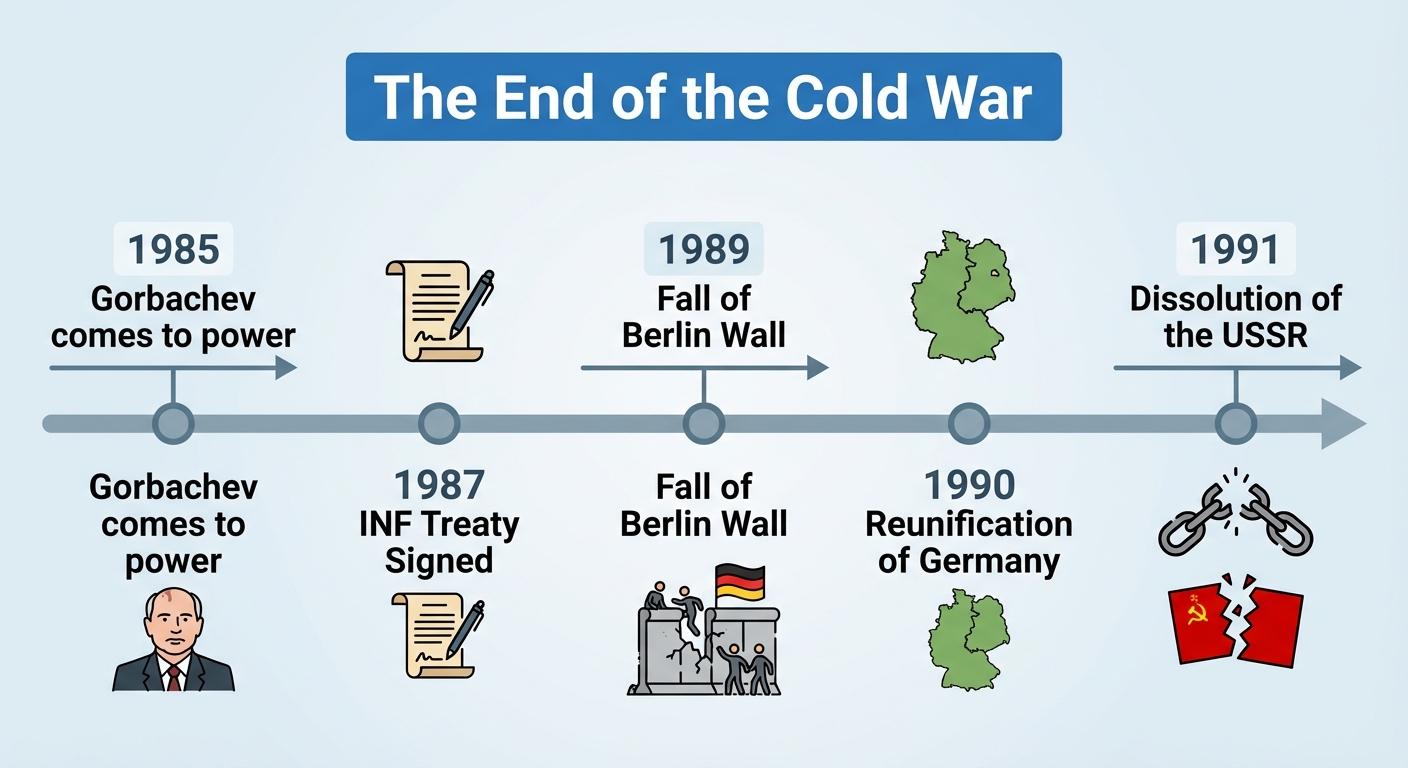
Starting in 1985, the dynamic changed with the rise of Mikhail Gorbachev as the Soviet leader. Gorbachev recognized firmly that the USSR could not survive economically without reform.
Gorbachev’s Reforms:
- Glasnost: (Openness) Increased political freedom and freedom of speech.
- Perestroika: (Restructuring) Introducing limited capitalist/free-market practices to the Soviet economy.
Reagan and Gorbachev held a series of historic summits. In 1987, they signed the Intermediate-Range Nuclear Forces (INF) Treaty, the first treaty to actually eliminate a class of nuclear weapons rather than just limiting their growth.
The Iran-Contra Affair (1985–1987)
This scandal marred Reagan's second term. Administration officials secretly sold weapons to Iran (an enemy) to secure the release of American hostages in Lebanon. They then illegally diverted the profits from these sales to fund the Contras (anti-communist rebels) in Nicaragua, despite Congress explicitly banning such aid (the Boland Amendment).
The Collapse of the Soviet Union (1989–1991)
The external pressure from the U.S. arms race, combined with the internal instability caused by Gorbachev's reforms, led to the rapid dissolution of the Soviet bloc.
- 1989: Pro-democracy movements swept Eastern Europe. The symbolic end of the Cold War occurred in November 1989 with the Fall of the Berlin Wall.
- 1991: The Soviet Union officially dissolved. The Cold War ended, leaving the United States as the world's sole superpower.
Common Mistakes & Pitfalls
- Mistaking the "New Right" for Traditional Republicans: Students often forget that the "New Right" wasn't just about economics; the inclusion of evangelical Christians (Moral Majority) marked a massive cultural shift in the party platform that persists today.
- Misunderstanding "Star Wars" (SDI): A common error is thinking SDI was actually built and functional. It was never fully developed or deployed, but its implication and the cost of trying to counter it helped bankrupt the Soviet Union.
- Ignoring the Deficit: Students often focus solely on the economic boom of the mid-80s (low inflation) but forget the massive increase in the national debt. Reagan was a fiscal conservative in theory, but in practice, he presided over record deficit spending.
- Iran-Contra vs. Watergate: Do not confuse these. Watergate (Nixon) was about political espionage and a cover-up concerning an election. Iran-Contra (Reagan) was about circumventing Congressional authority regarding foreign policy funding. Reagan avoided impeachment largely because no direct evidence proved he ordered the diversion of funds.