Unit 4 Overview: Functional Harmony and Musical Structure
Understanding Harmonic Function
In tonal music, chords are not random events; they follow a specific grammar or syntax known as Functional Harmony. This system dictates how chords progress from stability to tension and back to stability. Understanding this flow is essential for part-writing (FRQs 5 and 6) and harmonic dictation.
The Three Main Functions
Broadly speaking, every chord in a key can be categorized into one of three functional families. The standard progression of functional harmony is:
Tonic $\rightarrow$ Predominant $\rightarrow$ Dominant $\rightarrow$ Tonic
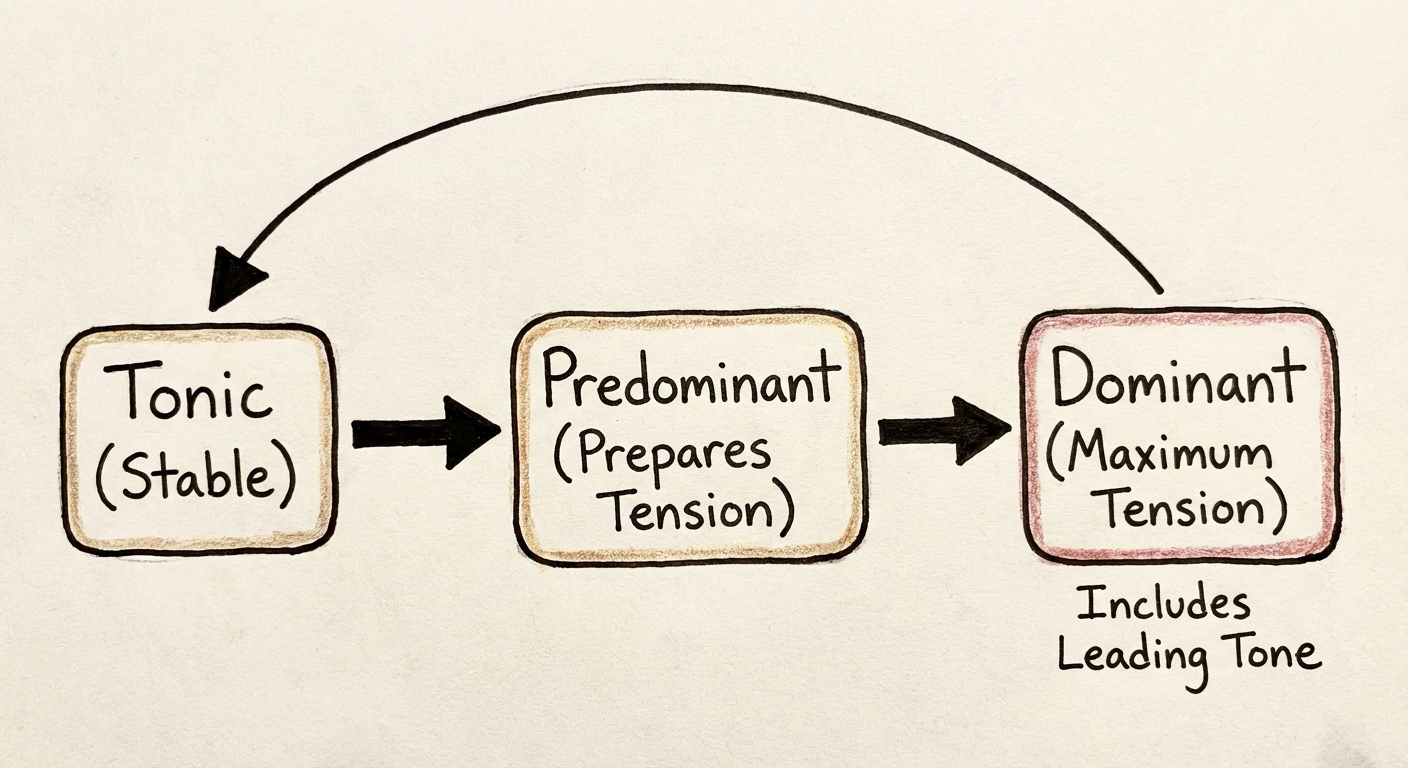
1. Part I: The Tonic Function (Stability)
- Role: The home base. It represents rest, stability, and resolution.
- Primary Chord: I (Major) or i (minor).
- Substitute: vi or VI (often used in Deceptive Cadences to prolong the phrase).
2. Part II: The Dominant Function (Tension)
- Role: The conflict or tension that demands resolution. The defining characteristic is the presence of the Leading Tone (scale degree 7), which pulls strongly upward to the Tonic (scale degree 1).
- Primary Chord: V and V$^7$ (the strongest dominant chords).
- Substitute: vii$^o$ or vii$^{o7}$ (leading-tone chords).
3. Part III: The Predominant (Subdominant) Function (Preparation)
- Role: Bridges the gap between Tonic and Dominant. It sets up the tension.
- Primary Chords: IV (iv) and ii (ii$^o$).
- Note: In AP Music Theory, the supertonic (ii) is considered a stronger predominant than the subdominant (IV) because its root movement to V is a descending 5th (strong root movement).
| Function | Major Key Chords | Minor Key Chords |
|---|---|---|
| Tonic | I, vi | i, VI |
| Predominant | IV, ii | iv, ii$^o$ |
| Dominant | V, vii$^o$ | V (must raise leading tone!), vii$^o$ |
Key Concept: You generally do not move backward from Dominant to Predominant (D $\rightarrow$ S). This is called a "retrogression" and is usually avoided in Common Practice style.
Cadences: The Punctuation of Music
A Cadence is a harmonic goal—a resting point at the end of a phrase. Think of cadences as punctuation marks (periods, commas, question marks). Identifying cadences requires looking at the last two chords of a musical phrase.
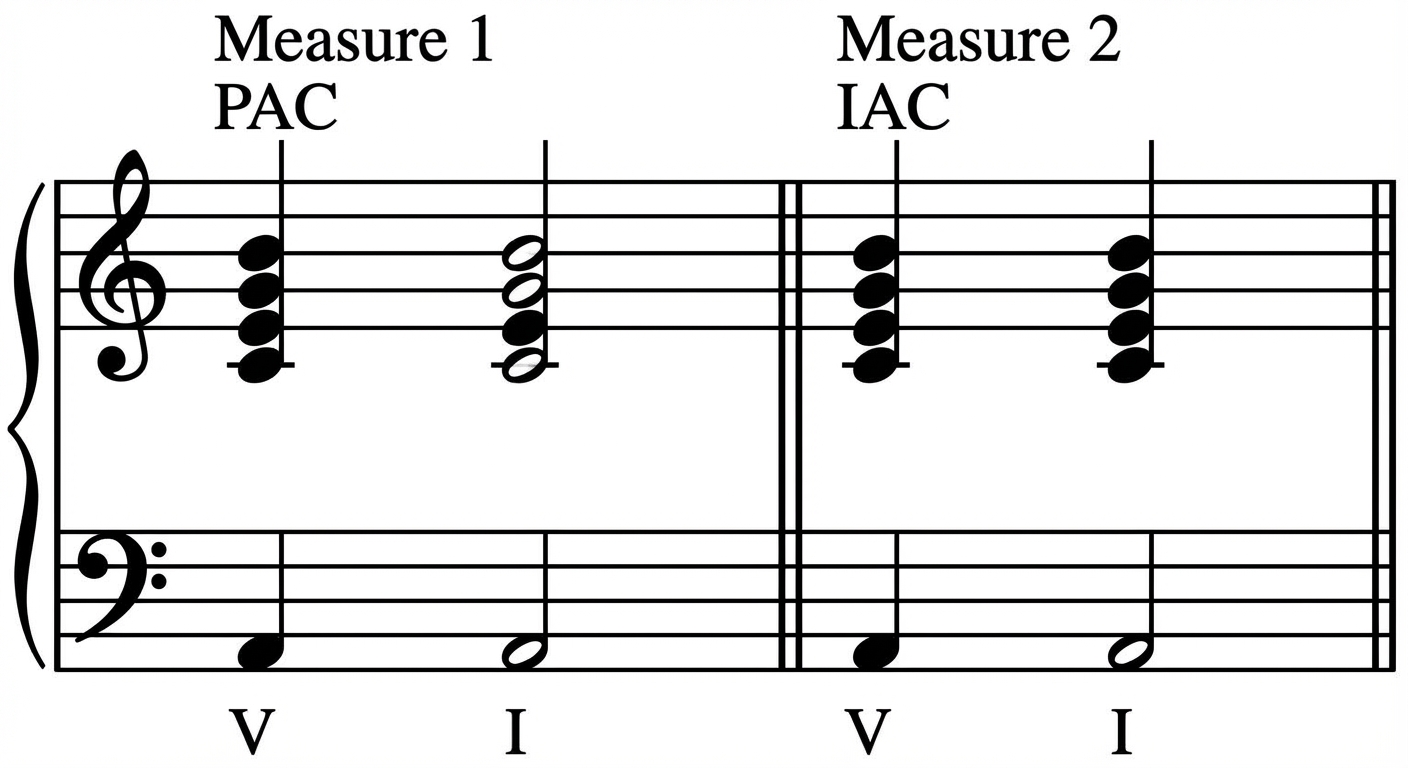
1. Authentic Cadences (V $\rightarrow$ I)
The most conclusive cadence type. It represents a full stop.
Perfect Authentic Cadence (PAC)
Ideally, this is the strongest finish in music.
- Progression: V $\rightarrow$ I (or V$^7$ $\rightarrow$ I).
- Condition A: Both chords must be in Root Position.
- Condition B: The Soprano must end on Scale Degree 1 (Do) in the final chord.
Imperfect Authentic Cadence (IAC)
Still V $\rightarrow$ I, but "weaker" because it fails one of the PAC tests.
- One or both chords are inverted.
- The Soprano ends on Scale Degree 3 (Mi) or 5 (Sol).
2. The Half Cadence (Ends on V)
This sounds like a question mark or a comma. It feels unfinished and demands a continuation.
- Progression: Anything $\rightarrow$ V.
- The most common approach is I $\rightarrow$ V or IV $\rightarrow$ V.
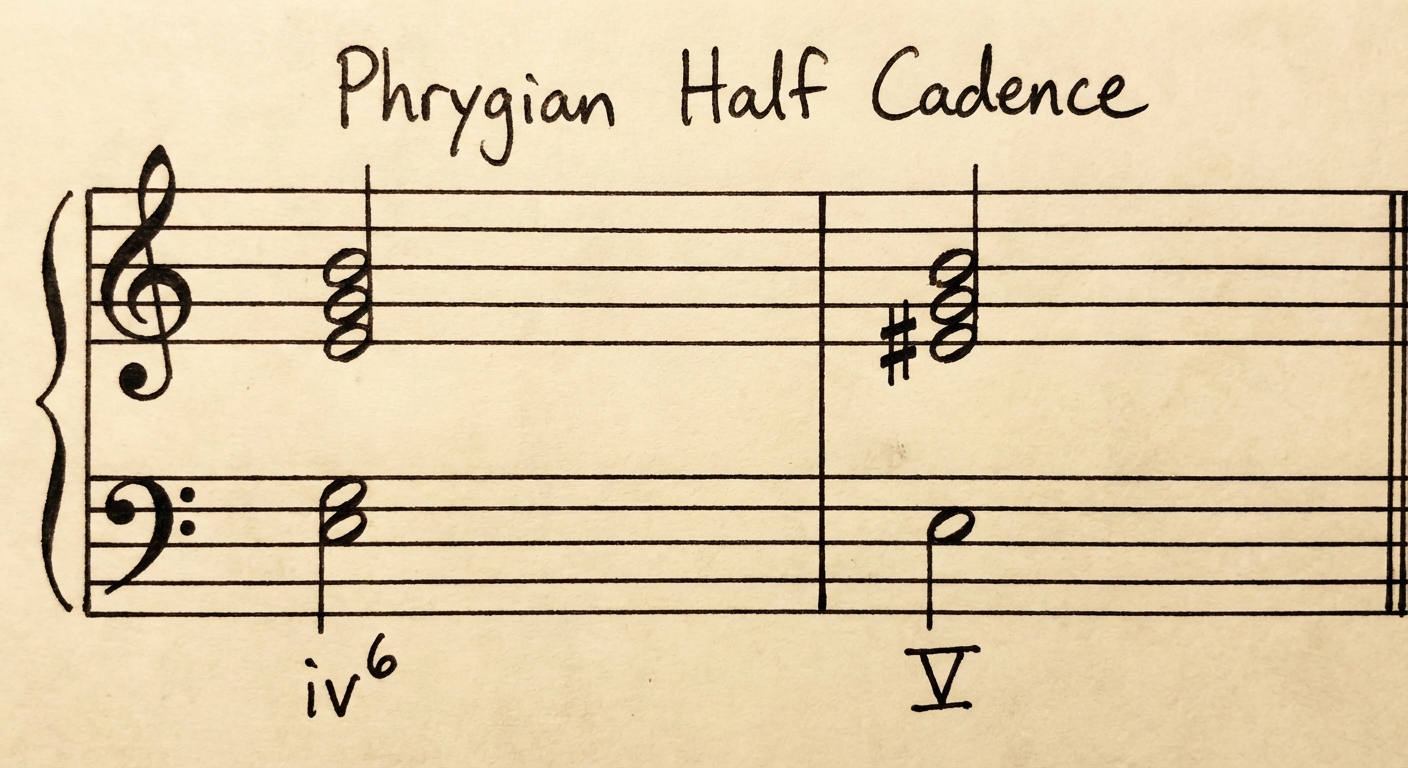
The Phrygian Half Cadence
A specific type of half cadence found only in minor keys.
- Progression: iv$^6$ $\rightarrow$ V.
- Voice Leading: The bass moves down by half-step ($Le \rightarrow Sol$) while the soprano usually moves up by whole step ($Fa \rightarrow Sol$). This contrary motion is highly characteristic.
3. The Plagal Cadence (IV $\rightarrow$ I)
Often called the "Amen" cadence. It creates a sense of "post-resolution" rather than active resolution, as it lacks the leading tone.
- Progression: IV $\rightarrow$ I (or iv $\rightarrow$ i).
4. The Deceptive Cadence (V $\rightarrow$ vi)
The "Psych Out." The ear expects the V to resolve to I, but it goes to the submediant (vi/VI) instead.
- Progression: V $\rightarrow$ vi (Major) or V $\rightarrow$ VI (minor).
- Voice Leading Rule: In a V $\rightarrow$ vi progression, the leading tone in the soprano MUST resolve up to tonic to avoid augmented intervals.
Phrase Structure and Period Form
A Phrase is a substantial musical thought that ends with a cadence. Generally, phrases are 4 measures long, though they can vary.
The Period
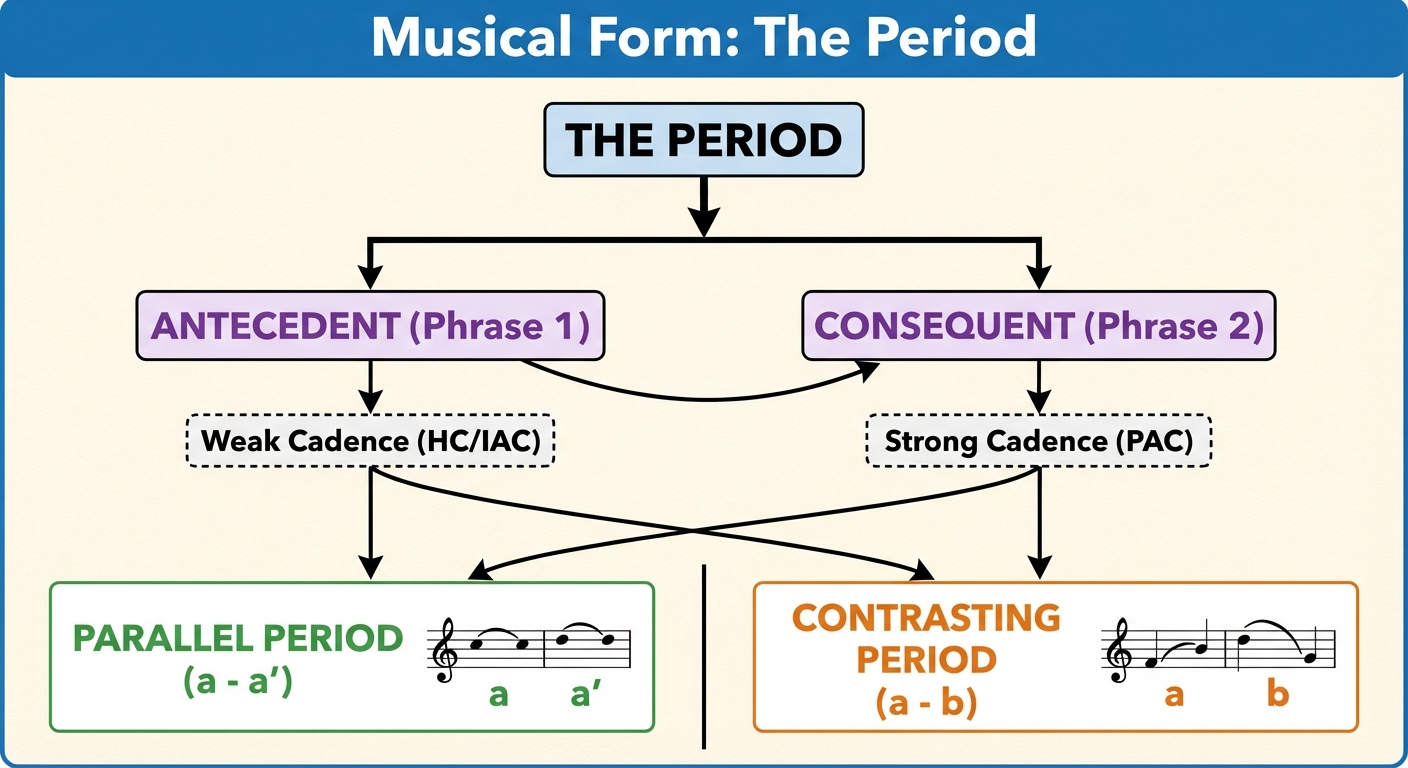
A Period is a pair of phrases that work together in an "Antecedent-Consequent" (Question-Answer) relationship.
- Phrase 1 (Antecedent): Ends with a weak cadence (usually a Half Cadence or IAC).
- Phrase 2 (Consequent): Ends with a strong cadence (usually a PAC) that feels more final than the first.
Types of Periods
To identify the type of period, compare the melodic material at the beginning of both phrases.
1. Parallel Period ($a$ … $a'$)
- The second phrase begins with the same melody as the first phrase (or very similar).
- Example: Phrase 1 starts with a specific motif; Phrase 2 starts with that same motif but alters the ending to achieve a stronger cadence.
2. Contrasting Period ($a$ … $b$)
- The second phrase begins with different melodic material than the first.
- Despite the difference in melody, they still function as a pair because of the weak-strong cadence relationship.
Memory Aid: The Cadence Checklist
When analyzing a cadence, ask these questions in order:
- Does it end on V? $\rightarrow$ Half Cadence (Check Bass: is it $iv^6$ to $V$ in minor? Then Phrygian).
- Does it end on vi? $\rightarrow$ Check previous chord. If V $\rightarrow$ vi, it's Deceptive.
- Does it end on I? $\rightarrow$ Check previous chord.
- If IV $\rightarrow$ I: Plagal.
- If V $\rightarrow$ I: Authentic.
- Drill Down: Is the soprano on Do? Roots in bass? Yes = PAC. No = IAC.
Common Mistakes & Pitfalls
Confusing the Phrygian Half Cadence:
- Mistake: Calling any minor key cadence ending on V "Phrygian."
- Correction: It implies a specific bass motion: iv$^6$ to V. If the bass doesn't move scale degree $6 \rightarrow 5$, it is just a standard Half Cadence.
Misidentifying PACs:
- Mistake: Seeing a V going to I and automatically labeling it a PAC.
- Correction: Always check the Soprano voice. If the soprano ends on the 3rd or 5th of the chord, it is an IAC, even if it sounds strong.
The "vii°" Trap:
- Mistake: Thinking a cadence must use V.
- Correction: vii$^o$ $\rightarrow$ I is also considered an Authentic cadence (usually IAC) because it has Dominant function resolving to Tonic, though V $\rightarrow$ I is standard.
Period Identification:
- Mistake: Identifying a "Period" just because there are two phrases.
- Correction: A Period strictly requires the weak-to-strong cadence relationship. If Phrase 1 ends in a PAC and Phrase 2 ends in a PAC, that is a "Phrase Group," not a Period, because there is no sense of unresolved tension leading to resolution.