Unit 8 Reference: Interactions, Diversity, and Change
Community Ecology
Community Ecology studies how populations of different species interact with one another within a specific area. Unlike population ecology, which focuses on the dynamics of a single species, community ecology looks at the complex web of relationships—who eats whom, who competes for space, and who helps whom survive.
Interspecific Interactions
The driving force of community structure is interspecific interaction—relationships between individuals of different species. These are categorized by how they affect the survival and reproduction of the participants.
| Interaction Type | Effect on Species A | Effect on Species B | Description |
|---|---|---|---|
| Competition | $-$ | $-$ | Both species are harmed as they fight for limited resources (space, sunlight, food). |
| Predation | $+$ | $-$ | One species (predator) kills and eats the other (prey). |
| Herbivory | $+$ | $-$ | A consumer eats a plant or alga. The plant usually survives but is harmed. |
| Parasitism | $+$ | $-$ | The parasite derives nourishment from the host, which is harmed but usually not killed immediately. |
| Mutualism | $+$ | $+$ | Both species benefit (e.g., bees and flowers, nitrogen-fixing bacteria and legumes). |
| Commensalism | $+$ | $0$ | One benefits, the other is unaffected (e.g., barnacles on a whale). |
Competition and Niches
When two species compete for the exact same limiting resource, they cannot coexist permanently. This is the Competitive Exclusion Principle. One will eventually outcompete and eliminate the other.
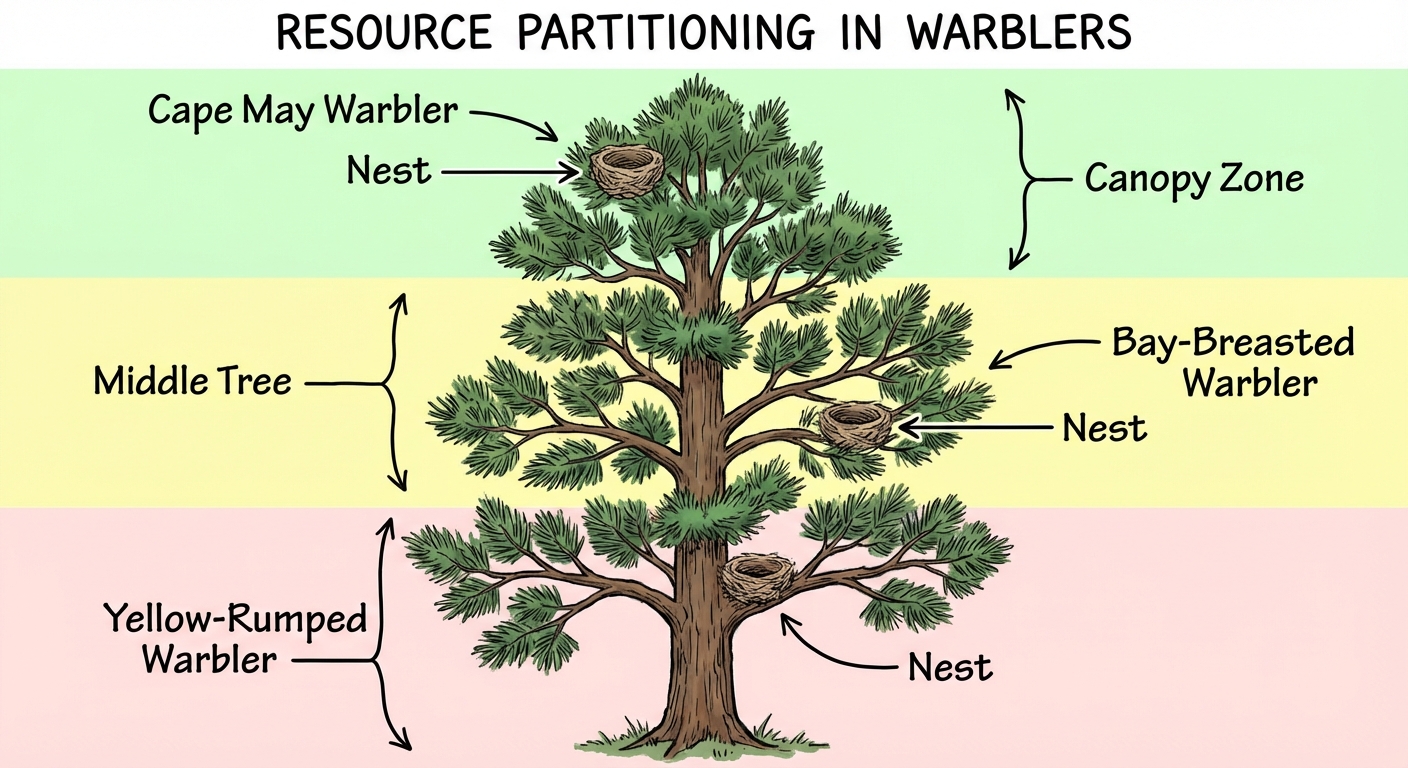
To avoid this, nature employs Resource Partitioning—the differentiation of ecological niches enabling similar species to coexist in a community.
- Ecological Niche: The sum of a species' use of the biotic and abiotic resources in its environment (its "job" or "role").
Fundamental vs. Realized Niche
- Fundamental Niche: The potential niche occupied by a species if there were no competition.
- Realized Niche: The portion of the fundamental niche the species actually occupies because of competition.
Predator-Prey Dynamics
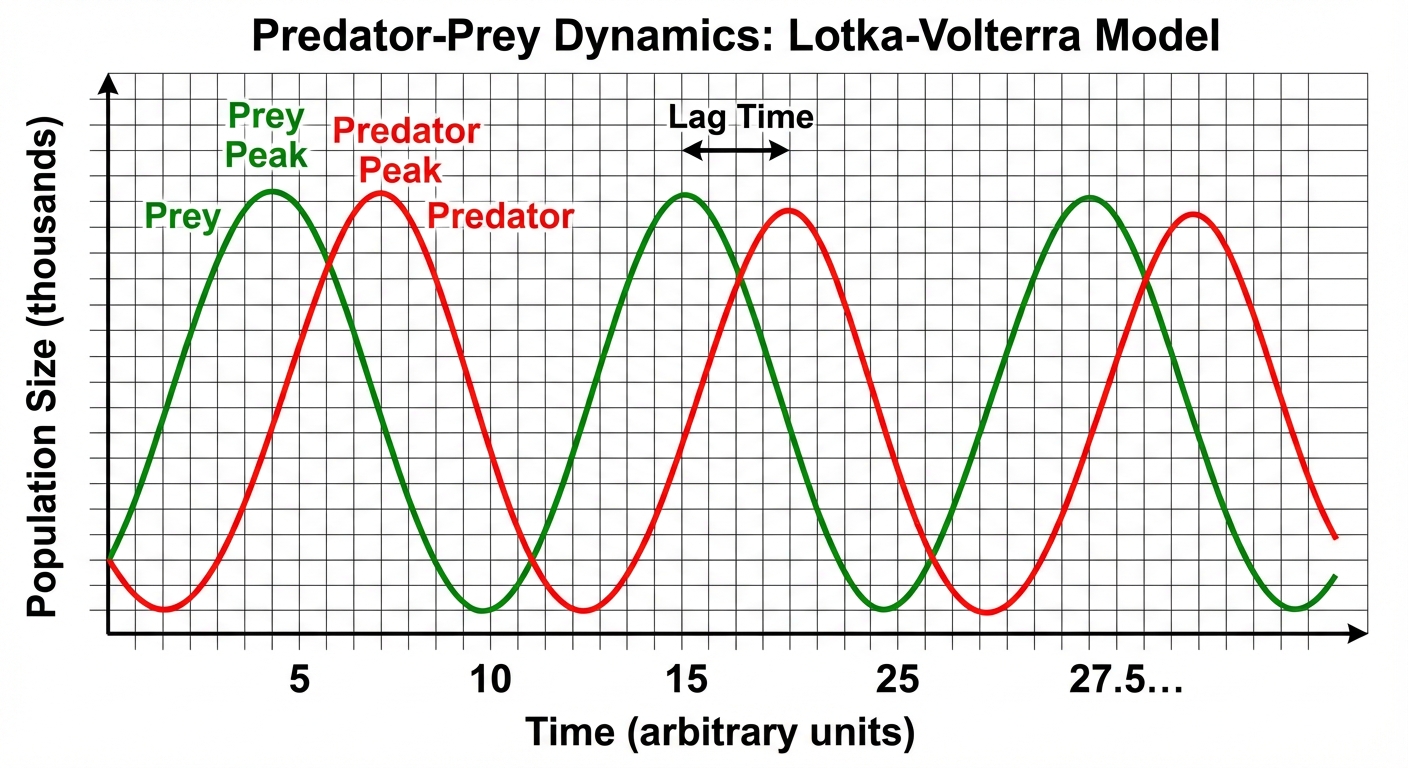
Populations of predators and prey often exhibit cyclic oscillations. As the prey population increases, the predator population increases shortly after (due to more food). As predators increase, they over-consume prey, causing prey numbers to crash, which subsequently causes predator numbers to crash.
Biodiversity
Biodiversity is not just the number of distinct species; it is a measure of the variety of life at the genetic, species, and ecosystem levels. Higher biodiversity generally correlates with higher ecosystem stability and resilience to change.
Components of Diversity
- Species Richness: The total number of different species in a community.
- Species Evenness: The relative abundance of each species (how effectively "even" the numbers are).
If Community A has 50 oak trees and 2 pine trees, and Community B has 26 oak trees and 26 pine trees, Community B is considered more diverse due to higher evenness, even though richness (2 species) is the same.
Simpson's Diversity Index
On the AP exam, you may need to calculate biodiversity to compare communities. The formula for Simpson's Diversity Index ($D$) is:
Where:
- $n$ = the total number of organisms of a particular species
- $N$ = the total number of organisms of all species
Interpretation: The value ranges between 0 and 1. The closer the value is to 1, the higher the biodiversity.
Worked Example
A community has 3 species with the following counts: A=4, B=5, C=1.
- Total ($N$) = 10
- Calculate $(\frac{n}{N})^2$ for each:
- Species A: $(4/10)^2 = 0.16$
- Species B: $(5/10)^2 = 0.25$
- Species C: $(1/10)^2 = 0.01$
- Sum them: $0.16 + 0.25 + 0.01 = 0.42$
- Calculate $1 - Sum$:
Disruptions to Ecosystems
Ecosystems are dynamic. Disruptions can be caused by natural events (volcanoes, storms) or human activity (logging, pollution). The impact of these disruptions often depends on specific species that hold the web of life together.
Keystone Species
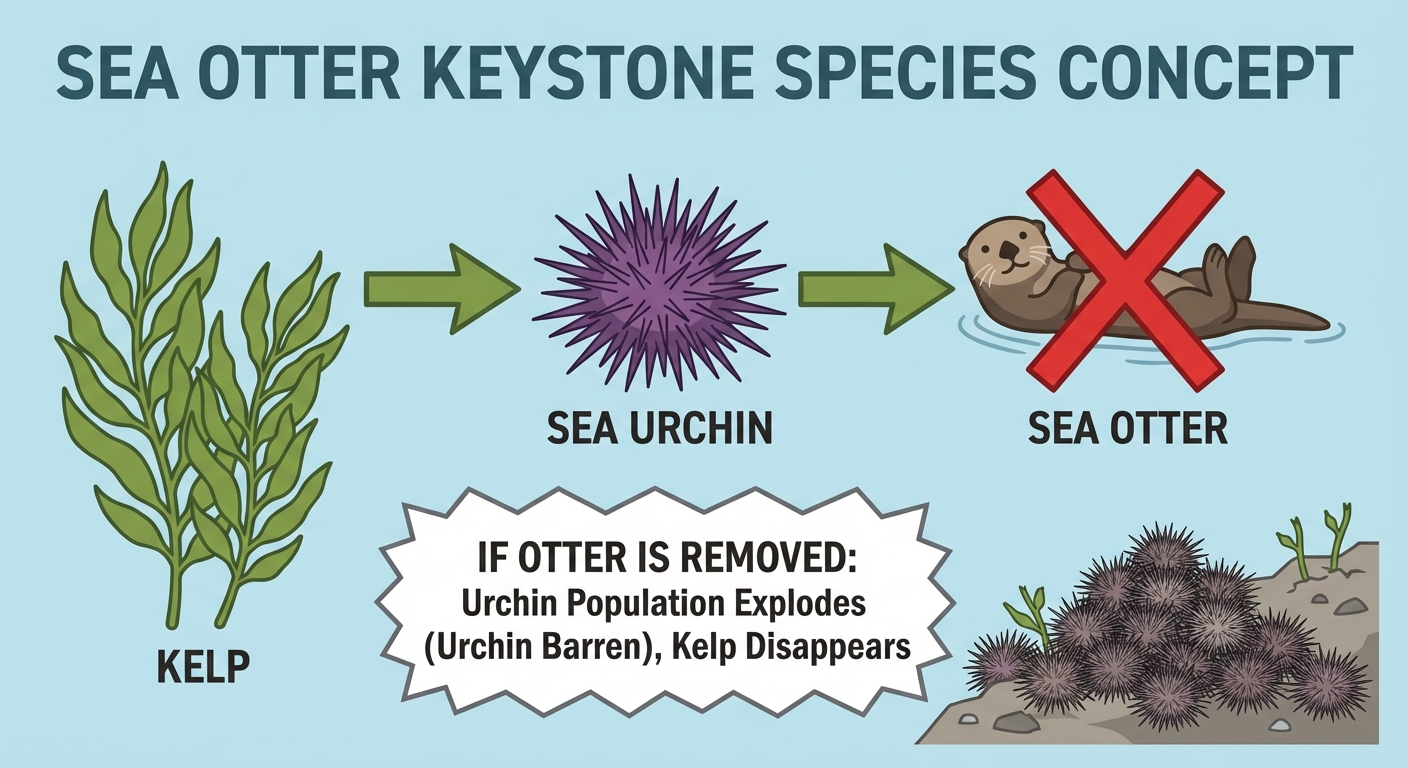
A Keystone Species is a species that has a disproportionately large effect on its environment relative to its abundance. They are not necessarily the most abundant species (which are called Dominant Species).
- The Arch Analogy: In a stone arch, the keystone is the center stone. If you remove it, the whole arch collapses.
- Example: The Sea Otter. Sea otters eat sea urchins. Sea urchins eat kelp. If you remove the otters, urchins reproduce unchecked and destroy the kelp forests (the habitat for fish). The ecosystem collapses.
Invasive Species
Invasive species are non-native species introduced to a new environment that spread widely and cause harm.
Why are they successful?
- They often lack natural predators, parasites, or pathogens in the new environment.
- They are typically r-selected species (fast reproduction, high number of offspring, generalist niche).
- They outcompete native species for resources.
Ecological Succession
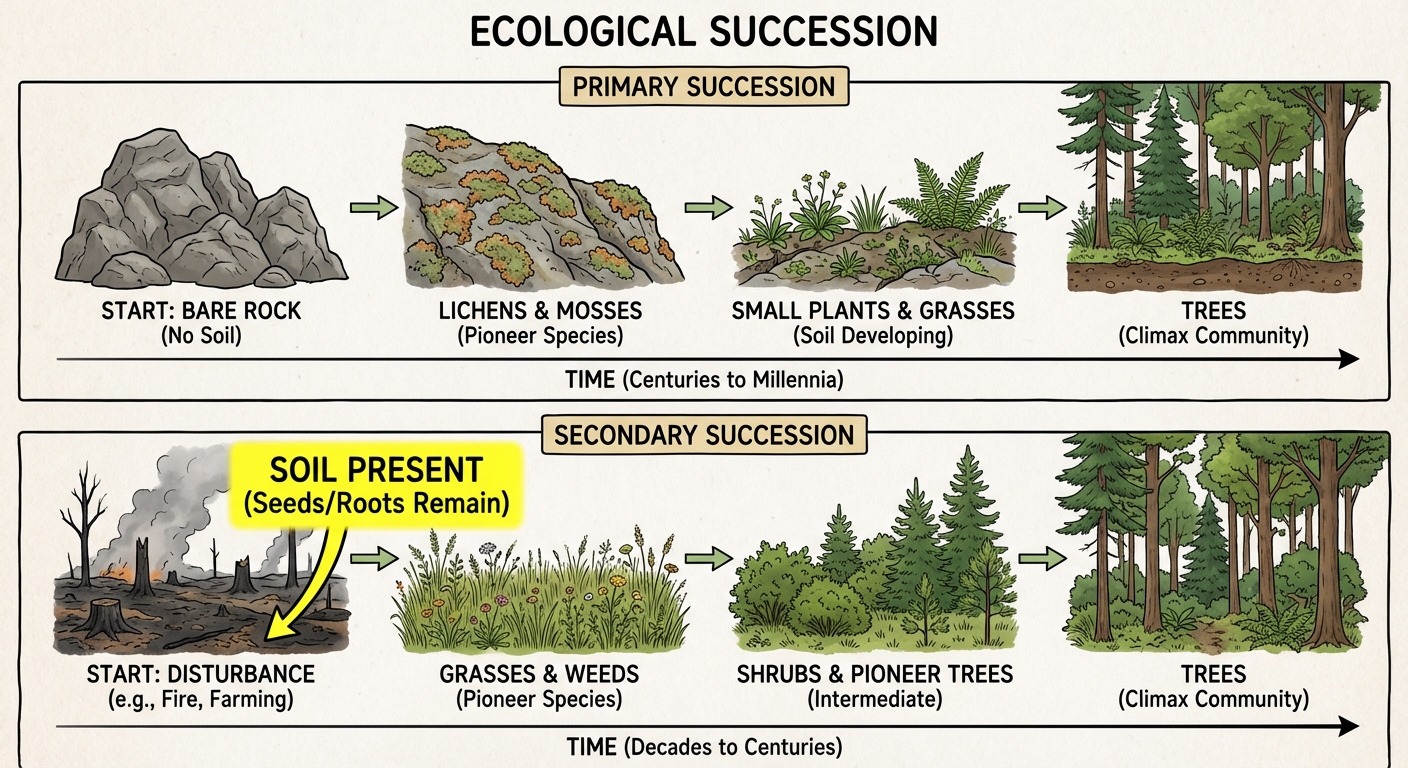
Succession is the sequence of community and ecosystem changes after a disturbance.
1. Primary Succession
Occurs in a virtually lifeless area where soil has not yet formed.
- Starting Point: Bare rock, volcanic lava, retreating glacier.
- Pioneer Species: Lichens and mosses (they break down rock to create soil).
- Process: Rock $\rightarrow$ Lichen $\rightarrow$ Soil $\rightarrow$ Grasses $\rightarrow$ Shrubs $\rightarrow$ Trees.
- Time: Centuries.
2. Secondary Succession
Occurs where an existing community has been cleared by a disturbance, but the soil is left intact.
- Starting Point: Forest fire, storm, abandoned farm.
- Process: Grasses/Weeds grow first (seeds are already in the soil).
- Time: Decades (much faster than primary).
Common Mistakes & Pitfalls
- Keystone vs. Dominant: Students often assume the most numerous species (like a specific tree) is the keystone. This is incorrect. The dominant species has the most biomass; the keystone species exerts strong control over community structure (often a predator or ecosystem engineer like a beaver).
- Unit confusion in Simpson's Index: Remember that the variable $n$ is the count for one species, and $N$ is the total count. Don't flip them. Also, don't forget the "1 minus" step at the end!
- Realized vs. Fundamental Niche: A realized niche is never larger than the fundamental niche. It is always equal to or smaller due to limiting factors like competition.
- Invasive Species Characteristics: Not all introduced species become invasive. Only those that outcompete natives and lack checks (predators) become invasive.
- Succession Soil: The critical difference between primary and secondary succession is the presence of soil. If soil exists: Secondary. If bare rock: Primary.