Unit 4: The 19th Century — Romanticism, Realism, and Naturalism
Unit 4: La literatura romántica, realista y naturalista
1. Contexto Histórico y Cultural (19th Century Spain)
To understand the literature of Unit 4, you must understand the turbulence of 19th-century Spain. The century was defined by a violent struggle between tradition (monarchy, Catholicism) and modernity (liberalism, science).
- The War of Independence (1808–1814): Spain fought against Napoleon's invasion. This sparked a rise in nationalism.
- Loss of Colonies: Throughout the century, Spain lost most of its empire, culminating in the Disaster of 1898 (though Unit 4 leads up to this, the mood of decline is pervasive).
- Political Instability: Developing tensions between liberals and conservatives led to the Carlist Wars.
- Industrialization: Arrived late to Spain compared to England or France, creating a sharp divide between the urban bourgeoisie and the rural poor.
The Shift in Thought
Literature swung like a pendulum during this century:
- Early 19th C (Romanticism): A reaction against the logic of the Enlightenment. It valued emotion, freedom, and the individual.
- Mid-to-Late 19th C (Realism): A reaction against Romanticism. It valued observation, logic, and the middle class.
- Late 19th C (Naturalism): An extreme evolution of Realism, influenced by Darwinian science and determinism.
2. El Romanticismo (Romanticism)
Definition: An artistic movement that prioritized the individual, freedom (political and artistic), and extreme emotion over reason.
Key Characteristics
- Subjetivismo (Subjectivity): The "Yo" (I) is the center of the universe. Reality is filtered through the poet's feelings.
- La Falacia Patética (Pathetic Fallacy): Nature reflects the poet's emotions. If the poet is sad, it rains; if the poet is angry, there is a storm.
- Evasión: Literature is an escape from a harsh reality, often to exotic lands or the medieval past.
- Lo Sublime: A feeling of awe mixed with terror when facing the overwhelming power of nature (e.g., storms, violent seas).

Required Work: En una tempestad
- Author: José María Heredia (Cuban).
- Movement: Neoclassicism transitioning into Romanticism.
Analysis
This poem is a prime example of Lo Sublime. The speaker witnesses a violent hurricane but, instead of hiding, he embraces it as a manifestation of God and freedom.
- Form: Silva. A non-strophic combination of heptasílabos (7 syllables) and endecasílabos (11 syllables) with irregular rhyme. This represents the chaos and freedom of the storm.
- Themes:
- El tiempo y el espacio (Nature's dominance over human space).
- La trayectoria y la transformación (The religious epiphany).
Key Literary Devices
- Apóstrofe: The speaker speaks directly to the hurricane ("Huracán, huracán, venir te siento").
- Metonimia: References "el manto" (the cloak) to represent the clouds/sky.
- Prosopopeya (Personification): The storm causes the earth to tremble and embrace the sky.
- Asíndeton: Omission of conjunctions to speed up the rhythm ("Lluvia, vientos, relámpagos, truenos").
- Metaphor (The Bull): Heredia compares the storm holding its breath to a bull ready to charge ("Cual toro…").
Exam Tip: Heredia is a Cuban poet writing while in exile. The storm often symbolizes the coming revolution for independence from Spain.
Required Work: Rima LIII ("Volverán las oscuras golondrinas")
- Author: Gustavo Adolfo Bécquer.
- Movement: Post-Romanticism (often called Intimismo).
Analysis
Bécquer represents a quieter, more lyrical Romanticism. This poem addresses a former lover, contrasting the cyclical nature of time (seasons return) with the linear nature of human experience (that specific love will never return).
- Form: Silva arromanzada. Alternating 11 and 7 syllable lines. Assonant rhyme in even lines ($a-a-a$).
- Themes:
- El amor y el desprecio.
- El tiempo y el espacio (The inevitability of time passing).
Key Literary Devices
- Anáfora: The repetition of "Volverán" at the start of multiple stanzas.
- Hipérbaton: Inverting syntax for emphasis ("Las oscuras golondrinas… volverán" instead of standard order).
- Pie Quebrado: The alternating long and short lines create a broken rhythm, symbolizing a broken heart.
- Paralelismo: The structure of the stanzas mirrors each other: Nature returns (birds/flowers) $\rightarrow$ BUT specific ones don't $\rightarrow$ Love might return $\rightarrow$ BUT not like ours.
3. Realismo y Naturalismo
While Romanticism looked inward (feelings), Realism looks outward (society). It tries to be a mirror walking along a road.
Realism (Realismo)
- Objetividad: The narrator acts like a reporter, often using an omniscient perspective.
- Verosimilitud: Plot and characters must be believable and grounded in everyday reality.
- Costumbrismo: intense focus on regional customs, dialects, and daily habits.
- Middle Class Focus: Often critiques the bourgeoisie.
Naturalism (Naturalismo)
Naturalism is Realism with a scientific hypothesis added. It was heavily influenced by Émile Zola.
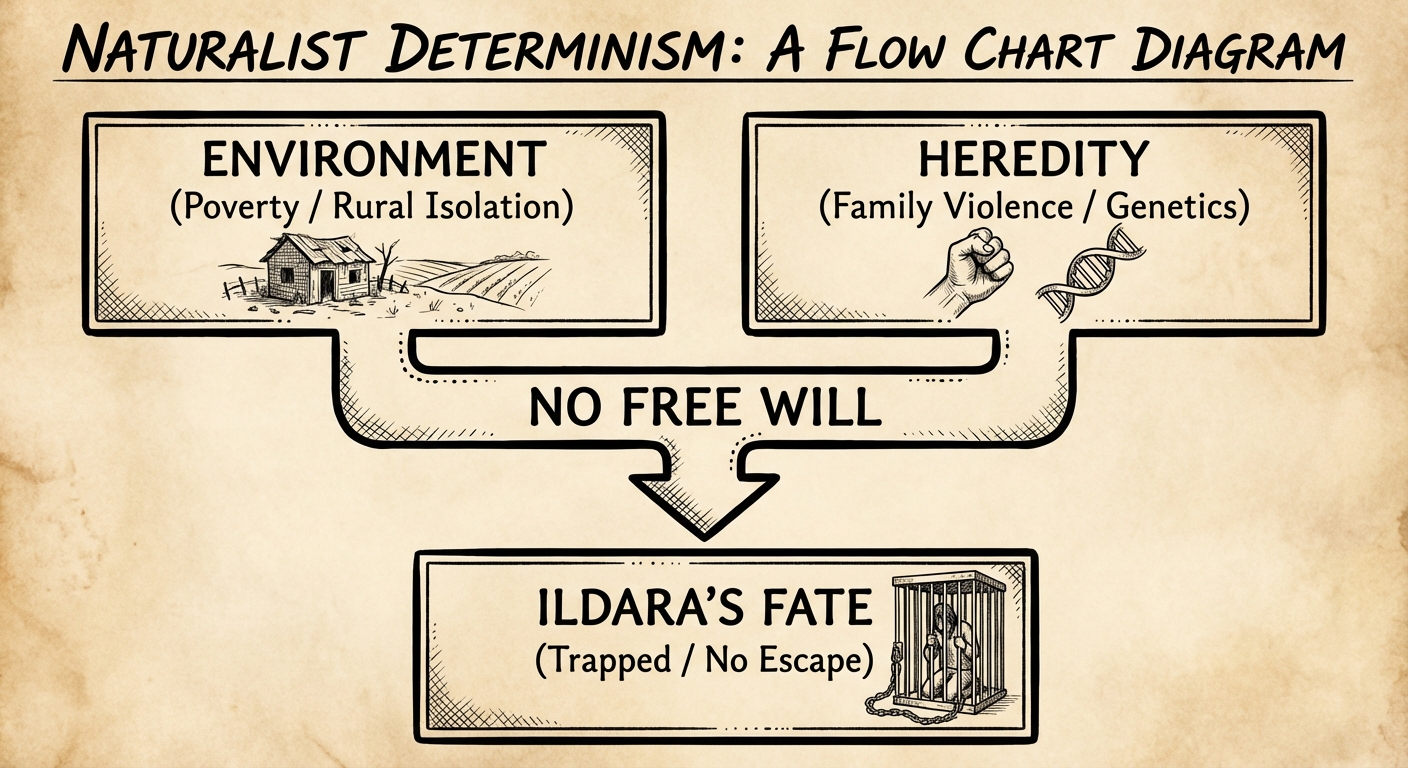
- Determinism (Determinismo): The defining concept. Human beings have no free will. Their fate is determined by two forces:
- Medio ambiente (Environment/Poverty).
- Herencia (Genetics/Heredity).
- Focus: The lower classes, the ugly, the morbid, and the violent side of life.
Required Work: Las medias rojas
- Author: Emilia Pardo Bazán (introduced Naturalism to Spain).
- Movement: Naturalism.
Analysis
The story is a tragedy about Ildara, a young girl in poor, rural Galicia who plans to emigrate to the "New World" (Americas) to escape poverty. She buys red stockings (a symbol of hope/feminity) with money she earned, not knowing her father, Tío Clodio, would react violently.
- Themes:
- La construcción del género (Patriarchy and violence against women).
- Las sociedades en contacto (The dream of emigration).
Key Literary Devices
- Cromatismo (Symbolism of Color):
- Grey/Black: The atmosphere of the house, the smoke, the poverty.
- Red (Las medias): Passion, hope, rebellion, but also blood and violence.
- Dialect/Regionalism: The characters speak with Galician syntax/vocabulary (e.g., "mociña"), adding realism.
- Media Res: The story begins in the middle of an action (loading wood).
- Implicit Social Critique: The narrator does not explicitly judge Clodio, but by presenting the brutality objectively ("detached observer"), the reader is horrified.
The Deterministic Ending
Ildara is beaten so badly she loses a tooth and becomes partially blind. She can no longer emigrate because the ship only accepts "healthy" laborers. Her environment (poverty) and heritage (her abusive father) have determined her fate: she will never leave.
4. Literary Comparison: The Three Movements
| Feature | Romanticism (Heredia/Bécquer) | Realism | Naturalism (Pardo Bazán) |
|---|---|---|---|
| Philosophy | Idealism, Individualism, Emotion | Positivism, Rationalism | Determinism, Darwinism |
| Focus | The "Self" (Yo), Nature, Exoticism | Society, Daily Life, Middle Class | The marginalized, biological instincts |
| Tone | Melancholic, Passionate, Dramatic | Objective, Critical, Observational | Pessimistic, detached, "Scientific" |
| Nature | Reflection of emotions (Pathetic Fallacy) | A setting (Backdrop) | A hostile force or resource trap |
| Free Will | Absolute champion of Liberty | Constraint by social norms | Non-existent; controlled by environment |
5. Course Themes & Connections
Las Sociedades en Contacto
- Realism/Naturalism: Seen in Las medias rojas via the theme of migration. The decay of rural Spain pushes people to seek life in the Americas. Also touches on class disparity.
La Creación Literaria
- Romanticism: In Rima LIII, Bécquer explores the limitations of language. Specifically, he differentiates between the repetition of nature and the singularity of the poet's experience.
El Tiempo y el Espacio
- Heredia: The storm transforms the space into a divine altar.
- Bécquer: Time is cyclical (seasons) but linear for humans (death/loss).
- Pardo Bazán: Space is a prison (rural Galicia) that limits the character's future (Time).
6. Common Mistakes & Pitfalls
Confusing "Silva" and "Silva Arromanzada":
- En una tempestad is a standard Silva (7s and 11s, irregular rhyme).
- Rima LIII is a Silva Arromanzada (7s and 11s, but with assonant rhyme in even lines, like a Romance).
Misunderstanding "Determinism":
- Students often think Naturalism is just "sad Realism." You MUST mention that characters cannot escape their fate due to biological or environmental factors. If they had a choice, it wasn't Naturalism.
Bécquer's Timeline:
- Bécquer wrote late in the 19th century. He is a Post-Romantic. While Europe was moving to Realism, Bécquer returned to a stripped-down, intimate Romanticism. Don't group him chronologically with early Romantics like Heredia.
The "Red" in Las medias rojas:
- Do not just say it represents "love." In the context of the story, it represents vanity and rebellion in the eyes of the father, and hope/freedom in the eyes of Ildara. It is the catalyst for the tragedy.
Apostrophe vs. Personification:
- In En una tempestad, talking to the hurricane is Apostrophe. Describing the hurricane acts like a bull or person is Personification.