Unit 8: Arc Length in Cartesian Coordinates
Concept and Derivation: From Linear to Curved
In previous units, you learned how to calculate the area under a curve or the volume of a solid of revolution. Now, we shift our focus to a one-dimensional measurement: the Arc Length (often denoted by $s$ or $L$). This measures the total distance if you were to walk along the path of a curve $f(x)$ from point $a$ to point $b$.
The Linear Approximation Approach
Calculus often solves complex problems by breaking them into infinitely small, simple pieces. To find the length of a curve, we approximate the curve using a series of straight line segments (secant lines).
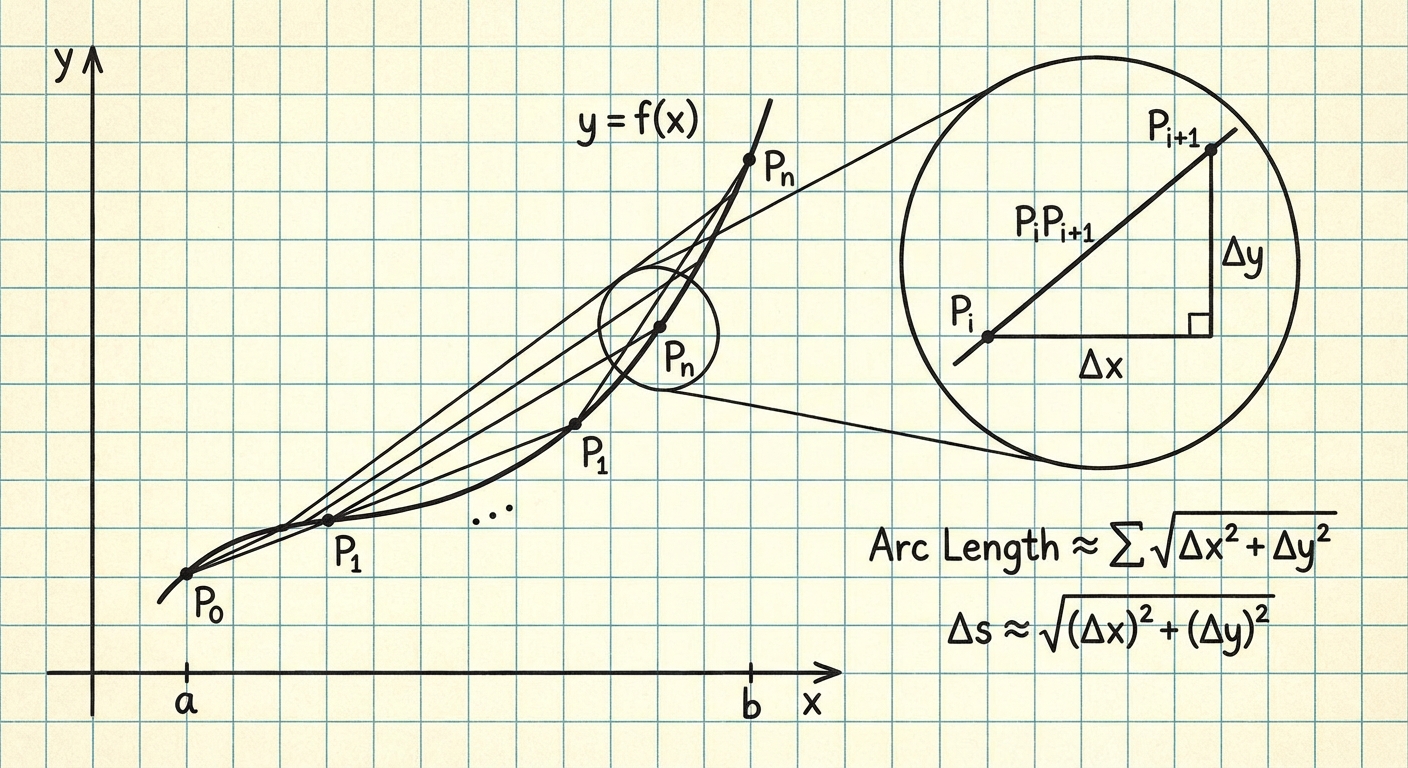
Imagine breaking a curve into $n$ subintervals. On any specific small interval, the length of the curve can be approximated by the hypotenuse of a right triangle with sides $\Delta x$ and $\Delta y$. Using the Pythagorean Theorem, the length of one small segment is:
By factoring out $(\Delta x)^2$, we get:
As we let the number of segments approach infinity ($n \to \infty$) and the width of the segments approach zero, the Riemann Sum turns into a definite integral, and the ratio $\frac{\Delta y}{\Delta x}$ becomes the derivative $f'(x)$.
The Arc Length Formula for Smooth Curves
For the arc length formula to apply, the curve must be smooth. A curve is considered smooth on an interval $[a, b]$ if its derivative, $f'(x)$, is continuous on that interval. This ensures there are no sharp corners or cusps where the slope is undefined.
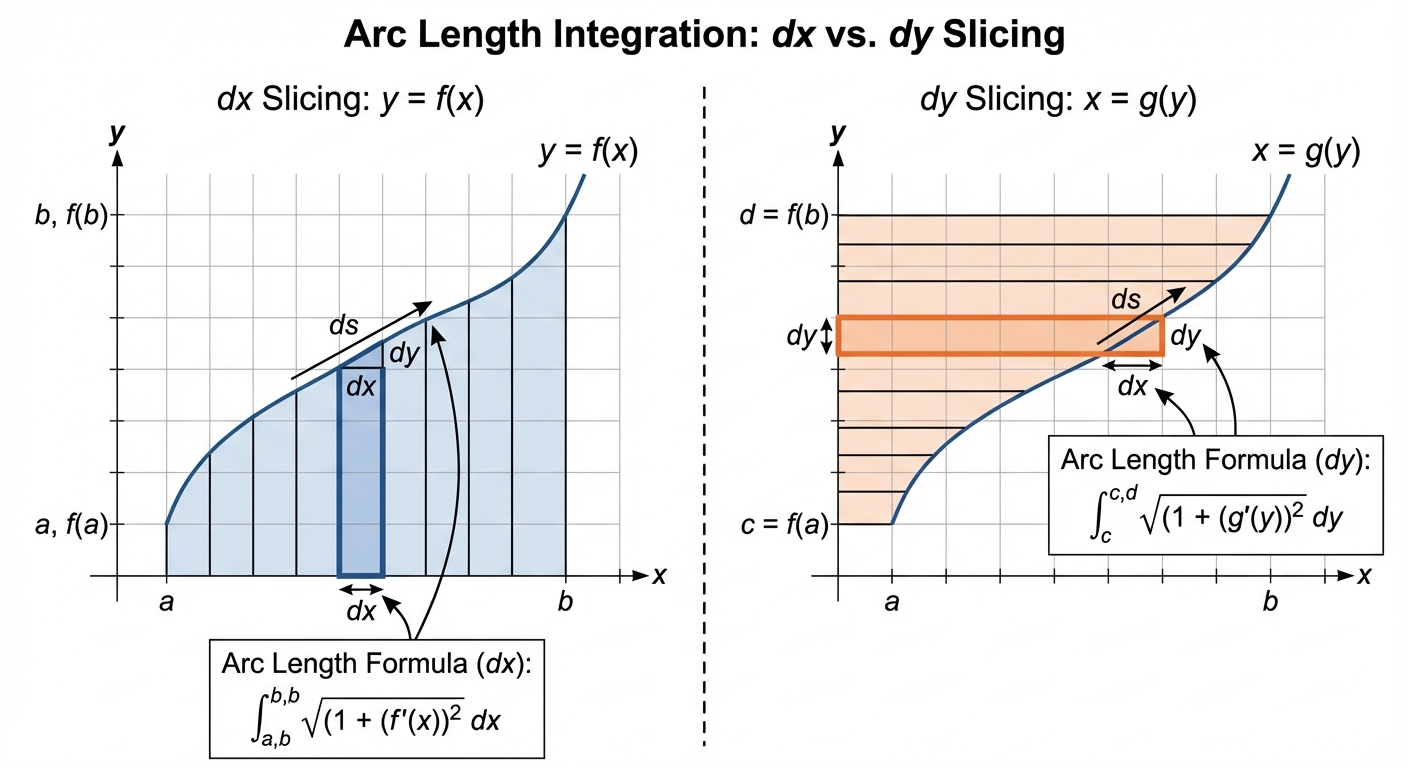
1. Integration with Respect to $x$
If a smooth curve is defined by $y = f(x)$ on the interval $[a, b]$, the arc length $L$ is given by:
or equivalently using Leibniz notation:
2. Integration with Respect to $y$
Sometimes a curve is better expressed as $x = g(y)$. If $g(y)$ defines a smooth curve on the interval $[c, d]$ (y-values), the arc length is:
or equivalently:
Note: It is crucial to match the limits of integration with the variable you are integrating. If integrating $dx$, use $x$-values ($x=a$ to $x=b$). If integrating $dy$, use $y$-values ($y=c$ to $y=d$).
Solving Arc Length Problems
Many arc length integrals result in functions that are impossible to integrate by hand (requiring standard antiderivatives). On the AP Calculus BC exam, questions usually fall into three categories:
- Set up but do not evaluate: Simply write the correct integral.
- Calculator Active: Set up the integral and use
fnIntto solve. - Algebraic Manipulation: The function is specifically designed so that $1 + (f'(x))^2$ becomes a perfect square, eliminating the square root.
Worked Example 1: The "Perfect Square" Scenario
Problem: Find the length of the curve $y = \frac{x^3}{6} + \frac{1}{2x}$ on the interval $[1, 2]$.
Solution:
Step 1: Find the derivative $dy/dx$.
Step 2: Square the derivative $(dy/dx)^2$.
Step 3: Add 1 to the squared derivative.
Notice the sign change in the middle term from $-1/2$ to $+1/2$. This converts the expression back into a perfect square!
Step 4: Integrate.
Since the square and square root cancel:
Worked Example 2: Integration with Respect to $y$
Problem: Set up the integral for the length of $x = y^2$ from $y=0$ to $y=2$.
Solution:
Here, it is easier to differentiate with respect to $y$.
This integral requires Trigonometric Substitution or a calculator to solve explicitly.
Distance Traveled (Review Connection)
In Unit 8, you may encounter particle motion problems. Remember the connection:
- Total Distance Traveled by a particle moving along the x-axis with velocity $v(t)$ is $\int |v(t)| \, dt$.
- Arc Length is the geometric distance along a curve in the plane. If a particle moves along a generic curve $s(t)$, the distance traveled uses the parametric arc length formula (covered in Unit 9), which is the generalized version of the formula above.
Memory Aids & Mnemonics
The "Pythagorean" Reminder
If you forget the formula, draw a tiny triangle on the curve.
- Horizontal side: $dx$ (change in x)
- Vertical side: $dy$ (change in y)
- Hypotenuse: $ds$ (arc length element)
Thinking $ds = \sqrt{dx^2 + dy^2}$ usually leads you to the right place.
- Factor out $dx^2$ inside the root $\to$ formula with respect to $x$.
- Factor out $dy^2$ inside the root $\to$ formula with respect to $y$.
Common Mistakes & Pitfalls
Forgetting the Square Root
- Mistake: Evaluating $\int (1 + (f'(x))^2) dx$.
- Correction: Arc length is geometric distance; don't forget the giant radical: $\sqrt{\dots}$.
Forgetting to Square the Derivative
- Mistake: Writing $\sqrt{1 + f'(x)}$ or $\sqrt{1 + f''(x)}$.
- Correction: The Pythagorean theorem requires $a^2 + b^2$. It must be $[f'(x)]^2$.
Forgetting the "1 +"
- Mistake: Integrating $\sqrt{(f'(x))^2}$, which just simplifies to $\int f'(x) dx = f(b) - f(a)$.
- Why it's wrong: This just calculates the vertical displacement (change in $y$), not the length of the curved path.
Mixing Variables
- Mistake: Calculating $\frac{dy}{dx}$ but integrating with respect to $dy$ without solving for $x$.
- Correction: If your integral ends in $dx$, your function must be in terms of $x$, your derivative must be $dy/dx$, and limits must be $x$-values.