Unit 2: The Judicial Branch and Federal Courts
The Judicial Branch in the US Political System
Constitutional Foundations of the Judiciary
The judicial branch is often described as the arbiter of the Constitution. Its primary function is to interpret laws and ensure that the actions of the other two branches remain within the bounds of the Constitution.
Article III of the Constitution
Unlike Article I (Congress) and Article II (Presidency), Article III is surprisingly brief. It establishes:
- The Supreme Court: The only court specifically mentioned in the Constitution.
- Lower Courts: It explicitly gives Congress the power to create "inferior courts" (lower federal courts).
- Tenure: Federal judges serve for "good behavior" (essentially life tenure) to insulate them from political pressure.
- Jurisdiction: Defines the types of cases federal courts can hear (federal laws, disputes between states, etc.).
Federalist No. 78
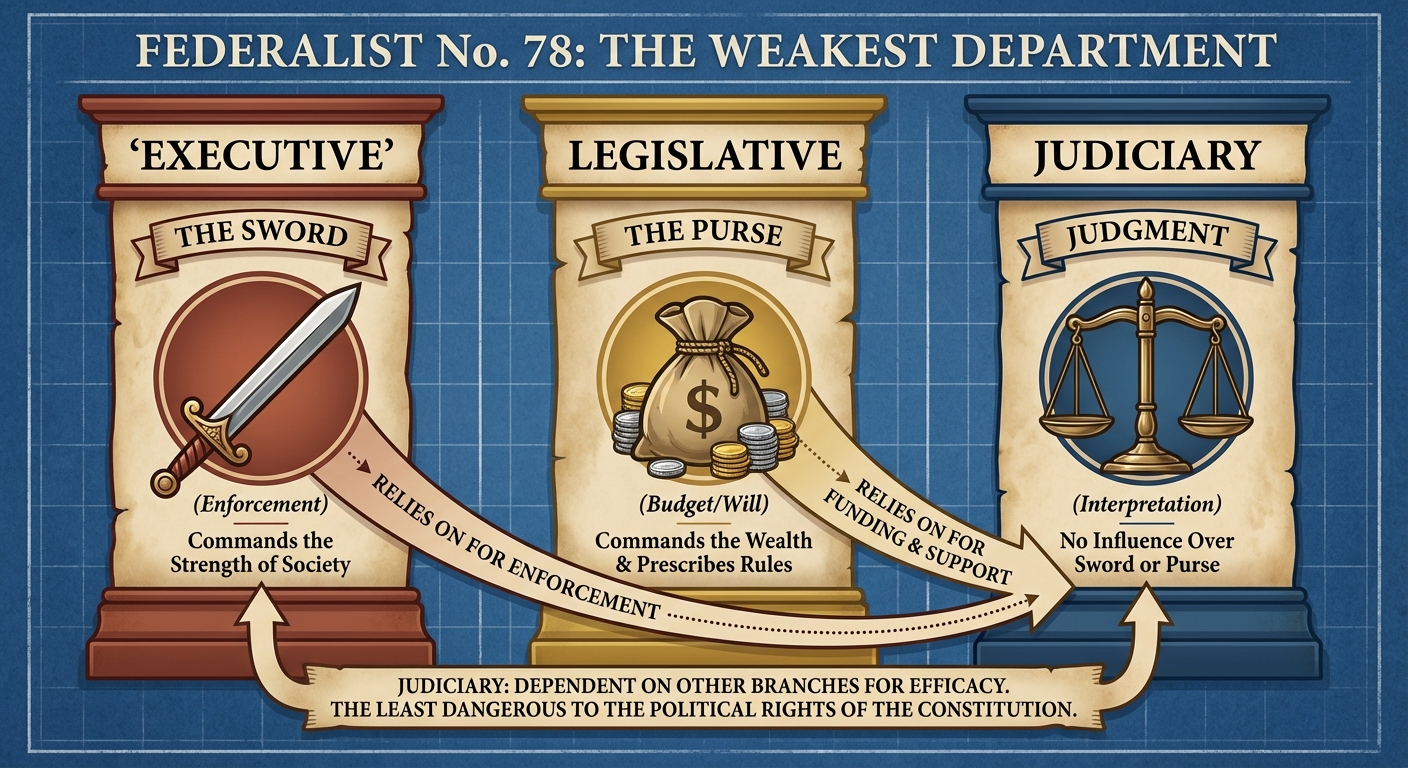
Written by Alexander Hamilton, Federalist No. 78 is the essential foundational document for understanding the role of the judiciary.
- "The Least Dangerous Branch": Hamilton argued the judiciary would be the weakest of the three branches because it holds neither the power of the sword (military strength/enforcement, held by the Executive) nor the purse (budgetary power, held by Congress).
- Judicial Review: Hamilton hinted at the power of judicial review, arguing that the courts were designed to be an intermediate body between the people and the legislature to ensure the legislature acts within its authority.
- Life Tenure: Hamilton defended life terms as necessary to ensure judicial independence. If judges had to run for election or be appointed frequently, they would be beholden to public opinion or the official who appointed them, rather than the law.
Structure of the Federal Court System
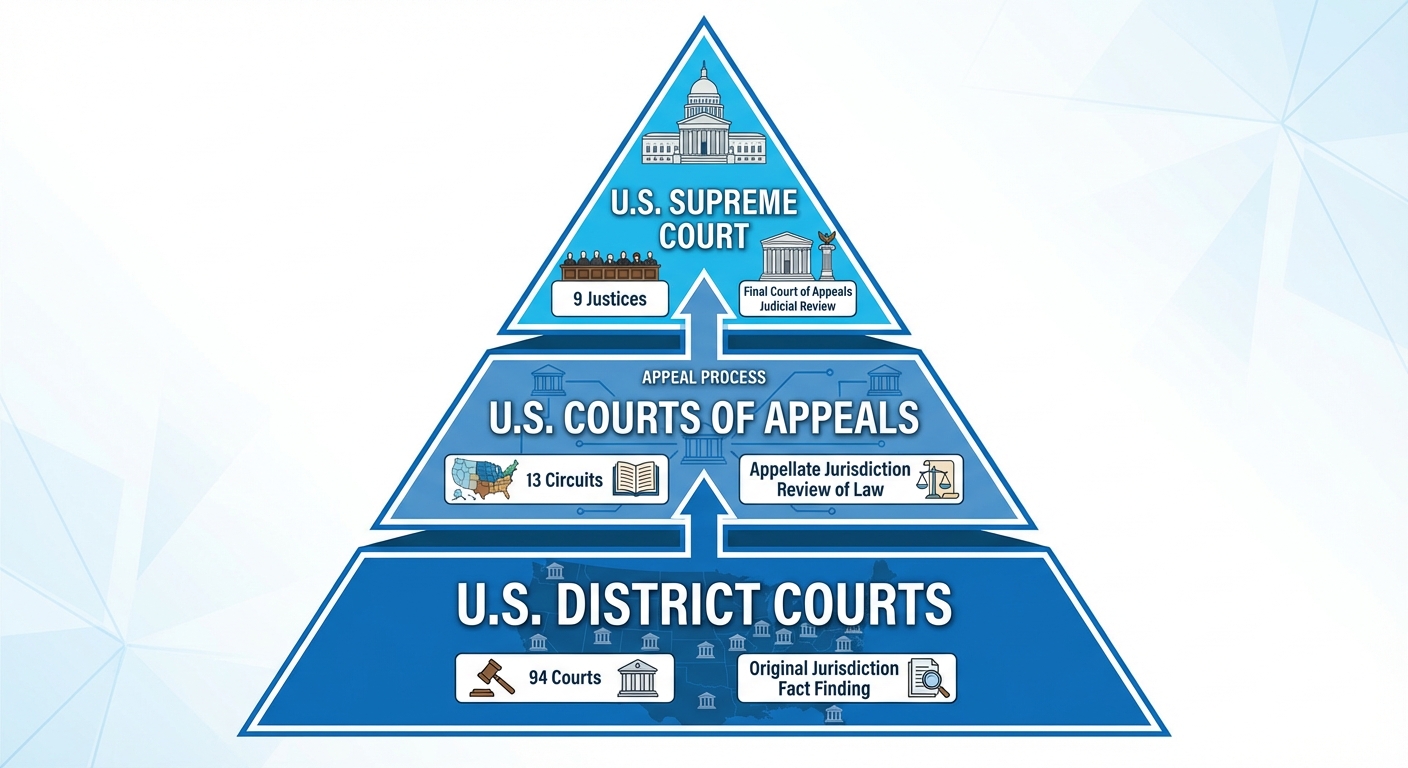
The United States operates under a dual court system, meaning federal and state courts exist side-by-side. Most cases start and end in state courts. Federal courts only hear cases involving federal law, the Constitution, treaties, or diversity of citizenship (disputes between citizens of different states involving >$75,000).
The Three-Tiered Hierarchy
The Judiciary Act of 1789 established the specific three-level structure we use today.
U.S. Distict Courts (Trial Courts)
- Function: Fact-finding. This is where trials are held, juries are impaneled, and evidence is presented.
- Jurisdiction: Original Jurisdiction (the authority to hear a case for the first time).
- Number: 94 courts globally.
U.S. Courts of Appeals (Circuit Courts)
- Function: They do not hold trials or hear testimony. They review the decisions of lower courts to determine if a legal error occurred.
- Jurisdiction: Appellate Jurisdiction only.
- Number: 13 circuits (12 regional + 1 federal circuit).
The U.S. Supreme Court (SCOTUS)
- Function: The court of last resort. Resolves conflicts between states, conflicts between different circuit courts, and constitutional questions.
- Jurisdiction: Mostly Appellate, but has Original Jurisdiction in rare cases affecting Ambassadors or disputes between States.
Judicial Review and the Supreme Court
Marbury v. Madison (1803)
This is the single most important case regarding the Judiciary. You MUST know this for the AP exam.
- Context: Outgoing President John Adams appointed "Midnight Judges" to preserve Federalist power. Incoming Secretary of State James Madison refused to deliver the commission to William Marbury. Marbury sued, asking the Court for a Writ of Mandamus (an order to force action) based on the Judiciary Act of 1789.
- The Ruling: Chief Justice John Marshall wrote that while Marbury was entitled to his commission, the part of the Judiciary Act of 1789 that allowed the Court to issue Writs of Mandamus was unconstitutional because it expanded the Court's original jurisdiction beyond what Article III allowed.
- The Impact: The Court sacrificed a small power (issuing writs) to gain a massive one: Judicial Review—the power to declare acts of Congress and the President unconstitutional.
How the Court Selects Cases
The Supreme Court receives thousands of petitions a year but hears fewer than 100.
- Rule of Four: At least four of the nine justices must agree to hear a case.
- Writ of Certiorari: If the Rule of Four is met, the Court issues this writ, ordering the lower court to send up the records for review.
Judicial Decision Making and Philosophy
Once a case is heard, justices issue opinions. These opinions rely heavily on Stare Decisis (Latin for "let the decision stand"), which is the practice of ruling based on precedent (previous court rulings).
Types of Opinions
- Majority Opinion: The official legal reasoning of the court; becomes the law of the land.
- Concurring Opinion: Written by a justice who agrees with the majority's conclusion (the winner) but for different legal reasons.
- Dissenting Opinion: Written by justices who disagree with the majority. While these have no legal force, they provide legal arguments for future courts to potentially overturn the precedent (e.g., the dissent in Plessy helped form the logic for Brown v. Board).
Philosophies: Activism vs. Restraint
| Philosophy | Definition | Core Belief | Example |
|---|---|---|---|
| Judicial Restraint | Judges should play a minimal policymaking role. | Defer to the democratically elected branches (Congress/President) unless a law is clearly unconstitutional. Closely tied to Constructionism (sticking to the text). | Upholding a state law you personally dislike because the Constitution doesn't explicitly forbid it. |
| Judicial Activism | Judges should use the bench to make bold policy changes and correct social injustices. | The Constitution is a "living document" that must evolve. Courts must protect minority rights when the majority (legislature) fails to do so. | Brown v. Board of Education (forcing integration); Roe v. Wade (establishing privacy rights). |
Checks on the Judicial Branch
Despite life tenure, the Judiciary is not immune to checks and balances.
Presidential Checks
- Appointments: The President selects all federal judges, shifting the ideological balance of the court for decades (e.g., a Conservative President appoints Conservative judges).
- Enforcement: The Court has no army or police. It relies on the Executive to enforce rulings. (Famous historical quote: "John Marshall has made his decision; now let him enforce it.")
Congressional Checks
- Confirmation: The Senate must confirm judicial nominees.
- Impeachment: Judges can be impeached and removed for bad behavior.
- Jurisdiction Stripping: Congress can pass laws attempting to limit what types of cases the Supreme Court can hear.
- Amendments: Congress can propose Constitutional Amendments to effectively "overrule" a Supreme Court decision (e.g., the 16th Amendment overruled a decision that declared income tax unconstitutional).
- Changing Court Size: The number of justices is not set in the Constitution. Congress can increase the size to "pack the court" (though this is politically controversial).
Common Mistakes & Pitfalls
- Confusing "Unconstitutional" with "Bad Law": Students often think the Supreme Court strikes down laws just because they are unfair. The Court can only strike down a law if it violates the Constitution. A law can be unfair or stupid but still be constitutional.
- Activism vs. Liberalism: Do not assume Judicial Activism is always Liberal and Restraint is always Conservative. A Conservative court overturning a decades-old liberal law is an act of Activism (actively changing precedent).
- Marbury v. Madison Details: Don't get lost in the weeds of the commissions. The destination is what matters: The Court established the power to strike down federal laws.
- Certiorari vs. Habeas Corpus: A Writ of Certiorari brings a case up to the Supreme Court. A Writ of Habeas Corpus demands a prisoner be brought before a judge to determine if detention is legal. Do not confuse them.