AP Physics 1: Principles of Energy Conservation and Power
Defining the System: The Foundation of Energy Analysis
Before writing down any equations, you must define your System. In AP Physics 1, the choice of system determines whether you calculate Work done by gravity or changes in Gravitational Potential Energy.
Open vs. Closed Systems
- Closed (Isolated) System: No mass or energy enters or leaves the system. The total energy remains constant ($E_{total} = \text{constant}$).
- Open System: Energy is transferred into or out of the system via external forces doing Work ($W$).
The System Boundary Rule
- Object-Only System (e.g., just a ball): The Earth is external. Gravity is an external force doing Work. The object has Kinetic Energy ($K$), but no Gravitational Potential Energy ($U_g$).
- Object-Earth System: The Earth is internal. Gravity is an internal conservative force. The system possesses both Kinetic and Gravitational Potential Energy.
AP Exam Tip: Most conservation of energy problems assume an Object-Earth (or Object-Spring-Earth) system so that you can utilize Potential Energy terms rather than calculating the Work done by gravity.
Conservation of Energy
The Law of Conservation of Energy states that energy can be transformed from one form to another, but the total amount of energy in an isolated system remains constant.
Mechanical Energy ($E_{mech}$)
Total mechanical energy is the sum of kinetic and potential energies:
Where:
- $K = \frac{1}{2}mv^2$ (Kinetic Energy)
- $U_g = mgh$ (Gravitational Potential Energy)
- $U_s = \frac{1}{2}kx^2$ (Elastic Potential Energy)
The Master Equation
For a system interacting with its environment, the general energy equation is:
Here, $W_{nc}$ (Work done by non-conservative forces) accounts for energy losses (like friction) or gains (like a motor).
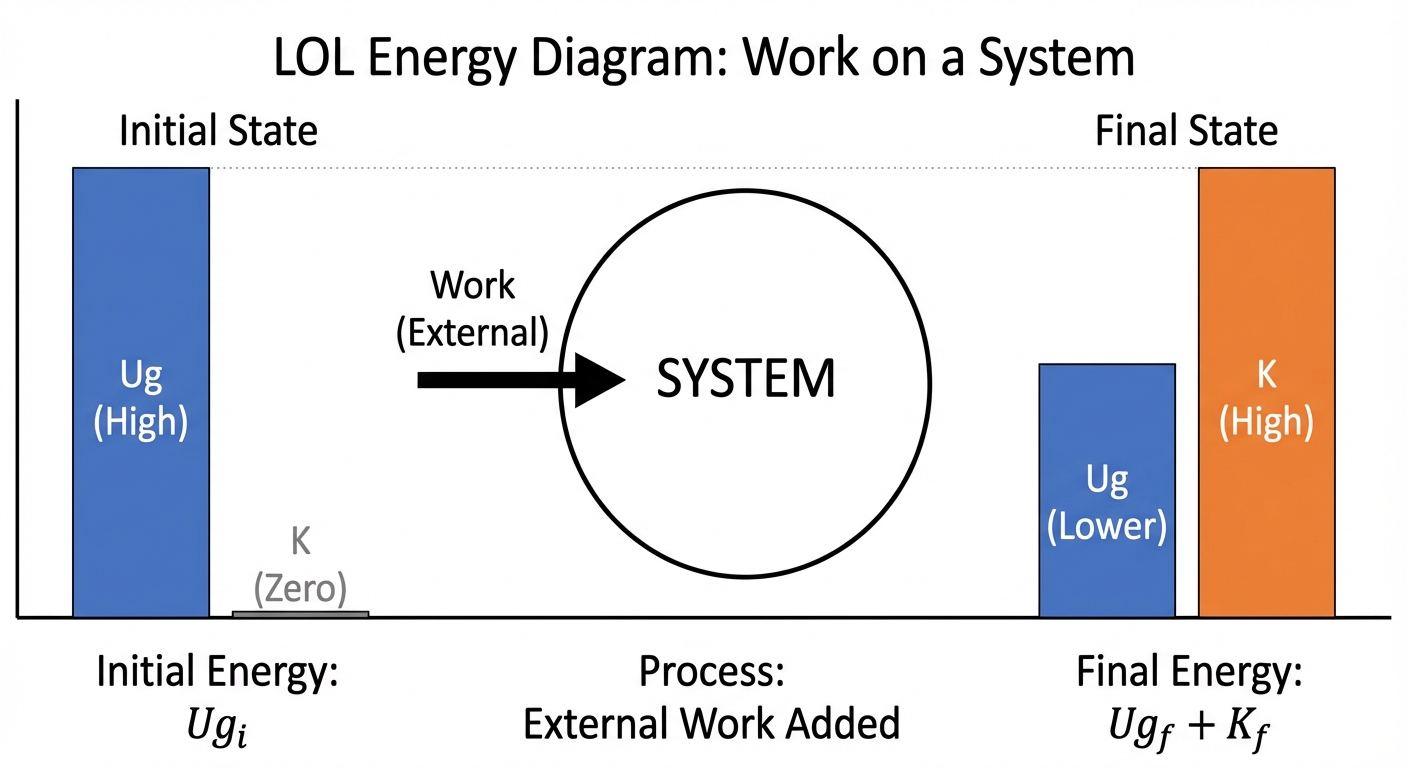
Conservation with Conservative Forces Only
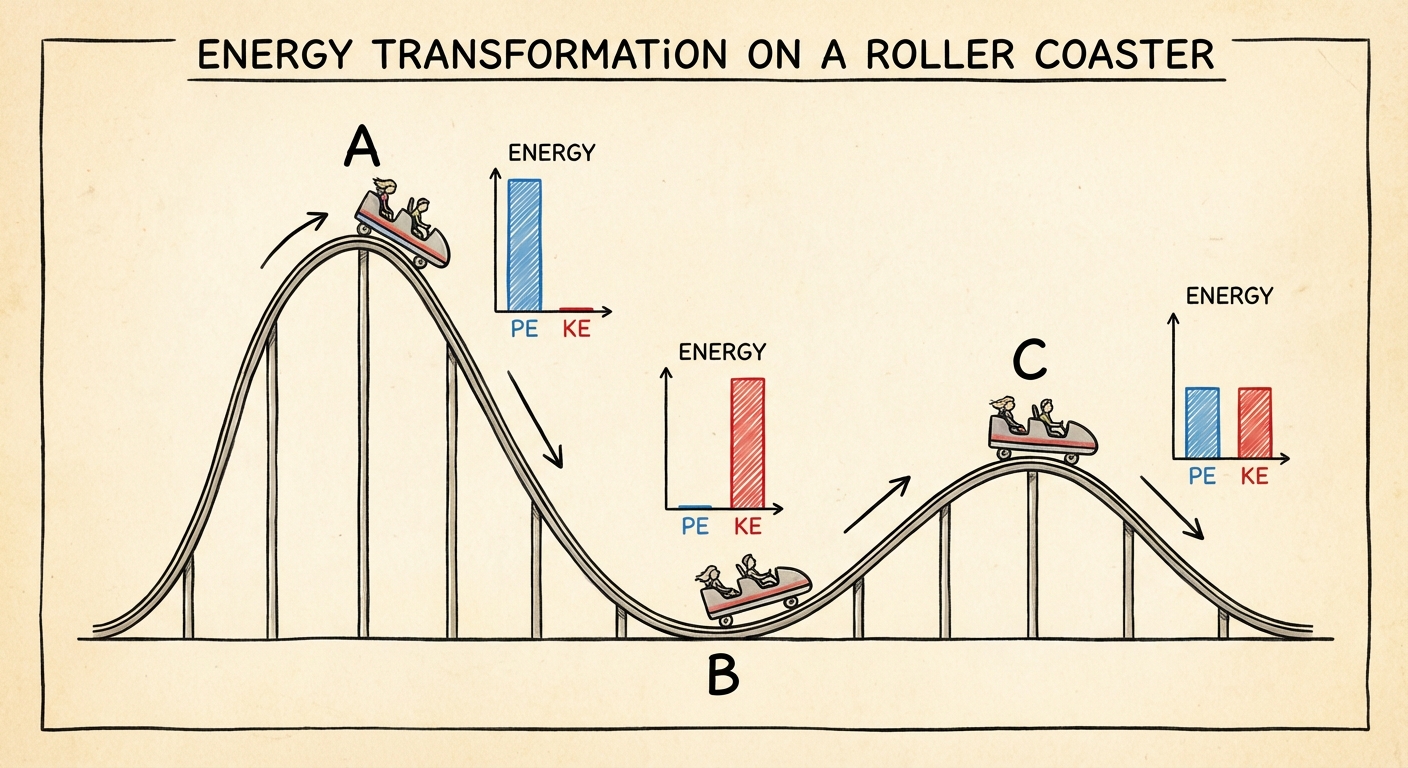
If no external forces do work and no friction acts (e.g., a frictionless roller coaster), Mechanical Energy is conserved:
Work by Non-Conservative Forces
Not all forces conserve mechanical energy. Non-conservative forces (like friction and air resistance) convert mechanical energy into internal energy (thermal energy/heat).
Metric of Dissipation
When friction acts over a distance $d$, the change in mechanical energy equals the work done by friction:
This results in a "loss" of mechanical energy, but total energy is still conserved if you account for the thermal energy generated:
Power
While energy tells us how much work can be done, Power tells us how fast it gets done. Power is the rate of energy transfer.
Definitions and Formulas
Average Power: Based on the work done over a time interval $t$ or energy change $\Delta E$.
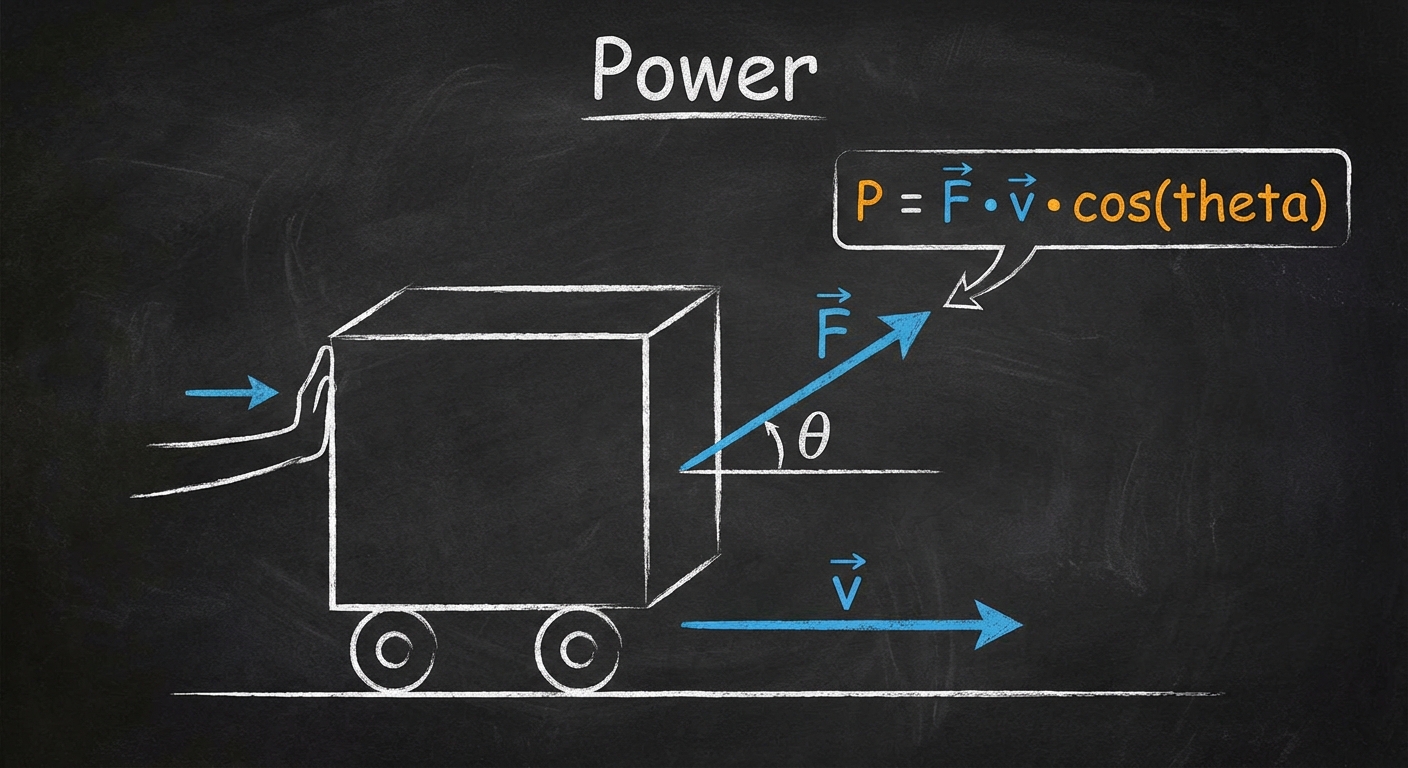
Instantaneous Power: The power output at a specific moment in time. If a constant force $F$ acts on an object moving at velocity $v$, power is defined as:
- Where $\theta$ is the angle between the force vector and the velocity vector.
- If the force is parallel to velocity (like a car engine pushing a car forward), $\cos(0) = 1$, so $P = Fv$.
Units
- SI Unit: Watt (W)
- 1 W = 1 Joule/second (J/s)
- 1 horsepower (hp) $\approx$ 746 W (occasionally seen, but Watts are standard)
Comparison Table: Work vs. Power
| Feature | Work ($W$) | Power ($P$) |
|---|---|---|
| Definition | Transfer of energy via force | Rate of energy transfer |
| Formula | $Fd\cos\theta$ | $W/t$ or $Fv\cos\theta$ |
| Scalar/Vector | Scalar (can be +, -, 0) | Scalar |
| Time Factor | Independent of time | Dependent on time |
| Example | Lifting a box 1m | Lifting a box 1m in 2 seconds |
Worked Examples
Example 1: The Roller Coaster (Conservation)
Problem: A 500 kg roller coaster cart starts from rest at the top of a 20m high hill (Point A). It travels down to a valley (Point B) at ground level (0m). Ignore friction. What is the speed of the cart at Point B?
Solution:
- System: Cart + Earth (includes $U_g$).
- State A (Top): $vA = 0$, $hA = 20\text{m}$.
- State B (Bottom): $hB = 0$, $vB = ?$
- Conservation: $EA = EB$
Example 2: Power Output
Problem: An elevator motor lifts a 1000 kg elevator upward at a constant speed of 3.0 m/s. Calculate the power output of the motor.
Solution:
- Analyze Forces: Since velocity is constant, acceleration is 0. The forces are balanced.
- Calculate Power: Since $F$ and $v$ are in the same direction:
Common Mistakes & Pitfalls
Undefined Systems: Students often fail to define the system. If your system is just "the block," gravity is an external force doing Work. If your system is "block + Earth," gravity creates Potential Energy. Never include both Work done by gravity and Gravitational Potential Energy in the same equation—that is double counting.
Confusing Work and Power: Remember, a strong person and a weak person can do the same amount of Work (lifting a box to the same shelf), but the strong person generates more Power if they do it faster.
Ignoring Signs:
- Work done by friction is always negative (removes energy).
- Changes in height ($\Delta y$) determine whether $U_g$ increases or decreases. Always set a consistent $y=0$ reference line.
Constant Forces in Spring Problems: Spring force ($Fs = -kx$) is not constant. You cannot use constant acceleration equations (kinematics) for spring motion. You must use Energy conservation ($Us = \frac{1}{2}kx^2$) or Calculus.