Mastering Basic Derivative Techniques
Fundamental Differentiation Rules
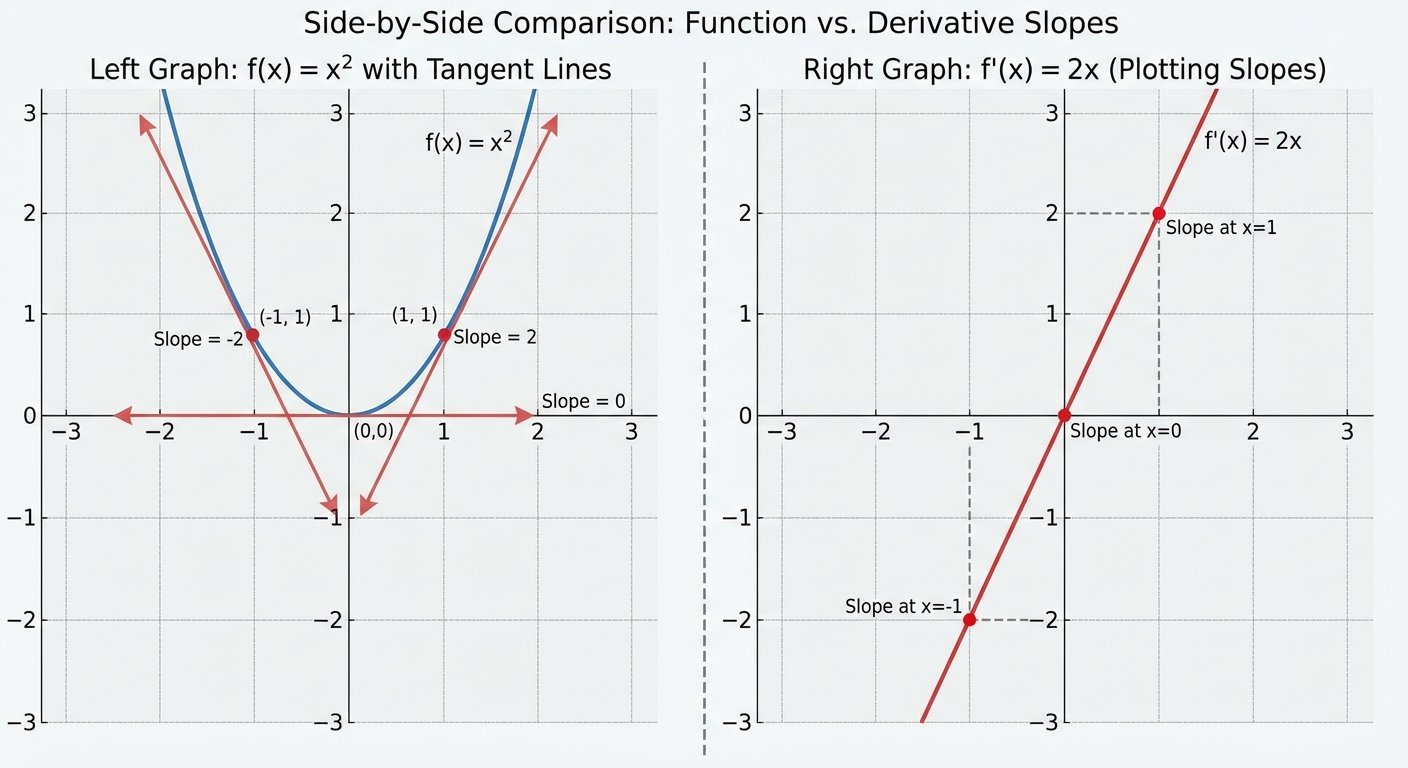
Differentiation is the algebraic process of finding the derivative, $f'(x)$, which represents the instantaneous rate of change or the slope of the tangent line to a curve. While the limit definition of a derivative is the conceptual foundation, calculating limits for every function is inefficient. This guide covers the algorithmic rules required for AP Calculus BC to compute derivatives quickly and accurately.
The Power Rule and Polynomials
The Power Rule is the most commonly used tool in calculus. It allows you to differentiate polynomial terms instantly.
The Rule
For any real number $n$:
This rule applies not just to integers, but to fractions (radicals) and negative exponents (rational functions).
Critical Pre-Step: Rewriting Functions
Before applying the Power Rule, you must often rewrite the function into the form $x^n$. This is where most algebra errors occur.
| Original Function | Rewrite as Power | Derivative Calculation | Final Answer |
|---|---|---|---|
| $f(x) = \frac{1}{x^3}$ | $x^{-3}$ | $-3x^{-3-1}$ | $-\frac{3}{x^4}$ |
| $g(x) = \sqrt{x}$ | $x^{1/2}$ | $\frac{1}{2}x^{1/2 - 1}$ | $\frac{1}{2\sqrt{x}}$ |
| $h(x) = \sqrt[3]{x^2}$ | $x^{2/3}$ | $\frac{2}{3}x^{2/3 - 1}$ | $\frac{2}{3\sqrt[3]{x}}$ |
Basic Operations and Linearity
Differentiation is a linear operator. This means derivatives respect addition, subtraction, and scalar multiplication, but not products or quotients (which have their own special rules).
The Rules
- Constant Rule: The slope of a horizontal line is zero.
- Constant Multiple Rule:
- Sum and Difference Rule:
Worked Example
Find $y'$ if $y = 5x^3 - 4x + 7$.
Derivatives of Transcendental Functions
In AP Calculus BC, you must memorize the derivatives of trigonometric, exponential, and logarithmic functions. These cannot be derived simply using the Power Rule.
Trigonometric Functions
The pattern to remember: "Co-" functions (Cosine, Cosecant, Cotangent) always result in a negative derivative.
| Function $f(x)$ | Derivative $f'(x)$ |
|---|---|
| $\sin(x)$ | $\cos(x)$ |
| $\cos(x)$ | $-\sin(x)$ |
| $\tan(x)$ | $\sec^2(x)$ |
| $\cot(x)$ | $-\csc^2(x)$ |
| $\sec(x)$ | $\sec(x)\tan(x)$ |
| $\csc(x)$ | $-\csc(x)\cot(x)$ |
Exponential and Logarithmic Functions
Natural Base ($e$) — The easiest functions in calculus:
General Bases ($a > 0, a \neq 1$) — Requires a correction factor:
The Product and Quotient Rules
When functions are multiplied or divided, you cannot simply differentiate the pieces individually. You must use specific algorithms.
The Product Rule
Used when differentiating the product of two functions, $f(x)g(x)$.
Formula:
Mnemonic: "First times derivative of the second, plus second times derivative of the first."
Example:
Find $y'$ for $y = x^2 \sin(x)$.
Let $f(x) = x^2$ and $g(x) = \sin(x)$.
The Quotient Rule
Used when differentiating a ratio of two functions, $\frac{f(x)}{g(x)}$.
Formula:
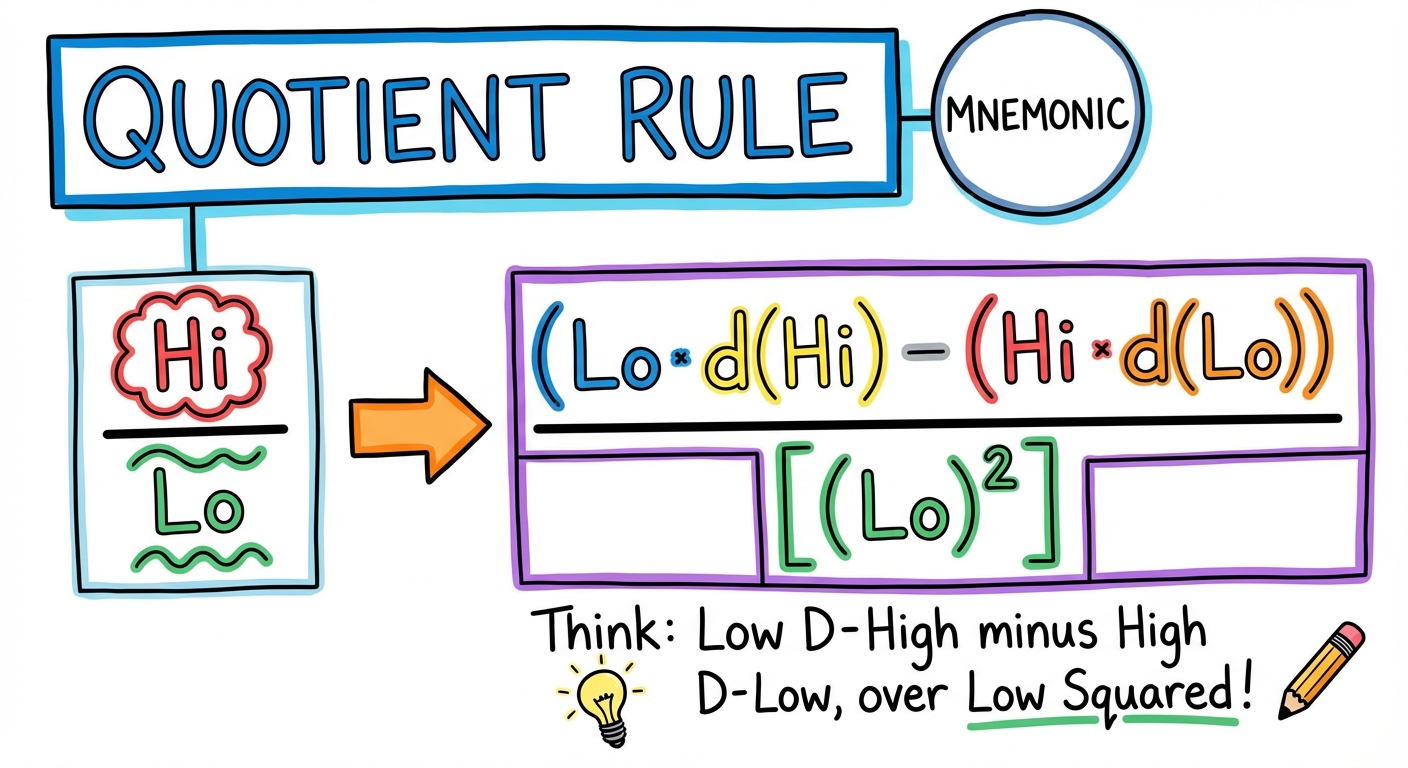
Mnemonic:
"Lo d-Hi minus Hi d-Lo, over Lo Lo"
Lo = denominator, Hi = numerator, d = derivative of.
Example:
Find $f'(x)$ for $f(x) = \frac{e^x}{x^2}$.
- Hi = $e^x$, d-Hi = $e^x$
- Lo = $x^2$, d-Lo = $2x$
Common Mistakes & Pitfalls
Confusing Polynomials and Exponentials:
- $x^n$ uses Power Rule $\to nx^{n-1}$.
- $a^x$ uses Exponential Rule $\to a^x \ln a$.
- Mistake: Writing $\frac{d}{dx}[2^x] = x2^{x-1}$ is incorrect. It is $2^x \ln 2$.
Quotient Rule Order:
- Subtraction is not commutative. You MUST calculate "Lo d-Hi" first. If you swap the numerator terms, your derivative will have the wrong sign.
Forgetting Parentheses:
- When subtracting derivatives (Difference Rule or Quotient Rule numerator), neglecting to distribute the negative to all terms is a frequent algebra error.
Implicit Chain Rule Assumption:
- Remember these rules are for basic $x$. If you have $\cos(x^2)$ or $e^{3x}$, you need the Chain Rule (Unit 3), not just the basic rules listed here.