Mastering Polar Coordinates in AP Calculus BC
Defining Polar Coordinates and Differentiating in Polar Form
In the Cartesian coordinate system, we define points using a horizontal and vertical distance $(x, y)$. In the Polar Coordinate System, we define points based on their distance from a fixed point (the pole or origin) and an angle from a fixed ray (the polar axis, usually the positive x-axis).
A point is represented as $P(r, \theta)$, where:
- $r$ (radius): The directed distance from the pole to point $P$.
- $\theta$ (theta): The directed angle, measured in radians, from the polar axis to the segment $OP$.
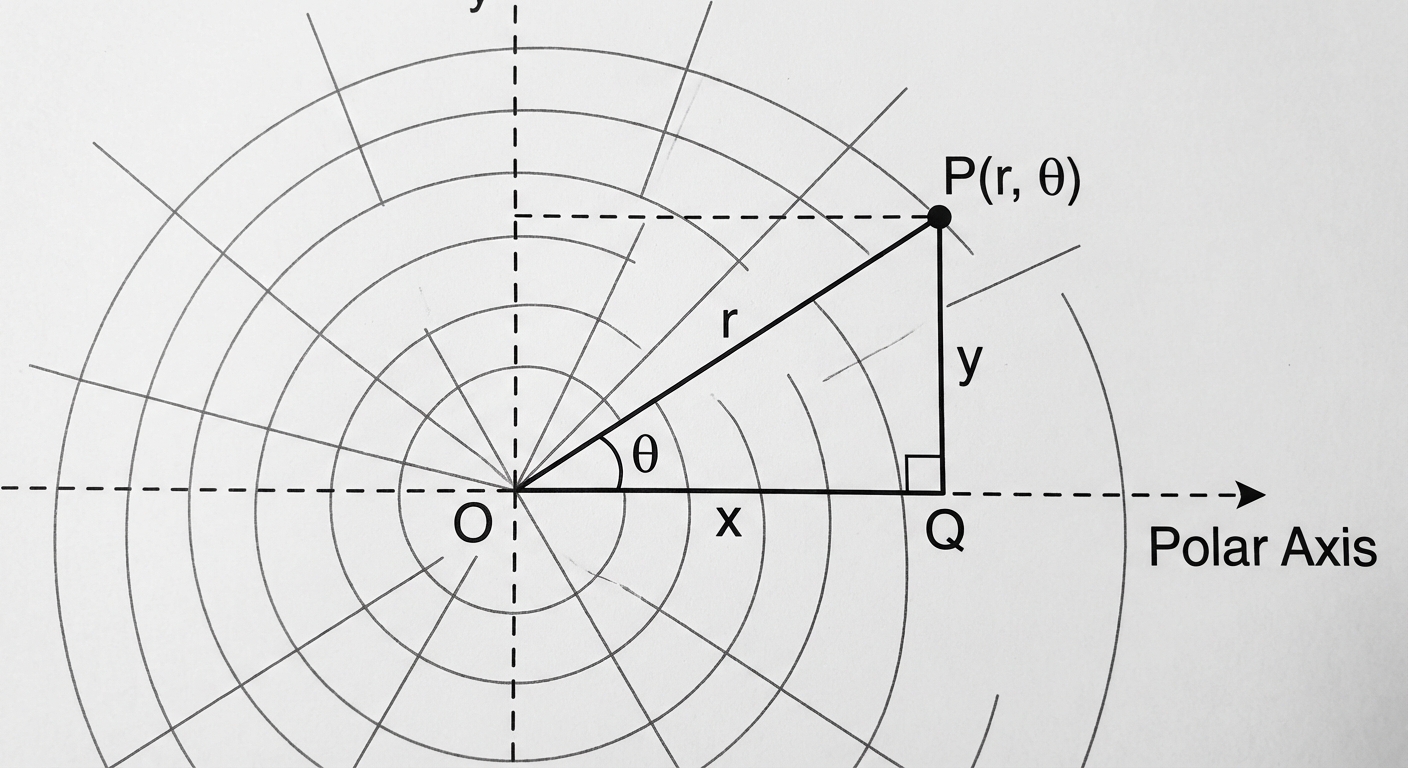
Coordinate Conversion Rules
Because the definitions of sine and cosine relate the radius $r$ to $x$ and $y$, we derive the fundamental conversion equations:
To convert from Polar to Cartesian:
To convert from Cartesian to Polar:
Slope and Differentiation
Differentiation in polar coordinates often involves finding the slope of the tangent line to the polar curve. The slope of the tangent line is the traditional derivative $\frac{dy}{dx}$.
Since $r$ is a function of $\theta$ (i.e., $r = f(\theta)$), we treat $x$ and $y$ as parametric equations with parameter $\theta$.
Using the Product Rule on the conversion equations:
- $x = f(\theta)\cos(\theta)$
- $y = f(\theta)\sin(\theta)$
The formula for the slope of the tangent line is:
Where $r'(\theta)$ or $\frac{dr}{d\theta}$ represents the change in radius with respect to the angle—not the slope of the curve.
Horizontal and Vertical Tangents
To analyze the shape of a polar graph, we look for:
- Horizontal Tangents: Set $\frac{dy}{d\theta} = 0$ (provided $\frac{dx}{d\theta} \neq 0$).
- Vertical Tangents: Set $\frac{dx}{d\theta} = 0$ (provided $\frac{dy}{d\theta} \neq 0$).
Finding the Area of a Polar Region
Unlike Cartesian integrals, which sum vertical rectangular strips ($A = \int y \, dx$), polar integrals sum the areas of infinite triangular wedges (sectors) radiating from the origin.
The area of a circular sector is given by $A = \frac{1}{2}r^2\theta$. In calculus, we integrate infinitesimal sectors with angle $d\theta$.
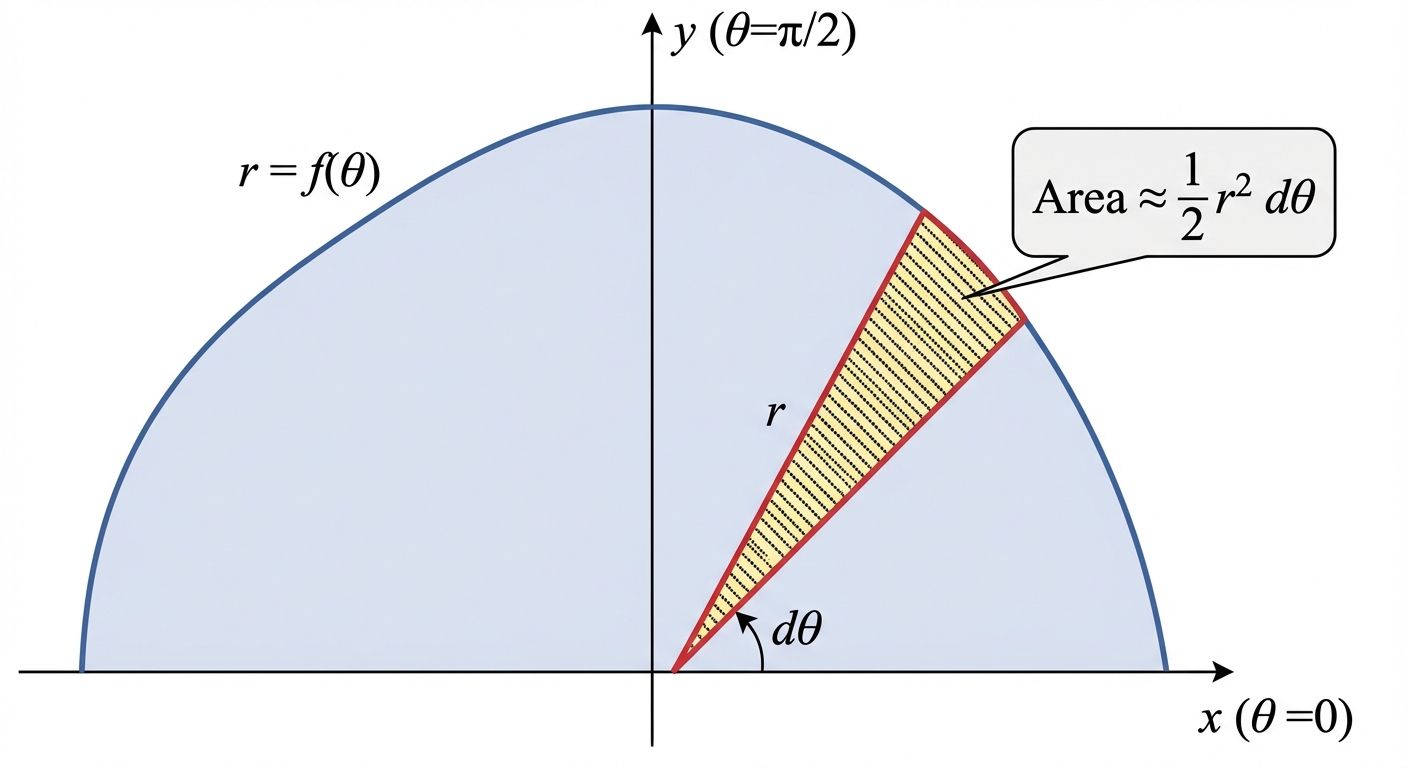
The Polar Area Formula
The area $A$ of the region bounded by the graph of a continuous polar equation $r = f(\theta)$ and the radial lines $\theta = \alpha$ and $\theta = \beta$ is:
Worked Example: Area of a Cardioid region
Problem: Find the area enclosed by the cardioid $r = 2(1 + \cos(\theta))$.
Solution:
- Identify Symmetry: The graph is symmetric over the polar axis. We can integrate from $0$ to $\pi$ and multiply by 2, or integrate $0$ to $2\pi$.
- Set up the Integral: Using bounds $0$ to $2\pi$:
- Expand: $r^2 = 4(1 + 2\cos\theta + \cos^2\theta)$.
- Integrate: Use the identity $\cos^2\theta = \frac{1+\cos(2\theta)}{2}$ to solve. The final result is $6\pi$.
Finding the Area of Regions Bounded by Polar Curves
AP Calculus BC frequently tests the ability to find the area between two polar curves. This requires identifying which curve is "distinctly further" from the origin over a specific interval.
Area Between Two Curves Formula
If $R(\theta)$ is the outer curve (further from the pole) and $r(\theta)$ is the inner curve (closer to the pole) over the interval $[\alpha, \beta]$:
Important: You square the radii individually and subtract. Do not calculate $(R - r)^2$.
Finding Points of Intersection
To determine the bounds of integration ($\alpha$ and $\beta$), you usually need to find where the curves intersect.
- Algebraic Method: Set $r1 = r2$ and solve for $\theta$.
- Example: Find intersection of $r = 3\sin\theta$ and $r = 1+\sin\theta$.
- $3\sin\theta = 1+\sin\theta \Rightarrow 2\sin\theta = 1 \Rightarrow \sin\theta = 1/2$.
- $\theta = \pi/6, 5\pi/6$.
- The Pole Issue: Sometimes curves intersect at the pole (origin) where $r=0$, but they reach the pole at different $\theta$ values. Set each equation to 0 individually to match them.
Total Area Strategies
Sometimes an area is not bounded by an "outer minus inner" relationship but is composed of two adjacent regions bounded by different curves. In this case, you must split the integral.
This occurs when the ray sweeping from the origin crosses different boundary curves at different angles.
Common Mistakes & Pitfalls
Squaring Errors ($R^2 - r^2$ vs $(R-r)^2$):
- Wrong: $\int (R - r)^2 d\theta$. This assumes you are integrating the distance between curves squared.
- Right: $\int (R^2 - r^2) d\theta$. You are subtracting the area of the inner sector from the area of the outer sector.
Forgetting the $\frac{1}{2}$:
The coefficient $\frac{1}{2}$ is part of the sector area formula. Students often omit this when setting up the integral.Incorrect Bounds (Tracing):
A polar curve may trace itself more than once (e.g., $r = \cos(2\theta)$ completes a petal in $\pi/2$ but the whole graph in $2\pi$). Verify the interval needed to close the loop once.Confusion over $dy/dx$ vs $dr/d\theta$:
- $dr/d\theta$: How the radius changes as the angle rotates.
- $dy/dx$: The slope of the curve on the $xy$-plane.
Negative Radius logic:
Remember that if $r < 0$, the point is plotted in the opposite quadrant. This can complicate area visualization, though squaring $r$ in the area formula handles the sign automatically.