Unit 4: The Art of Argumentation and Synthesis
Welcome to Big Idea 4: Synthesize Ideas. In AP Seminar, this is the pivot point where you stop being a passive consumer of information and become an active creator of knowledge. You have asked questions, questioned the answers, and evaluated sources. Now, it is time to weave those threads together to form your own complex, well-reasoned argument.
Defining Synthesis in AP Seminar
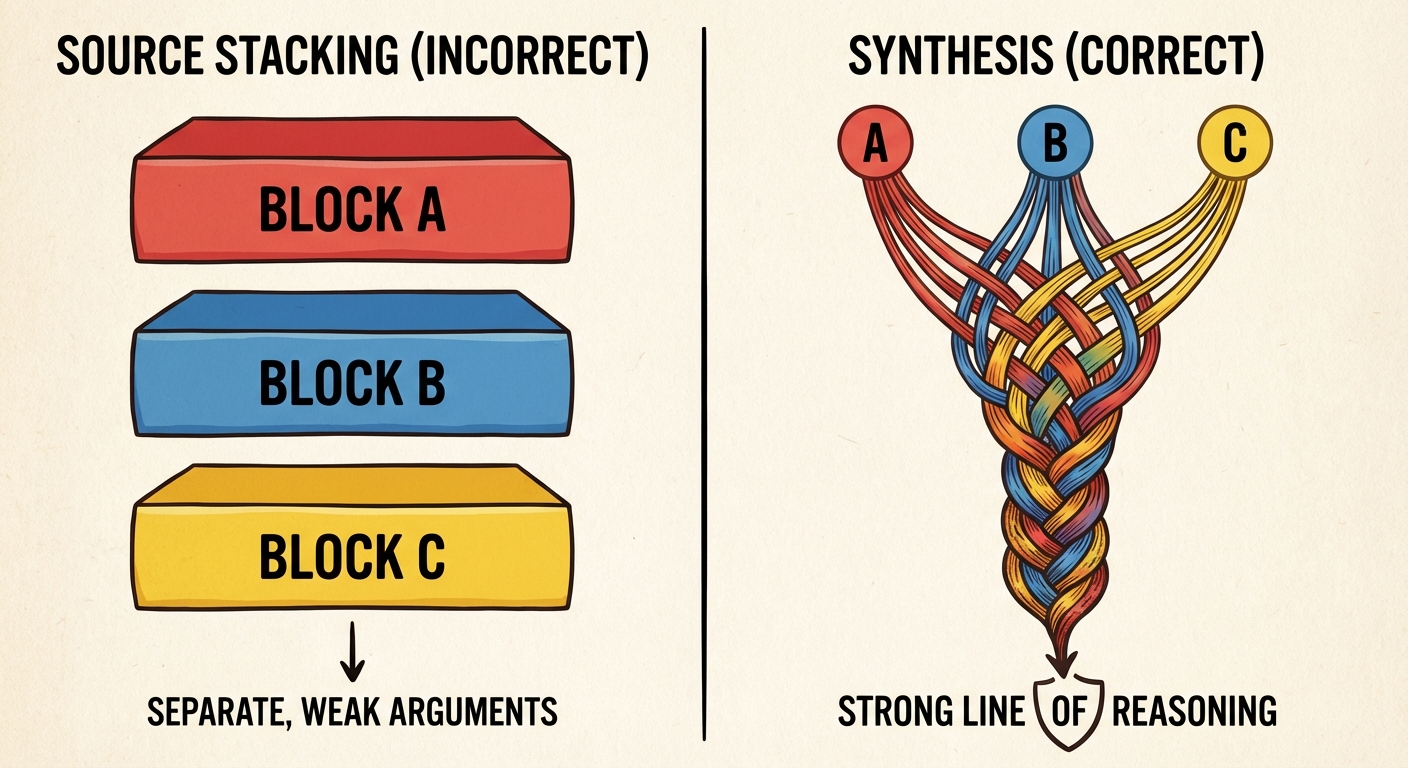
Synthesis is not merely summarizing multiple sources one after another. It is the process of connecting, comparing, and combining diverse resources to create a new, coherent argument or understanding.
Think of the academic conversation as a dinner party (often called Burke’s Parlor): you listen to what others are saying, understanding their perspectives, and then you jump in with your own contribution that acknowledges the previous speakers but adds something new.
The Difference Between Summary and Synthesis
| Summary | Synthesis |
|---|---|
| Restates the main points of a single source. | Combines ideas from multiple sources to support a new claim. |
| Neutral and objective. | Argumentative; drives toward a specific conclusion. |
| Structure: Source A $\rightarrow$ Source B $\rightarrow$ Source C. | Structure: Point 1 (supported by A & B) $\rightarrow$ Point 2 (supported by C & A). |
Essential Questions for Big Idea 4
You should be able to answer these by the end of the unit:
- How do I connect and analyze evidence to develop an argument?
- What Line of Reasoning best supports my argument?
- Are there other conclusions or perspectives I should consider?
- How do I account for my own biases and assumptions?
- How do I avoid plagiarism while attributing the work of others?
Formulating a Complex Argument (LO 4.1)
A Complex Argument is more than just a statement of fact; it is a claim that is debatable, defensible, and nuanced.
The Thesis Statement
Your argument anchors on your thesis. A strong AP Seminar thesis must be:
- Focused: Narrow enough to be covered in the word count.
- Debatable: Reasonable people could disagree (avoid truisms like "Murder is bad").
- Nuanced: Acknowledges complexity (often uses "Although," "While," or "However").
Example:
- Weak: "Social media is bad for teenagers."
- Strong: "While social media facilitates necessary peer connection, its algorithms foster addictive behaviors in adolescents that necessitate stricter regulatory oversight."
Establishing a Line of Reasoning (LO 4.2)
The Line of Reasoning (LOR) is the logical pathway your argument follows. It is the "spine" that holds your essay together. If a reader reads only your topic sentences, they should understand your whole argument.
Structuring Your Logic
Avoid the "List of Facts" approach. Instead, use logical structures:
- Inductive Reasoning: Gathering specific pieces of evidence to draw a broad conclusion. (Specific $\rightarrow$ General)
- Deductive Reasoning: Applying a general principle to a specific case. (General $\rightarrow$ Specific)
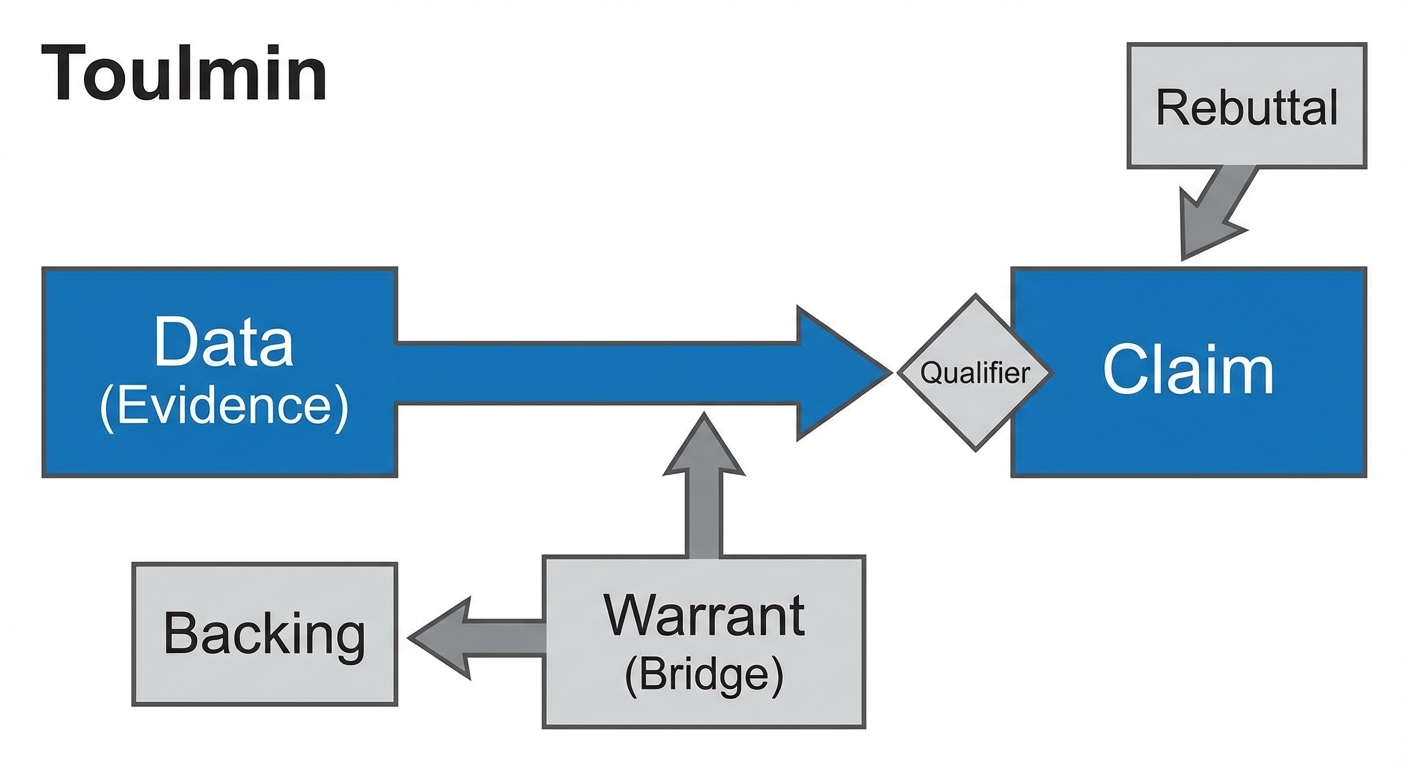
- The Toulmin Model: A useful framework for breaking down components of an argument.
- Claim: The assertion you are making.
- Data: The evidence supporting the claim.
- Warrant: The logical connection explaining why the data supports the claim.
- Backing: Support for the warrant itself.
- Qualifier: Limits the scope (e.g., "probably," "in most cases").
- Rebuttal: Addresses potential objections.
Transitions as Glue
Transitions are crucial for synthesis. They show the relationship between ideas.
- To show agreement: "Similarly," "Corroborating this," "In concert with…"
- To show contrast: "Conversely," "However," "On the other hand," "While Author X claims…"
- To show cause/effect: "Consequently," "Therefore," "As a result…"
Selecting and Integrating Evidence (LO 4.3 & 4.6)
Researching (Big Idea 1 & 2) gives you a pile of evidence. Synthesizing (Big Idea 4) requires you to curate the best pieces to support your specific LOR.
The Three Ways to Integrate Sources
- Quoting: Using the exact words. Use sparingly—only when the wording is unique or powerful.
- Paraphrasing: Restating in your own words. Used for specific details/stats.
- Summarizing: Condensing main ideas. Used for broad context.
Tip: "Patchwriting" (replacing just a few words in a sentence) is a form of plagiarism. You must fully digest and rewrite the idea.
Attribution and Citations
You must attribute ideas to their original authors to build credibility and avoid plagiarism.
- Signal Phrases: Introduce the source in the sentence.
- "According to Dr. Smith, a sociologist at Yale…"
- Note: Explicitly mentioning the author's credentials (like "sociologist") adds weight to your argument (Appeal to Ethos).
Dealing with Perspectives and Counterarguments (LO 4.4 & 4.5)
A "perspective" is not just a person; it is a point of view shared by groups (e.g., Economic perspective, Environmental perspective).
The Counterargument
Ignoring opposing views makes your argument weak. You must acknowledge and refute (or qualify) them.
- Concession: Admit where the opposing side has a valid point. ("It is true that implementing this policy will be costly…")
- Refutation: Explain why your argument is still stronger. ("…however, the long-term healthcare savings outweigh the initial investment.")
Visualizing the Conversation:
Imagine your sources talking to each other.
- Source A says X. Source B disagrees with X because of Y. Source C suggests a compromise Z.
- Your job is to report on this conversation and decide who is right.
Application: The Assessments
Performance Task 1 (Team Project)
- Synthesis Goal: You must synthesize your individual research report into a cohesive team argument.
- Challenge: Avoiding a "Frankenstein's Monster" presentation where it looks like 3 separate reports glued together. The team argument must be seamless.
Performance Task 2 (Individual Essay)
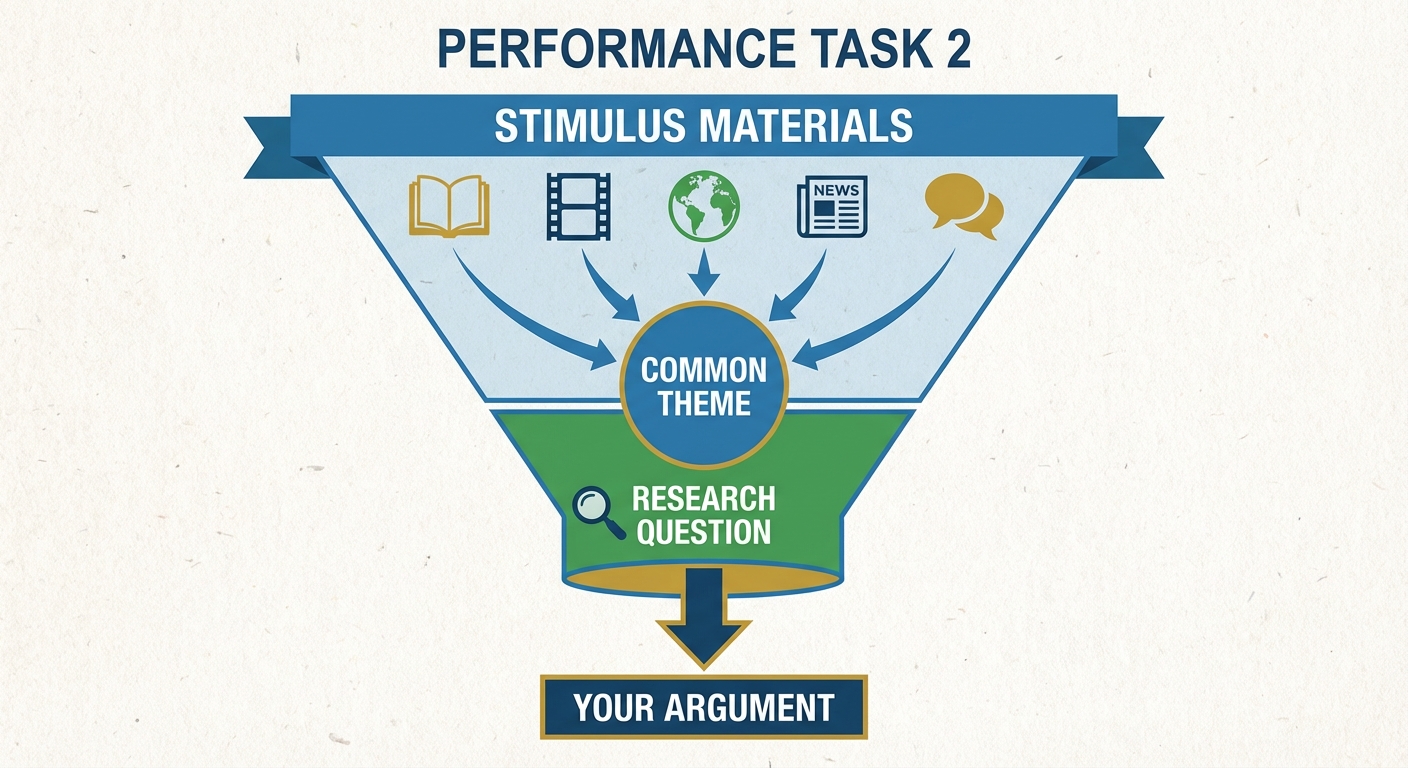
- Synthesis Goal: You are given stimulus materials (a set of unconnected documents). You must find a theme effectively connecting at least two of them and use that theme to launch your own research question and argument.
- Challenge: The stimulus materials must be integral to the argument, not just mentioned in passing.
EOC Exam Part B
- Synthesis Goal: You are given 4 distinct sources. You must read them, identify a common theme, and write a synthesized argument using them.
- Strategy: Create a matrix. List sources on one axis and themes on the other. See where they overlap before you write.
Common Mistakes to Avoid
"The Book Report" / Source Stacking:
- Mistake: Paragraph 1 summarizes Source A. Paragraph 2 summarizes Source B.
- Fix: Organize by themes or reasons, not by sources. A single paragraph should often cite multiple sources interacting with each other.
The "Drive-By" Citation:
- Mistake: Dropping a quote and moving on without explaining it.
- Fix: Use the ACE method: Assert (make a detailed claim), Cite (provide evidence), Explain (analyze how the evidence proves the claim).
Weak or Missing Line of Reasoning:
- Mistake: The essay feels like a random collection of facts.
- Fix: Check your transition words between paragraphs. If you can swap the order of your body paragraphs and it makes no difference, your Line of Reasoning is weak.
Neglecting the "So What?":
- Mistake: Reaching a conclusion that just restates the thesis.
- Fix: Discuss the implications, limitations, or future directions of your findings. Why does this argument matter now?
Memory Aid: The "Synthesizing Script"
Use this mental script to ensure you are synthesizing:
- "While [Source A] argues [X], [Source B] deepens this understanding by showing [Y]. However, [Source C] warns that [Z]. Therefore, the most logical conclusion is…"
By mastering Big Idea 4, you are doing the work of real scholars: moving the world forward by connecting ideas in new and powerful ways.