AP Physics C: Mechanics — Unit 1: Kinematics Breakdown
Fundamental Concepts: Position, Velocity, and Acceleration
One-dimensional kinematics describes motion along a straight line (e.g., the x-axis or y-axis) without considering the forces causing the motion. In AP Physics C, unlike Physics 1, we define these quantities using differential calculus.
Position and Displacement
- Position ($x$): The location of an object relative to a defined origin at a specific time $t$.
- Displacement ($\Delta x$): The change in position. It is a vector quantity.
- Distance: The total path length traveled. It is a scalar and is never negative.
Velocity vs. Speed
- Average Velocity: The total displacement divided by the time interval.
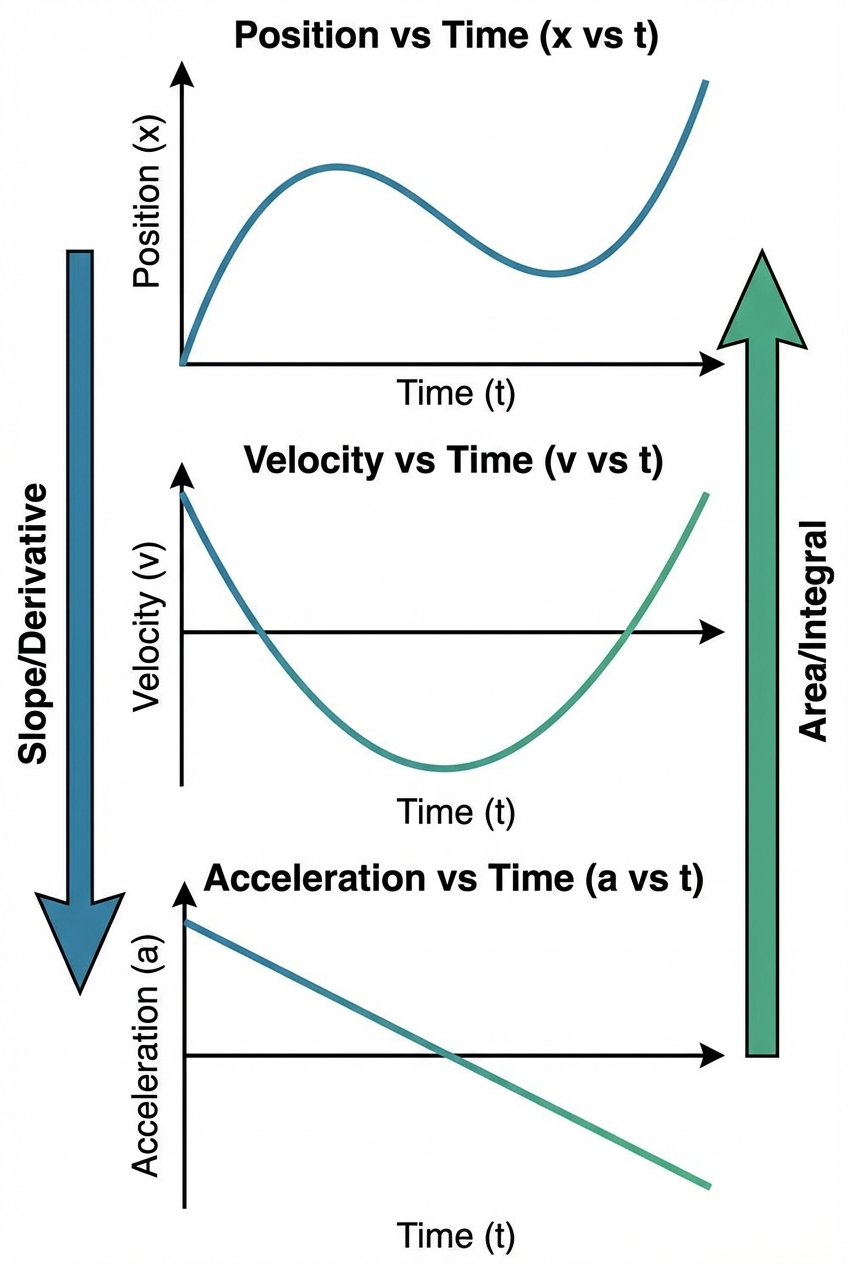
- Instantaneous Velocity ($v$): The velocity at a specific moment in time. Following calculus definitions, it is the derivative of position with respect to time.
- Speed: The magnitude of the instantaneous velocity vector ($|v|$). Speed is a scalar.
Acceleration
- Average Acceleration: The change in velocity over a time interval.
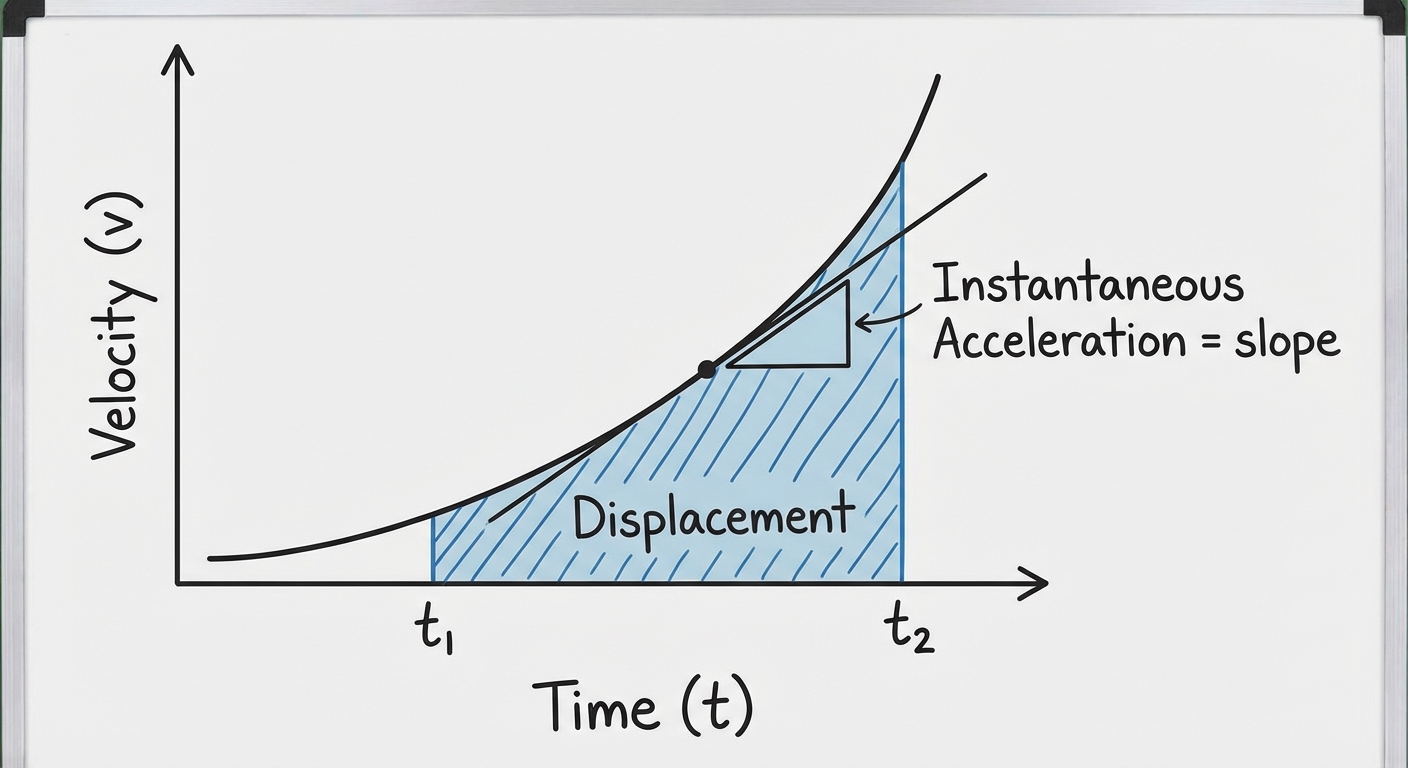
- Instantaneous Acceleration ($a$): The rate of change of velocity. It is the derivative of velocity, or the second derivative of position.
Motion with Constant Acceleration
When acceleration is constant (i.e., $a(t) = \text{constant}$), we can derive the "Big Three" kinematic equations. These are frequently used for free-fall problems and uniform interactions.
Warning: These equations ONLY apply when acceleration is constant.
The Kinematic Equations
| Equation | Variables Related | Missing Variable |
|---|---|---|
| Velocity, Time, Accel | Position ($x$) | |
| Position, Time, Accel | Final Velocity ($v$) | |
| Velocity, Position, Accel | Time ($t$) |
Notation Refresher:
- $x_0$: Initial position at $t=0$
- $v_{x0}$: Initial velocity at $t=0$
- $a_x$: Constant acceleration
Free Fall
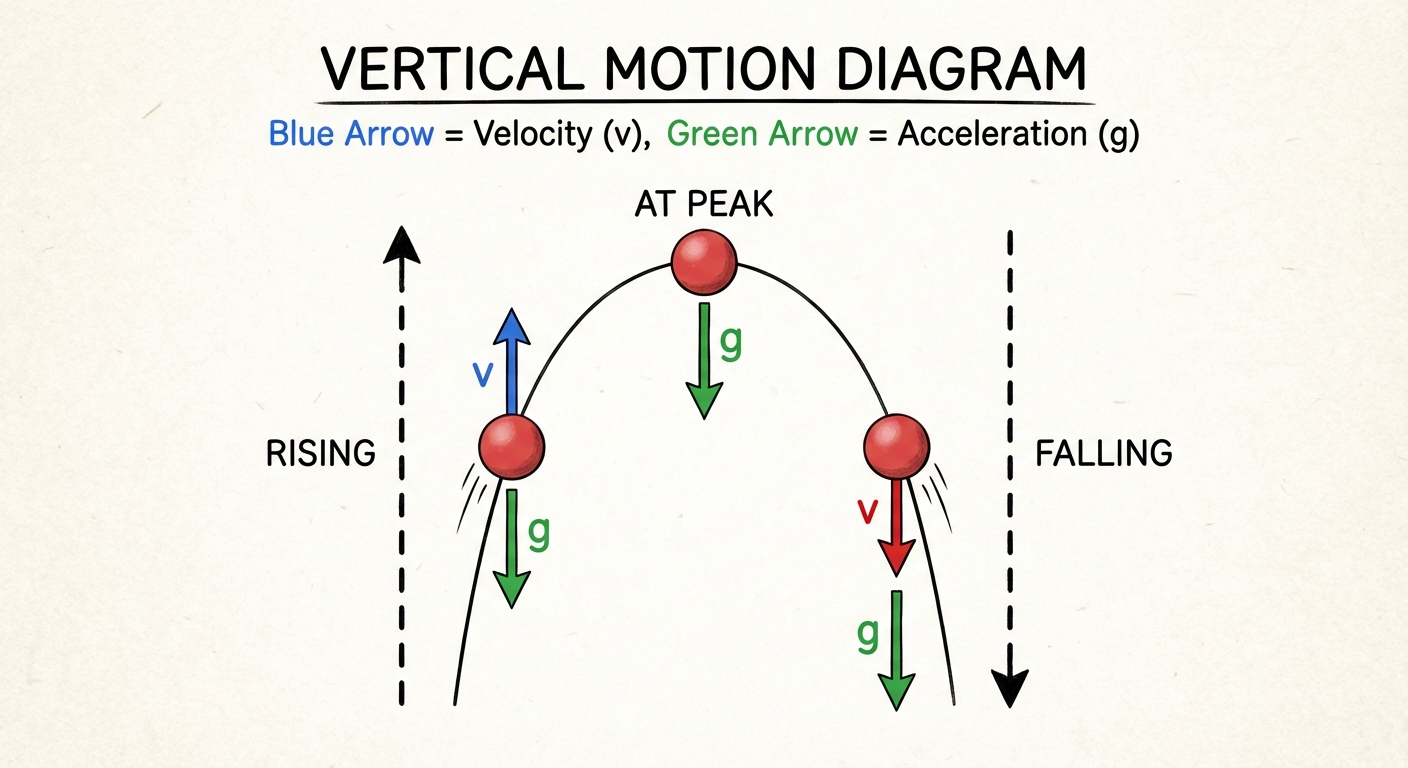
Free fall is the most common example of constant acceleration. In the absence of air resistance, all objects near Earth's surface accelerate downward at a constant rate $g$.
- Value: $g \approx 9.8 \; m/s^2$ (often approximated as $10 \; m/s^2$ on multiple choice depending on exam instructions).
- Direction: Gravity acts downward. If you define "up" as positive, then $a_y = -g = -9.8 \; m/s^2$.
Example: The Vertical Toss
A ball is thrown straight up with an initial speed of $20 \; m/s$. How high does it go?
Solution:
- Define coordinates: Let ground $= 0$, Up $= +y$.
- Identify variables: $v{y0} = 20$, $ay = -9.8$, $v_{final} = 0$ (at the peak).
- Select Equation: $vy^2 = v{y0}^2 + 2a_y(\Delta y)$
- Substitute: $0 = (20)^2 + 2(-9.8)(\Delta y)$
- Solve: $-400 = -19.6(\Delta y) \Rightarrow \Delta y \approx 20.4 \; m$
Motion with Non-Constant Acceleration (Calculus)
This section distinguishes AP Physics C from lower-level physics. If acceleration changes with time (e.g., air resistance, varying engine thrust), you cannot use the kinematic equations above. You must use integration.
From Acceleration to Velocity
Since $a = \frac{dv}{dt}$, we can integrate acceleration to find velocity:
Or, using definite limits:
Note: The area under the Acceleration vs. Time graph represents the change in velocity ($\Delta v$).
From Velocity to Position
Since $v = \frac{dx}{dt}$, we can integrate velocity to find position:
Or, using definite limits:
Note: The area under the Velocity vs. Time graph represents the change in position (displacement).
Worked Example: Non-Constant Acceleration
An object moves with acceleration given by $a(t) = 6t \; m/s^2$. At $t=0$, the object is at rest at the origin.
Find the velocity function $v(t)$.
Apply initial condition: at $t=0, v=0$. Therefore $C1 = 0$.Find the position function $x(t)$.
Apply initial condition: at $t=0, x=0$. Therefore $C2 = 0$.
Graphical Analysis Summary
Understanding the relationship between graphs is crucial.
| Graph Type | Slope Represents | Area Under Curve Represents |
|---|---|---|
| Position vs. Time ($x-t$) | Velocity ($v$) | N/A (physically meaningless) |
| Velocity vs. Time ($v-t$) | Acceleration ($a$) | Displacement ($\Delta x$) |
| Acceleration vs. Time ($a-t$) | Jerk (change in accel) | Change in velocity ($\Delta v$) |
Common Mistakes & Pitfalls
- Using Kinematic Equations when $a \neq constant$: This is the most common error. If $a$ depends on time ($t$) or position ($x$), you MUST use calculus (integration), not the algebraic equations.
- Confusing Displacement with Distance: If an object moves forward and then backward to its starting point, displacement is 0, but distance is positive. $\int |v(t)| dt$ is distance, while $\int v(t) dt$ is displacement.
- Forgetting the $+C$: When performing indefinite integration, always add the constant of integration ($C$) and solve for it using the Initial Conditions given in the problem statement.
- Sign Errors in Free Fall: Define your coordinate system immediately. If Up is positive, then $g$ is negative. If Down is positive, $g$ is positive. Be consistent.