Unit 10: Global Contemporary (1980 CE–Present) — Comprehensive Study Guide
Unit 10: Global Contemporary (1980 CE–Present)
Overview and Historical Context
Global Contemporary Art marks a departure from the Eurocentric focus of previous art history eras. Starting around 1980, the art world expanded to include diverse voices from every continent, heavily influenced by globalization, the digital revolution, and postmodern philosophy.
Key Themes
- Globalization: The acceleration of cultural exchange, migration, and the internet created an interconnected art world. Artists travel frequently (biennials, art fairs) and often live in countries different from their birth.
- Postmodernism: A rejection of the "purity" and "universality" of Modernism. It embraces pluralism, irony, parody, and the mixing of high and low culture.
- Identity Politics: Art became a primary vehicle for exploring race, gender, class, sexual orientation, and ethnicity (e.g., Feminist Art, Post-Colonial critiques).
- New Media & Materials: The use of video, computers, the internet, and hazardous or organic materials (e.g., blood, trash, food) expanded the definition of "art."
- Institutional Critique: Artists began to question the role of museums and galleries in establishing value and meaning (e.g., Shibboleth).
Architecture: Deconstructivism and Technology
In the late 20th century, architecture moved away from the rigid boxes of the International Style toward fluid, fragmented, and computer-aided designs.
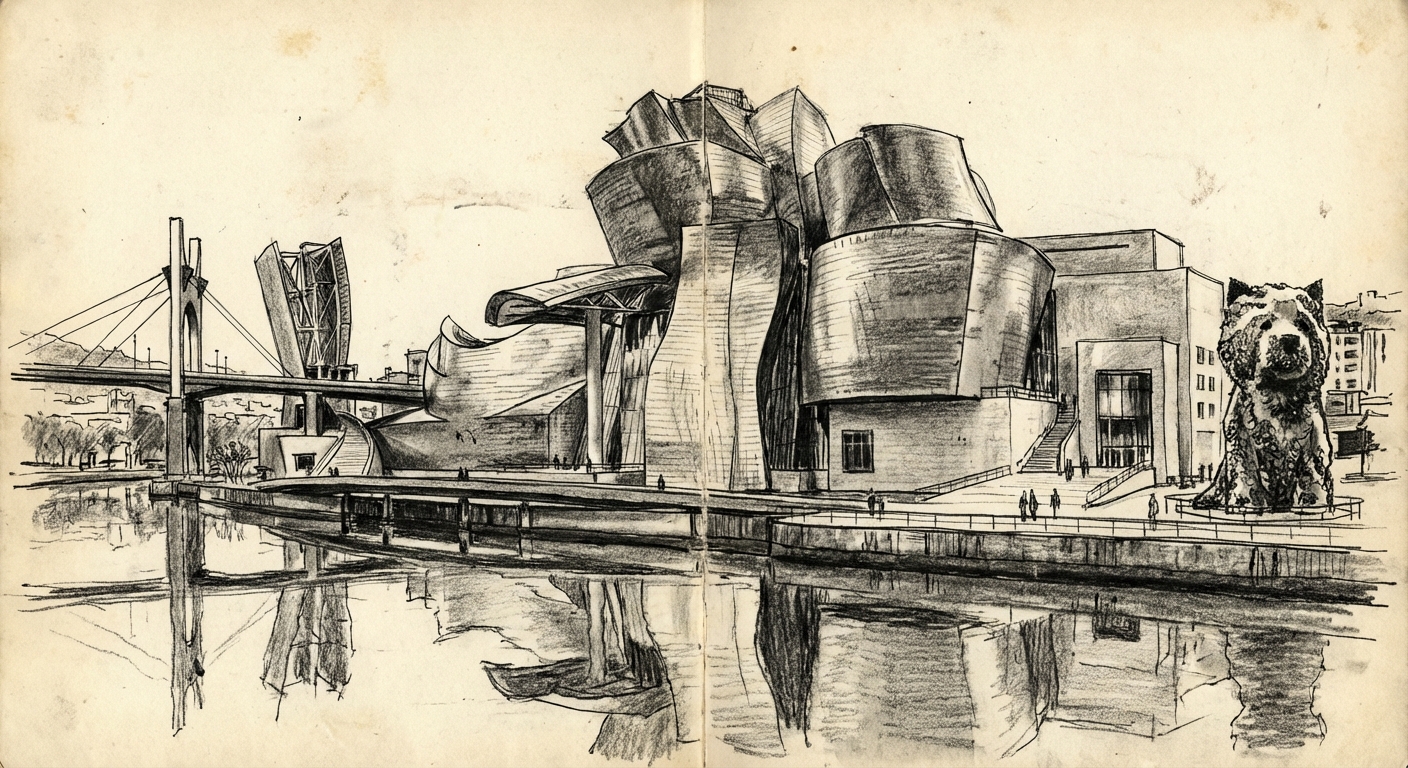
240. Guggenheim Museum Bilbao
- Artist: Frank Gehry
- Date: 1997 CE
- Location: Bilbao, Spain
- Material: Titanium, glass, and limestone
Form:
- Deconstructivism: Characterized by fragmentation, an interest in manipulating a structure's surface, and non-rectilinear shapes.
- Asymmetrical, sweeping curves that resemble a ship (referencing Bilbao's port history) or a metallic flower.
- The chaotic interior curves were designed using CATIA, an aerospace software.
- Titanium shimmers gold or silver depending on the light.
Function:
- Contemporary art museum.
- Economic Catalyst: Created the "Bilbao Effect"—using iconic architecture to revitalize a decaying industrial city.
Context:
- Critiqued for dominating the art inside it; the building is the main attraction.
249. MAXXI National Museum of XXI Century Arts
- Artist: Zaha Hadid (Iraqi-British architect)
- Date: 2009 CE
- Location: Rome, Italy
- Material: Glass, steel, and cement
Form:
- Characterized by movement and flow; walls "melt" into one another.
- Uses concrete (referencing Rome's history) but in curving, ribbon-like streams.
- Interior staircases are black ribbons contrasting with white walls.
Function:
- Museum for 21st-century art.
- Intended to move away from the "museum as object" to a "field of buildings."
Context:
- Hadid was the first woman to win the Pritzker Architecture Prize.
- The building sits on the site of old military barracks.
Identity, Race, and Colonialism
Many artists in this unit explore the legacy of colonialism, slavery, and racial stereotyping.
226. Horn Players
- Artist: Jean-Michel Basquiat
- Date: 1983 CE
- Material: Acrylic and oil paintstick on three canvas panels (triptych)
Form:
- Neo-Expressionism: Aggressive brushwork, graffiti influence, text integration.
- Main figures: Jazz legends Charlie Parker (sax) and Dizzy Gillespie (trumpet).
- Use of anatomical diagrams and crossed-out words (to draw attention to them).
Context:
- Basquiat (Haitian/Puerto Rican descent) started as a graffiti artist (SAMO).
- elevates African American jazz musicians to the status of "high art" typically reserved for white masters.
243. Darkytown Rebellion
- Artist: Kara Walker
- Date: 2001 CE
- Material: Cut paper and projection on wall
Form:
- Silhouettes: Historically a polite, Victorian "lady's craft." Walker subverts this by depicting violent, gruesome scenes.
- Overhead projectors cast colored light; viewers' shadows block the light, forcing them into the scene.
Content:
- Depicts a nightmare scene of the Antebellum South. Figures are caricatures (stereotypes) dealing with rebellion, torture, and sexuality.
Context:
- Challenges the romanticized version of history (e.g., Gone with the Wind).
- Forces viewers to confront their own recognition of racial stereotypes based only on profiles.
244. The Swing (after Fragonard)
- Artist: Yinka Shonibare
- Date: 2001 CE
- Material: Mixed-media installation
Content:
- A 3D recreation of Fragonard's Rococo painting The Swing.
- The mannequin is headless (alluding to the French Revolution/guillotine).
- The dress is made of Dutch Wax Fabric.
Context and Meaning:
- Dutch Wax Fabric: Looks African, but is actually a product of Dutch colonization (printed in Europe/Asia, sold to Africa). It represents the complexity of post-colonial identity and global trade.
- Shonibare (British-Nigerian) explores class, frivolity, and the tangles of history.
233. Trade (Gifts for Trading Land with White People)
- Artist: Jaune Quick-to-See Smith
- Date: 1992 CE
- Material: Oil and mixed media on canvas
Form:
- Layering: Collage elements (newspaper clippings about Native life) covered in dripping red paint (blood/sacrifice) + outline of a canoe.
- Clothesline: Hanging above are cheap souvenirs (sports mascots, toy tomahawks) engaging in cultural appropriation.
Context:
- Created 500 years after Columbus's arrival (the "Quincentenary Non-Celebration").
- Comments on the "trade" of Manhattan for $24 vs. the cheap trinkets given back to Native Americans.
Gender, The Body, and Feminism
231. Untitled #228 (from the History Portraits series)
- Artist: Cindy Sherman
- Date: 1990 CE
- Material: Photograph
Form:
- Sherman is the model, makeup artist, and photographer.
- Reproduces the Baroque style (Judith beheading Holofernes) but looks intentionally artificial (cheap fabric, plastic mask for the head, obvious makeup).
Function:
- Critique of the "Male Gaze" and art historical tropes.
- Deconstructs how women are presented in history and media.
235. Rebellious Silence (from Women of Allah series)
- Artist: Shirin Neshat (Photo by Cynthia Preston)
- Date: 1994 CE
- Material: Ink on photograph
Form:
- Black and white portrait involving four symbols: the Veil (chador), the Gun, the Text (Farsi poetry), and the Gaze.
- Symmetrical composition bisected by the rifle.
Context:
- Neshat returned to Iran after the 1979 Islamic Revolution to find the country changed.
- Explores the paradox of the Iranian woman: seen by the West as oppressed, but by the regime as a militant defender of the faith.
247. Preying Mantra
- Artist: Wangechi Mutu
- Date: 2006 CE
- Material: Mixed media on Mylar
Form:
- Collage: Fragments of fashion magazines, pornography, medical diagrams, and African ethnography.
- The figure is a "cyborg"—part human, part animal, part machine.
Content:
- Female figure reclining on a Kuba cloth (traditional African textile).
- Title Pun: Preying (predatory) vs. Praying (religious) vs. Mantis (insect that eats its mate).
- Critiques the exoticization of the African female body.
Methodology: Challenging Space and Material
224. The Gates
- Artist: Christo and Jeanne-Claude
- Date: 1979–2005 CE
- Material: Mixed-media installation (saffron fabric, steel)
- Location: Central Park, NYC
Key Concepts:
- Ephemerality: It only lasted 16 days. The urgency to see it was part of the art.
- Site-Specificity: Designed specifically for the pathways of Central Park (interacting with the Victorian landscape design by Olmsted).
- Funding: Entirely self-funded by the artists (selling sketches) to maintain artistic freedom—no sponsors, no city money.

248. Shibboleth
- Artist: Doris Salcedo
- Date: 2007–2008 CE
- Location: Tate Modern, London (Turbine Hall)
Form:
- A massive crack in the concrete floor of the museum, widening and deepening as it moves.
- It was real (structural), not painted.
Context:
- Shibboleth: A biblical term used to distinguish "in-group" from "out-group" based on pronunciation.
- Represents the immigrant experience: the "crack" in society, racism, and segregation that is often ignored. Even after it was filled, the "scar" remains on the museum floor.
250. Kui Hua Zi (Sunflower Seeds)
- Artist: Ai Weiwei
- Date: 2010–2011 CE
- Material: Sculpted and painted porcelain
Form:
- 100 million distinct ceramic seeds, handmade by 1,600 artisans in Jingdezhen (China’s porcelain capital).
- Looks like a mass produced pile, but every seed is unique.
Meaning:
- Propaganda: Mao Zedong was the "sun" and the people were "sunflowers" turning toward him.
- Labor: Comments on the "Made in China" phenomenon—Western consumption relies on cheap Chinese labor, but Ai Weiwei elevates that labor back to individual craftsmanship.
Technology, Video, and New Media
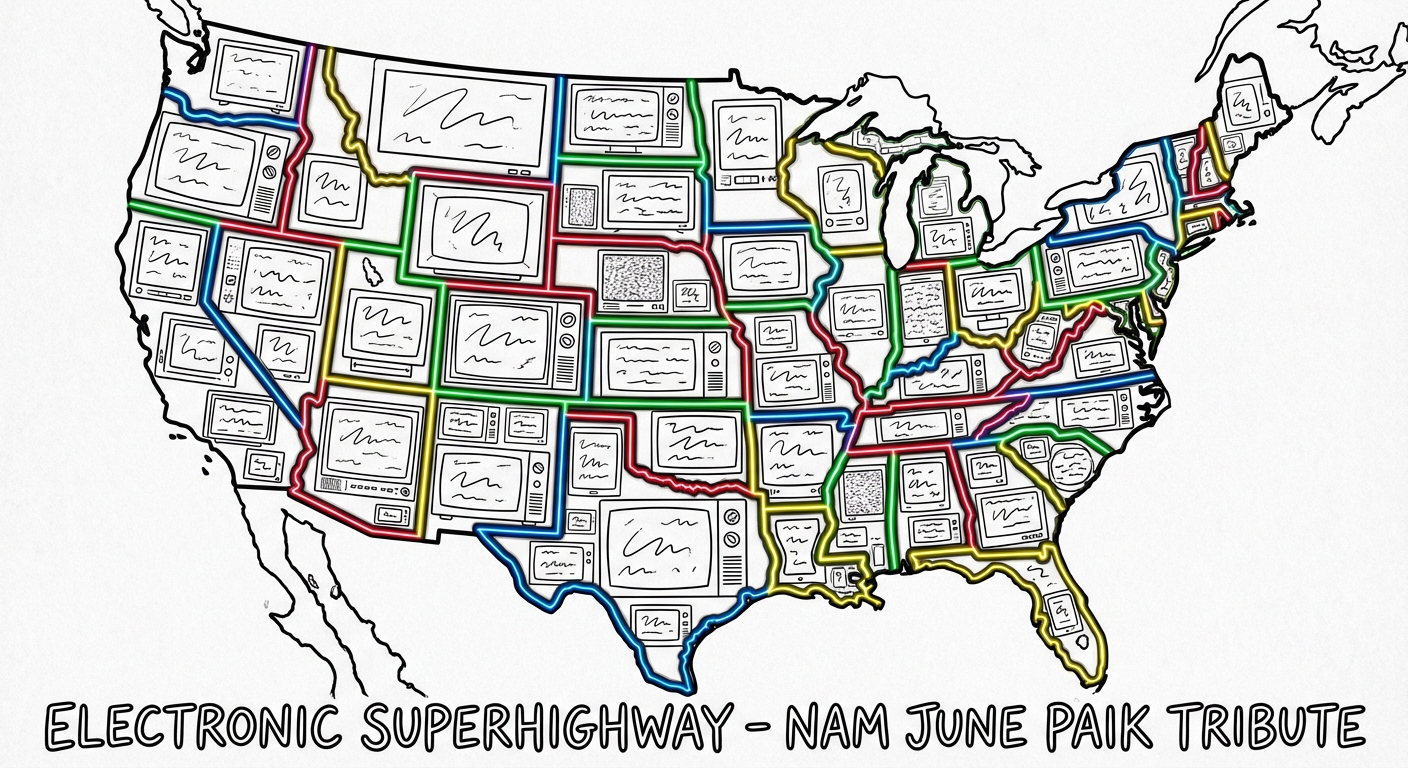
238. Electronic Superhighway
- Artist: Nam June Paik (Father of Video Art)
- Date: 1995 CE
- Material: 49-channel video installation, neon, steel
Form:
- Map of the USA outlined in neon.
- Each state is filled with TV monitors playing clips associated with that state (e.g., potatoes for Idaho, Oklahoma! for Oklahoma).
Context:
- Prediction of the internet age (Paik coined the term "Electronic Superhighway").
- Information Overload: The flashing images reflect how media consumption overwhelms the senses.
239. The Crossing
- Artist: Bill Viola
- Date: 1996 CE
- Material: Video/Sound installation
Form:
- Double-sided screen. Slow-motion video.
- Side 1: A man is consumed by fire.
- Side 2: A man is consumed by water.
- The figure vanishes; the cycle repeats.
Content:
- Promotes a meditative state.
- Explores spirituality, purgation, and the cycle of destruction/creation common in Zen Buddhism and Christian mysticism.
Spiritual and Cultural Revitalization
227. Summer Trees
- Artist: Song Su-nam
- Date: 1983 CE
- Material: Ink on paper
Context:
- Sumukhwa Movement: Oriental Ink Movement in the 1980s. A Korean attempt to recover traditional identity after decades of colonization and modernization.
- Combines traditional ink wash methods with Western abstract composition (Morris Louis).
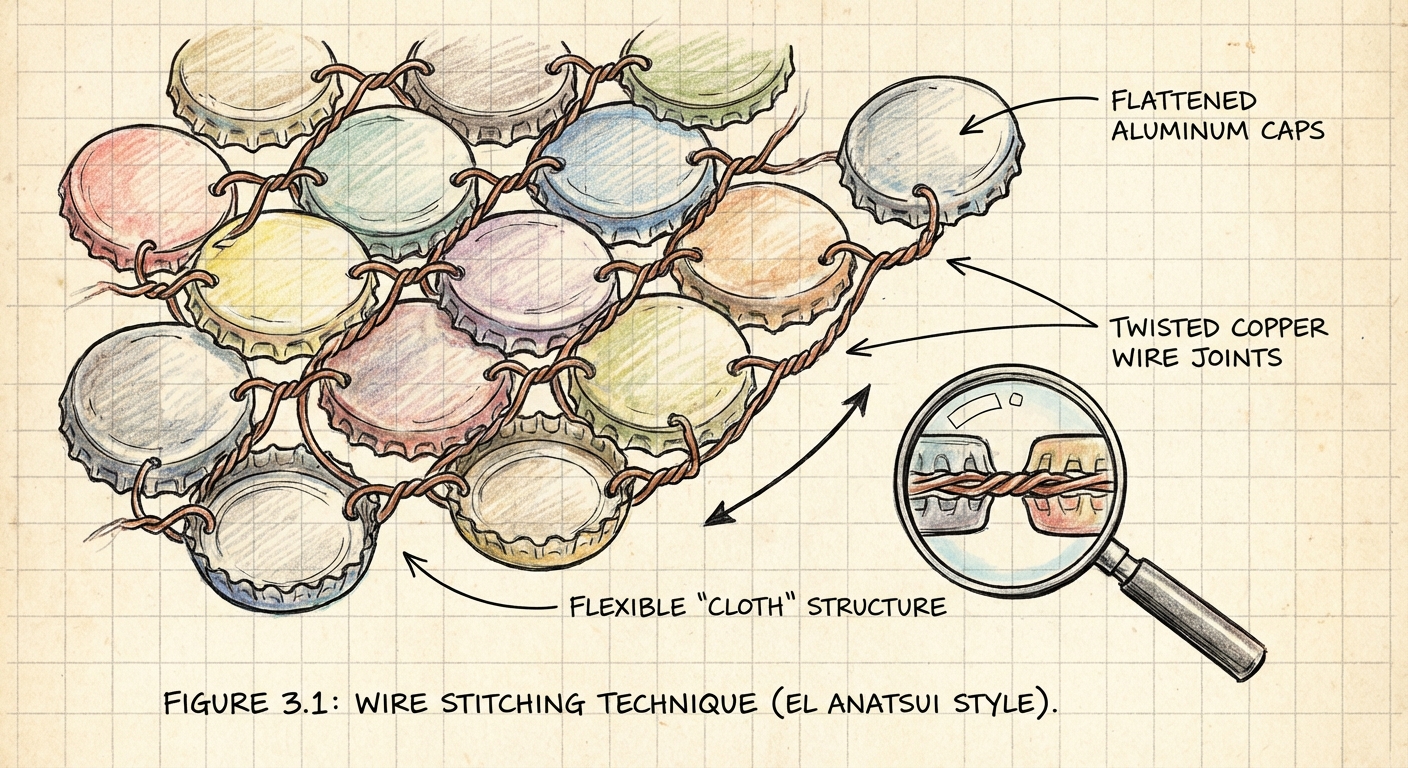
245. Old Man’s Cloth
- Artist: El Anatsui
- Date: 2003 CE
- Material: Aluminum and copper wire (liquor bottle caps)
Form:
- Thousands of flattened metal liquor bottle caps wired together.
- Flexible: It hangs like a textile/tapestry but is made of metal.
- Form changes every time it is installed.
Content:
- Alcohol & Trade: Liquor was a key commodity in the Trans-Atlantic slave trade (Triangle Trade). Alcohol was introduced by Europeans to Africa.
- Gold Color: References the "Gold Coast" (Ghana).
- Kente Cloth: Mimics the patterns of traditional Ashanti textiles.
Additional Works Checklist (Quick Review)
- 225. Vietnam Veterans Memorial (Maya Lin): Minimalist. Black granite cut into the earth (a scar/wound). Apolitical list of names. Intense controversy upon release due to lack of heroic figuration.
- 228. Androgyne III (Magdalena Abakanowicz): Hollow shell, headless figures made of burlap/resin. Reflection of dehumanization in WWII and Soviet-occupied Poland.
- 229. A Book from the Sky (Xu Bing): Room filled with books/scrolls containing thousands of "fake" Chinese characters. Critique of the meaninglessness of political propaganda during the Cultural Revolution.
- 230. Pink Panther (Jeff Koons): Kitsch. Banality. Porcelain (high art) depicting cartoon/Playboy model (low art). Introduction of consumerism into the gallery.
- 232. Dancing at the Louvre (Faith Ringgold): Story quilt. Rewrites art history to include black women in spaces they were excluded from.
- 236. En la Barberia no se Llora (Pepón Osorio): "Nuyorican" identity. Challenges "Machismo" in Latino culture. Kitsch/Maximalist installation.
- 237. Pisupo Lua Afe (Michel Tuffery): Corned beef tin bull. Critique of ecological health in the Pacific (obesity/diabetes) and dump-trade economics.
- 241. Pure Land (Mariko Mori): Digital photography on glass. Features the artist as a pop-culture Buddha deity. Merges consumerism, anime, and Buddhism.
- 242. Lying with the Wolf (Kiki Smith): Feminist re-telling of Little Red Riding Hood/St. Genevieve. Woman acts as equal/tamer to the beast, not a victim.
- 246. Stadia II (Julie Mehretu): Abstract. Layers of architectural blueprints, flags, and corporate logos. Energy of the globalized world (protests, sports, revolutions).
Common Mistakes & Pitfalls
- Modern vs. Contemporary: Do not confuse these. "Modern Art" (capital M) generally ends around the 1970s. This unit is Contemporary (Postmodern).
- Contextualizing "Global": Students often forget why a work is global. (e.g., El Anatsui is not just African art; it's about the global trade of alcohol and slaves).
- Materials Matter: In this unit, the medium is often the message. (e.g., Using "trash" for El Anatsui, "sugar/chocolate" for other Kara Walker works not listed here, or "porcelain" for Koons). Do not just say "sculpture."
- Misidentifying Form: Guggenheim Bilbao is Deconstructivism, NOT International Style. It is chaotic and organic, not a glass box.
- Ai Weiwei's Seeds: Remember they are porcelain, not real seeds. This is crucial to the meaning (labor/craft vs. natural).