Unit 4: Structural Choices and Argument Development
Rhetorical Choices in Developing Arguments
In AP English Language and Composition (Unit 4), the focus shifts from identifying what devices a writer uses to understanding how a writer structures an entire argument to move an audience. A Rhetorical Choice is any strategic decision a writer makes to craft their argument—including how they construct their introduction, what evidence they select, and how they conclude.
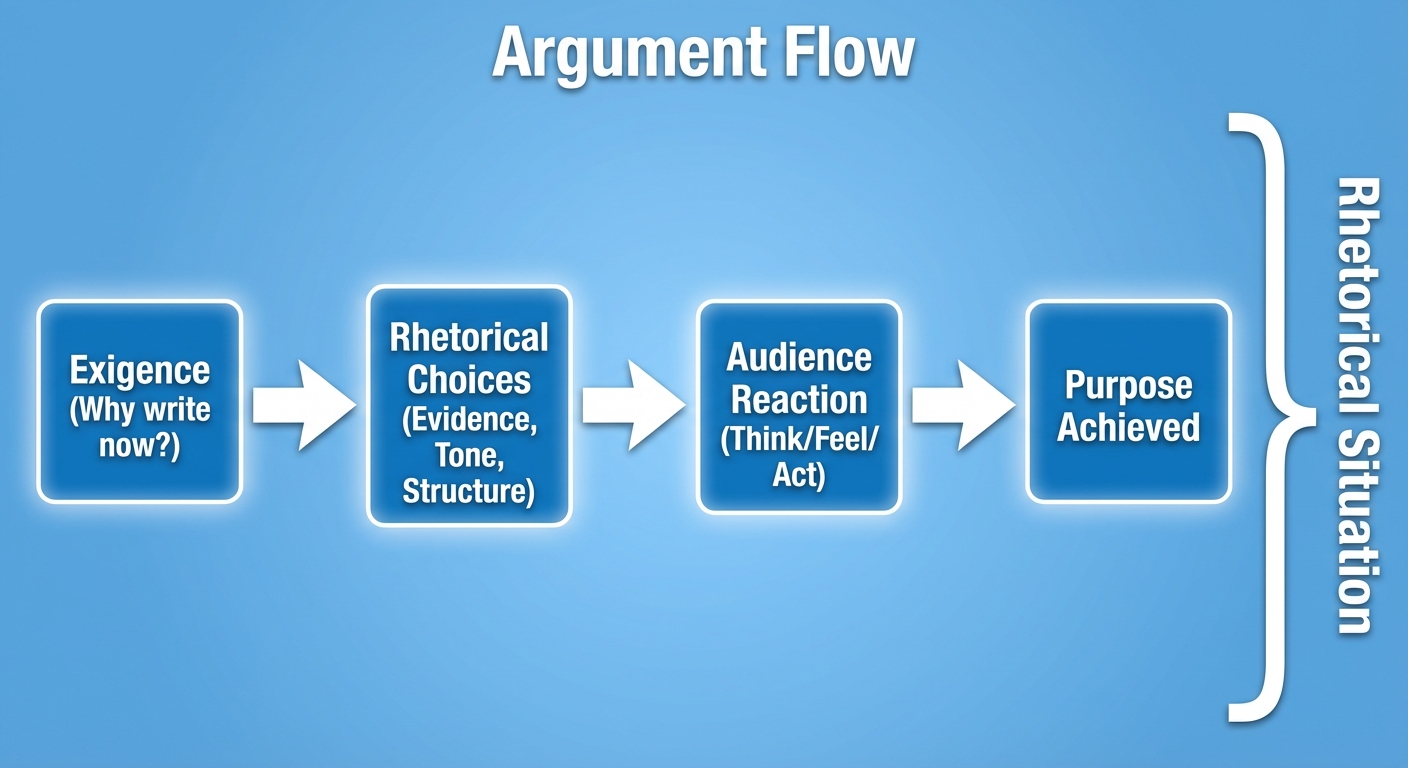
The Role of the Rhetorical Situation
Every structural choice depends on the Rhetorical Situation: the interplay between the speaker, audience, and subject.
- Exigence: The spark or catalyst that moves the writer to write now. The introduction usually establishes this.
- Audience: The specific group the writer aims to persuade. Evidence is selected specifically to appeal to their values.
- Purpose: What the writer wants the audience to do or think by the end (often solidified in the conclusion).
The Thesis Statement as an Anchor
In Unit 4, the thesis is viewed as the structural anchor of the essay. A strong thesis does not merely state a fact; it creates a tension that requires proof.
- Observation: The subject or context.
- Stance: The writer's arguable position.
- "Because" clause: The line of reasoning that outlines how the argument will develop.
Strategic Use of Evidence
Writers do not use random facts; they curate evidence based on what will be most convincing to their specific audience. This process is crucial for the Development of the argument.
Matching Evidence to Audience
The effectiveness of evidence relies on the audience’s relationship to the subject.
| Type of Evidence | Definition | Best Used For… |
|---|---|---|
| Anecdote | A short, personal or historical story. | Building Pathos (emotion/connection); effective for general audiences. |
| Expert Testimony | Quotes/ideas from recognized authorities. | Building Ethos (credibility); effective for skeptical or academic audiences. |
| Quantitative Data | Statistics, charts, and hard numbers. | Building Logos (logic); effective for scientific or pragmatic audiences. |
| Analogy/Hypothetical | Comparisons or "what if" scenarios. | Clarifying complex abstract concepts for laypeople. |
The Function of Commentary
Evidence cannot stand alone. It requires Commentary (analysis). Common pitfalls involve listing evidence without explaining how it supports the thesis.
The Evidence-Commentary Ratio:
Generally, for every sentence of evidence, you should provide at least two sentences of commentary.
- Identify: State the evidence.
- Explain: Clarify what the evidence means.
- Connect: Tie the evidence back to the thesis and the writer's line of reasoning.
Effective Introductions
The introduction is a strategic opening move, not just a summary of what lies ahead. It establishes the context and the exigence.
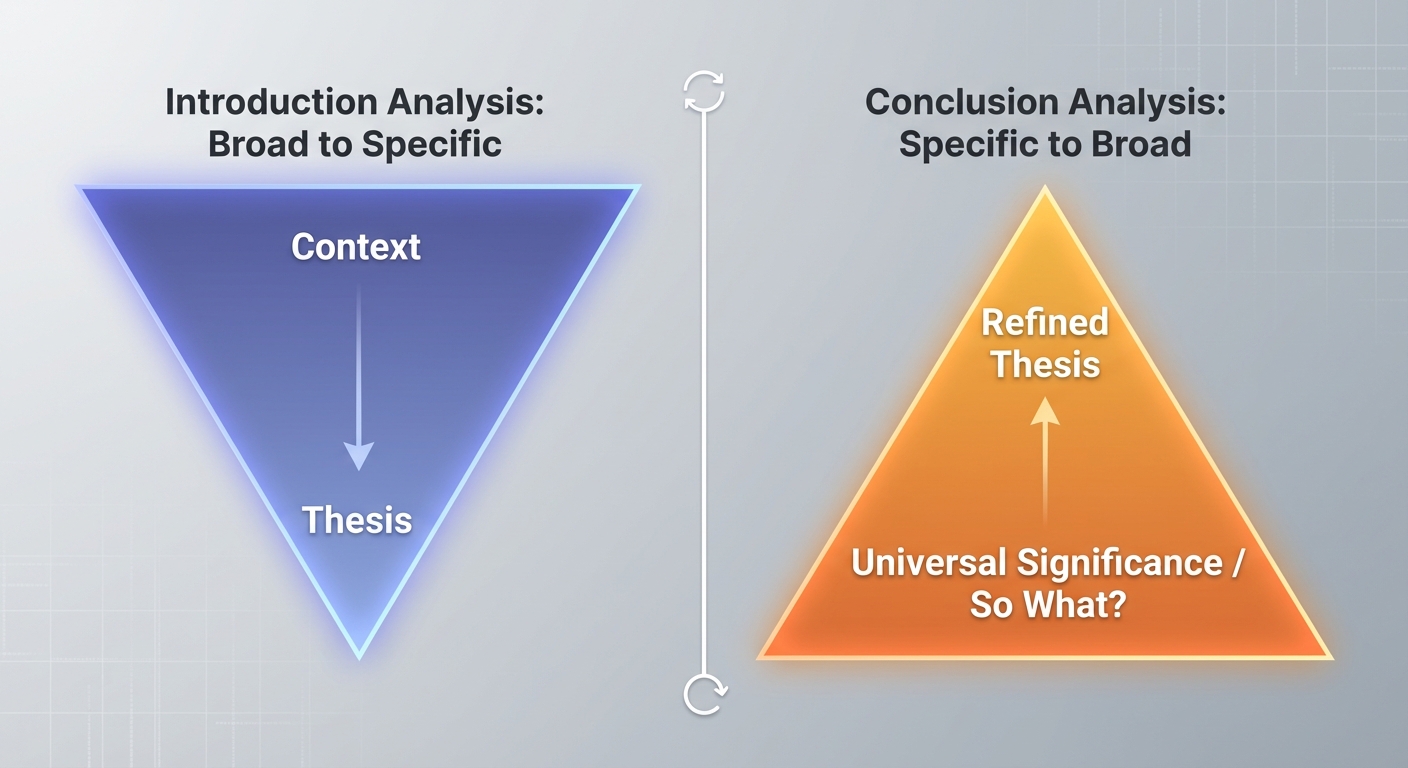
The Funnel Method
A common structure for introductions is the "Funnel Method," moving from broad context to specific argument.
Strategies for Hooking the Audience
- Challenge a Common Assumption: Start by stating what people usually think, then pivot to why that view is incomplete.
- Provide a Definition: Redefine a key term central to the argument.
- State a Paradox: Present a contradictory situation that the essay resolves.
Example of Contextualization:
Weak: "People have always argued about freedom."
Strong: "In the wake of the 21st-century digital revolution, the concept of personal privacy has shifted from a guarded right to a tradable commodity."
Effective Conclusions
A strong conclusion does not merely repeat the introduction. It provides a sense of closure and answers the question: "So What?"
The Reverse Funnel
If the introduction is a funnel (broad to specific), the conclusion creates a "Reverse Funnel" (specific to broad).
- Restate the Thesis (New Phrasing): Remind the reader of the claim, using the insight gaining during the essay.
- Synthesis: Show how the points made in the body paragraphs work together.
- Broader Significance: Explain the universal implications of the argument.
The "So What?" Factor
To score high in the AP rubric, a conclusion must explain why the argument matters beyond the specific text.
- Call to Action: Urging the audience to specific behavior (common in speeches).
- Prediction: Warning or projecting what will happen if the argument is ignored.
- Universal Truth: Connecting the specific topic to the human condition.
Common Mistakes & Pitfalls
1. The "Book Report" Trap
- Mistake: Focusing only on what the text says (summary) rather than why the author wrote it that way (analysis).
- Fix: Use action verbs related to writing choices (e.g., "The author contrasts…" rather than "The author says…").
2. Disconnected Evidence
- Mistake: Dropping a quote or statistic without explaining its relevance to the specific audience.
- Fix: Ensure your commentary explicitly links the evidence to the audience's values or needs.
3. Circular Conclusions
- Mistake: Ending the essay by writing, "In conclusion, [Thesis word-for-word]."
- Fix: Ask yourself, "What should the reader think now that they didn't think at the start?" Focus on the implications.
4. Weak Contextualization
- Mistake: Using "Since the dawn of time" or broad generalizations in the intro.
- Fix: Be specific to the particular era, cultural moment, or conversation surrounding the topic.