Mechanics of Uniform Circular Motion
Kinematics of Uniform Circular Motion
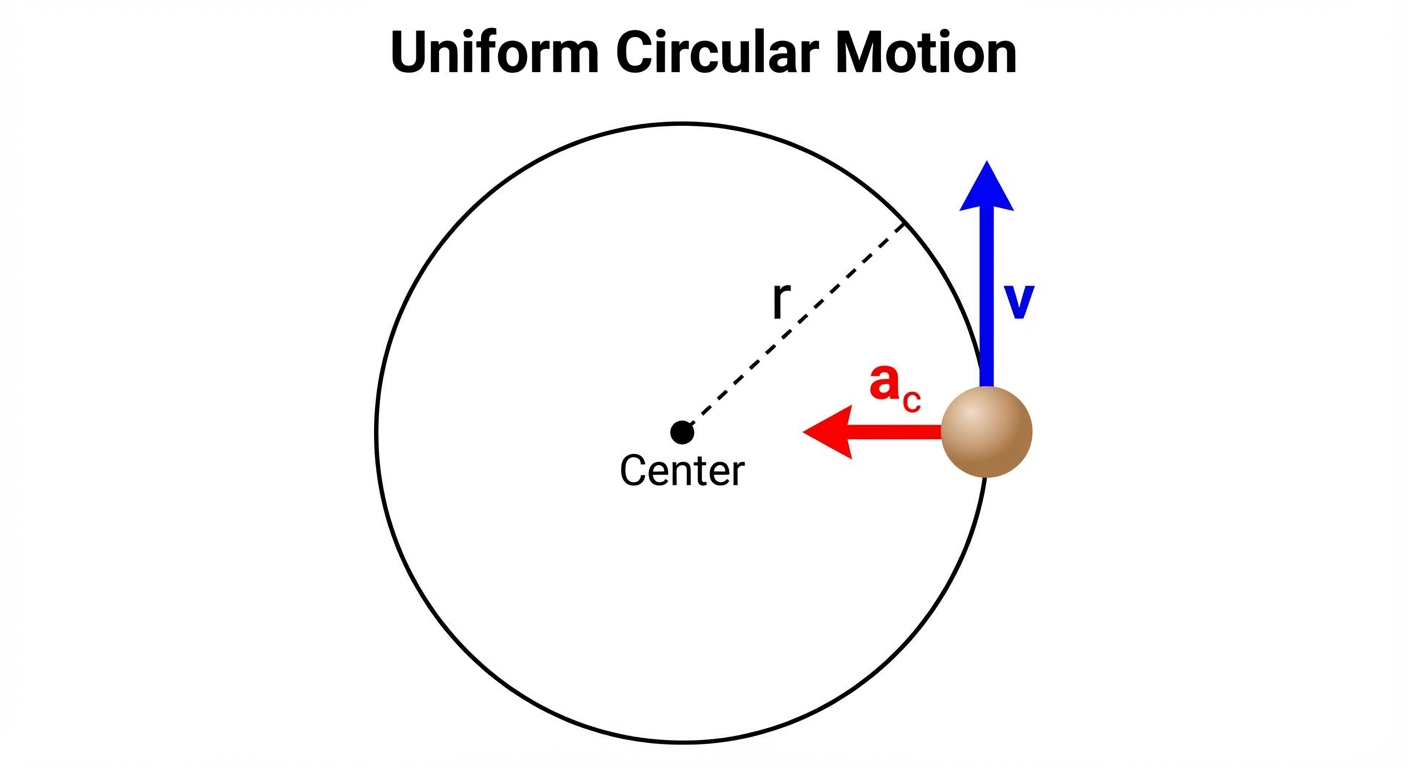
Circular motion is a specific subset of dynamics where an object travels along a circular path. In AP Physics 1, the primary focus is on Uniform Circular Motion (UCM), where the object moves at a constant speed.
Velocity vs. Speed
It is crucial to distinguish between speed and velocity in UCM:
- Speed ($v$): The magnitude of the velocity is constant. The object covers equal arc lengths in equal time intervals.
- Velocity ($\vec{v}$): The velocity is changing constantly because the direction of motion is always changing.
At any specific instant, the velocity vector is tangent to the circle. This is often referred to as tangential velocity.
Period and Frequency
To describe the timing of rotation, we use specific terms:
- Period ($T$): The time it takes to complete one full revolution (measured in seconds, s).
- Frequency ($f$): The number of revolutions completed per second (measured in Hertz, Hz).
The relationship between them is reciprocal:
The tangential speed can be calculated using the circumference of the circle ($2\pi r$) and the period:
Centripetal Acceleration
Even though the speed is constant, the object is accelerating because the direction of the velocity vector changes. This acceleration is called centripetal acceleration ($a_c$).
Key Characteristics:
- Direction: Always points toward the center of the circular path.
- Magnitude: Proportional to the square of the speed and inversely proportional to the radius.
Dynamics: Centripetal Force
The most important conceptual hurdle in this unit is understanding that Centripetal Force is not a physical type of force. You will never see a force labeled "$F_c$" on a Free Body Diagram (FBD).
Newton’s Second Law for Rotation
"Centripetal" is a job description—it means "center-seeking." It describes the net force required to keep an object moving in a circle. It is the result of other physical forces (Tension, Friction, Normal Force, Gravity) acting together.
Applying Newton's Second Law in the radial direction:
- If $\Sigma F$ points toward the center, it is positive.
- If $\Sigma F$ points away from the center, it is negative.
Identifying the Source Force
To solve problems, you must identify which physical force provides the centripetal acceleration:
| Scenario | Force Providing Centripetal Force ($F_c$) |
|---|---|
| Ball on a string | Tension ($T$) |
| Car turning on a flat road | Static Friction ($f_s$) |
| Satellite orbiting Earth | Gravity ($F_g$) |
| Roller coaster at bottom of loop | Normal Force - Gravity ($N - mg$) |
| Car on a banked curve | Horizontal component of Normal Force ($N_x$) |
Horizontal Circular Motion
Example 1: Car on a Flat Curve
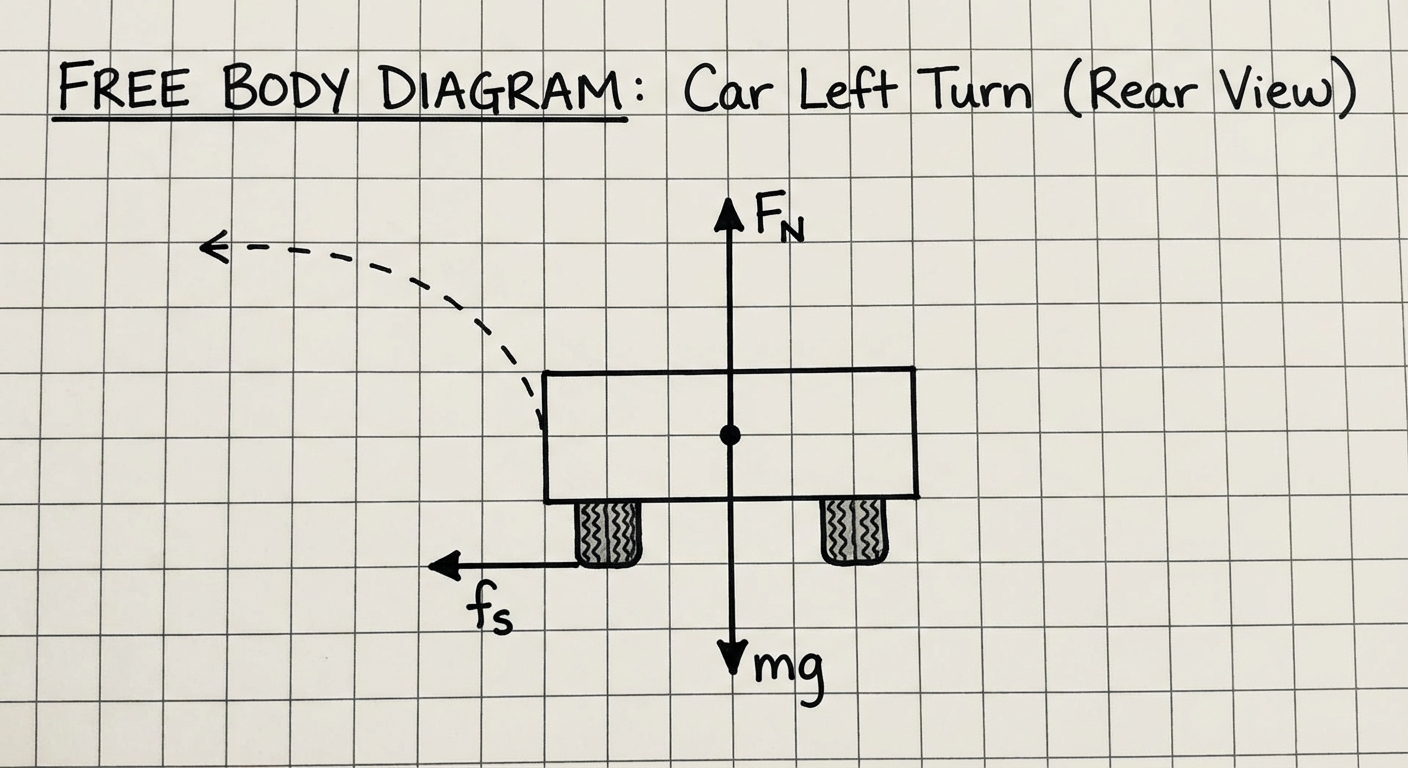
When a car turns a corner on a flat road, it is static friction between the tires and the road that pushes the car toward the center of the turn. If the road is icy (friction $\approx$ 0), the car will continue in a straight line (inertia).
The Equations:
- Vertical Axis: The car is not accelerating vertically.
- Radial Axis: Friction provides the net force.
Since maximum static friction is $f{s,max} = \mus FN$, the maximum speed a car can take a turn without slipping is derived by:
Note that mass cancels out—a heavy truck and a small car slip at the same speed (assuming equal tires).
The Conical Pendulum
Consider a ball on a string moving in a horizontal circle, creating a cone shape. The tension ($F_T$) pulls at an angle $\theta$ to the vertical.
Analysis:
- Vertical Component: Balances gravity. $F_T \cos\theta = mg$
- Horizontal Component: Provides centripetal force. $F_T \sin\theta = \frac{mv^2}{r}$
Vertical Circular Motion
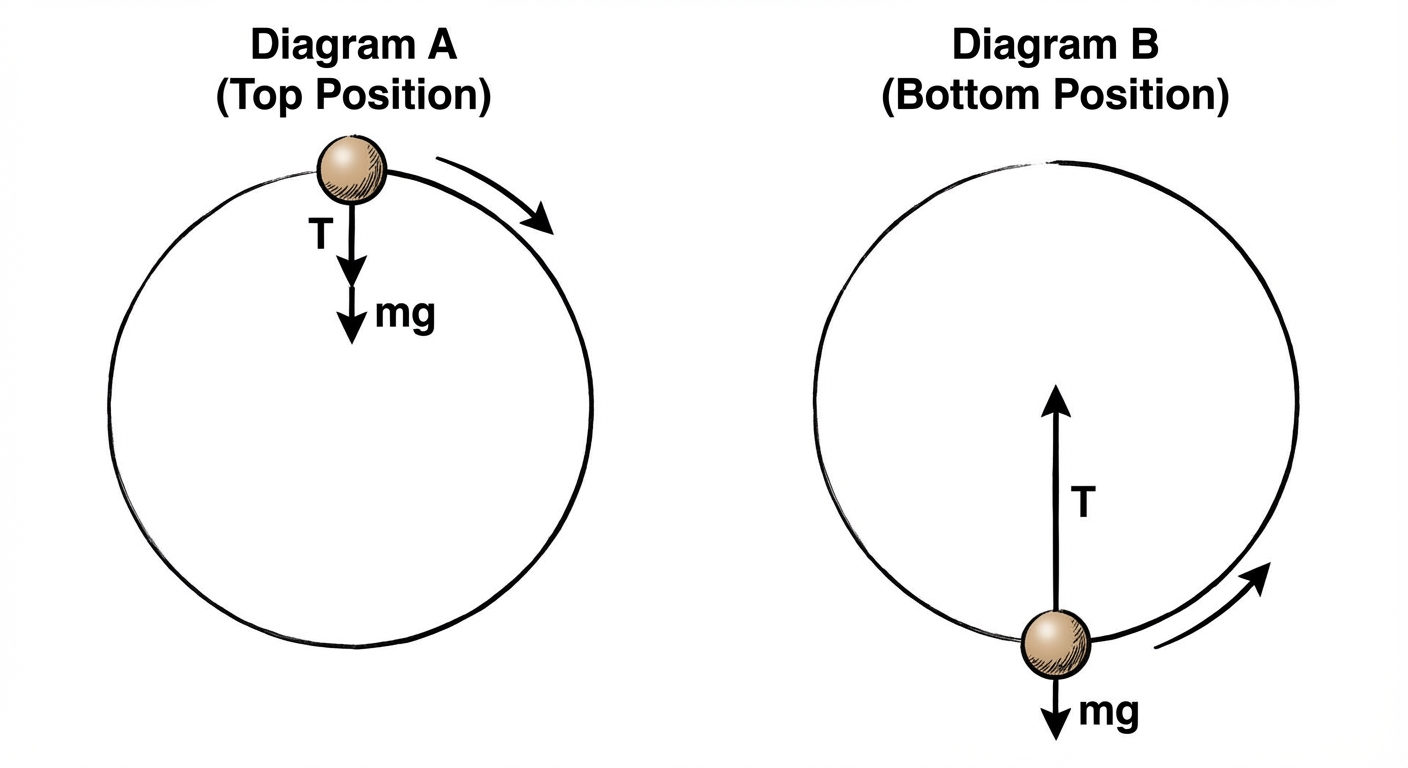
Vertical circles are non-uniform because gravity acts downward, causing the object's speed to change (slower at the top, faster at the bottom). However, we analyze them at specific points (top and bottom) where forces are aligned with the radius.
The Bottom of the Loop
At the bottom, the Normal Force (or Tension) points up toward the center, while Gravity points down away from the center. The net force must point upward (center) to maintain the circle.
Result: You feel heavier at the bottom of a rollercoaster loop because the seat must support your weight plus provide the force to accelerate you upward.
The Top of the Loop
At the top, both Gravity and the Normal Force point down toward the center.
Minimum Speed (Critical Velocity)
To complete a loop-the-loop, you must maintain a minimum speed at the top. If you go too slow, you fall out of the circle.
The limit occurs when the Normal Force (or tension) drops to zero ($F_N = 0$). This means gravity alone provides the centripetal force.
If $v < \sqrt{gr}$, the object leaves the circular path.
Common Mistakes & Pitfalls
Drawing $F_c$ on the Free Body Diagram
- Mistake: Students often draw an arrow labeled "Centripetal Force" alongside Gravity and Tension.
- Correction: Never put $Fc$ on an FBD. $Fc$ is the sum of the forces already on the diagram. Write the Sum of Forces equation first, then set it equal to $ma_c$.
The "Centrifugal" Force Myth
- Mistake: Thinking there is an outward force pushing you against the car door when turning.
- Correction: There is no outward force. What you feel is your own inertia. Your body wants to travel in a straight line (Newton's 1st Law), but the car door turns into you, pushing you toward the center.
Kinematics Confusion
- Mistake: Assuming acceleration is zero because speed is constant.
- Correction: Remember that acceleration is defined as a change in velocity (which is a vector). A change in direction is an acceleration.
Misidentifying Friction Direction
- Mistake: Thinking friction acts backward or outward for a turning car.
- Correction: For a car to turn, friction must act radially inward (toward the center of the turn) to prevent the tires from sliding outward.