Unit 5: Expansion, Regionalism, and the Road to Secession (1844–1860)
Unit 5: Expansion, Regionalism, and the Road to Secession (1844–1860)
Manifest Destiny and the Mexican-American War
The Ideology of Expansion
Manifest Destiny was the 19th-century belief that the United States was destined by God to expand its dominion across the entire North American continent, spreading democracy and capitalism. This ideology justified territorial acquisition and sparked conflict with Native Americans and Mexico.
- Motivation: Access to natural resources (mineral wealth in California), new economic opportunities, and religious refuge (Mormons in Utah).
- The Election of 1844: James K. Polk (Democrat) won on an expansionist platform, promising to annex Texas and acquire Oregon.
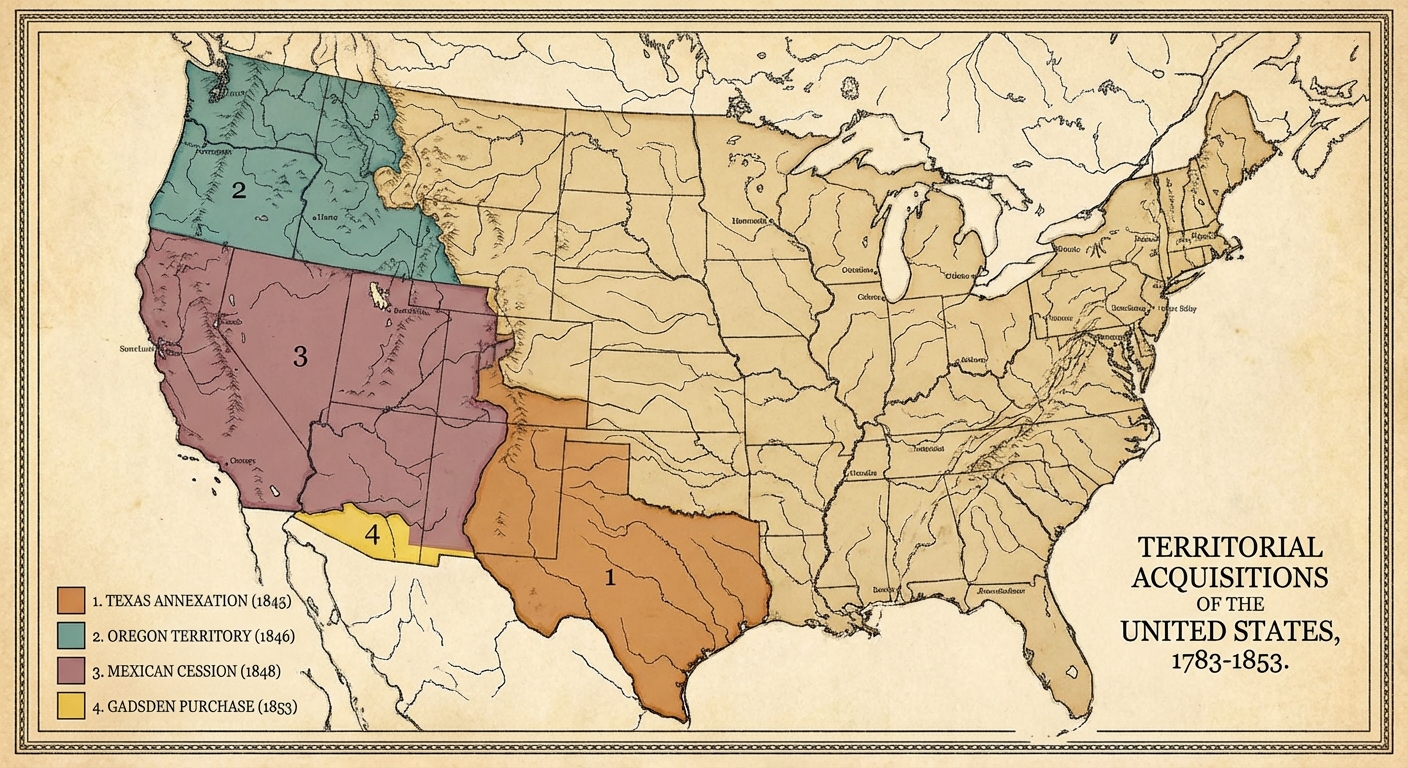
The Mexican-American War (1846–1848)
Following the U.S. annexation of Texas (1845), diplomatic relations with Mexico collapsed over border disputes (Rio Grande vs. Nueces River) and the U.S. desire to purchase California.
- Conflict: Polk sent troops to the disputed territory, provoking a skirmish used to justify a declaration of war.
- Treaty of Guadalupe Hidalgo (1848): Ended the war. Mexico recognized the Rio Grande as the southern border of Texas.
- The Mexican Cession: Mexico ceded California and New Mexico territory (modern-day AZ, NV, UT) to the U.S. for $15 million.
The Wilmot Proviso: A Defining Moment
Though never passed by the Senate, the Wilmot Proviso (1846) was a legislative amendment proposing that slavery be banned in all territory acquired from the Mexican War.
- Significance: It reignited the slavery debate in Congress, transforming a political dispute into a moral and sectional crisis. It highlighted that the issue was not just about slavery's existence, but its expansion.
Sectional Conflict: Regional Differences
By the 1850s, the North and South had developed into two distinct societies with conflicting economic systems and cultural values.
The North: Industrializing and Free Labor
- Economy: Manufacturing, railroads, and shipping. Relied on Free Labor (wage earners).
- Demographics: Rapid population growth due to mass immigration from Ireland (fleeing famine) and Germany (fleeing political unrest).
- Nativism: The influx of Catholic immigrants led to the rise of the Know-Nothing Party, an anti-immigrant, anti-Catholic nativist movement.
- Abolitionism vs. Free Soil:
- Abolitionists (e.g., William Lloyd Garrison) wanted an immediate end to slavery everywhere on moral grounds.
- Free Soilers did not necessarily want to end slavery in the South but opposed its expansion into the West to reserve land for white laborers.
The South: Agrarian and King Cotton
- Economy: Dominated by the plantation system and export agriculture, specifically cotton (