Comprehensive Study Notes on Sequences and Series Fundamentals
Defining Convergent and Divergent Infinite Series
In calculus, understanding infinite series is crucial for analyzing functions and their behaviors.
- An infinite series is the sum of the terms of an infinite sequence. It can be written as:
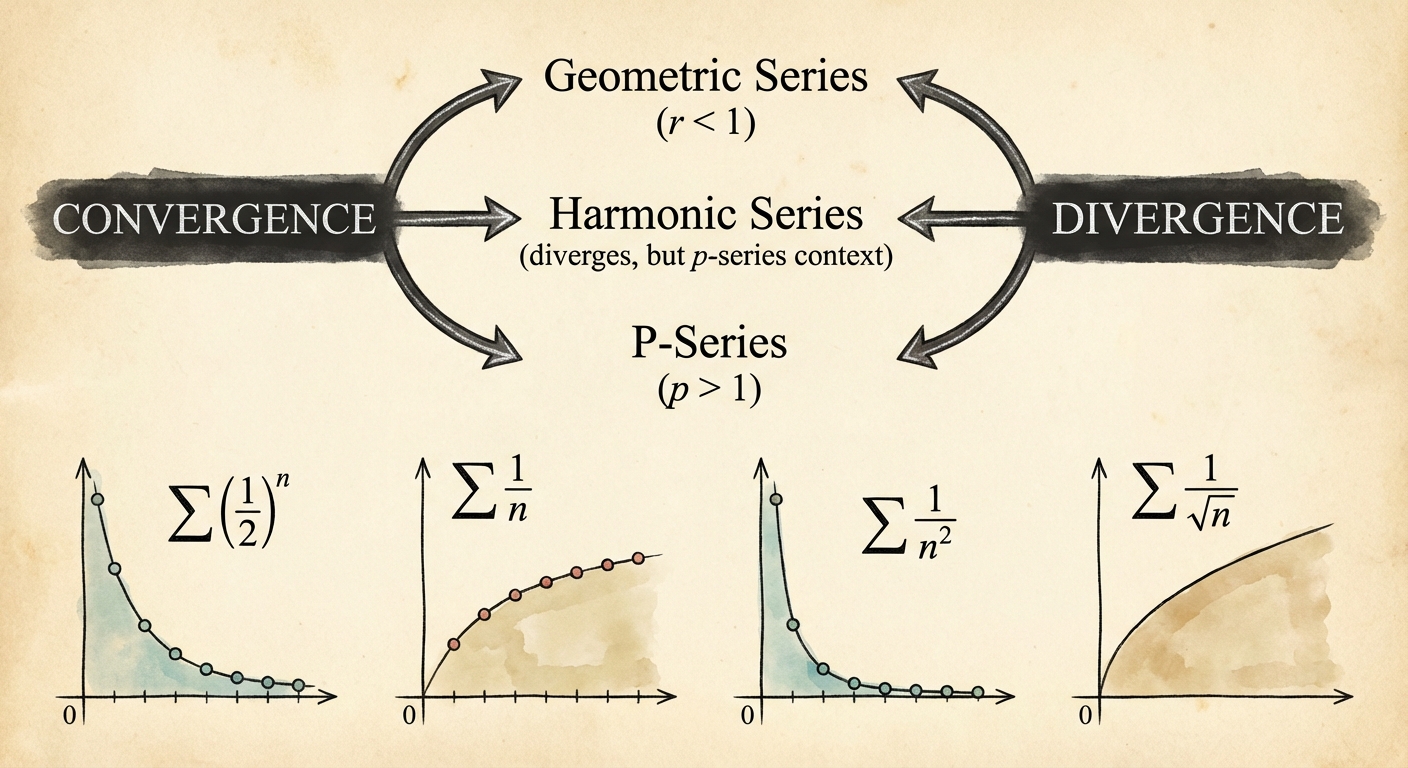
- An infinite series is considered convergent if the sum approaches a finite value (often denoted as $S$) as more terms are added. Conversely, it is divergent if the sum does not approach a finite limit.
Key Points
- Convergent series have a limit:
where $S_n$ is the partial sum of the first $n$ terms. - Common tests for convergence include the Ratio Test, Root Test, and p-Series Test.
Geometric Series
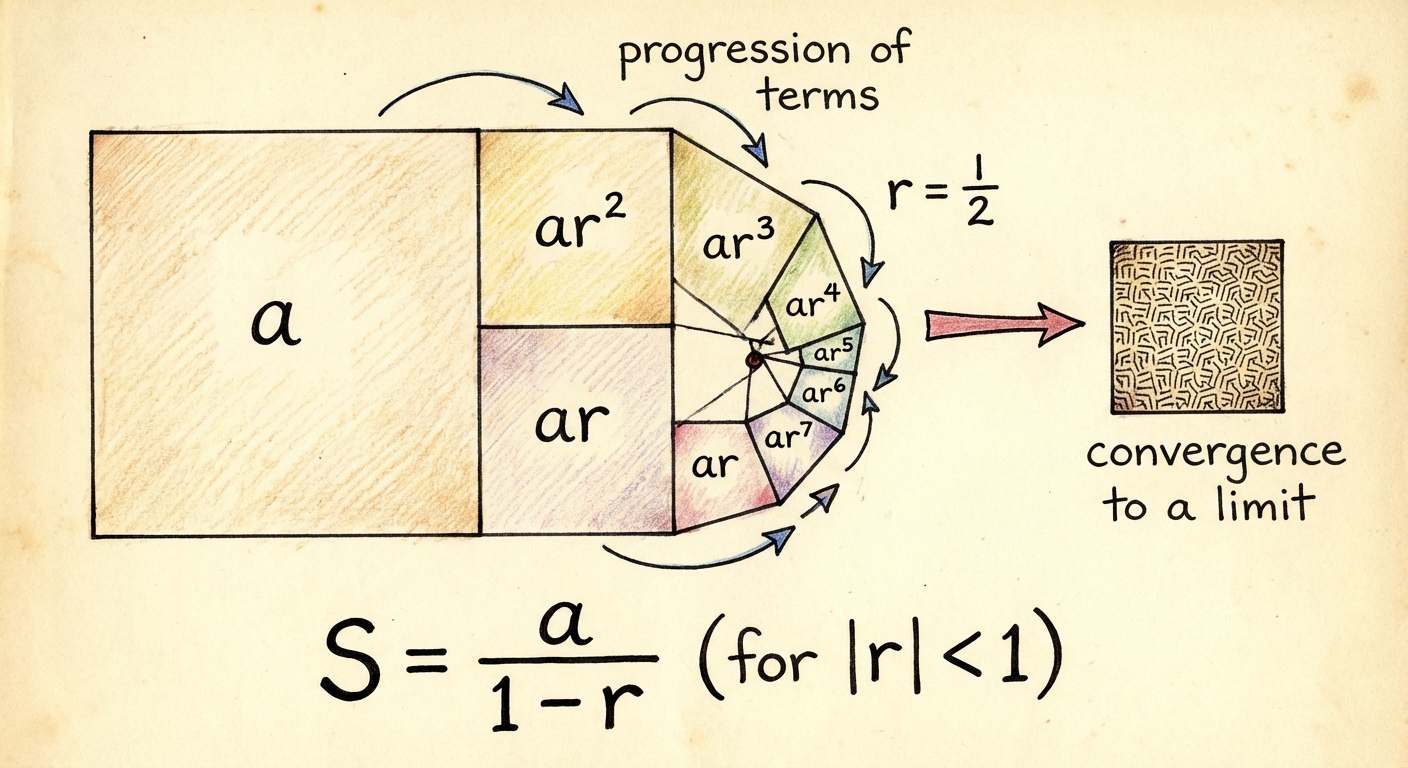
A geometric series is a specific type of series where each term is a constant multiple (the common ratio, $r$) of the previous term.
- The general form is:
where $a$ is the first term and $r$ is the common ratio. - The series converges if $|r| < 1$ and diverges if $|r| \geq 1$.
Formula for Sum of a Convergent Geometric Series
If $|r| < 1$, then the sum can be calculated as:
Example
Let’s calculate the sum of the series:
- Here, $a = 1$ and $r = \frac{1}{2}$. Since $|\frac{1}{2}| < 1$, it converges:
The nth Term Test for Divergence
The nth term test for divergence states that if the limit of the nth term of the series does not approach zero, then the series diverges:
- If:
then the series diverges.
Common Misconception
- A common mistake is assuming that if , then the series must converge. This is false; additional tests are required.
Example
Consider the series:
- The nth term: $an = 1$, and its limit is:
Thus, the series diverges.
Harmonic Series and p-Series
A Harmonic series is a specific series of the form:
- This series diverges as $n$ approaches infinity.
p-Series Test
- A p-series is defined as:
- It converges if $p > 1$ and diverges if $p \leq 1$.
Examples
- Harmonic Series: Since $p = 1$, it diverges.
- Example of p-Series: The series converges since $p = 2 > 1$.
Common Mistakes & Pitfalls
- **Confusing divergence and convergence: ** students often misinterpret the limit of terms approaching zero as indicating convergence.
- Misapplication of tests: not using the nth-term test correctly can lead to errors in determining convergence.
- Assuming geometric series: not recognizing when the series is geometric can lead to miscalculation of summation.
- Ignoring conditions: recognizing that the common ratio $r$ needs to be less than 1 for geometric series to converge is essential.
- Overlooking context: forgetting to apply context and properties like the partial sums in more complex series can cause mistakes.
Remember to practice problems related to these concepts to solidify your understanding! Ensure you review different convergence tests and examples to navigate potential pitfalls effectively.