Unit 3 Mastery: Work, Energy, and Power
Kinetic Energy and the Work-Energy Theorem
Kinetic Energy ($K$) is the energy associated with the motion of an object. Unlike velocity or momentum, kinetic energy is a scalar quantity—it has magnitude but no direction. In AP Physics C, you must understand the calculus derivation of calculating work to fully grasp changes in kinetic energy.
The Definition
For a particle of mass $m$ moving with speed $v$, the translational kinetic energy is defined as:
Because mass is always positive and velocity is squared, $K \geq 0$. An object cannot have negative kinetic energy.
The Work-Energy Theorem
The Work-Energy Theorem states that the net work done on an object by all forces connects directly to the change in the object's kinetic energy. This is a fundamental principle derived from Newton's Second Law.
In calculus notation, starting from Newton's second law ($F_{net} = ma$), we can derive this relationship:
Conservative and Non-Conservative Forces
Before discussing potential energy, we must distinguish between the two types of forces acting on systems.
Conservative Forces
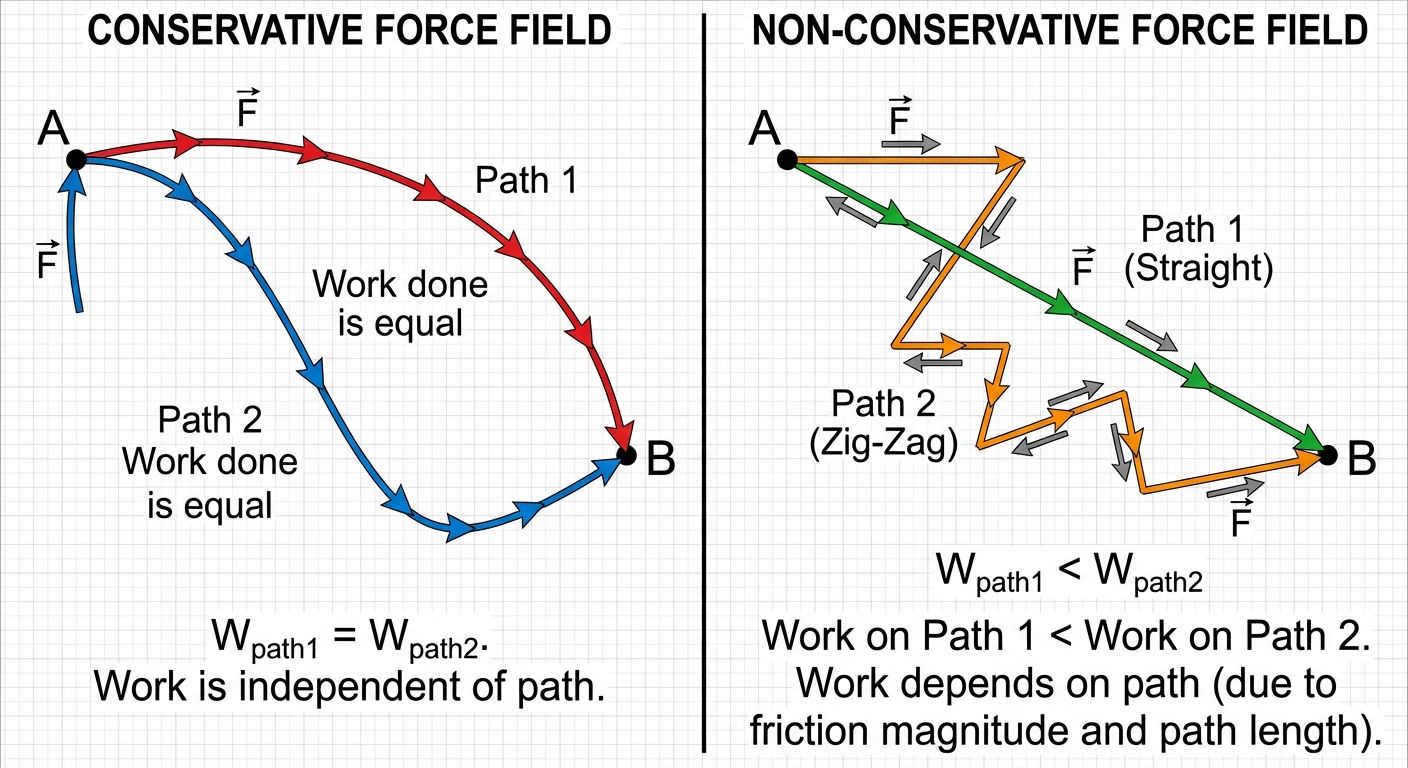
A force is conservative if the work it does on an object moving between two points is independent of the path taken.
Alternatively, a force is conservative if the total work done by the force on a particle moving around any closed path is zero.
Examples:
- Gravitational Force
- Spring (Elastic) Force
- Electrostatic Force
Non-Conservative Forces
A force is non-conservative (or dissipative) if the work depends on the path. These forces usually transfer mechanical energy out of the system (converting it to thermal energy/heat) or add energy into the system from chemical/electrical sources.
Examples:
- Kinetic Friction
- Air Resistance (Drag)
- Applied pushing forces
Potential Energy ($U$)
Potential Energy is the energy stored in a system due to the configuration or relative position of objects within that system. Potential energy can only be defined for conservative forces.
The Fundamental Relation
The change in potential energy is defined as the negative of the work done by a conservative force:
This negative sign is crucial. When gravity does positive work (an apple falling), potential energy decreases.
Gravitational Potential Energy ($U_g$)
For objects near Earth's surface where gravity is constant ($g \approx 9.8 \, m/s^2$):
Here, $y$ is the vertical height relative to a chosen reference level ($y=0$). This gives us the change:
Elastic Potential Energy ($U_s$)
For an ideal spring obeying Hooke's Law ($F_s = -kx$):
Where:
- $k$ is the spring constant ($N/m$)
- $x$ is the displacement from the equilibrium position (equilibrium is $x=0$)
Calculating Force from Potential Energy
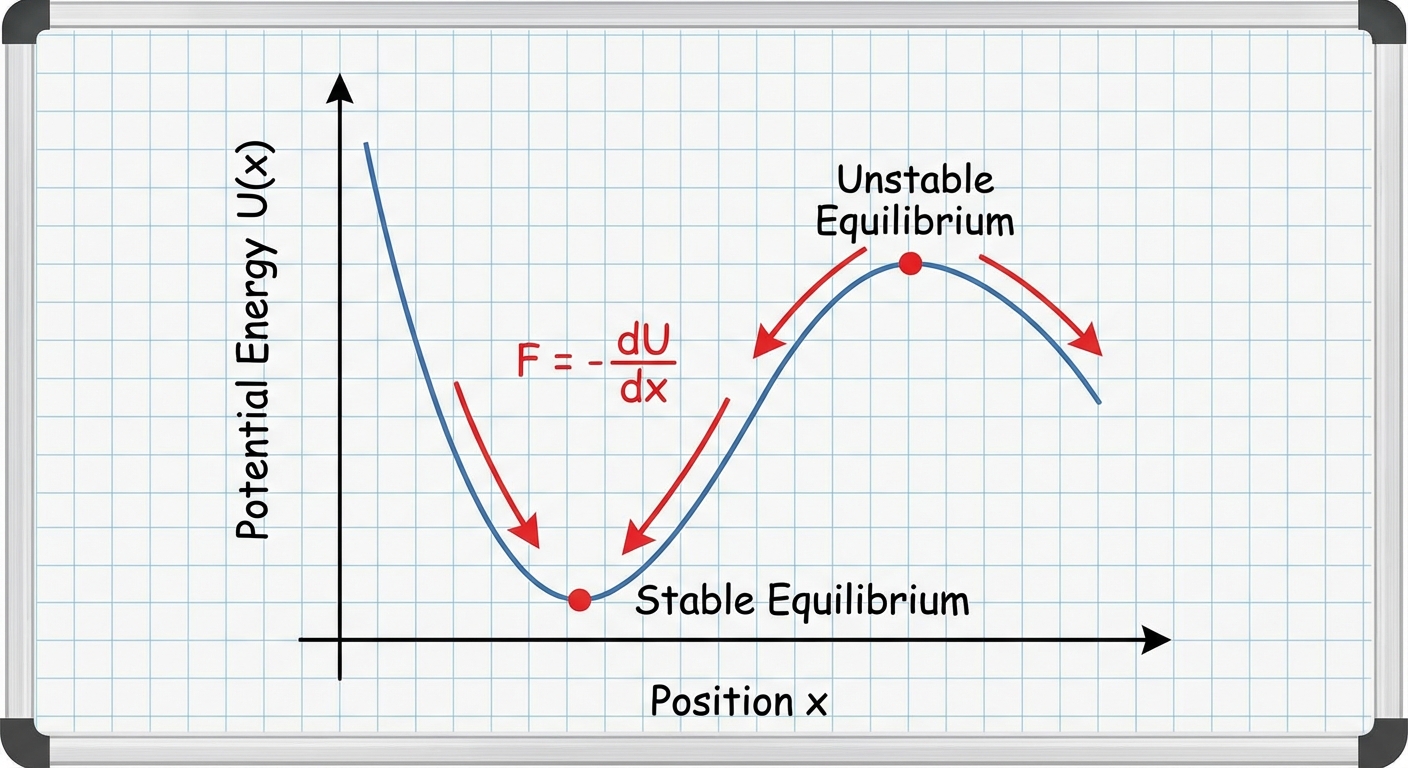
Since $\Delta U = - \int F \cdot dx$, we can use the derivative to find the force if we know the potential energy function:
This means the force is the negative slope of the Potential Energy vs. Position graph.
- Stable Equilibrium: A local minimum on the $U(x)$ graph (slope is zero, curvature is positive like a cup). If displaced, the restoring force pushes the object back.
- Unstable Equilibrium: A local maximum on the $U(x)$ graph (slope is zero, curvature is negative like a hill). If displaced, the force accelerates the object away.
Conservation of Energy
The Law of Conservation of Energy
The Total Mechanical Energy ($E$) of a system is the sum of its kinetic and potential energies:
If only conservative forces do work on the system, mechanical energy is conserved:
Handling Non-Conservative Forces
If non-conservative forces (like friction) are present, the change in mechanical energy equals the work done by those forces:
Usually, friction does negative work, removing energy from the mechanical system and turning it into internal (thermal) energy.
Summary Table: Energy Types
| Energy Type | Symbol | Formula | Conservative? | Notes |
|---|---|---|---|---|
| Kinetic | $K$ | $\frac{1}{2}mv^2$ | N/A | Always $\geq 0$. Depends on speed. |
| Gravitational | $U_g$ | $mgy$ | Yes | Requires a reference height $h=0$. |
| Elastic | $U_s$ | $\frac{1}{2}kx^2$ | Yes | $x$ is stretch/compression from equilibrium. |
| Work | $W$ | $\int \vec{F} \cdot d\vec{r}$ | N/A | Scalar product (Dot product). |
Worked Problems
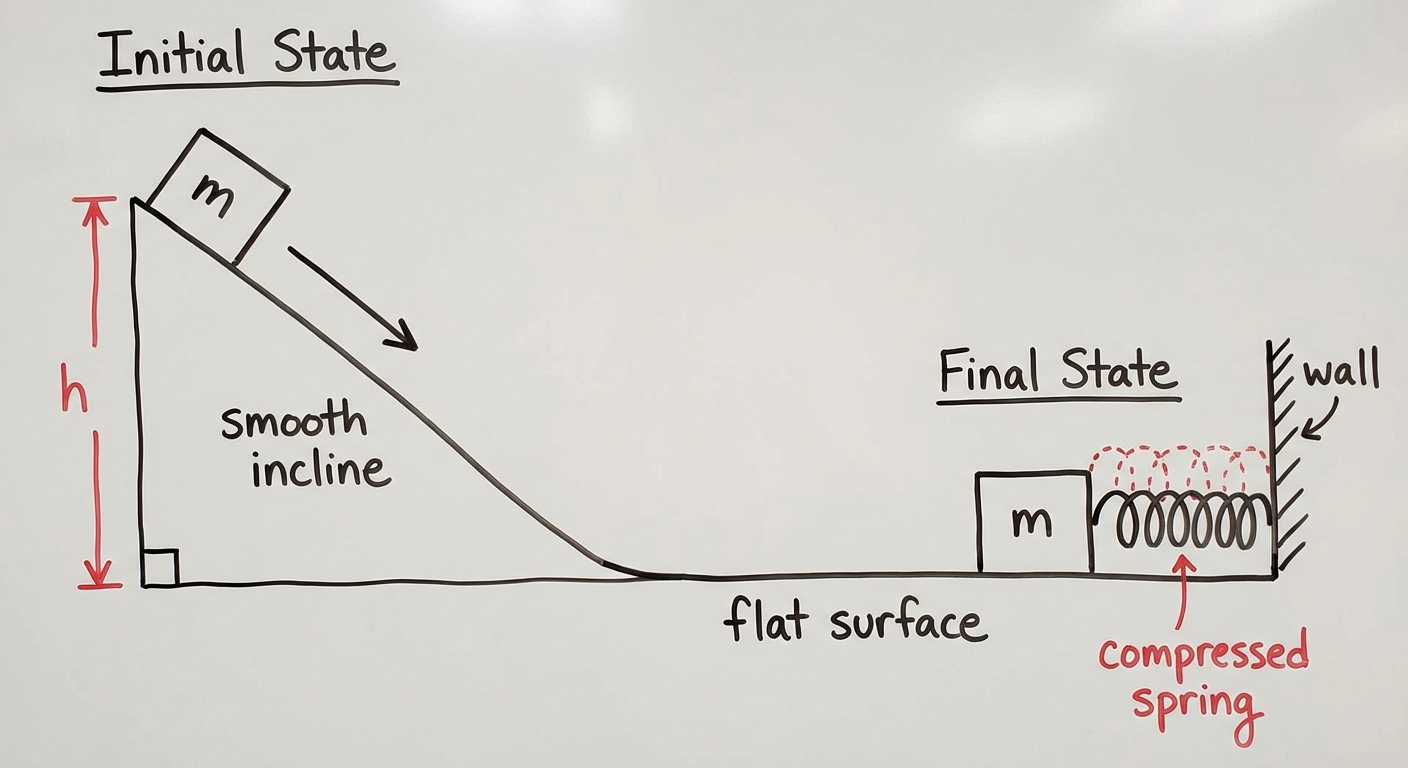
Example 1: The Spring-Loaded Ramp
Scenario: A block of mass $m = 2.0 \, kg$ starts from rest at the top of a frictionless incline of height $h = 5.0 \, m$. At the bottom, it encounters a horizontal spring with constant $k = 400 \, N/m$. Determine the maximum compression of the spring.
Solution:
Identify Systems and Forces:
- System: Block + Earth + Spring.
- Non-conservative forces: Normal force (does no work because it is perpendicular to motion). Friction is zero.
- Therefore, $Ei = Ef$.
Set Initial and Final States:
- Initial State (Top): Velocity $vi = 0$. Height $yi = 5.0$. Spring is uncompressed ($x_i = 0$).
- Final State (Max Compression): Velocity $vf = 0$ (momentarily stops). Height $yf = 0$ (bottom). Spring compression is $x$.
Apply Conservation:
Solve for $x$:
Answer: The spring compresses by $0.70$ meters.
Common Mistakes & Pitfalls
Double Counting Gravity:
- Mistake: Including both the work done by gravity AND the change in gravitational potential energy in the equation.
- Correction: Choose one method. Either use $W{net} = \Delta K$ (where gravity is a force doing work) OR $Ei = Ef$ (where gravity is accounted for in $Ug$). The Conservation of Energy approach is usually safer.
Sign Errors with Potentials:
- Mistake: Thinking $\Delta U = W_{cons}$.
- Correction: Remember $\Delta U = -W{cons}$. If gravity pulls an object down (positive work), $Ug$ decreases.
Spring Variables:
- Mistake: Using the length of the spring as $x$ in $\frac{1}{2}kx^2$.
- Correction: In Hooke's Law energy, $x$ is the change in length (displacement) from the equilibrium position, not the total length.
Reference Frames:
- Mistake: Changing the $y=0$ line halfway through a problem.
- Correction: Set your reference line ($y=0$) at the lowest point of the motion immediately and stick to it for the entire calculation.
Assuming Force is Constant:
- Mistake: Calculating work for a spring using $W = Fd = (kx)(x)$.
- Correction: Spring force varies with position. You must use calculus or the average force. This yields $W = \int kx \, dx = \frac{1}{2}kx^2$.