Comprehensive Guide to Beauty, Art, and Aesthetics in the German-Speaking World
3.1 Ideals of Beauty and Aesthetics (Schönheitsideale und Ästhetik)
1. Architecture: From Medieval to Modern
German architecture reflects a deep tension between preserving history and embracing functional innovation. It is often the most visible representation of German history.
A. Historic Architectural Styles
Fachwerkhaus (Timber-Framed House):
- Concept: The quintessential image of traditional Germany. Wooden beams are visible on the exterior, with spaces filled with brick or plaster.
- Region: Common in medieval towns (e.g., Rothenburg ob der Tauber, Quedlinburg).
- AP Connection: Represents Tradition (Tradition) and Regional Identity (Regionale Identität).
Romanesque & Gothic (Mittelalter):
- Romanesque: Thick walls, small windows (e.g., Speyer Cathedral).
- Gothic: Pointed arches, flying buttresses, light. Kölner Dom (Cologne Cathedral) is the most famous example, taking over 600 years to complete.
Baroque & Rococo:
- Characterized by ornamentation, gold, symmetry, and grandeur.
- Examples: Würzburg Residence, Sanssouci Palace (Potsdam). Often associated with absolute monarchy.
B. The Bauhaus Movement (Das Bauhaus)
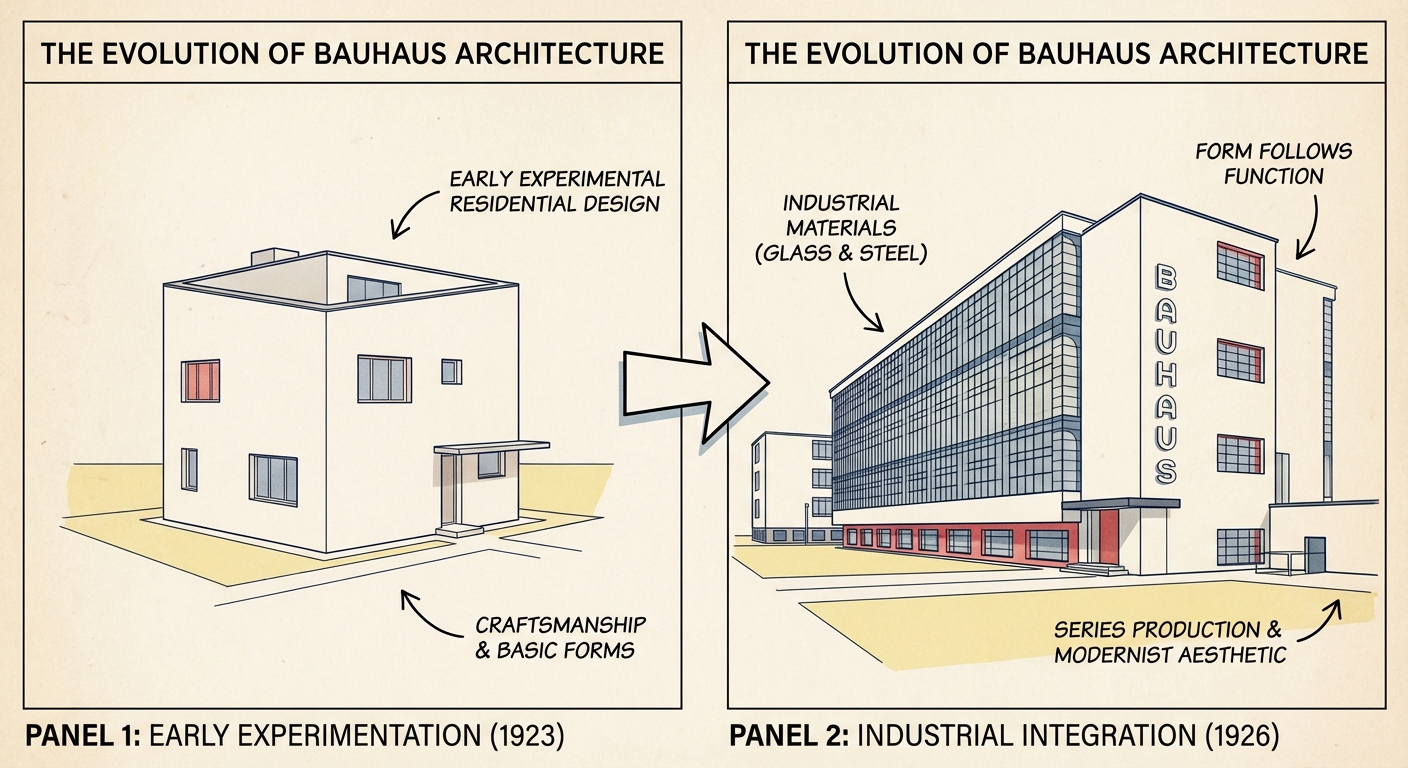
This is the most critical architectural topic for the AP exam. It revolutionized how the world perceives design.
- Origins: Founded by Walter Gropius in 1919 (Weimar).
- Identify: "Form follows function" (Form folgt Funktion). It rejected unnecessary ornamentation.
- Three Phases:
- Weimar (1919–1925): Focus on uniting art and craft. Spiritual and expressionist roots.
- Dessau (1925–1932): The "Golden Age." Shift to industrial design, mass production, and the famous glass-fronted workshop building.
- Berlin (1932–1933): Led by Mies van der Rohe. Brief final phase before being forced to close by the Nazis, whom viewed it as "un-German" and bolshevist.
- Global Legacy: After closing, instructors fled to the US (Chicago, Harvard), spreading the "International Style" worldwide. It influences IKEA and Apple design today.
C. Contemporary & Green Architecture
- Germany is a pioneer in Sustainable Architecture (Nachhaltige Architektur).
- Passivhaus: A standard for energy efficiency in buildings, reducing the building's ecological footprint by requiring little energy for space heating or cooling.
- Reichstag Dome (Berlin): Designed by Norman Foster, it symbolizes transparency in government (Transparenz). Visitors can walk above the politicians, signifying that the people are above the government.
3.2 The Visual Arts (Die Bildende Kunst)
1. German Romanticism (Die Romantik): 1800–1850
A reaction against the rationalism of the Enlightenment and the Industrial Revolution.
- Key Themes: Nature (Natur), Emotion (Gefühl), Fernweh (longing for far-off places), and the sublime.
- Key Figure: Caspar David Friedrich. His painting Wanderer above the Sea of Fog (Der Wanderer über dem Nebel) is the icon of this era. It depicts a lone figure gazing at a vast landscape, emphasizing human smallness against nature.
2. German Expressionism (Der Expressionismus): 1905–1925
Often confused with Abstract Expressionism, German Expressionism is a distinct movement that distorted reality to express inner emotional experiences.
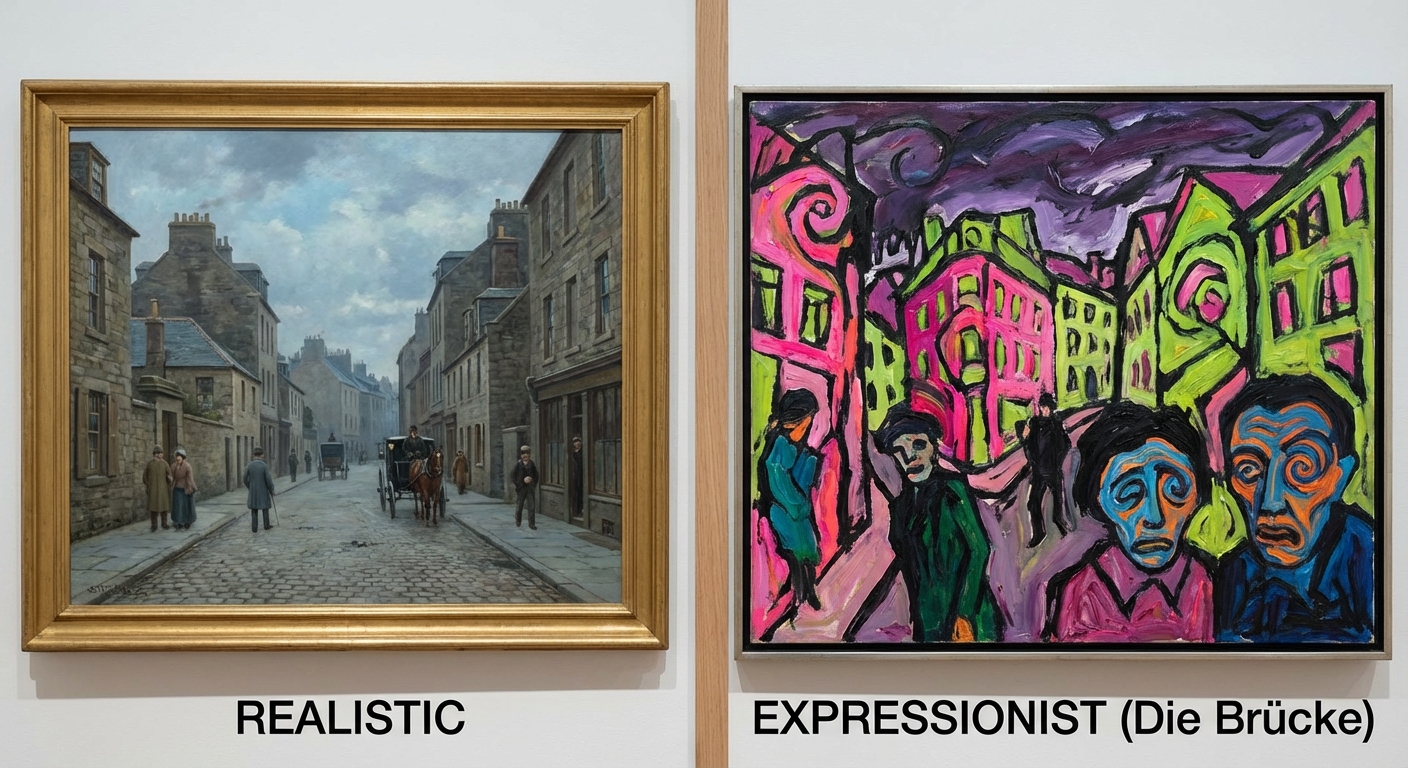
- Die Brücke (The Bridge): Based in Dresden/Berlin (Kirchner). Focused on the angst of modern city life, crude shapes, and clashing colors.
- Der Blaue Reiter (The Blue Rider): Based in Munich (Kandinsky, Franz Marc). More spiritual, moving toward total abstraction. They believed colors had spiritual values (Blue = Male/Spiritual, Yellow = Female/Joy).
- Entartete Kunst (Degenerate Art): In 1937, the Nazis organized an exhibition effectively mocking Expressionist and Modern art, labeling it "degenerate" and seizing thousands of works. This highlights art as a political target.
3. Dadaism
- Context: Emerged during WWI (Zurich/Berlin) as a protest against the war and the logic/rationality that caused it.
- Anti-Art: They used absurdity, nonsense, and "ready-mades" (everyday objects declared as art).
- Hugo Ball: His sound poems (e.g., "Karawane") consisted of nonsense syllables to dismantle the language of propaganda.
3.3 Music and Performing Arts (Musik und Darstellende Kunst)
1. The Land of Music (Das Land der Musik)
Germany has a deep cultural identification with music, funding it heavily through state subsidies (Kulturförderung).
- The Three Bs: Bach (Baroque, structure), Beethoven (Bridge between Classical/Romantic, Ode to Joy), Brahms (Romantic).
- Role in Society: Even small German towns often have a state-funded orchestra or opera house. It is viewed as a public good, not just entertainment.
2. Modern Music & Identity
- Electronic Music: Germany (specifically Berlin/Düsseldorf) was central to the birth of electronic music.
- Kraftwerk: Pioneers who influenced Hip Hop and Techno.
- Techno: Historically significant in post-wall Berlin. Abandoned industrial spaces in East Berlin became clubs (e.g., Berghain), creating a unifying youth culture after reunification.
3. Theater and Film
- Bertolt Brecht: The most influential German playwright. He created Epic Theater and the Verfremdungseffekt (Alienation Effect)—reminding the audience they are watching a play so they think critically about the politics rather than getting lost in emotion.
- Cinema:
- Weimar Era: Metropolis (Fritz Lang) - deeply influential sci-fi.
- Post-Wall: Das Leben der Anderen (The Lives of Others) - examines the surveillance state of the DDR (East Germany).
3.4 Art as Social Commentary and History
1. Art Challenging Norms
Art in German-speaking countries often pushes boundaries regarding gender, politics, and identity.
- Conchita Wurst:
- Austrian drag artist (Thomas Neuwirth) who won Eurovision 2014.
- Significance: The "Bearded Lady" look challenged binary gender norms. Her victory was framed as a victory for tolerance across Europe (Toleranz und Akzeptanz).
2. Recording History: The Berlin Wall
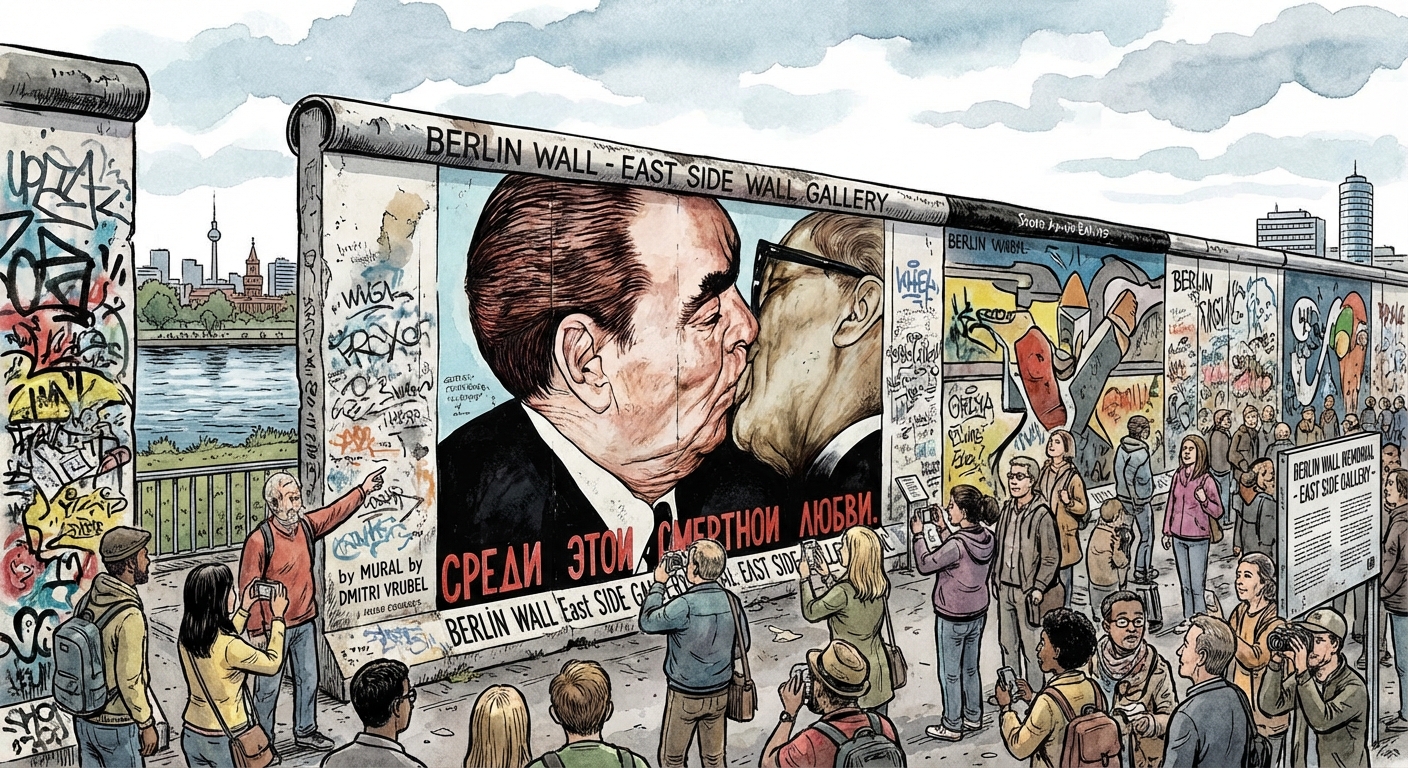
- West Side (Pre-1989): A canvas for dissent. Graffiti was a way for West Berliners to psychologically dismantle the barrier.
- East Side (Pre-1989): The "Death Strip." No art was allowed.
- East Side Gallery (Post-1989):
- After the fall, 1.3km of the wall was painted by 118 artists from 21 countries.
- Famous Mural: My God, Help Me to Survive This Deadly Love (The Fraternal Kiss) depicting Soviet leader Brezhnev kissing East German leader Honecker. It satirizes the political intimacy of the socialist bloc.
3. Museums and Public Memory
Germany has a unique "Museum Culture" (Museumskultur).
- Museum Island (Berlin): A UNESCO World Heritage site housing five museums (e.g., Pergamon, Nefertiti Bust in the Neues Museum).
- Vergangenheitsbewältigung: This distinct German concept means "struggle to overcome the past." Art and museums (like the Jewish Museum Berlin or Topography of Terror) play a central role in processing the Nazi and Stasi past responsibly.
3.5 Common Mistakes & Exam Tips
Common Mistakes
- Confusing "Abstract Expressionism" with "German Expressionism": Jackson Pollock is Abstract Expressionist (American). Ernst Ludwig Kirchner and Franz Marc are German Expressionists. The AP exam focuses on the latter.
- Stereotyping Architecture: Not all German houses are timber-framed (Fachwerkhäuser). Do not ignore the massive influence of Bauhaus and modern sustainable design.
- Overlooking East Germany (DDR): Students often focus only on West German history. Remember that for 40 years, art in the East was state-controlled (Socialist Realism), and underground art was a form of rebellion.
- Vocabulary Mix-ups:
- Kunst = Art (general).
- Künstler = Artist.
- Künstlich = Artificial (False friend! It does not mean "artistic"—that is künstlerisch).
Vocabulary Checklist for Unit 3
- Die Ästhetik (Aesthetics)
- Der Einfluss (Influence)
- Das Denkmal (Monument/Memorial)
- Der Vordergrund / Der Hintergrund (Foreground / Background - for describing images)
- Zeitgenössisch (Contemporary)
- Das Weltkulturerbe (World Cultural Heritage)
- Die Entfremdung (Alienation - in current society or Brechtian theater)