Unit 9 Guide: Advanced Synthesis and Interpretation in Long Fiction
Synthesis of Literary Elements
At the AP English Literature level, specifically in Unit 9, you are expected to move beyond identifying literary devices in isolation (e.g., "this is a metaphor") to understanding how multiple elements interact to create the meaning of the work as a whole. This is the core of Synthesis.
The Ecosystem of a Text
Think of a novel or play as an ecosystem. No element exists in a vacuum. The setting dictates the limits of the plot; the plot forces character development; character development reveals the theme.
- Interdependence: An author’s choice in point of view (e.g., unreliable narrator) directly influences exactly how much the reader trusts the character’s description of the setting or other characters.
- Cumulative Effect: One symbol might represent sadness, but repeated symbolic imagery combined with a specific tone creates a motif that builds a thematic argument.
To analyze synthesis effectively, ask yourself: "How does element X change or constrain element Y?"

Structural Synthesis
In longer fiction and drama, the arrangement of parts (structure) is significant. You must synthesize the pacing and sequence of events with the emotional impact on the reader.
- Flashbacks and Nonlinear Narratives: These disrupt the timeline to reveal past trauma or motivation that re-contextualizes the present action.
- Juxtaposition: Placing two contrasting scenes, characters, or settings side-by-side to highlight their differences.
- Example: In Shakespeare’s Hamlet, the synthesis of the "To be or not to be" soliloquy (philosophical inaction) with the immediate arrival of Ophelia (tangible interaction) highlights Hamlet’s inability to connect his intellect with his reality.
Complex Character Analysis
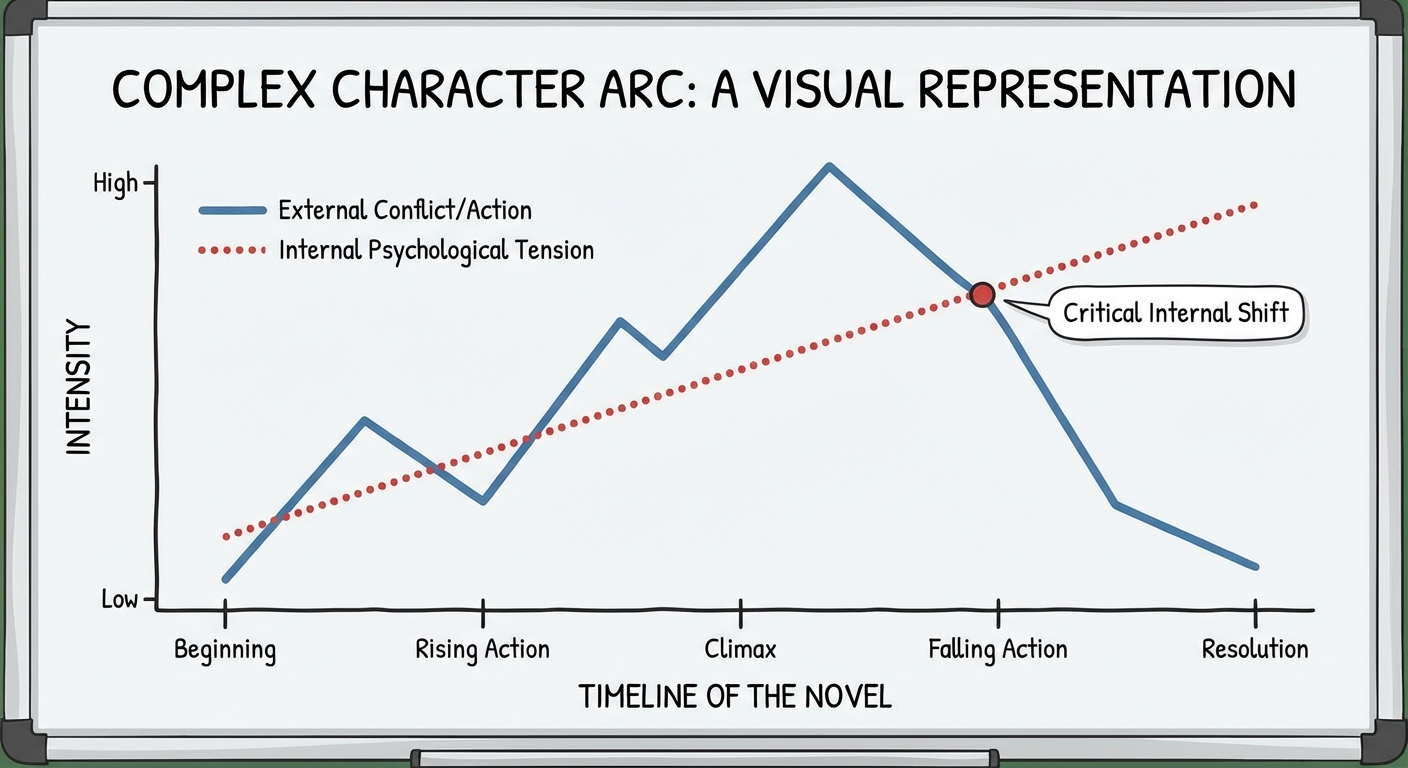
Unit 9 emphasizes that in longer works, characters are rarely static or simple. They are often bundles of contradictions, mirroring the complexity of real human psychology.
Contradiction and Inconsistency
Students often try to "solve" a character by labeling them as "good" or "evil." However, AP readers look for your ability to analyze inconsistency as a deliberate authorial choice.
- Competing Motivations: Characters often want two mutually exclusive things (e.g., safety vs. freedom, loyalty vs. ambition).
- Internal Conflict: This is the engine of character complexity. It is not just about a character making a hard choice, but about the psychological toll of that choice.
Character Interactions and Foils
Characters are defined not just by their internal monologues, but by how they bounce off others.
- The Foil: A character who contrasts with another character (usually the protagonist) to highlight particular qualities of the other character.
- Note: A foil does not have to be an antagonist. In Macbeth, Banquo represents the path of integrity that Macbeth could have taken, making Macbeth’s fall more tragic.
- The Catalyst: A character who may not change much themselves but causes significant change in the protagonist.
Nuance in Character Arcs
Epiphany is a key concept in longer fiction. This is a moment of sudden realization that leads to a change in the character's view of themselves or the world.
- Warning: Not all epiphanies result in positive change. A character might realize the world is cruel and become cynical (a negative arc).
- Dynamic vs. Static: While main characters usually change (dynamic), analyzing why a character refuses to change (remains static) despite pressure can be just as profound.
Literary Argumentation
This is the practical application of your analysis—writing the essay (specifically FRQ 3). The goal is to construct a defensible claim about an interpretation of the work as a whole.
Determining the "Meaning of the Work as a Whole" (MOWAAW)
The MOWAAW is not a single word (e.g., "Love" or "War"). It is a thematic statement about the human condition derived from the synthesis of the text's elements.
The Formula for Complexity:
To achieve complexity in your argument, avoid absolutes. Use a "Although X, Y" structure to acknowledge counter-evidence or conflicting themes.
Developing a Sophisticated Thesis
Your thesis establishes the roadmap for your argument. It must be specific, defensible, and arguably complex.
| Weak Thesis | Strong, Complex Thesis |
|---|---|
| "In The Great Gatsby, F. Scott Fitzgerald uses symbols to show that the American Dream is dead." | "While Fitzgerald portrays the allure of the American Dream through the symbolism of the green light, he ultimately suggests that the dream is destructive because it relies on the erasure of the past and the corruption of moral values." |
Breakdown of the Strong Thesis:
- Concession ("While…"): Acknowledges a surface-level interpretation.
- Specific Device: Mentions specific literary elements (symbolism).
- Thematic Argument: Explains why the dream is destructive (erasure of past/corruption).
Organizing the Argument
Avoid organizing your essay by literary element (e.g., one paragraph on symbolism, one on tone). Instead, organize by insight or chronological development of the theme.
- Insight 1: How the conflict is established.
- Insight 2: How the conflict complicates the character's psychology.
- Insight 3: How the resolution (or lack thereof) cements the theme.
Common Mistakes & Pitfalls
- The Plot Summary Trap: The most common error in Unit 9 is retelling the story rather than analyzing it. Assume the reader knows the plot.
- Correction: If you write a sentence describing what happened, immediately follow it with a sentence explaining why it matters to the theme.
- Simplifying Theories: ignoring evidence that contradicts your thesis. If a character acts out of character, do not ignore it—analyze it. That "flaw" in your theory is actually where the complexity lies.
- Cliché Themes: Avoid "Disney" themes like "Love conquers all" or "Always be yourself." Literary fiction usually deals with harder truths.
- Better approach: "Love often requires sacrifice that erodes personal identity."
- Ignoring the Ending: In longer fiction, the resolution is vital. If the ending is ambiguous, your essay must address that ambiguity, not force a happy or sad conclusion.
Checklist for Synthesis
Before finalizing your interpretation of a long work/drama, ensure you can answer these specific questions:
- [ ] Does my interpretation account for the entire text, including the ending?
- [ ] Have I explained how the setting influences the character's internal conflict?
- [ ] Is my thesis an argument (opinion) rather than a statement of fact?
- [ ] Have I identified a "tension" or contradiction in the text to analyze?