Mastering Differentiation: Composite and Implicit Functions
The Chain Rule
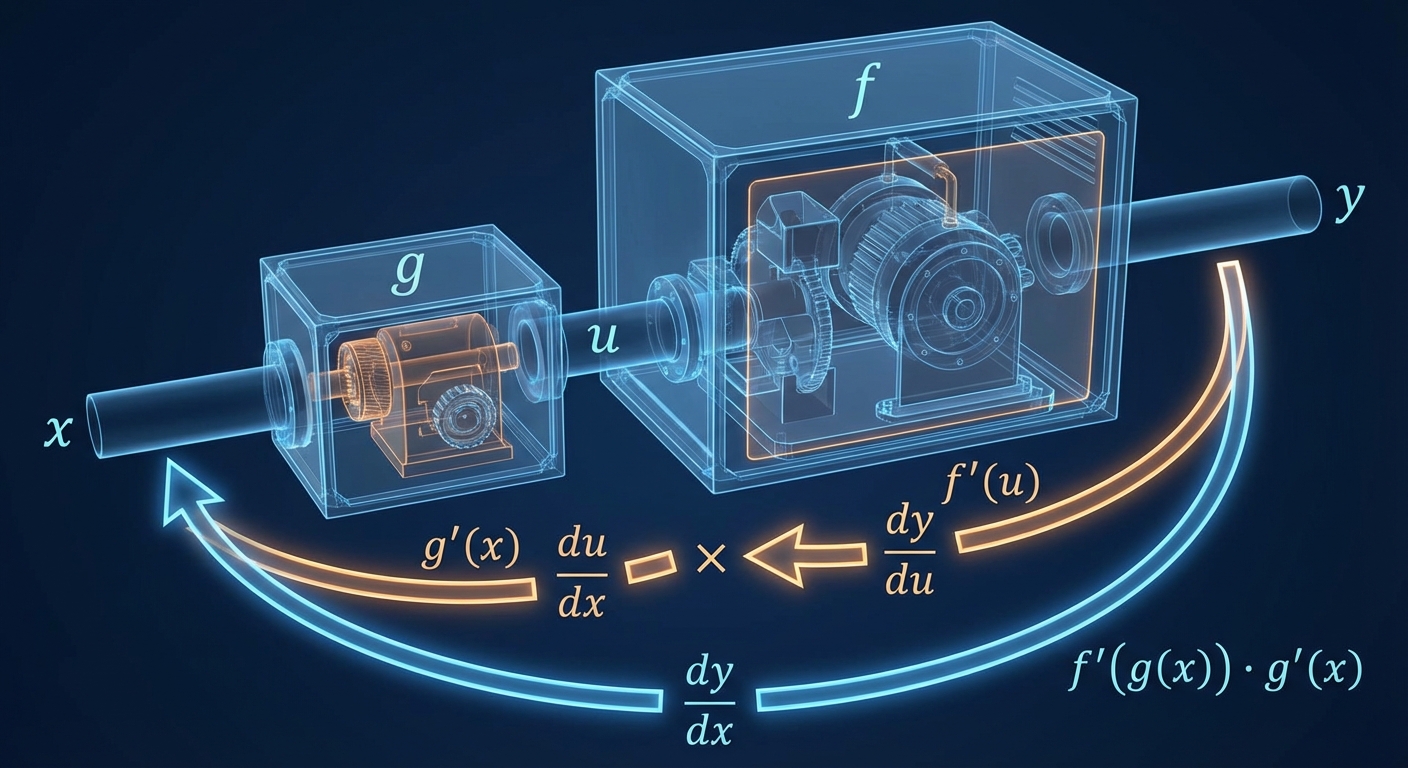
The Chain Rule is the fundamental tool for differentiating composite functions—functions inside of other functions. If you view a function like an onion, the Chain Rule is the mathematical equivalent of peeling it layer by layer, starting from the outside and working your way in.
Concept & Definition
Formally, if $g$ is differentiable at $x$ and $f$ is differentiable at $g(x)$, then the composite function $F = f \circ g$ defined by $F(x) = f(g(x))$ is differentiable at $x$.
The rule states that the derivative of a composite function is the derivative of the outer function evaluated at the inner function, multiplied by the derivative of the inner function.
Formulas & Notation
There are two primary ways to express the Chain Rule. You should be comfortable with both, as AP questions may switch between them.
1. Newton's Notation (Function Notation):
2. Leibniz Notation:
If $y = f(u)$ and $u = g(x)$, then:
This format is particularly useful for visualizing the "cancellation" of differentials, though mathematically they are rates of change.
Step-by-Step Procedure
- Identify the layers: Determine which function is the "outer" ($f$) and which is the "inner" ($g$).
- Differentiate the outer: Find $f'$, keeping the inner function $g(x)$ exactly as it is.
- Differentiate the inner: Find $g'(x)$.
- Multiply: Multiply the result of step 2 by the result of step 3.
Worked Example
Problem: Find $f'(x)$ if $f(x) = \sin(3x^2 + 5x)$.
Solution:
- Outer function: $\sin(\dots)$ $\rightarrow$ Derivative is $\cos(\dots)$
- Inner function: $3x^2 + 5x$ $\rightarrow$ Derivative is $6x + 5$
- Apply Formula:
Answer: $f'(x) = (6x+5)\cos(3x^2 + 5x)$
Implicit Differentiation
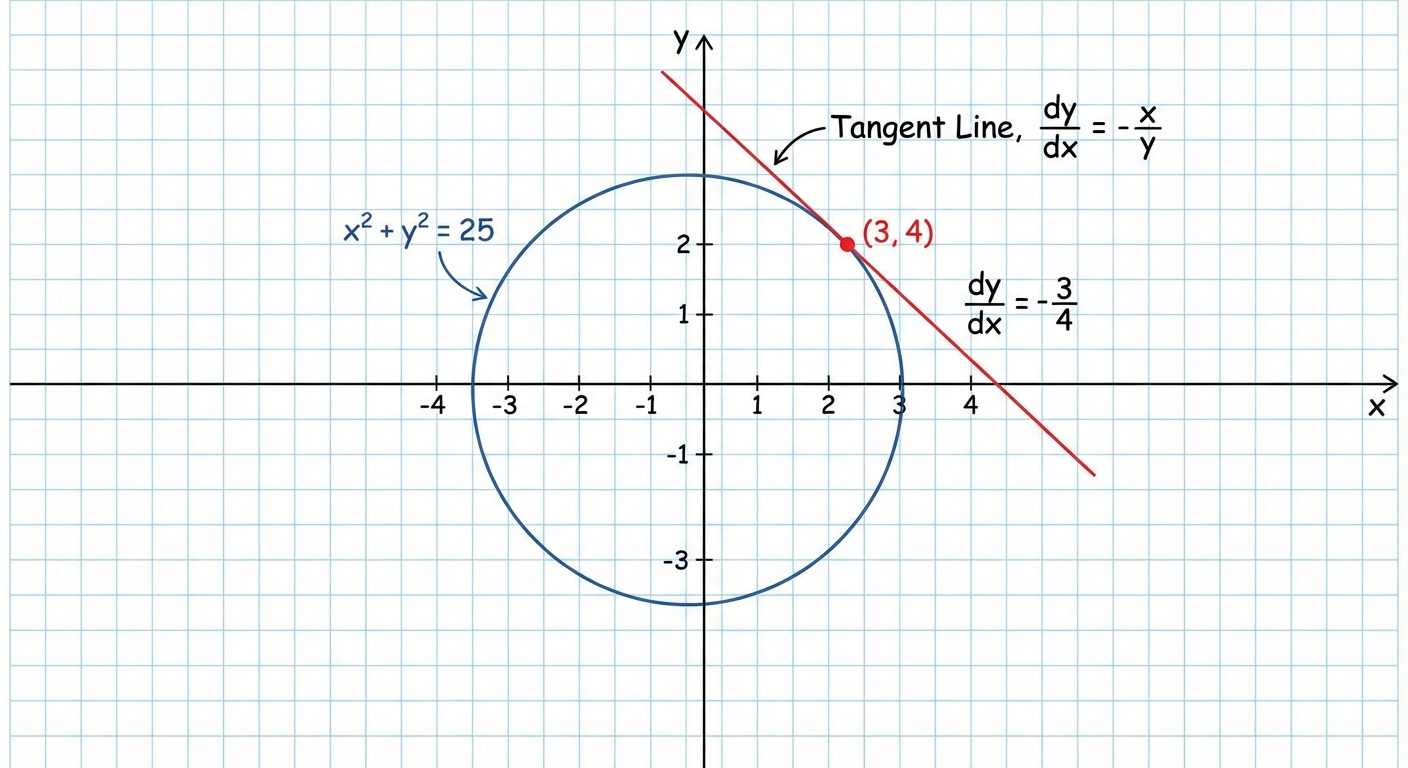
Sometimes functions are not written in the explicit form $y = f(x)$ (e.g., $y = x^2 + 1$). Instead, $x$ and $y$ are mixed together in an equation, such as $x^2 + y^2 = 25$. This is an implicit relation. Implicit differentiation allows us to find the slope of the tangent line ($\frac{dy}{dx}$) without solving for $y$ first.
The Core Concept
When differentiating implicit equations with respect to $x$:
- Terms with only $x$ represent standard differentiation.
- Terms with $y$ must currently be treated as composite functions $f(y(x))$. By the Chain Rule, differentiating a function of $y$ produces a $\frac{dy}{dx}$ term.
Key Rule:
Procedure for Implicit Differentiation
- Differentiate both sides of the equation with respect to $x$.
- Apply the Chain Rule whenever you differentiate a term containing $y$ (multiply by $\frac{dy}{dx}$).
- Apply Product or Quotient rules if $x$ and $y$ are multiplied or divided (e.g., $xy$).
- Gather all terms containing $\frac{dy}{dx}$ on one side of the equation.
- Factor out $\frac{dy}{dx}$ and divide to isolate it.
Worked Example
Problem: Find $\frac{dy}{dx}$ for the circle $x^2 + y^2 = 25$.
Solution:
- Differentiate both sides:
- Apply Chain Rule to y:
- Isolate terms with $\frac{dy}{dx}$:
- Solve:
Higher-Order Derivatives
Higher-order derivatives represent the rate of change of the rate of change. In physics, if $y$ is position, $y'$ is velocity, and $y''$ is acceleration.
Notation Breakdown
| Order | Prime Notation | Leibniz Notation | Description |
|---|---|---|---|
| First | $y'$ or $f'(x)$ | $\frac{dy}{dx}$ | Slope/Velocity |
| Second | $y''$ or $f''(x)$ | $\frac{d^2y}{dx^2}$ | Concavity/Acceleration |
| Third | $y'''$ or $f'''(x)$ | $\frac{d^3y}{dx^3}$ | Jerk |
Higher-Order Implicit Differentiation
A common AP Calculus BC exam question involves finding the second derivative ($y''$) of an implicit relation.
The Critical Substitution Step:
When finding $\frac{d^2y}{dx^2}$ implicitly:
- Find the first derivative $\frac{dy}{dx}$ in terms of $x$ and $y$.
- Differentiate that expression again (often using the Quotient Rule).
- Substitution: The result will likely contain a $\frac{dy}{dx}$ term. You MUST substitute your answer from Step 1 into this new equation to express the final answer solely in terms of $x$ and $y$.
Worked Example (Second Derivative)
Problem: Find $\frac{d^2y}{dx^2}$ if $y^2 = x$.
Solution:
Find First Derivative:
$2y \cdot y' = 1 \implies y' = \frac{1}{2y}$Find Second Derivative (Differentiate $y'$):
Substitute $y'$:
Substitute $y' = \frac{1}{2y}$ into the equation above:
Common Mistakes & Pitfalls
1. The "Missing Link" in Chain Rule
Students frequently differentiate the outer function but forget to multiply by the derivative of the inner function.
- Wrong: $\frac{d}{dx}(5x+1)^3 = 3(5x+1)^2$
- Correct: $\frac{d}{dx}(5x+1)^3 = 3(5x+1)^2 \cdot \mathbf{5}$
2. Implicit $y$ Neglect
When differentiating implicitly, students often treat $y$ as a constant or just like $x$, forgetting the chain rule attachment ($\'$).
- Wrong: $\frac{d}{dx}(y^3) = 3y^2$
- Correct: $\frac{d}{dx}(y^3) = 3y^2 \cdot \mathbf{y'}$ or $3y^2 \frac{dy}{dx}$
3. The Product Rule in Implicit Differentiation
In terms like $xy$, students often forget this is a product of two functions.
- Wrong: $\frac{d}{dx}(xy) = y \cdot 1$
- Wrong: $\frac{d}{dx}(xy) = x \frac{dy}{dx}$
- Correct: $\frac{d}{dx}(xy) = (1)y + x(\frac{dy}{dx})$ (Left d-Right + Right d-Left)
4. Forgetting to Substitute in Higher-Order Derivatives
On Free Response Questions (FRQs), if asked for $\frac{d^2y}{dx^2}$ in terms of $x$ and $y$, leaving a $\frac{dy}{dx}$ in the final answer will result in lost points. You must substitute the expression for the first derivative back in.