Mechanics of Oscillating Systems: Energy, Decay, and Resonance
Energy in Simple Harmonic Motion (SHM)
In ideal Simple Harmonic Motion, the most fundamental principle is the conservation of Mechanical Energy. Because the restoring force (like Hooke's Law, $F_s = -kx$) is a conservative force, the system constantly exchanges potential energy for kinetic energy without loss, assuming no friction or air resistance.
The Energy Transformation Cycle
Consider a horizontal mass-spring system. The energy oscillates between two forms:
- Elastic Potential Energy ($U_s$): Stored in the spring when it is stretched or compressed.
- Kinetic Energy ($K$): Possessed by the mass due to its velocity.
At any point in time $t$ or position $x$, the Total Mechanical Energy ($E$) is the sum of kinetic and potential energies:
Mathematical Definitions
Using the standard equations for SHM, where position $x(t) = A\cos(\omega t + \phi)$ and velocity $v(t) = -A\omega\sin(\omega t + \phi)$, we can express the energies as:
- Potential Energy:
- Kinetic Energy:
Substituting the time-dependent functions:
Since $\omega^2 = k/m$, we can simplify $m\omega^2$ to $k$. Using the identity $\sin^2\theta + \cos^2\theta = 1$, we derive the crucial expression for Total Energy:
Key Takeaway: The total energy of an oscillator is proportional to the square of the amplitude ($A^2$). If you double the amplitude, you quadruple the energy.
Energy vs. Position and Time
Visualizing energy helps deepen understanding.
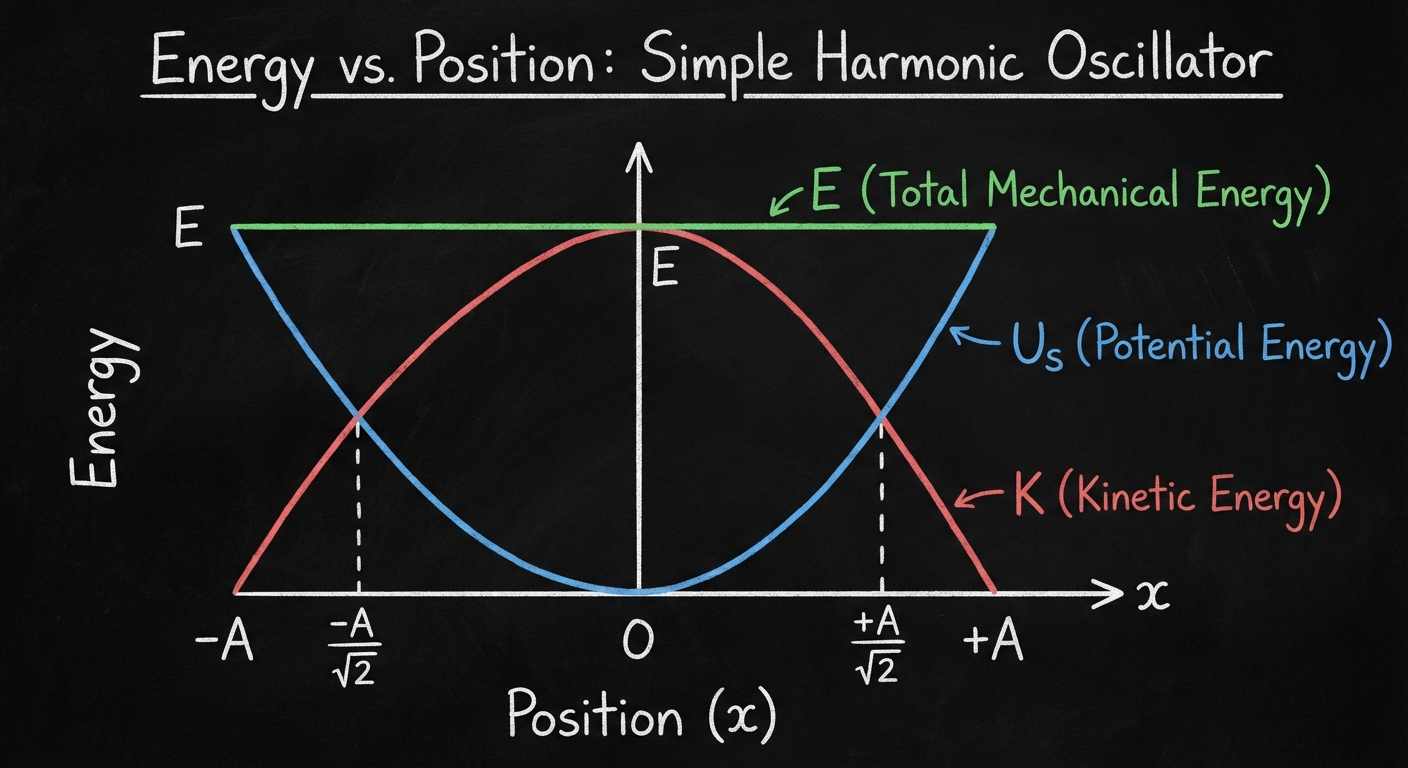
Analysis of Energy Locations:
- At Equilibrium ($x = 0$): $Us = 0$, $K = K{max} = E_{total}$. The mass is moving fastest.
- At Turning Points ($x = \pm A$): $v = 0$, so $K = 0$. $Us = U{max} = E_{total}$. The mass is momentarily at rest.
- Intermediate Points: The energy is shared. For example, at $x = A/\sqrt{2}$, Kinetic and Potential energies are equal.
Example Problem: Velocity at a Specific Position
Problem: A $0.5\text{ kg}$ mass on a spring ($k = 200\text{ N/m}$) oscillates with an amplitude of $0.1\text{ m}$. Calculate the speed of the mass when it is at position $x = 0.06\text{ m}$.
Solution:
Using Conservation of Energy:
Cancel the $\frac{1}{2}$ and solve for $v$:
Damped Oscillations
In the real world, friction and air resistance act on oscillating systems. These are non-conservative forces that dissipate mechanical energy into thermal energy. This process is called Damping.
The Damping Force
We usually model the damping force ($F_{damp}$) as being proportional to the velocity but in the opposite direction (viscous damping):
Here, $b$ is the damping coefficient (unit: $\text{kg/s}$), which depends on the fluid properties and the shape of the object.
The Differential Equation
Using Newton's Second Law somewhat differently than in ideal SHM:
Rearranging gives the differential equation for damped harmonic motion:
Solution: Exponential Decay
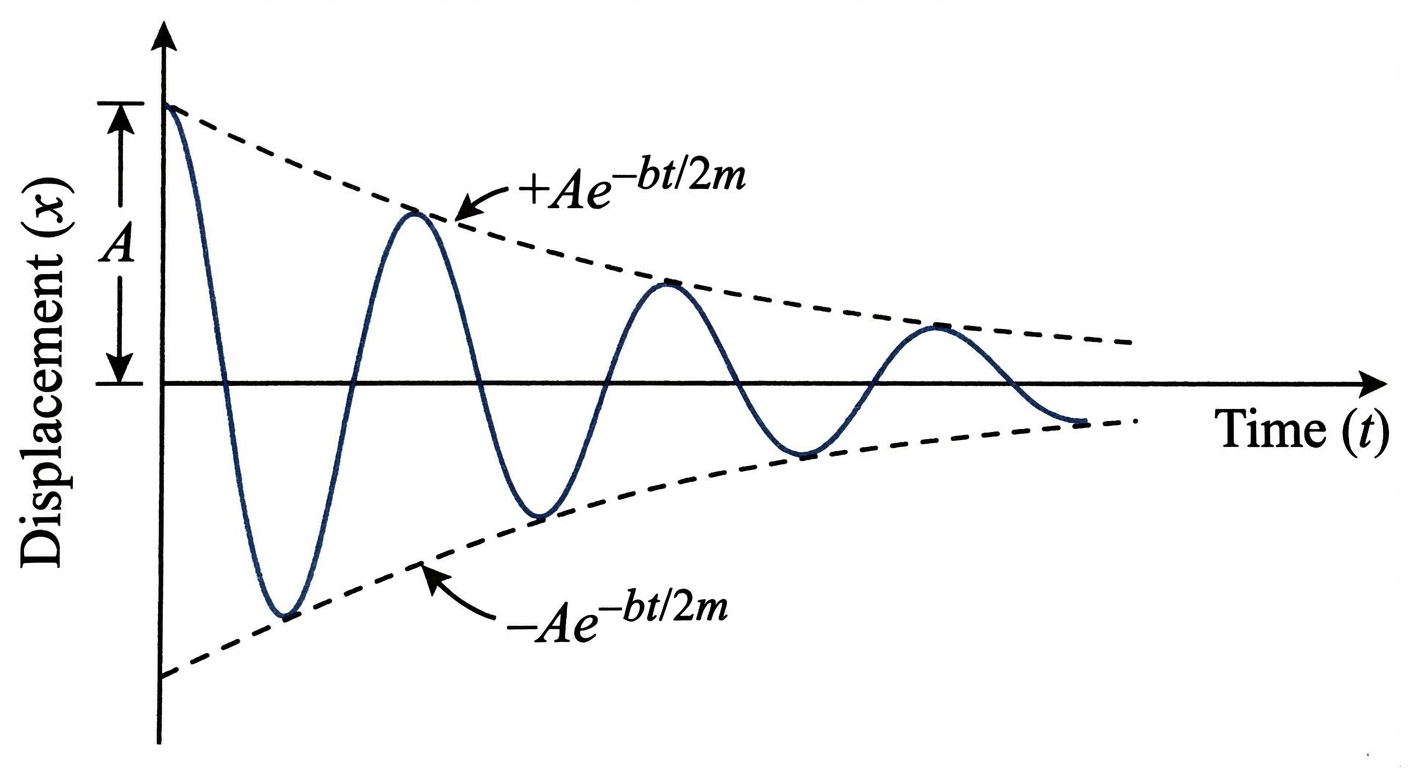
For a system that is "lightly" damped (underdamped), the solution combines a sine wave with an exponential decay function:
- $A_0$: Initial amplitude
- $e^{-\frac{b}{2m}t}$: The decay envelope. The amplitude decreases exponentially over time.
- Angular Frequency Shift: The damping slows the oscillation slightly. The new frequency $\omega'$ is:
Types of Damping
The behavior of the system depends on the relationship between $b$, $m$, and $k$ (specifically the term under the square root in the frequency equation).
| Type | Condition | Description |
|---|---|---|
| Underdamped | $b^2 < 4mk$ | The system oscillates, but the amplitude decays exponentially to zero. |
| Critically Damped | $b^2 = 4mk$ | The system returns to equilibrium as quickly as possible without oscillating. This is vital for car shock absorbers. |
| Overdamped | $b^2 > 4mk$ | The damping is so strong the system returns to equilibrium very slowly, without oscillating. |
Driven Oscillations and Resonance
Driven oscillations occur when an external periodic force acts on the system to supply energy, countering the energy lost to damping.
The Driving Force
Assume an external driving force:
Where:
- $F_0$ is the maximum amplitude of the driving force.
- $\omega_d$ is the driving angular frequency (frequency of the pusher).
- $\omega_0 = \sqrt{k/m}$ is the system's natural angular frequency.
Amplitude and Resonance
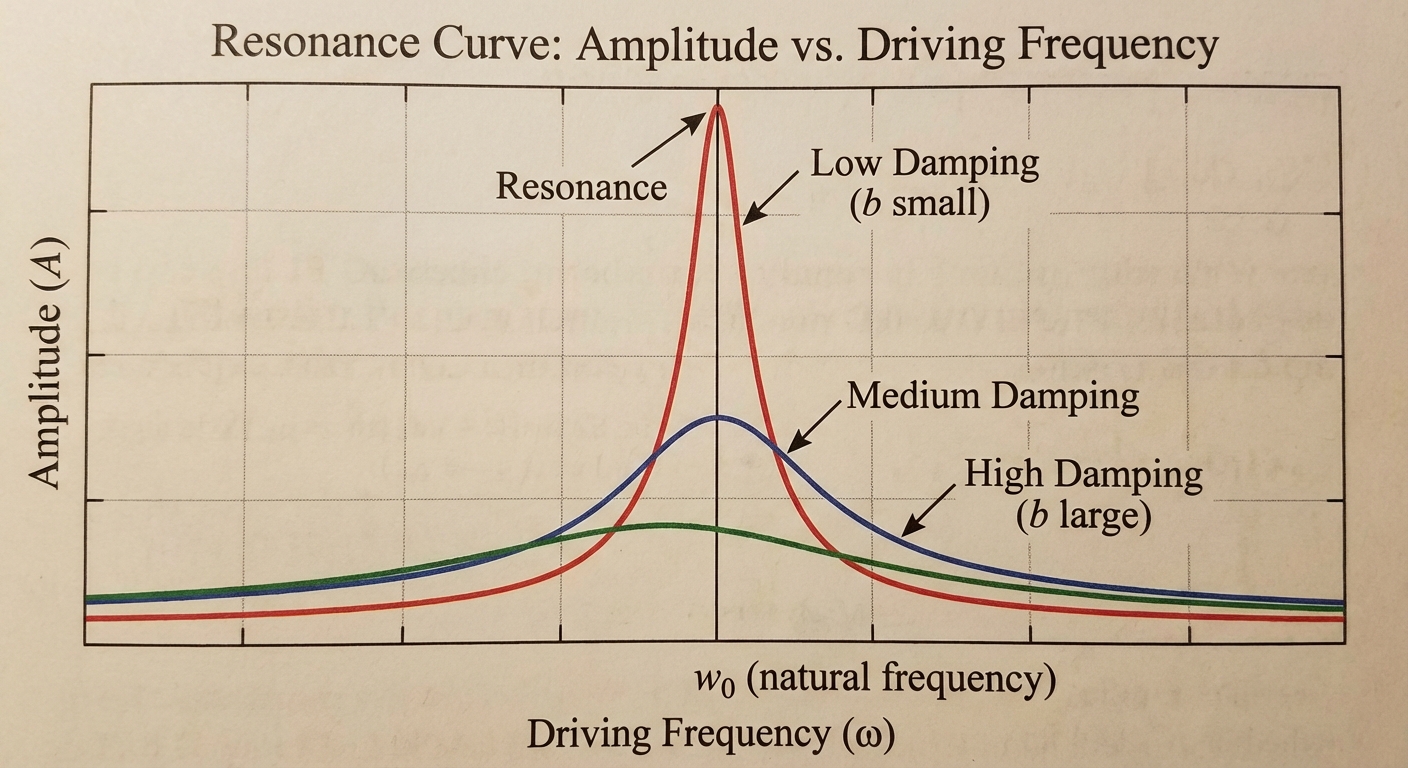
The amplitude $A$ of the steady-state motion depends on the difference between the driving frequency and the natural frequency. The formula for the amplitude is:
Resonance occurs when the driving frequency matches the natural frequency ($\%omegad \approx \omega0$).
- At resonance, the term $(\omegad^2 - \omega0^2)$ becomes zero.
- The denominator is minimized.
- The Amplitude becomes maximized.
Real-World Implications
- Tacoma Narrows Bridge: A famous example (though technically aeroelastic flutter) often used to illustrate resonance where wind provided a driving force matching a natural mode of the bridge, causing collapse.
- Musical Instruments: Instruments rely on resonance boxes to amplify sound waves.
Common Mistakes & Pitfalls
Confusing Total Energy ($E$) with Kinetic/Potential:
- Correction: In ideal SHM, $E$ is constant. $K$ and $U$ vary with time. Don't try to integrate power to find energy if you can just use $E = \frac{1}{2}kA^2$.
Misunderstanding Amplitude in Damping:
- Correction: Students often forget that in Damping, amplitude is not constant. It is a function of time: $A(t) = A_0 e^{-bt/2m}$.
Frequency Confusion:
- Correction: Distinguish between $\omega0$ (natural frequency, determined by system properties $k$ and $m$) and $\omegad$ (driving frequency, determined by the external source). Resonance only happens when they match.
The Frequency of Energy Oscillation:
- Correction: If the position oscillates with frequency $f$, the kinetic and potential energies oscillate with frequency 2f. (Think about it: the spring is fully compressed and fully extended—peaks of potential energy—twice per full position cycle).
Memory Aid: Damping Types
Remember the "Goldilocks" rule for returning to equilibrium:
- Overdamped: Too slow (porridge is too thick).
- Underdamped: Wiggles too much (porridge is too watery).
- Critically Damped: Just right (returns fast, no wiggle).