Mastering the Fundamental Theorem of Calculus in Unit 6
The Fundamental Theorem of Calculus (FTC) is the bridge connecting differential calculus (rates of change) and integral calculus (accumulation). In AP Calculus BC, mastering both parts of the FTC is essential for solving problems involving accumulation functions, graphical analysis, and net change.
FTC and Accumulation Functions
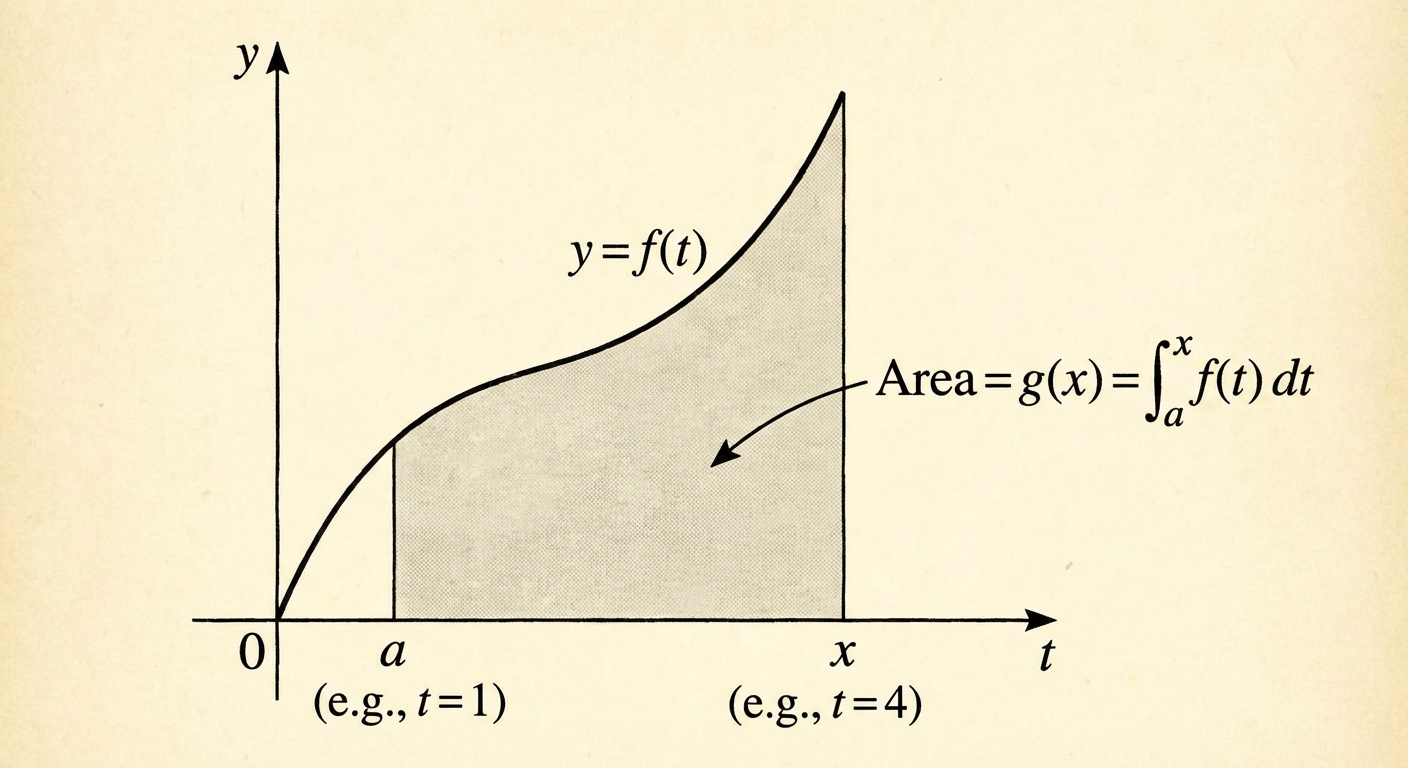
An accumulation function describes the "net area" accumulated under a curve from a fixed starting point $a$ up to a variable point $x$. It is typically written as:
Here, $t$ is the dummy variable of integration, while $x$ serves as the independent variable which determines the upper limit of the interval.
The Fundamental Theorem of Calculus, Part 1
Also known as the Evaluation Theorem for Derivatives, Part 1 states that if $f$ is continuous on $[a, b]$, then the function $g$ defined by $g(x) = \int_a^x f(t) \, dt$ is continuous on $[a, b]$, differentiable on $(a, b)$, and:
This theorem confirms that differentiation and integration are inverse processes. If you integrate $f$ to get $g$, deriving $g$ brings you back to $f$.
FTC Part 1 with the Chain Rule
Often on the AP exam, the upper limit of integration is not just $x$, but a function of $x$, say $u(x)$. In this case, you must apply the Chain Rule:
Example 1: Applying the Chain Rule
Find $h'(x)$ if $h(x) = \int_2^{x^3} \sin(t^2) \, dt$.
- Identify the "outer" function structure: the integral of $\sin(t^2)$.
- Identify the "inner" function (upper limit): $u(x) = x^3$, so $u'(x) = 3x^2$.
- Solution: $h'(x) = \sin((x^3)^2) \cdot 3x^2 = 3x^2 \sin(x^6)$.
Interpreting the Behavior of Accumulation Functions
A major component of the AP Calculus BC exam involves analyzing the graph of a function $f$ to deduce the properties of its accumulation function $g(x) = \int_a^x f(t) \, dt$.
The Relationship Pyramid
To interpret the behavior of $g(x)$, use the relationships derived from FTC Part 1:
- $g(x)$ represents the Accumulated Area (Net Signed Area).
- $g'(x) = f(x)$ represents the Height of the graph.
- $g''(x) = f'(x)$ represents the Slope of the graph.
Behavior Analysis Table
Use this table to translate features of the graph of $f$ into properties of $g$:
| Feature of Graph $f(x)$ | Behavior of Accumulation Function $g(x)$ |
|---|---|
| $f(x)$ is Positive (+) | $g(x)$ is Increasing |
| $f(x)$ is Negative (-) | $g(x)$ is Decreasing |
| $f(x) = 0$ (changes sign) | $g(x)$ has a Local Extrema (Max/Min) |
| $f(x)$ is Increasing (Slope +) | $g(x)$ is Concave Up |
| $f(x)$ is Decreasing (Slope -) | $g(x)$ is Concave Down |
| $f(x)$ has a local extrema | $g(x)$ has a Point of Inflection |
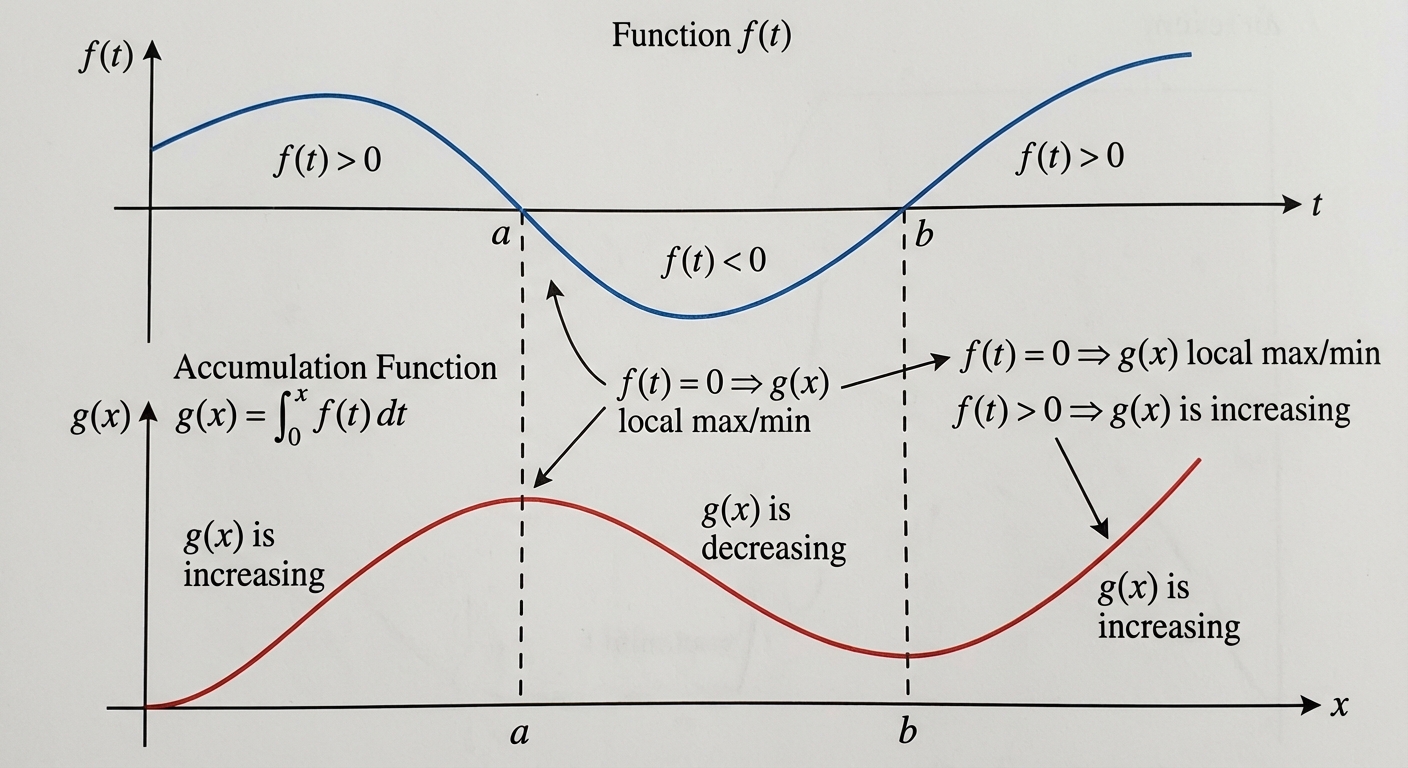
Example 2: Graphical Analysis
Suppose $g(x) = \int_0^x f(t) dt$ and the graph of $f$ is shown to be positive and decreasing for $0 < x < 5$.
- Since $f$ is positive, $g$ is increasing.
- Since $f$ is decreasing ($f'$ is negative), $g$ is concave down.
Applying Properties of Definite Integrals
Before evaluating difficult integrals or when working with abstract functions, you often need to manipulate the expression using these fundamental properties.
Integral Rules Checklist
- Zero Interval Property:
- Reversing Limits:
Tip: Always check your limit order. If the bottom number is larger than the top, flip them and add a negative sign. - Additive Interval Property:
- Scalar Multiplication:
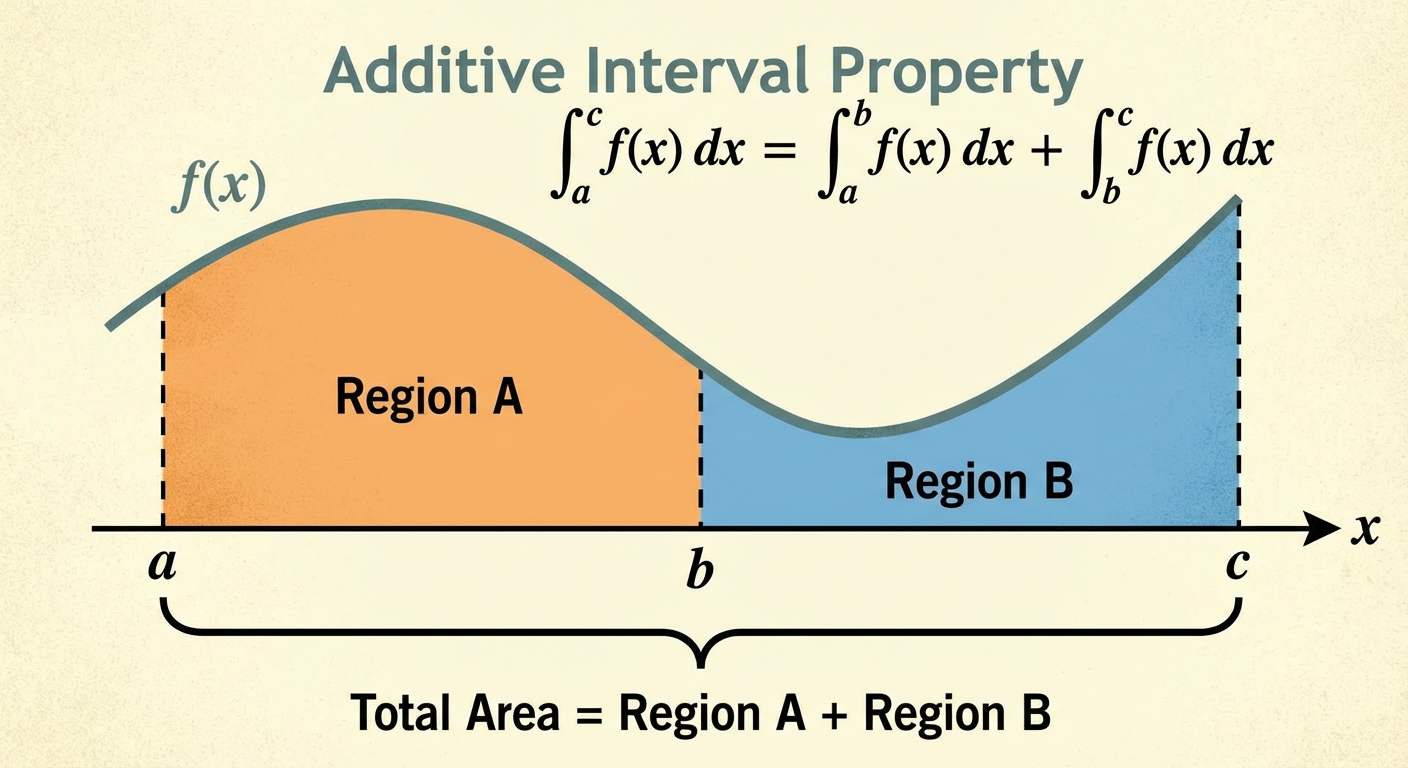
Example 3: Combining Intervals
Given $\int1^5 f(x) dx = 12$ and $\int1^3 f(x) dx = 4$, find $\int3^5 f(x) dx$.
Using the additive property:
FTC and Evaluating Definite Integrals
While Part 1 focuses on the derivative of an integral, FTC Part 2 provides the method for evaluating definite integrals using antiderivatives.
The Fundamental Theorem of Calculus, Part 2
If $f$ is continuous on $[a, b]$ and $F$ is any antiderivative of $f$ (meaning $F' = f$), then:
This theorem transforms a geometry problem (finding area) into an algebraic problem (evaluating antiderivatives).
The Total Change Theorem (Net Change)
A crucial application of FTC Part 2 in physics and AP Free Response Questions is the Net Change Theorem. Rearranging the standard formula gives:
Interpretation:
Final Value = Initial Value + Accumulation of Change
Example 4: Calculating Displacement
A particle's velocity is $v(t) = 3t^2 - 1$. If the position at $t=1$ is $x(1) = 4$, determine the position at $t=3$.
Using the Net Change Theorem:
Common Mistakes & Pitfalls
- Ignoring the Chain Rule in FTC 1: When differentiating $\int_a^{x^2} f(t) dt$, students often forget to multiply by the derivative of the upper limit ($2x$).
- Confusing $f(x)$ with Slope: When analyzing $g(x) = \int_0^x f(t) dt$, remember that the y-values of the graph $f$ tell you the slope of $g$, not the slope of $f$ itself.
- Variable Confusion: In an accumulation function $\inta^x f(t) dt$, the variable $x$ belongs in the limit and $t$ belongs in the integrand. Never write $\inta^x f(x) dx$.
- Reversing Bounds Signs: When applying $\intb^a f(x) dx = -\inta^b f(x) dx$, students frequently drop the negative sign, leading to incorrect net areas.
- Initial Condition Errors: In "Net Change" problems ($F(b) = F(a) + \int$), students often calculate the integral perfectly but forget to add the initial value $F(a)$.