AP German Unit 1: Families and Communities (Familie und Gemeinschaft)
1.1 Diverse Family Structures (Familienstrukturen)
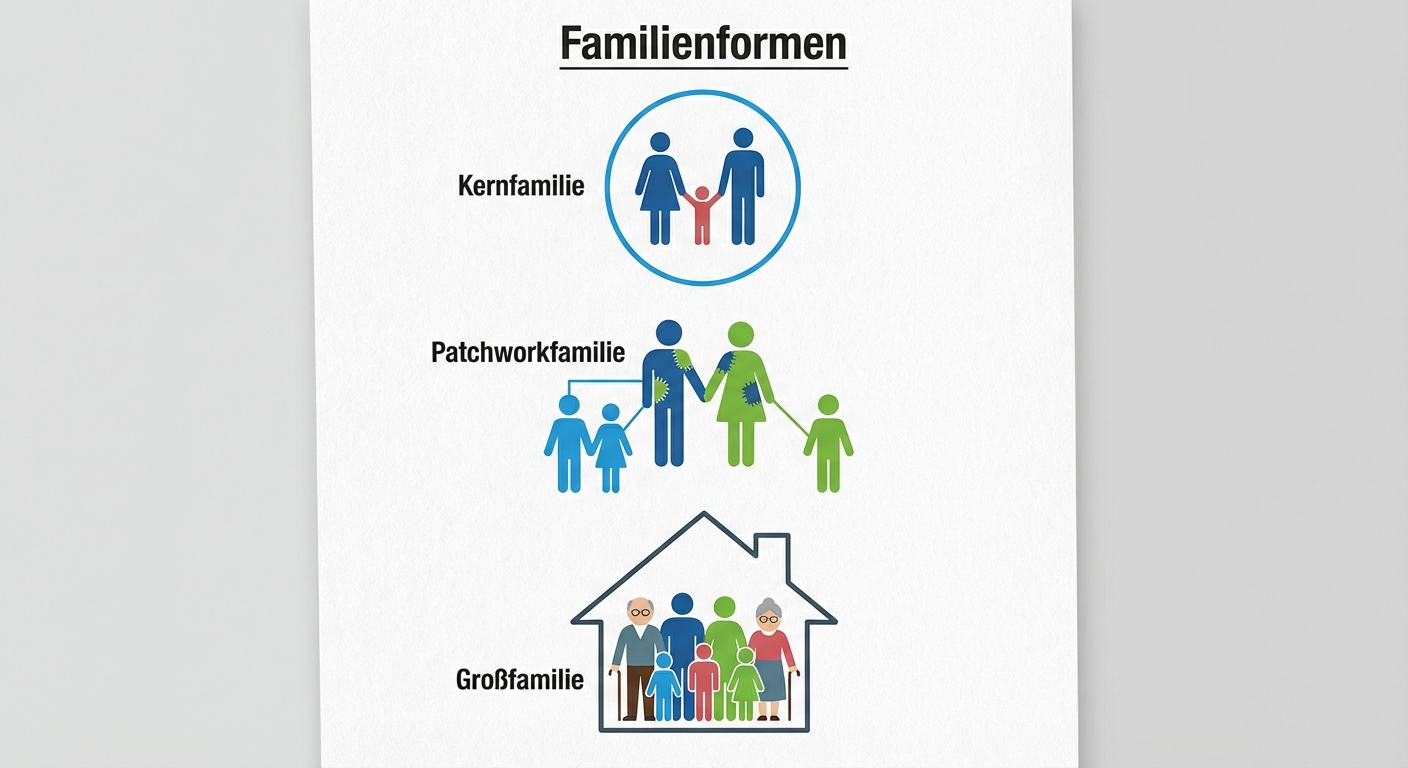
In the German-speaking world (DACH: Deutschland, Österreich, die Schweiz), the concept of family has evolved significantly from the mid-20th century to today. While the traditional model remains visible, society openly embraces various forms of living together.
Key Concepts & Vocabulary
- Die Kernfamilie (The Nuclear Family): The traditional structure consisting of a mother, father, and children (Mutter, Vater, Kinder). While still common, it is no longer the sole standard.
- Die Großfamilie (Extended Family): Includes grandparents, aunts, uncles, and cousins. In rural areas, it is historically common for multiple generations to live under one roof (Mehrgenerationenhaus), though this is declining due to labor mobility.
- Die Patchworkfamilie (Blended Family): Formed when parents separate or divorce and find new partners, bringing children from previous relationships together.
- Note: Divorce rates (Scheidungsraten) are high, making this a very common structure.
- Alleinerziehende (Single Parents): Parents raising children alone.
- Context: This is the fastest-growing demographic change. Single mothers (Alleinerziehende Mütter) make up the vast majority (approx. 83% in Switzerland), but single fathers (Alleinerziehende Väter) also exist.
- Regenbogenfamilie (Rainbow Family): Same-sex couples raising children.
- Legal Context: Germany introduced "Marriage for All" (Ehe für alle) in 2017, granting full adoption rights to same-sex couples.
- Ehe ohne Trauschein (Cohabitation/Marriage without a license): Living together without being married. This is extremely common in DACH countries compared to the US; couples often have children and live together for decades without ever legally marrying.
Current Trends and Statistics
- Family Size: Families are shrinking. A typical family has 1 to 2 children.
- In Germany, 53% of families have only one child.
- Age of Parents: People are starting families later (späte Familiengründung) to prioritize education and career.
- Average age of first-time mothers: ~30 years.
- Average age of first-time fathers: ~35 years.
- Swiss Specifics:
- Household size is small (avg 2.23 persons).
- Over 33% of Swiss households are single-person households (Einpersonenhaushalte).
1.2 Demographics and Social Challenges (Demografischer Wandel)
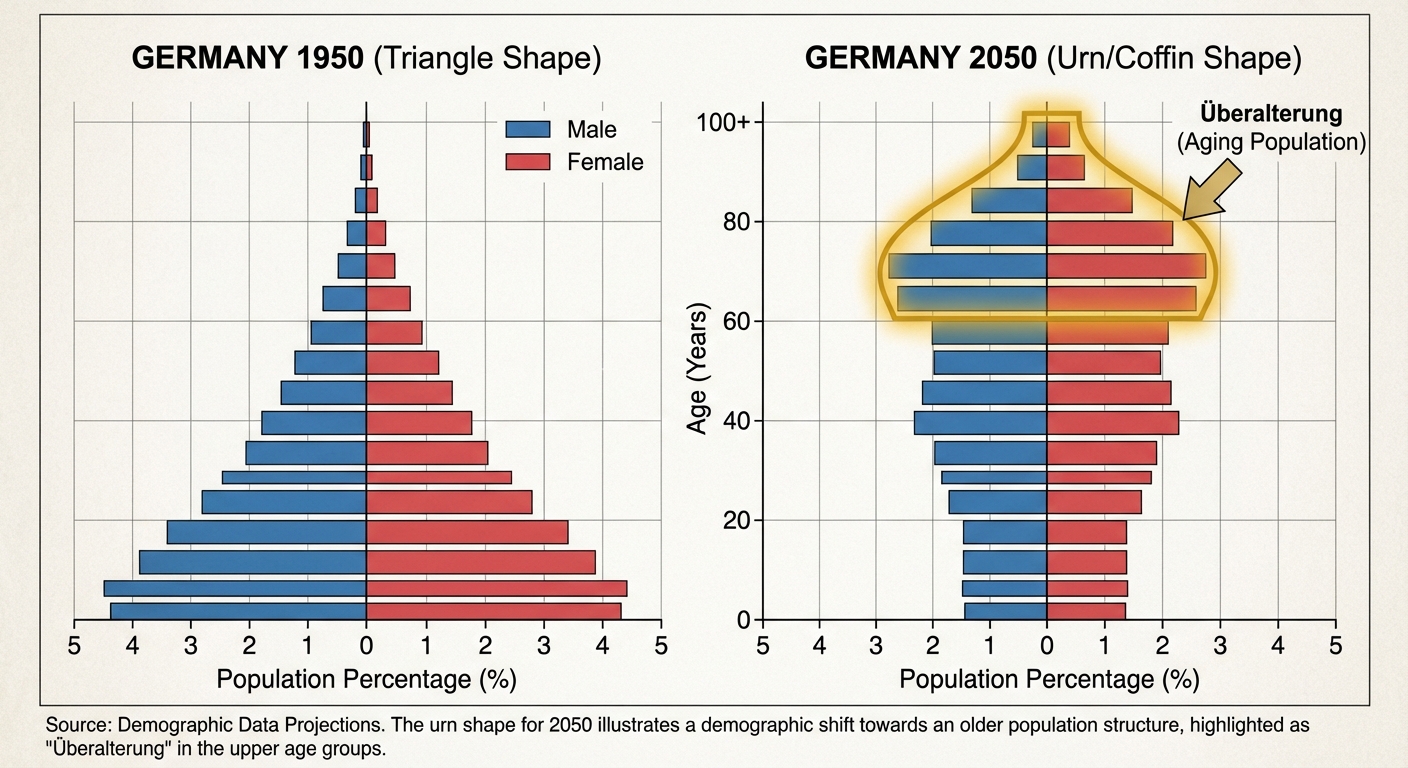
Germany is typically described as an aging society. This demographic shift is a central theme in the AP exam, often appearing in charts and graphs.
The Aging Population (Die Überalterung)
Germany is in Stage 5 of the Demographic Transition Model (very low birth rate, high life expectancy).
- The Cause: Low birth rates (niedrige Geburtenrate). Women generally start families later and have fewer children.
- The Consequence: The population is shrinking and getting older.
- Workforce Shortage: Fewer young people entering the workforce leads to a shortage of skilled labor (Fachkräftemangel).
- Pension Crisis: Fewer workers pay into the social security system to support a growing number of retirees (Rentner).
Urban vs. Rural Living (Stadt vs. Land)
- Urban (Stadt): Preferred by young singles (Singles) and students due to universities, jobs, and nightlife. Cities face housing shortages and high rent.
- Rural (Land): Preferred by families with children due to:
- Lower cost of living.
- Access to nature and more space.
- Safety for children playing outside.
The Role of Immigration (Zuwanderung)
To combat the aging population and labor shortage, DACH countries rely on immigration.
- Multiculturalism: Germany acts as a "land of immigration" (Einwanderungsland).
- Switzerland: Has one of the highest foreign-born populations in Europe (~25%). While not in the EU, Switzerland has open borders for workers via bilateral agreements, though this sometimes creates political tension.
1.3 Government Support and Social Security
Unlike in the US, the government in German-speaking countries plays a massive role in supporting families (The Welfare State / Der Sozialstaat). This is a crucial point for Cultural Comparison FRQs.
Key Comparisons (USA vs. DACH)
| Feature | USA | DACH (Germany/Austria/Switzerland) |
|---|---|---|
| Child Support | Tax credits (limited) | Kindergeld: Monthly cash payment from the gov't to parents for every child until age 18-25. |
| Parental Leave | FMLA (unpaid/short) | Elternzeit/Mutterschutz: Paid leave for up to 1-3 years with job protection. |
| Childcare | Expensive, private | Kita/Kindergarten: Heavily subsidized or free, often a legal right (Rechtsanspruch). |
| Education | Expensive college tuition | Universität: Tuition is free or very low cost (~300€/semester). |
Balancing Work and Life (Vereinbarkeit von Familie und Beruf)
- The Challenge: Despite support, balancing a career and children remains difficult.
- Part-time Work: Mothers often work part-time (Teilzeit) to care for children while fathers work full-time, though this traditional role distribution is slowly changing.
- Kita-Plätze: In cities, there is often a shortage of spots in daycare centers (Kindertagesstätten), causing stress for parents returning to work.
1.4 Values and Social Life in the Community
Parenting Style: Education for Independence
- Selbstständigkeit (Self-reliance): German parents value independence highly.
- Children often walk or bike to school alone or with friends from a young age (unlike the "chauffeur" culture in the US).
- Example: Children are encouraged to resolve conflicts on their own before adults intervene.
Communication Norms
- Directness: Germans value direct communication. Criticism is often constructive, not meant to be rude. "Sugar-coating" is less common.
- Small Talk: Generally avoided. Initial greetings (Guten Tag) are polite, but deep conversation is preferred over superficial chat about the weather.
- Privacy: There is a stricter separation between public/work life and private/family life.
Community Organization: Vereine
- Der Verein (Club/Association): This is the heart of social life in DACH regions.
- Over 600,000 clubs exist in Germany.
- People bond over hobbies (sports, music, gardening, rabbit breeding) rather than just through school sports teams.
- Membership in a Sportverein is cheaper and more lifelong than US school sports.
1.5 Common Mistakes & Exam Pitfalls
False Friends & Vocabulary Errors
- "Die Familie" vs. "Das Familienmitglied"
- Mistake: "Meine Familie sind nett." (My family are nice.)
- Correction: "Meine Familie ist nett." (Familie is a singular noun, even if it contains many people).
- "Bekannte" vs. "Freunde"
- Concept: In English, we call many people "friends." In German, a Freund is a close confidant. A coworker or neighbor is usually a Bekannter (acquaintance). Don't use Freund too loosely.
- "Hochschule"
- Mistake: Thinking this means "High School."
- Correction: Hochschule means University/College. High School is Gymnasium, Realschule, etc.
Cultural Misunderstandings
- Assuming Similarity: Do not assume German schools have the same spirit/sports culture as US schools. German social life happens outside of school in Vereinen.
- Stereotypes: Avoid mentioning Lederhosen or Oktoberfest unless specifically relevant to Bavaria. Discussing modern family diversity is much better for the AP exam than relying on old stereotypes.
Grammar Watch: Plural vs. Singular
- Eltern (Parents): Always plural. Meine Eltern sind…
- Großeltern (Grandparents): Always plural.
- Kind (Child): Singular (Das Kind). Plural (Die Kinder).
1.6 Summary for AP Cultural Comparison
When asked to compare families in your community to families in a German-speaking region, use these contrasts:
- Independence: German children have more physical freedom (mobility/transport) vs. US children (dependency on cars/parents).
- Cost: Raising a family in DACH is supported by taxes (Kindergeld, free University) vs. US individual financial responsibility.
- Structure: Cohabitation without marriage is more normalized in DACH than in conservative parts of the US.
- Social Circles: DACH social life focuses on Vereine (clubs); US social life often centers around School Spirit/Teams.