Unit 4 Master Guide: The Aeneid Books 1–2 and Latin Hexameter
The Meter of Epic: Dactylic Hexameter
To master Vergil, you must first master the rhythm of epic poetry. The Dactylic Hexameter is the standard meter for Greek and Latin epics (including the Iliad, Odyssey, and Aeneid).
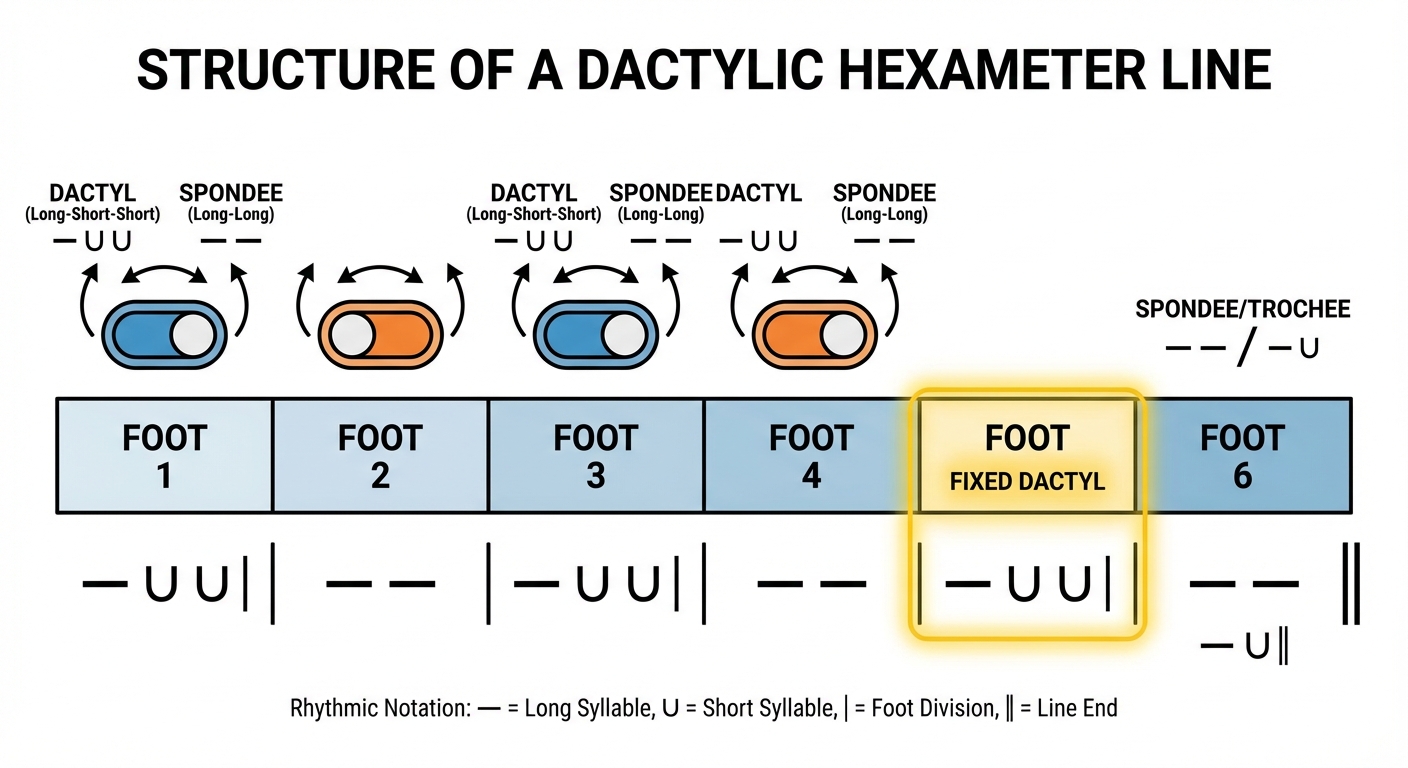
Structure of the Verse
A line of hexameter consists of exactly six metric units called feet.
- The Beat: A foot can be a Dactyl (one long syllable followed by two shorts:
— ∪ ∪) or a Spondee (two long syllables:— —). - The Rules of the Feet:
- Feet 1–4: Can be either dactyls or spondees.
- Foot 5: Is almost always a dactyl (
— ∪ ∪). (A line with a spondee here is called a spondaic line, utilized rarely for heavy, slow emphasis). - Foot 6: Is always two syllables. The first is long; the second is anceps (can be long or short), often treated as a spondee (
— x).
Scansion Rules
Scansion is the act of marking the meter. Follow these steps to determine if syllables are Long (—) or Short (∪):
- Definition of a Syllable: A vowel or a diphthong counts as the core of a syllable.
- Long by Nature: The vowel has a macron in the dictionary (e.g., the 'o' in Rōma). Diphthongs (ae, au, ei, oe, ui, eu) are always long.
- Long by Position: A short vowel becomes long if it is followed by two consonants (either in the same word or across the word boundary). Note: 'x' and 'z' count as double consonants. 'h' is ignored.
- Elision: The