Unit 6 Study Guide: Antiderivatives & Integration Methods
Finding Antiderivatives and Indefinite Integrals: Basic Rules
At its core, integration is the inverse operation of differentiation. While derivatives measure instantaneous rates of change, integrals allow us to calculate accumulation—such as total displacement from velocity or total area under a curve.
The Definition of the Antiderivative
A function $F(x)$ is called an antiderivative of $f(x)$ on an interval $I$ if $F'(x) = f(x)$ for all $x$ in $I$.
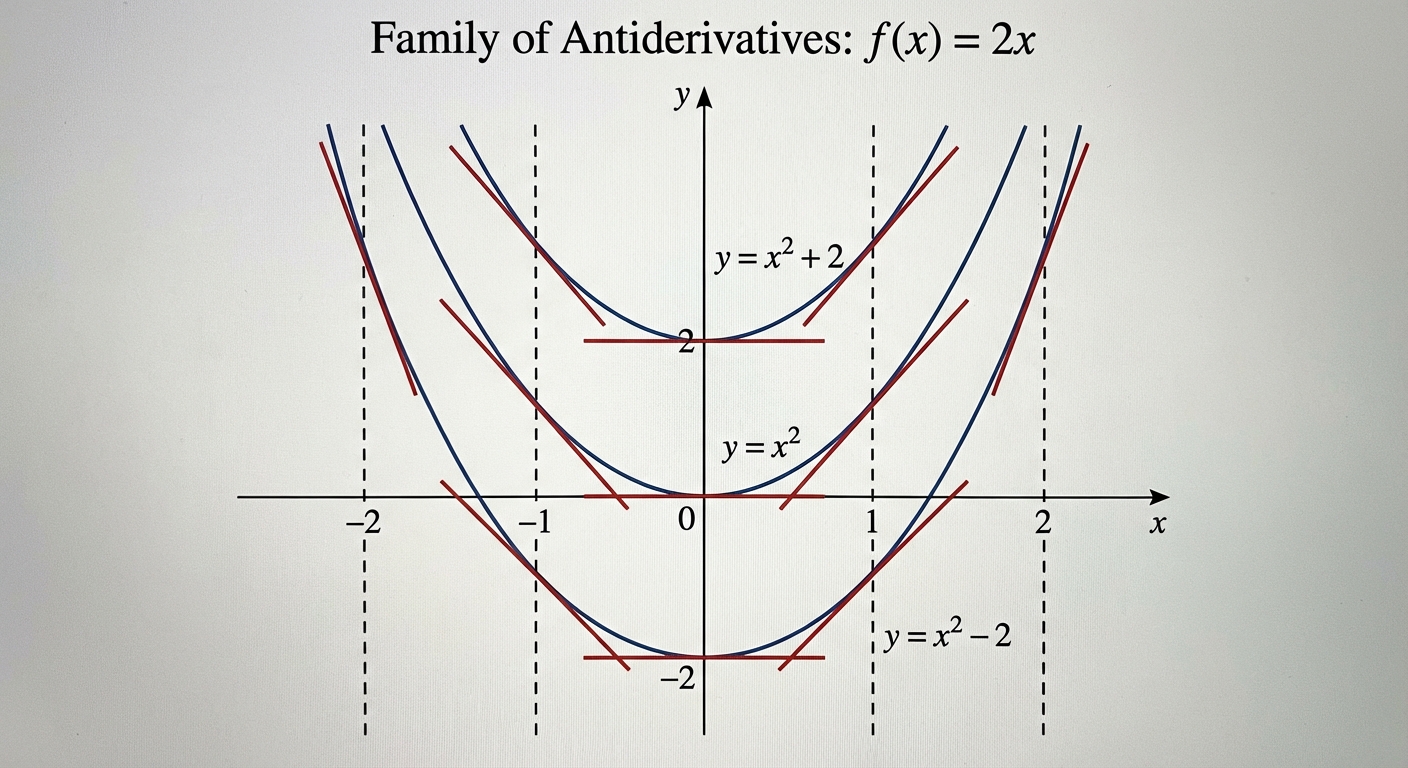
Because the derivative of any constant is zero, antiderivatives are not unique. If $F(x)$ is an antiderivative of $f(x)$, then $F(x) + C$ (where $C$ is an arbitrary constant) represents the general antiderivative. This entire family of functions is denoted by the indefinite integral:
Power Rule for Integration
The Power Rule is likely the technique you will use most frequently. It essentially reverses the Power Rule for differentiation.
The Rule:
- Example: $\int 3x^4 \, dx = 3 \cdot \frac{x^5}{5} + C = \frac{3}{5}x^5 + C$
- Note: If $n = -1$, the function is $x^{-1} = \frac{1}{x}$. The Power Rule causes division by zero here, so we use a special rule: $\int \frac{1}{x} \, dx = \ln|x| + C$.
Trigonometric and Exponential Rules
You must memorize the standard integration formulas. Since integration reverses differentiation, you can derive these by thinking backwards from your derivative rules.
| Function | Indefinite Integral |
|---|---|
| $\sin x$ | $-\cos x + C$ |
| $\cos x$ | $\sin x + C$ |
| $\sec^2 x$ | $\tan x + C$ |
| $\sec x \tan x$ | $\sec x + C$ |
| $\csc^2 x$ | $-\cot x + C$ |
| $\csc x \cot x$ | $-\csc x + C$ |
| $e^x$ | $e^x + C$ |
| $a^x$ | $\frac{a^x}{\ln a} + C$ |
Tip: In differentiation, the "co-" functions (cos, cot, csc) result in negative derivatives. In integration, integrating to get a "co-" function (like integrating $\sin x$ to get $-\cos x$) results in the negative sign.
Linearity Properties
Integration is a linear operation, meaning you can split sums and pull out constants:
- Sum/Difference: $\int [f(x) \pm g(x)] \, dx = \int f(x) \, dx \pm \int g(x) \, dx$
- Constant Multiple: $\int k \cdot f(x) \, dx = k \int f(x) \, dx$
Integrating Using Substitution
When a function is composite—meaning one function is "inside" another—standard rules often fail. Integration by Substitution (also called $u$-substitution) is the method used to reverse the Chain Rule.
The Concept
If you have an integral of the form $\int f(g(x))g'(x) \, dx$, you can substitute $u = g(x)$, which implies $du = g'(x) \, dx$. The integral simplifies to:
Step-by-Step Procedure
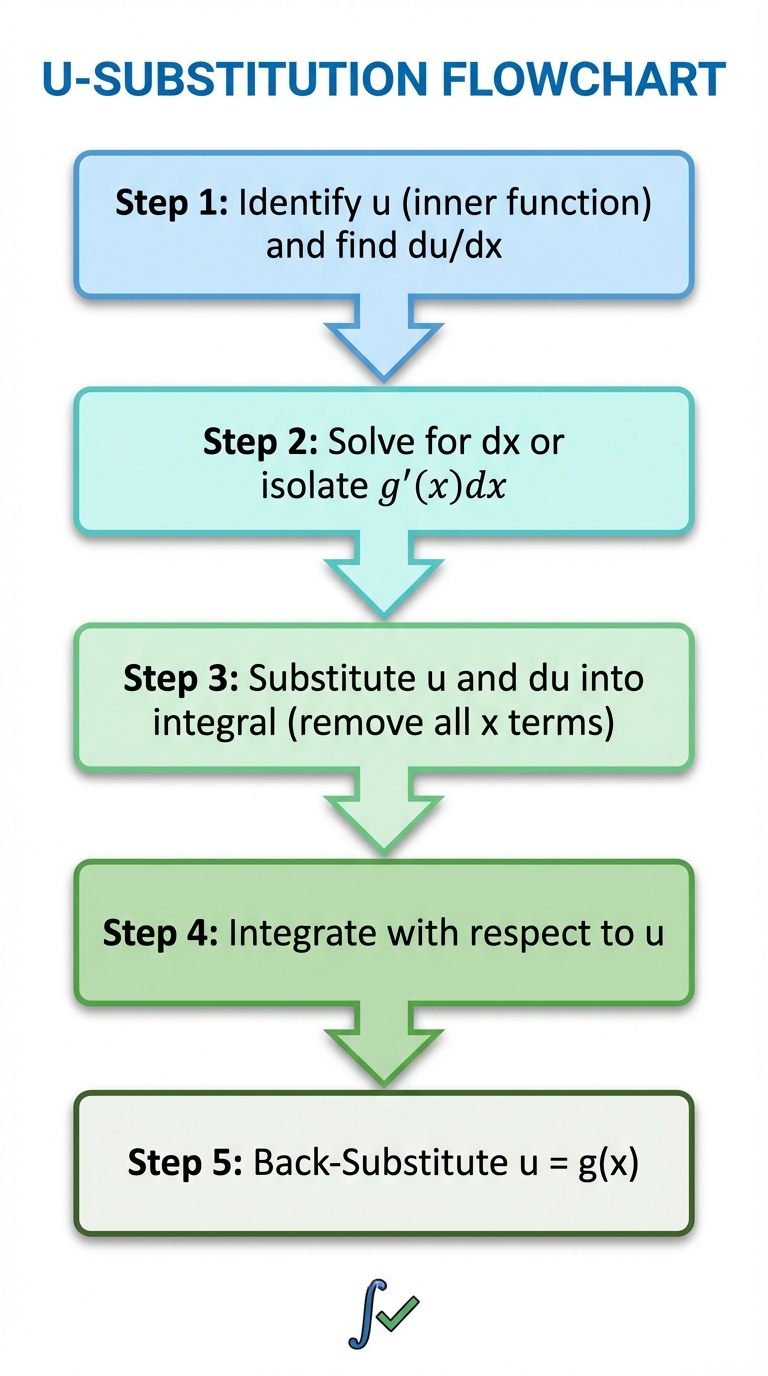
- Choose $u$: Look for a function distinct in the integrand whose derivative is also present (up to a constant multiple). Common choices for $u$ are expressions inside parentheses, under square roots, in denominators, or exponents.
- Differentiate: Calculate $du = g'(x) \, dx$.
- Isolate $dx$ (Optional): Solve for $dx$ implies $dx = \frac{du}{g'(x)}$.
- Substitute: Rewrite the entire integral in terms of $u$. All $x$ terms must disappear.
- Integrate: Evaluate the simplified integral with respect to $u$.
- Back-Substitute: Replace $u$ with the original expression $g(x)$.
Example: Standard Substitution
Problem: Evaluate $\int x^2 (x^3 + 5)^8 \, dx$.
- Choose $u$: The inner function is $x^3 + 5$. Let $u = x^3 + 5$.
- Find $du$: $du = 3x^2 \, dx$.
- Adjust: We have $x^2 \, dx$ in the problem, but our derivative is $3x^2 \, dx$. We can write $\frac{1}{3} du = x^2 \, dx$.
- Substitute: $\int u^8 \cdot \frac{1}{3} \, du = \frac{1}{3} \int u^8 \, du$.
- Integrate: $\frac{1}{3} \cdot \frac{u^9}{9} + C = \frac{u^9}{27} + C$.
- Back-Substitute: $\frac{(x^3+5)^9}{27} + C$.
Integrating Using Long Division and Completing the Square
Sometimes an integrand looks overly complex but can be simplified using algebra before you apply calculus rules. This is common with rational functions (fractions with polynomials).
Polynomial Long Division
When to use it: When the integrand is a rational function $\frac{N(x)}{D(x)}$ and the degree of the numerator is greater than or equal to the degree of the denominator.
The Strategy:
Perform polynomial long division (or synthetic division if the denominator is linear) to rewrite the fraction as:
Where $Q(x)$ is a polynomial (easy to integrate via Power Rule) and the remainder part is often a simple natural log integral.
Example:
Evaluate $\int \frac{x+5}{x+2} \, dx$.
- Since degrees are equal (both 1), we divide.
- $(x+5) \div (x+2) = 1$ with a remainder of $3$.
- Rewrite: $\int (1 + \frac{3}{x+2}) \, dx$.
- Integrate: $x + 3\ln|x+2| + C$.
Completing the Square
When to use it: When the integrand contains a quadratic polynomial in the denominator ($ax^2 + bx + c$) that does not factor easily, and standard $u$-substitution fails (usually because the numerator lacks the derivative of the denominator).
The Goal:
To manipulate the denominator into the form $u^2 + a^2$ or $\sqrt{a^2 - u^2}$, allowing you to use inverse trigonometric integration rules.
Key Formula:
Example:
Evaluate $\int \frac{1}{x^2 - 4x + 13} \, dx$.
- Analyze Denominator: $x^2 - 4x + 13$. We cannot factor this over real numbers.
- Complete the Square: Take half of $b$ (which is -4), square it ($(-2)^2 = 4$).
- Rewrite Integral: $\int \frac{1}{(x-2)^2 + 3^2} \, dx$.
- Apply Formula: Here, $u = x-2$ ($du=dx$) and $a = 3$.
Common Mistakes & Pitfalls
- The $+C$ Omission: The most frequent error on indefinite integrals is forgetting the Constant of Integration ($+C$). It represents the infinite family of antiderivatives.
- Variable confusion in $u$-sub: When using $u$-substitution, students often replace parts of the function with $u$ but leave $dx$ instead of converting to $du$. You cannot integrate a function of $u$ with respect to $x$.
- Incomplete Chain Rule Reversal: Failing to account for the constant multiplier when finding $du$. For $\int e^{5x} \, dx$, the result is $\frac{1}{5}e^{5x} + C$, not $e^{5x} + C$.
- Log Rule Misapplication: Students often try to apply the Power Rule to $\int x^{-1} \, dx$ (getting $\frac{x^0}{0}$), or they assume $\int \frac{1}{x^2+1}dx = \ln(x^2+1)$. Remember: $\int \frac{1}{x} dx$ is specifically $\ln|x|$, and specific rational structures yield arctan, not natural logs.