APUSH Period 4: The Transformation of Politics and Economy (1800–1848)
APUSH Period 4: The Transformation of Politics and Economy (1800–1848)
The Rise of Political Parties and The Peaceful Revolution
The period begins with a crucial test of the young republic's stability: the first peaceful transfer of power between opposing political factions.
The Revolution of 1800
The Election of 1800 is often termed the "Revolution of 1800" not because of violence, but because it marked the peaceful shift from the Federalist Party (John Adams) to the Democratic-Republicans (Thomas Jefferson). This solidified the two-party system as a mechanism for democratic stability.
- Jeffersonian Democracy: Jefferson advocated for a predominantly agrarian society, limited federal government, and strict construction of the Constitution. However, once in office, he adopted a more pragmatic approach (e.g., the Louisiana Purchase of 1803), which expanded federal power despite his theoretical opposition to it.
The Role of the Supreme Court
While the Federalists died out as a political party (largely after the Hartford Convention during the War of 1812), their ideology survived through the judicial branch.
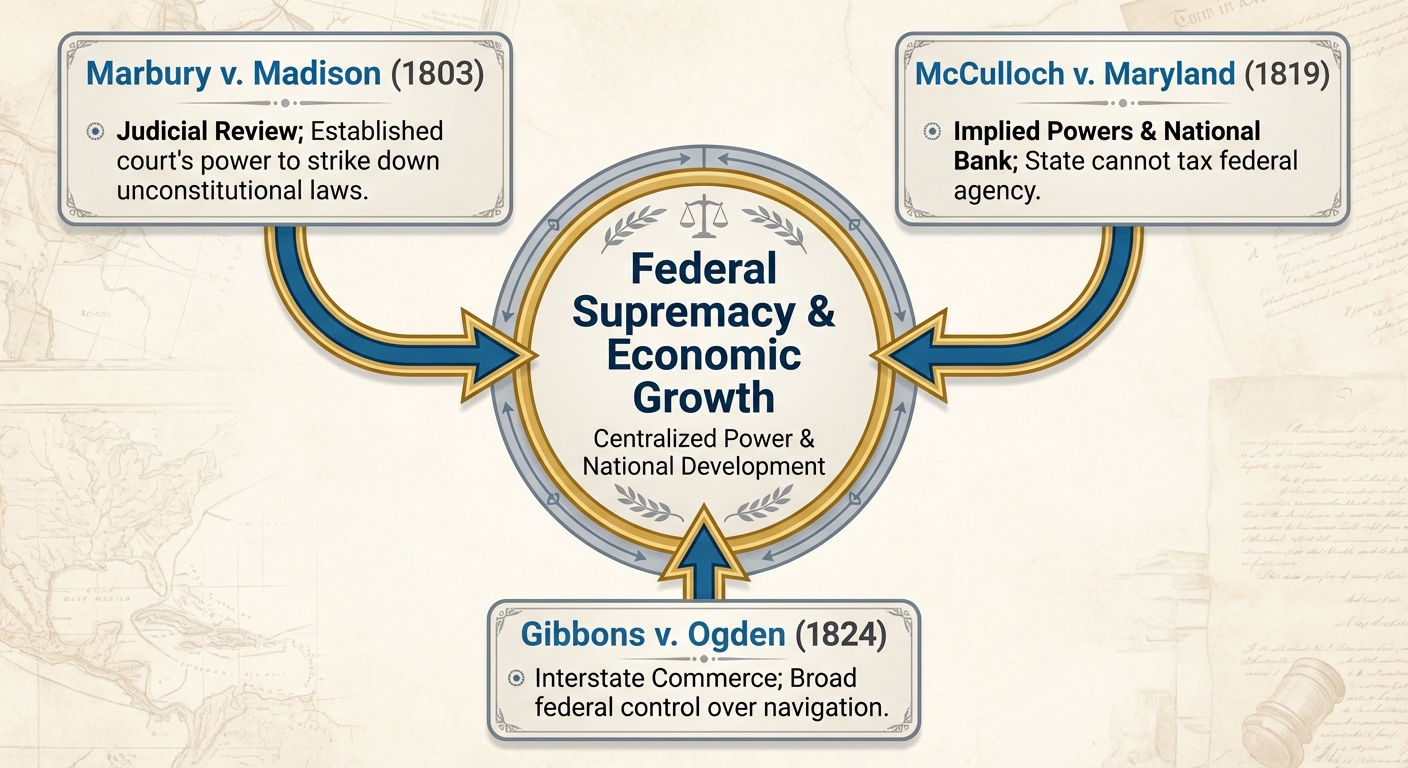
John Marshall, the Chief Justice appointed by Adams, established the authority of the Supreme Court through landmark decisions:
- Marbury v. Madison (1803): Established Judicial Review—the power of the Supreme Court to declare laws unconstitutional.
- McCulloch v. Maryland (1819): Upheld the constitutionality of the Second Bank of the United States and prohibited states from taxing federal institutions (asserting federal supremacy).
- Gibbons v. Ogden (1824): Clarified that Congress has the sole power to regulate interstate commerce.
The Market Revolution
Between 1800 and 1848, the United States underwent a massive economic transformation known as the Market Revolution. This was not just an economic change but a social one, fundamentally altering how Americans thought about democracy, labor, and gender.
Technical Innovations and Transportation
The transition from subsistence farming to a national network of industry and commerce was driven by key technologies:
- Transportation Revolution:
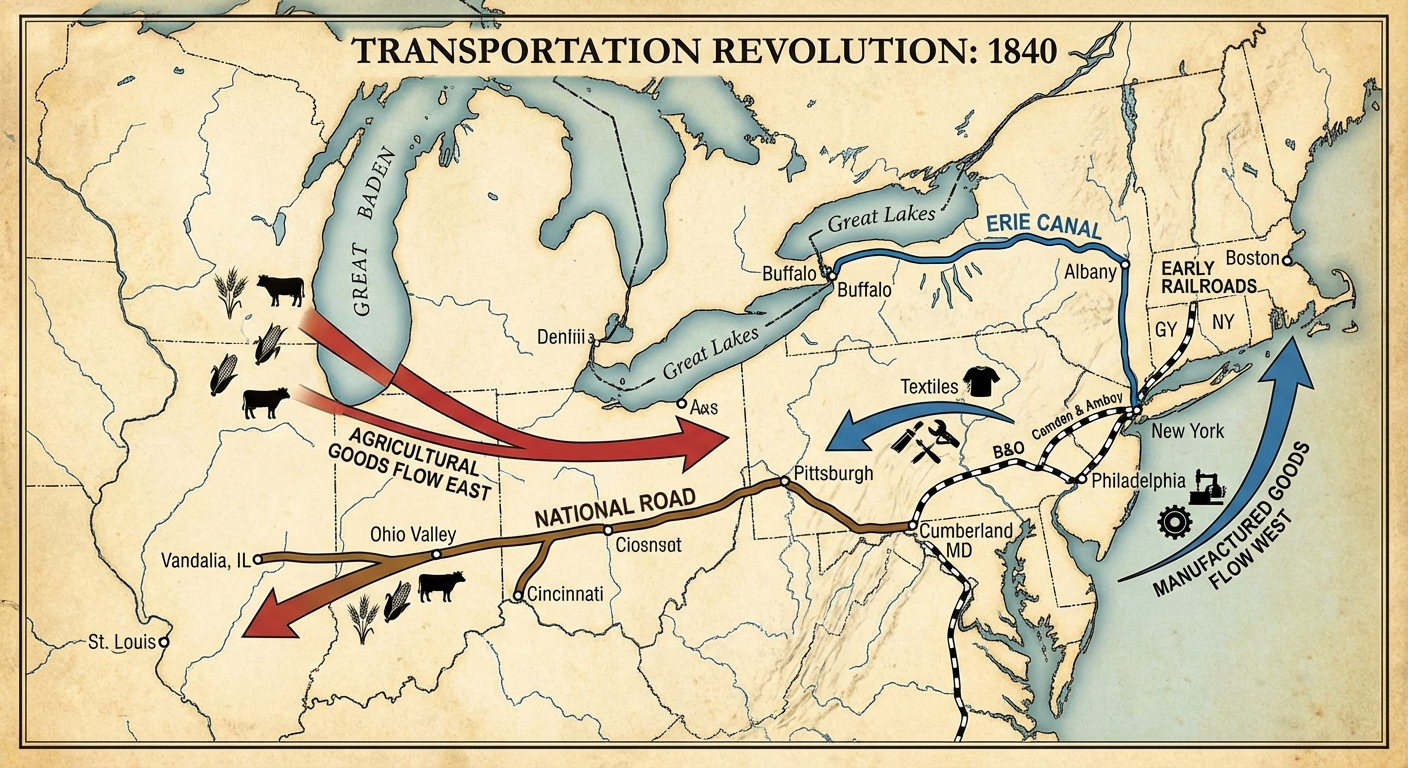
- Steamboats (Robert Fulton): Allowed for upstream travel, drastically reducing shipping costs.
- Canals (The Erie Canal, 1825): Linked the Atlantic economy (New York) to the agrarian Midwest, creating a unified national market.
- Railroads: By the 1840s, trains began replacing canals as the dominant mode of transport, further accelerating trade.
- Inventions:
- Cotton Gin (Eli Whitney): Revolutionized Southern agriculture, entrenching slavery and fueling the Northern textile industry.
- Interchangeable Parts (Eli Whitney): Allowed for mass production and the assembly line system.
- Telegraph (Samuel Morse): enabled instant communication over long distances.
Social and Economic Impacts
- Rise of the Factory System: The Lowell System in Massachusetts employed young, unmarried women in textile mills, representing the first time women entered the industrial workforce in large numbers.
- Class Stratification: A distinct middle class emerged, along with a growing gap between the wealthy business owners and the working poor.
- Separate Spheres: The cultural idea that men belonged in the public sphere (work/politics) and women belonged in the domestic sphere (home/family), known as the Cult of Domesticity.
Expanding Democracy and Jacksonian Era
Following the Era of Good Feelings (1815–1824), where there was only one dominant party, political tensions resurfaced. The controversial Election of 1824, settled by the House of Representatives in what Jacksonians called the "Corrupt Bargain," led to the permanent split of the Democratic-Republicans into two new parties.
The Expansion of Suffrage
The most significant political change of this era was the expansion of the electorate.
- Universal White Male Suffrage: By 1828, most states had dropped property requirements for voting. This shifted politics from the elite to the common man.
- Nominating Conventions: Replaced the secret "King Caucus" system, making the selection of candidates more democratic.
The Second Party System
By the 1830s, a robust two-party system had formed:
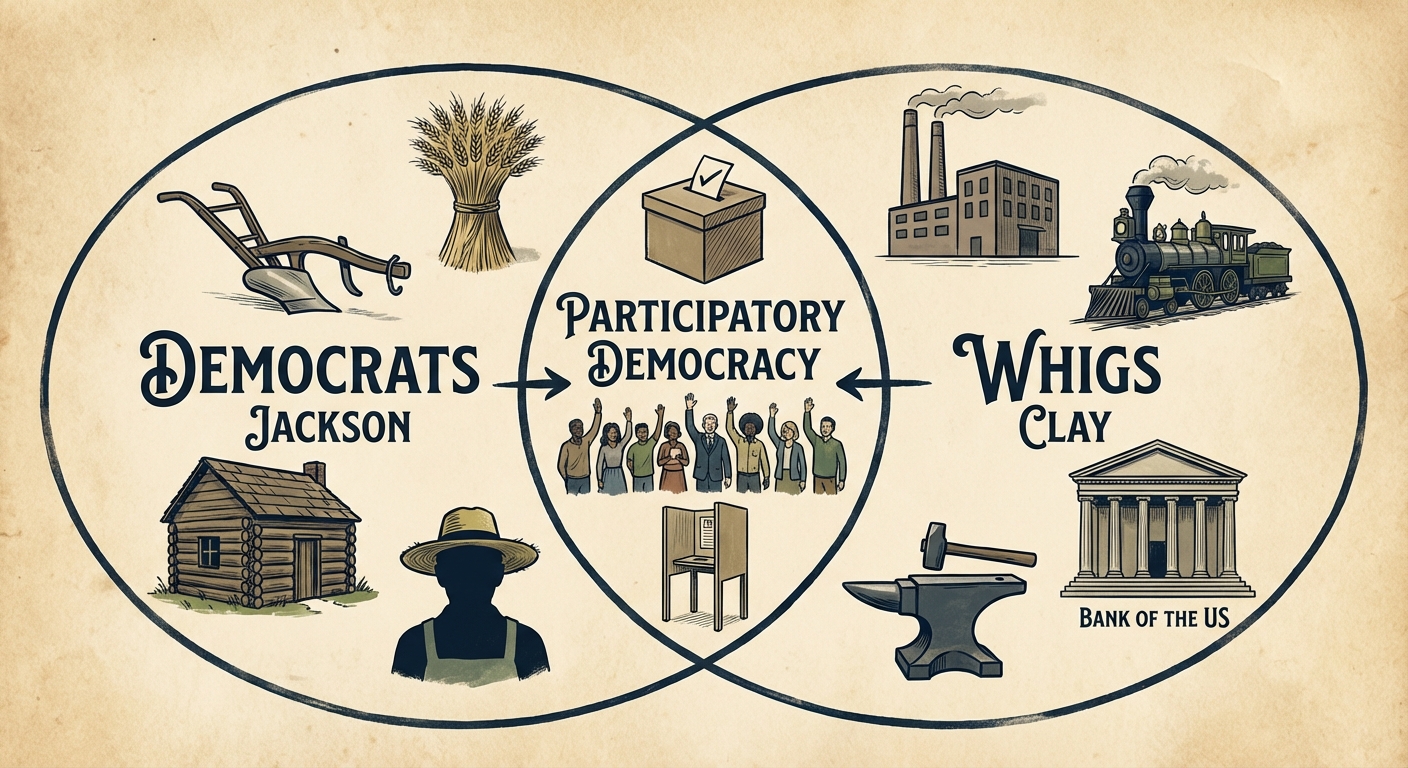
| Feature | Democrats (Andrew Jackson) | Whigs (Henry Clay) |
|---|---|---|
| Base of Support | Common man, South & West, immigrants | Business elites, New England, middle-class reformers |
| View of Gov. | States' rights, limited federal power | Strong federal gov., national planning |
| Economic Policy | Against the national bank & tariffs (Laissez-faire) | The American System (National Bank, Protective Tariffs, Internal Improvements) |
| Key Issues | Indian Removal, Territorital Expansion | Moral reform (temperance), internal improvements |
Andrew Jackson’s Presidency (1829–1837)
Jackson viewed himself as the direct representative of "the people" and used the veto power more than all previous presidents combined. Key events include:
- The Spoils System: The practice of giving government jobs to political supporters (patronage).
- The Nullification Crisis (1832): South Carolina (led by John C. Calhoun) attempted to nullify federal tariffs. Jackson threatened military force, asserting federal authority over states' rights.
- The Bank War: Jackson vetoed the recharter of the Second Bank of the U.S., claiming it favored the wealthy elite. He withdrew federal funds to state "pet banks," leading to the Panic of 1837.
- Indian Removal Act (1830): Despite the Supreme Court ruling in Worcester v. Georgia that Cherokee lands were sovereign, Jackson enforced removal, leading to the Trail of Tears.
Mnemonics
- BIT for Henry Clay's American System (favored by Whigs):
- Bank of the U.S.
- Internal Improvements (Infrastructure)
- Tariffs (Protective)
Common Mistakes & Pitfalls
- Confusing the First and Second Party Systems:
- Correction: The First System was Federalists vs. Democratic-Republicans (1790s–1810s). The Second System was Democrats vs. Whigs (1830s–1850s). Don't mix them up!
- Misunderstanding "Universal Suffrage":
- Correction: In this period, it only refers to Universal White Male Suffrage. Women and African Americans (free or enslaved) were systematically excluded from this "expansion" of democracy.
- Assuming Jackson Supported State Rights in All Cases:
- Correction: While Jackson generally favored states' rights, the Nullification Crisis proves he prioritized the Union and federal supremacy when the nation's integrity was threatened.
- The "Era of Good Feelings" Misnomer:
- Correction: While there was only one party, the era was fraught with economic panic (1819) and sectional tension over slavery (Missouri Compromise 1820). It was not actually a time of total unity.