AP Calculus AB Unit 4 (Contextual Applications of Differentiation): Related Rates — Complete Study Guide
Introduction to Related Rates
What “related rates” means
A related rates problem asks how the rates of change of two or more quantities are connected. The key idea is that the quantities are tied together by a constraint: a geometric relationship (like the Pythagorean Theorem), a measurement formula (like area or volume), or another equation that must remain true as time passes.
In these problems, you are not usually given an explicit function like %%LATEX0%%. Instead, you’re told information about rates such as %%LATEX1%% and asked to find another rate such as . What makes related rates feel tricky at first is that you must translate a real-world situation into variables and a constraint equation, then use differentiation to connect the rates.
Why related rates matters in calculus
Related rates is one of the first topics where derivatives become a tool for modeling real change, not just an algebraic procedure. You use derivatives as rates of change, careful units, and the Chain Rule (usually via implicit differentiation) because variables change with respect to time even if time is not explicitly written.
This connects directly to later ideas like linearization, optimization, and differential equations because you’re learning to take a relationship and “differentiate the relationship” to understand how change in one quantity forces change in another.
The core calculus idea: everything depends on time
In related rates, almost every variable represents a quantity changing with respect to time %%LATEX3%%. Even if a problem never writes %%LATEX4%% or , you should think that changing quantities are functions of time.
For example, if the radius of a circle is increasing, think %%LATEX6%% and %%LATEX7%%. Since the relationship is always true,
Differentiating both sides with respect to gives the rate relationship:
That is the heart of related rates: differentiate the constraint equation with respect to time.
The Core Concept: implicit differentiation with respect to time
Unlike standard differentiation where we often find %%LATEX11%%, in related rates we differentiate an equation implicitly with respect to %%LATEX12%%. The Chain Rule forces a rate factor whenever you differentiate a time-dependent variable.
If %%LATEX13%% is a differentiable function of %%LATEX14%%, then:
A very common pattern is differentiating a Pythagorean relationship:
Notation you’ll see (and what it means)
You’re expected to be fluent with multiple notations for rates.
| Meaning | Common notations | Interpretation |
|---|---|---|
| Rate of change of with respect to time | %%LATEX18%%, %%LATEX19%% (when variable is time), (less common in AP) | “How fast is changing per unit time” |
| Rate of change of volume | “Cubic units per unit time” | |
| Rate of change of an angle | “Radians per unit time” |
It’s also helpful to keep the meaning of signs clear.
- A positive rate means the quantity is increasing.
- A negative rate means the quantity is decreasing.
A major habit to build is attaching units mentally. If %%LATEX24%% cm/s, then %%LATEX25%% should come out in cm/s.
The “instant” matters (and avoiding the snapshot error)
Related rates questions almost always ask for a rate at a specific moment, such as “when ” or “when the ladder is 6 ft from the wall.” The rate you want typically depends on the current values of the variables.
That means you usually:
- Write a general derivative relationship (still in variables).
- Use the original constraint equation to find any missing measurements at that instant.
- Substitute the instant’s values and solve for the unknown rate.
A classic pitfall is the snapshot error: plugging in the “when” values before differentiating. If you substitute too early, you often turn an expression into a constant, and the derivative of a constant is 0, which destroys the rate relationship. Substitute only true constants (like a ladder length) at the start, and save “when” values until after differentiation.
Common relationship types (constraints) used in AB related rates
Most AB problems use familiar formulas. The main skill is choosing the one that matches the geometry.
Right triangles and distances in the plane:
Circle area:
Sphere volume:
Cone volume:
Similar triangles (especially shadows): proportions such as
Trigonometric ratios can also serve as the static constraint, for example:
In similarity problems, the key difficulty is setting up the correct proportion from the diagram and labeling variables clearly.
Exam Focus
- Typical question patterns:
- “A quantity is increasing/decreasing at a rate of … Find how fast another quantity changes when …” using a geometry formula.
- Ladder, shadow, or distance problems where you must write one constraint equation, differentiate, then substitute a specific instant.
- Problems that give one rate and one instantaneous measurement (like a radius or height) and ask for a related rate (like area or volume).
- Common mistakes:
- Forgetting the Chain Rule with respect to time (for example, differentiating %%LATEX35%% as %%LATEX36%% instead of ).
- Plugging in values before differentiating and losing needed variable dependence.
- Mixing up units or sign (e.g., a distance decreasing should give a negative rate).
Solving Related Rates Problems
A systematic workflow (draw, translate, relate, differentiate, evaluate)
A reliable way to solve related rates problems is to treat them as a modeling pipeline. Following a fixed structure prevents most errors.
Step 1: Draw a picture and define variables. Sketch the situation and label it. Use variables for quantities that change (such as %%LATEX38%%, %%LATEX39%%, %%LATEX40%%, %%LATEX41%%) and write numerical values for constants.
Step 2: Identify “Given,” “Find,” and “When.” Translate the prompt into math.
- Given: What rates or values are known? (Example: .)
- Find: What rate is requested? (Example: .)
- When: At what instant is the answer required? (Example: when .)
Step 3: Write the static (constraint) equation. This is the relationship among the variables before differentiating, such as a geometry formula, a measurement formula, a similarity proportion, or a trig ratio.
Step 4: Differentiate implicitly with respect to time . Do not substitute the “when” values yet.
Step 5: Substitute and evaluate. Now plug in the instantaneous values from the “when” statement and the known rates. Include units in your final answer and interpret the sign.
Differentiation mechanics you must be fluent with
Most related rates derivatives are straightforward, but they require careful Chain Rule use.
Power rule with time dependence:
Product rule (important when both factors depend on time):
A common product-rule mistake is differentiating something like as if
That is incorrect. The correct differentiation is:
Quotient rule (occasionally appears in similarity setups if you keep ratios):
A practical tip: in similar triangle problems, cross-multiplying first often avoids quotient rule complexity.
Worked Example 1: Expanding circle (area and radius)
Situation: The radius of a circle increases at %%LATEX52%% cm/s. Find %%LATEX53%% when cm.
Constraint equation:
Differentiate with respect to :
Substitute %%LATEX58%% and %%LATEX59%%:
Interpretation: the area is increasing at %%LATEX62%% cm%%LATEX63%%/s when .
A common error is forgetting the Chain Rule factor .
Worked Example 2: Sliding ladder (Pythagorean Theorem)
Scenario: A 10 ft ladder leans against a vertical wall. The bottom slides away from the wall at ft/s. How fast is the top sliding down when the bottom is 6 ft from the wall?
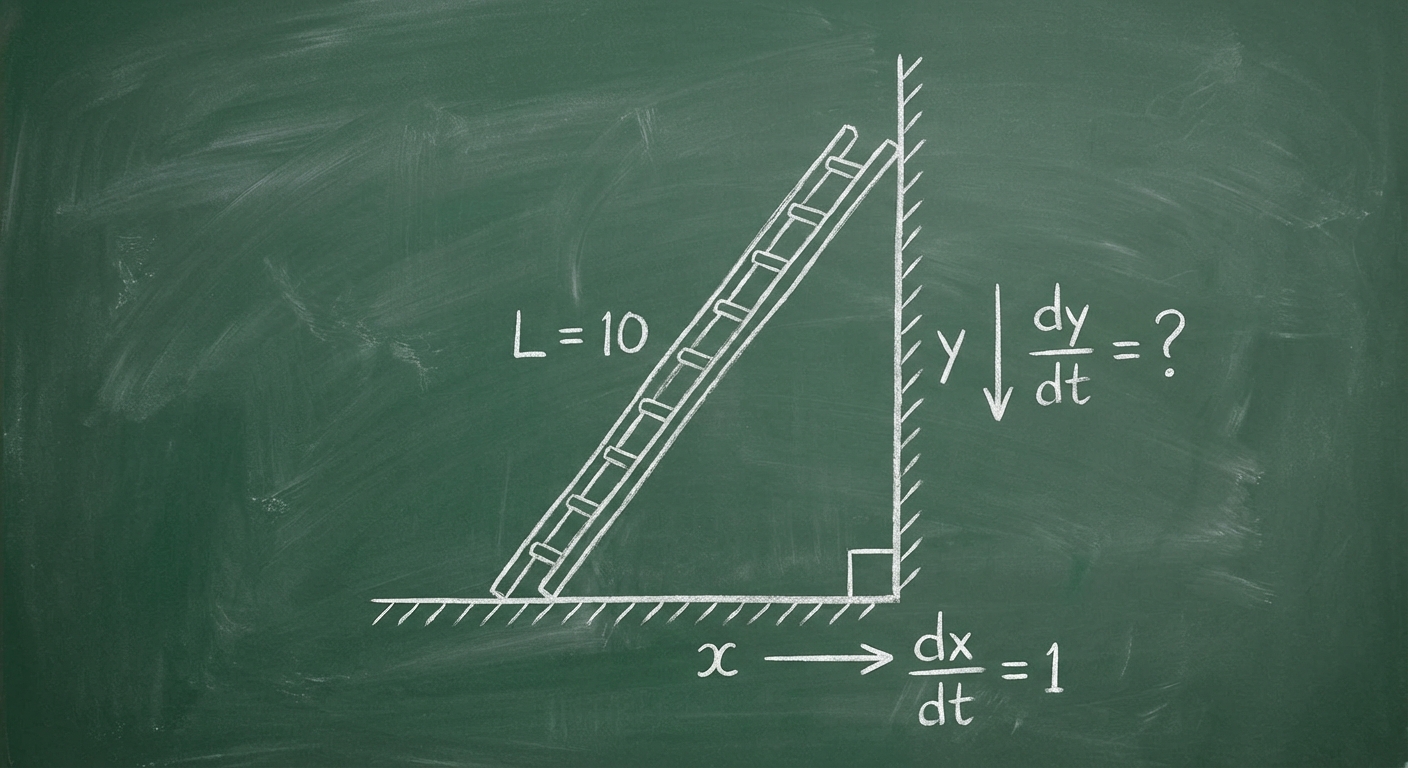
Define variables: let %%LATEX67%% be the distance from the wall to the bottom, %%LATEX68%% the height of the top on the wall, and the ladder length.
Given/Find/When:
- Given: %%LATEX70%% ft/s (positive because %%LATEX71%% increases).
- Constant: %%LATEX72%%, so %%LATEX73%%.
- Find: .
- When: .
Static equation:
Differentiate with respect to :
At the instant %%LATEX80%%, first find %%LATEX81%% from the static equation:
Now substitute into the differentiated equation:
Interpretation: the top is sliding down at %%LATEX88%% ft/s; the negative sign indicates %%LATEX89%% is decreasing.
Common issues include trying to use %%LATEX90%% (height is taken nonnegative) or forgetting to compute %%LATEX91%% before solving for .
Worked Example 3: Distance between two moving points (right-triangle model)
Situation: One car travels east at 30 mph and another travels north at 40 mph from the same intersection. How fast is the distance between them increasing after 2 hours?
Let %%LATEX93%% be the east distance, %%LATEX94%% the north distance, and the distance between cars. Given:
After 2 hours:
Constraint:
Differentiate:
Find at 2 hours:
Substitute:
Interpretation: the distance is increasing at 50 mph after 2 hours. Watch unit consistency (hours vs minutes) and remember you often must compute the current value of .
Similar triangles problems (shadows): setting up the constraint
Shadow problems are mostly algebra and geometry until the proportion is correct. Choose variables carefully and remember the large triangle’s base usually involves a sum like .
A common setup: a light of height %%LATEX113%% shines on a person of height %%LATEX114%% walking away. Let %%LATEX115%% be the distance from the light to the person, and let %%LATEX116%% be the shadow length, so the total distance from the light to the tip is .
Similar triangles give:
Cross-multiply to simplify before differentiating:
Now you have a clean relationship between %%LATEX122%% and %%LATEX123%%.
Worked Example 4: Shadow (similar triangles)
Situation: A 15 ft streetlamp casts a shadow of a 6 ft person walking away from the lamp. The person walks at ft/s. How fast is the shadow length changing?
Let %%LATEX125%% be the person’s distance from the lamp and %%LATEX126%% the shadow length.
Similar triangles:
Cross-multiply and simplify:
Differentiate:
Substitute :
Interpretation: the shadow length is increasing at %%LATEX136%% ft/s. This problem does not require a particular value of %%LATEX137%% because the simplified relationship between %%LATEX138%% and %%LATEX139%% is linear.
A common setup mistake is using %%LATEX140%% instead of %%LATEX141%% for the large triangle’s base.
“Find the missing variable first” is often essential
Many problems give a moment like “when %%LATEX142%%,” but your differentiated equation still contains both %%LATEX143%% and . You must use the original constraint equation (not the differentiated one) to find the missing value at that same instant.
This is not an extra step; it’s part of modeling. The constraint equation describes the geometry, and the derivative equation describes how that geometry changes.
Rates with volumes: cones and the role of auxiliary relationships
Volume problems often involve multiple changing dimensions (such as %%LATEX145%% and %%LATEX146%%), but the container’s shape usually creates an additional relationship. For cones, the water’s surface radius and depth are often related by similarity.
Cone volume:
If the full cone has radius %%LATEX148%% and height %%LATEX149%%, then for the water level you often have:
This lets you rewrite volume in terms of one variable before differentiating, which usually prevents getting stuck with both %%LATEX151%% and %%LATEX152%%.
Worked Example 5: Filling a cone (volume and similarity)
Situation: Water is poured into a conical tank at %%LATEX153%% ft%%LATEX154%%/min. The tank has height 12 ft and radius 6 ft. How fast is the water level rising when the water is ft deep?
Similarity from the full cone:
Substitute into the volume formula:
Differentiate with respect to :
Substitute %%LATEX163%% and %%LATEX164%%:
Interpretation: the water level is rising at %%LATEX168%% ft/min when %%LATEX169%%.
Common issues include treating the tank’s radius 6 ft as the water surface radius at all times (it is only 6 ft when full) or differentiating before eliminating a variable and then getting stuck with too many unknown rates.
Worked Example 6: Inverted cone (similar triangles)
Scenario: Water is being poured into an inverted conical tank at a rate of %%LATEX170%% ft%%LATEX171%%/min. The tank has a height of 10 ft and a radius at the top of 5 ft. How fast is the water level rising when the water is ft deep?
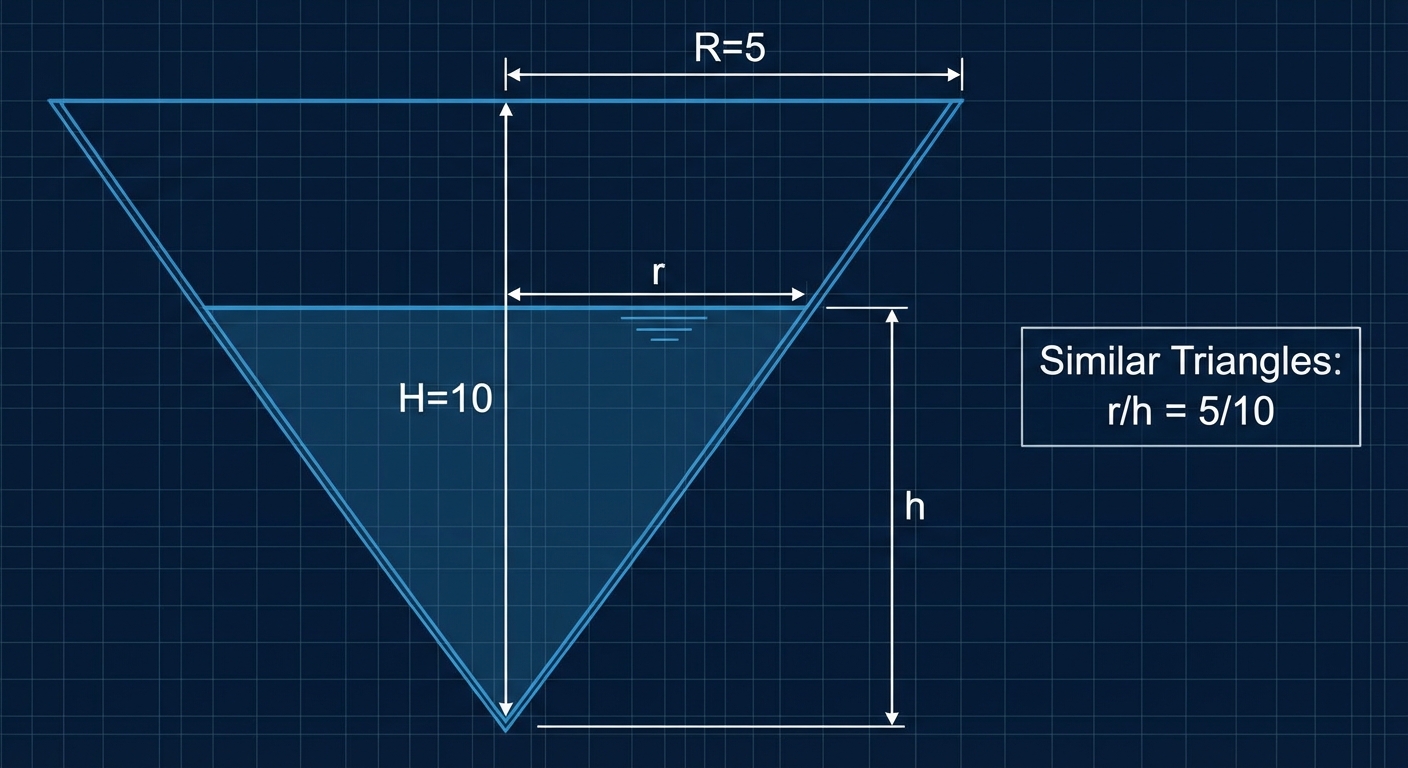
Let %%LATEX173%% be volume, %%LATEX174%% be water height, and be the radius of the water surface.
Static volume equation:
Eliminate using similar triangles. For the full tank:
Substitute:
Differentiate:
Substitute %%LATEX183%% and %%LATEX184%%:
Interpretation: the water level is rising at %%LATEX189%% ft/min when %%LATEX190%%.
How to keep signs and units consistent
A related rates answer that is numerically correct but has the wrong sign is incorrect in context.
- If a quantity is decreasing, its derivative with respect to time should be negative.
- Phrases like “moving toward,” “dropping,” “leaking,” “melting,” or “shrinking” are strong sign clues.
Units are also a built-in error check:
- Length rates: ft/s, m/min
- Area rates: ft/s
- Volume rates: m/min
If your units don’t match the requested rate, you may have used the wrong formula or differentiated the wrong quantity.
Typical AP-style framing and what they’re really testing
On AP Calculus AB, related rates questions are less about clever algebra and more about disciplined setup.
- If the problem gives “when %%LATEX193%%,” it’s testing whether you’ll compute other needed variables (like %%LATEX194%%) at that same instant.
- If it’s a shadow or cone problem, it’s testing whether you can build the correct relationship (similar triangles) before doing calculus.
- If it’s a ladder or distance problem, it’s testing implicit differentiation and sign reasoning.
Common Mistakes & Pitfalls
These are the patterns that most often cost points.
The snapshot error (substituting too early). Plugging in “when” values before differentiating often turns your equation into a constant, whose derivative is 0. Differentiate first, then substitute. Only substitute true constants (like ladder length) immediately.
Sign errors. If a distance is shrinking, a volume is leaking, or a snowball is melting, the given rate (such as %%LATEX195%% or %%LATEX196%%) must be negative. An incorrect sign can also make your final answer’s sign wrong.
Missing the Product Rule. If an expression involves a product of two time-varying quantities, you must use the product rule. Do not treat the derivative of a product as the product of derivatives.
Forgetting the Chain Rule rate factor. Writing something like
misses the time dependence. The correct derivative is:
Differentiating with respect to the wrong variable. In related rates, differentiate with respect to %%LATEX199%%. Differentiating with respect to %%LATEX200%% instead can cause you to lose needed factors like .
Using inconsistent snapshot values. Plugging in %%LATEX202%% from one time and %%LATEX203%% from another happens when the diagram and the “when” condition aren’t kept tied to the same instant.
Forgetting the auxiliary relationship. In cones (and many similarity problems), you often need a relationship like before differentiating, otherwise you end with too many unknowns.
Exam Focus
- Typical question patterns:
- Ladder or right-triangle geometry with a constant hypotenuse and a changing leg, asking for %%LATEX205%% at a specific %%LATEX206%%.
- Similar triangles (shadow/line of sight) where you must create a proportion, simplify to a constraint, then differentiate to relate %%LATEX207%% and %%LATEX208%%.
- Volume or area rate problems where you differentiate a measurement formula and evaluate at a given dimension.
- Common mistakes:
- Differentiating with respect to the wrong variable (using %%LATEX209%% instead of %%LATEX210%%), leading to missing rate factors like .
- Using inconsistent “snapshot” values (plugging in %%LATEX212%% from one time and %%LATEX213%% from another).
- Forgetting the auxiliary relationship (like similarity in cone problems) and ending with too many unknown rates.