Regional Divergence: The Rise of Sectionalism (1800–1848)
African Americans in the Early Republic
In Period 4, the experience of African Americans was defined by the paradox of expanding democratic ideals for white males versus the entrenchment of slavery for Black people. This era witnessed the development of distinct African American cultures and communities, both free and enslaved, amidst a legal landscape that increasingly sought to control them.
Life Under Enslavement and the “King Cotton” Economy
The invention of the Cotton Gin by Eli Whitney (1793) revolutionized the Southern economy, transforming cotton into the nation's primary export. This solidified the institution of Chattel Slavery deep into the 19th century.
- The Domestic Slave Trade: As the international slave trade was banned in 1808, a massive internal trade (often called the "Second Middle Passage") emerged. Enslaved people were forcibly moved from the Upper South (Virginia, Maryland) to the Deep South (Alabama, Mississippi, Louisiana) to meet labor demands.
- Cultural Preservation: Despite brutal oppression, enslaved people maintained agency by blending African traditions with Christian beliefs to create a unique culture. This included spirituals (music used for rhythm, morale, and secret communication) and extended kinship networks to replace families separated by sale.
- Forms of Resistance:
- Passive Resistance: Breaking tools, feigning illness, and working slowly (sabotage).
- Overt Rebellion: The most notable was Nat Turner’s Rebellion (1831) in Virginia. Turner, a preacher, led a revolt that killed roughly 60 white people.
- Consequence: The rebellion failed, but it terrified Southern whites, leading to stricter Slave Codes (laws prohibiting teaching enslaved people to read or write) and the suppression of anti-slavery literature.
Free Black Communities in the North and South
By 1848, a distinct population of free African Americans existed, though "free" rarely meant "equal."
- In the North: Many Northern states passed laws for Gradual Emancipation.
- However, free Blacks faced segregation, discrimination, and lack of voting rights.
- Community Building: They established their own institutions, most notably the African Methodist Episcopal (AME) Church, founded by Richard Allen. This was the first independent Black denomination in the U.S. and served as a cultural center.
- In the South: A smaller population of free Blacks lived in cities (like New Orleans and Charleston).
- They lived in a precarious middle ground, often working as skilled artisans but under constant surveillance and threat of being kidnapped into slavery.
The Growing Sectional Conflict
Sectionalism is the loyalty to the interests of one's own region or section of the country, rather than to the country as a whole. During this period, the interests of the industrial North, the agrarian South, and the developing West began to clash violently over economics and the expansion of slavery.
distinct Regional Economies
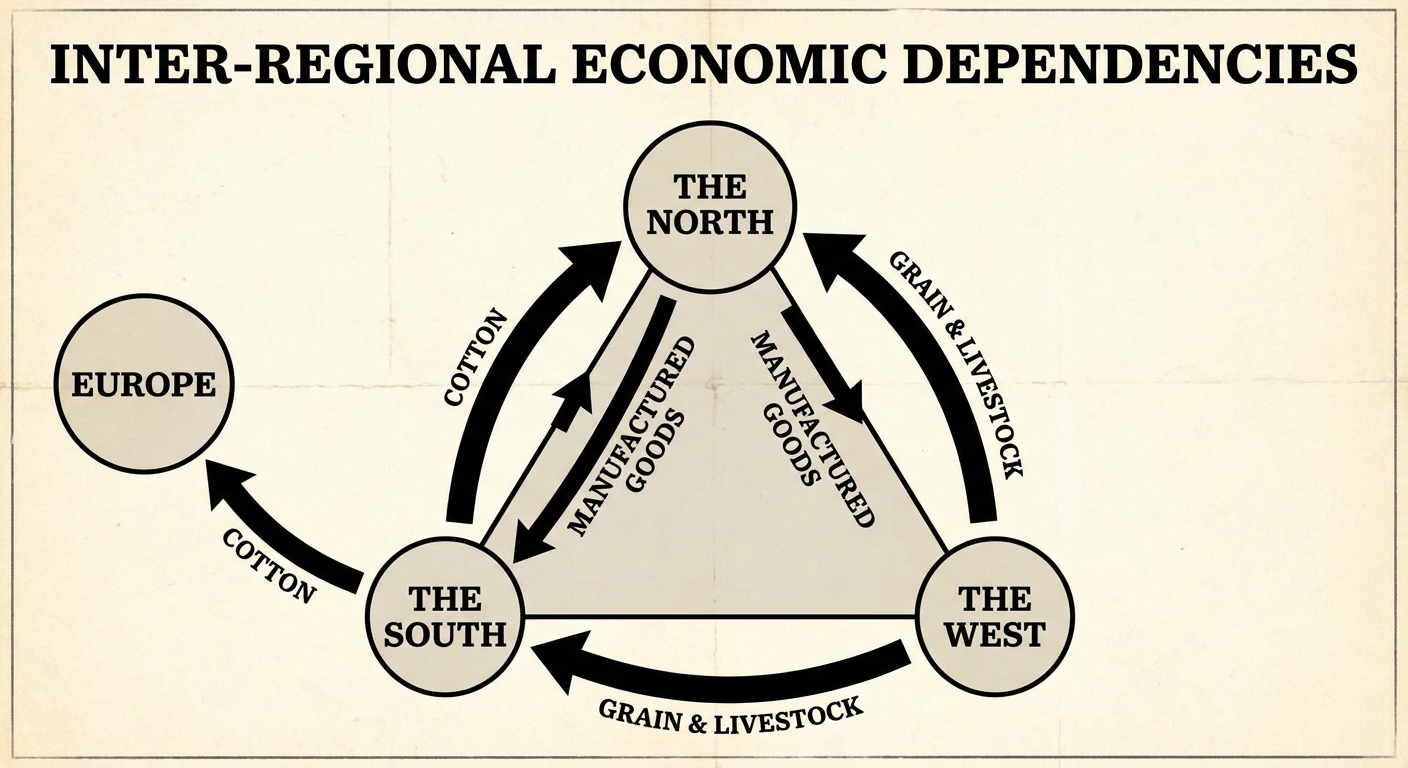
| Feature | The North | The South | The West |
|---|---|---|---|
| Primary Economy | Industrial manufacturing, textiles, shipping, banking. | Commercial agriculture (King Cotton), tobacco, plantations. | Commercial farming (grains/livestock) and fur trapping. |
| Labor System | "Free labor" (wage labor), growing immigrant workforce (Irish/German). | Enslaved labor force; reliance on the plantation system. | Family farms; mix of free labor and distrust of banks/monopolies. |
| Infrastructure | Heavily invested in canals (Erie Canal) and railroads. Connected to the West. | Relied on river systems; fewer railroads. Reluctant to pay federal tax for internal improvements. | Demanded federal roads and canals to get goods to market. |
| View on Tariffs | Supported: Protected American industry from British competition. | Opposed: Increased the cost of manufactured goods; feared retaliatory tariffs on cotton. | Mixed: Generally supported if revenue sparked internal improvements (roads). |
The American System
Proposed by Henry Clay, the American System was a neo-Federalist economic plan designed to unify the nation, but ironically ended up fueling sectionalism.
- Protective Tariffs: To promote American manufacturing (favored by North, hated by South).
- National Bank (Second Bank of the U.S.): To stabilize currency (distrusted by West/South).
- Internal Improvements: Federally funded roads and canals to knit the country together (vetoed often by Presidents like Monroe and Jackson on constitutional grounds).
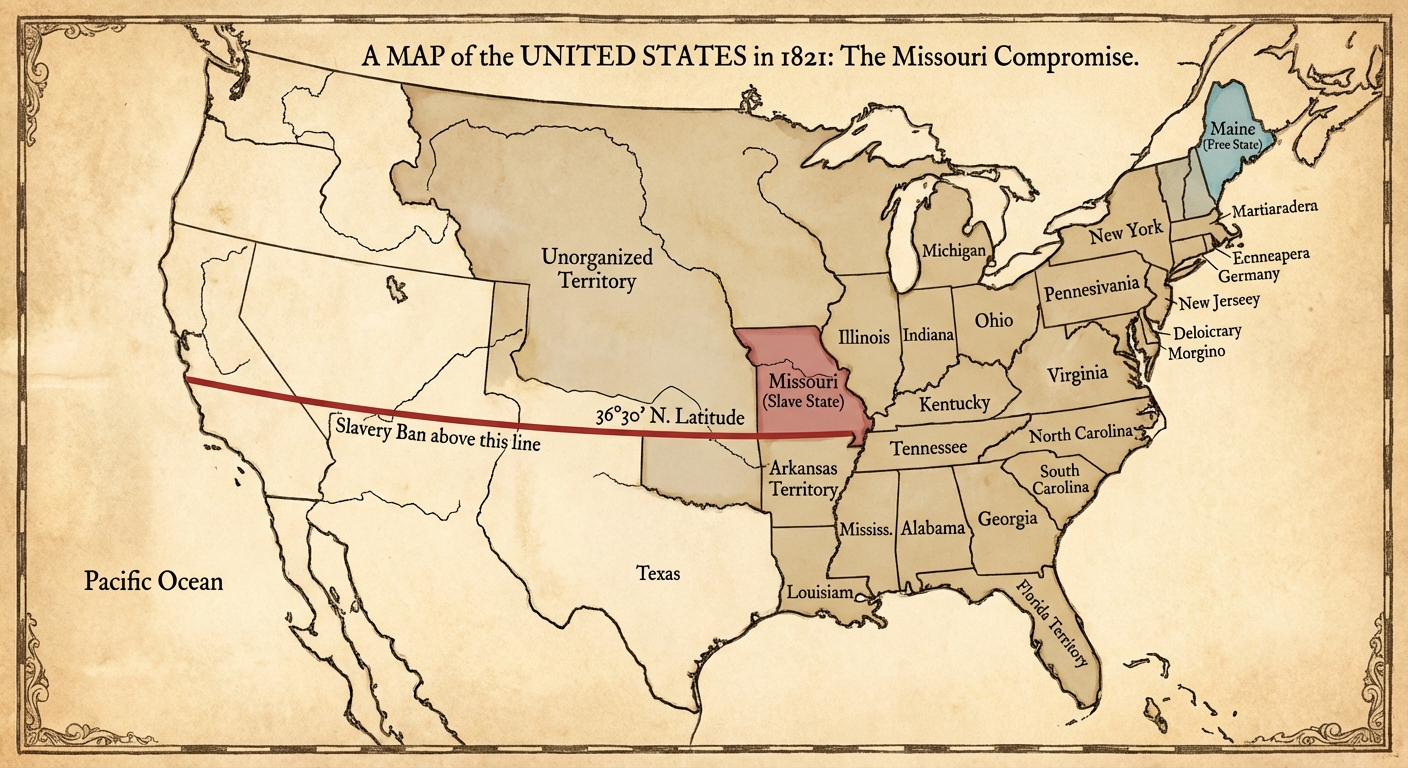
The Missouri Compromise (1820)
The first major political crisis over slavery expansion occurred when Missouri applied for statehood.
- The Problem: Admitting Missouri would upset the balance between Slave States (11) and Free States (11) in the Senate.
- The Tallmadge Amendment: A failed proposal to ban further slavery in Missouri and emancipate current slaves gradually. It outraged the South, who saw it as a threat to the state power.
- The Compromise (Henry Clay):
- Missouri enters as a Slave State.
- Maine enters as a Free State (keeping the balance at 12-12).
- The 36°30' Line: Slavery was prohibited in the rest of the Louisiana Purchase territory north of this latitude line (the southern border of Missouri).
The Nullification Crisis (1832–1833)
This crisis foreshadowed the Civil War, testing the relationship between federal authority and states' rights.
- Tariff of Abominations (1828): Congress passed a very high protective tariff. The South, particularly South Carolina (SC), felt targeted.
- Calhoun's Theory: Vice President John C. Calhoun wrote the South Carolina Exposition and Protest, arguing that states could nullify (void) federal laws they deemed unconstitutional.
- The Crisis: In 1832, SC formally nullified the tariffs and threatened secession.
- Jackson's Response: President Andrew Jackson secured the Force Bill, authorizing the use of the military to collect duties in SC.
- Resolution: Henry Clay (The Great Compromiser) negotiated a lower tariff (Compromise Tariff of 1833). SC rescinded nullification, but nullified the Force Bill as a symbolic gesture.
Significance: It proved that the South would use secession as a tool to protect slavery and its economic interests.
Common Mistakes & Pitfalls
- Mistake: Confusing the Missouri Compromise (1820) with the Compromise of 1850.
- Correction: The Missouri Compromise dealt with the Louisiana Purchase territory and established the 36°30' line. The Compromise of 1850 dealt with land gained from the Mexican-American War.
- Mistake: Believing the North was racially tolerant because they abolished slavery.
- Correction: The North was anti-slavery (economic/political reasons) but largely anti-Black. Racial segregation and voting restrictions were common in the North.
- Mistake: Thinking the "Era of Good Feelings" (1815-1825) had no conflict.
- Correction: Despite one-party rule, this era saw the panic of 1819 and the boiling tension of the Missouri crisis. The “good feelings” were superficial.
- Mistake: Assuming all Southerners owned slaves.
- Correction: The majority of white Southerners did not own slaves. However, the “Planter Aristocracy” dominated politics, and poor whites still supported the institution due to racial hierarchy (white supremacy).