Unit 4: Transoceanic Interconnections (1450–1750)
Maritime Empires Maintained and Developed
The period from 1450 to 1750 witnessed the rise of the first global economy, driven by European maritime exploration and colonization. However, maintaining these empires required new economic theories and labor systems to extract distinct resources.
Economic Strategies: Mercantilism and Companies
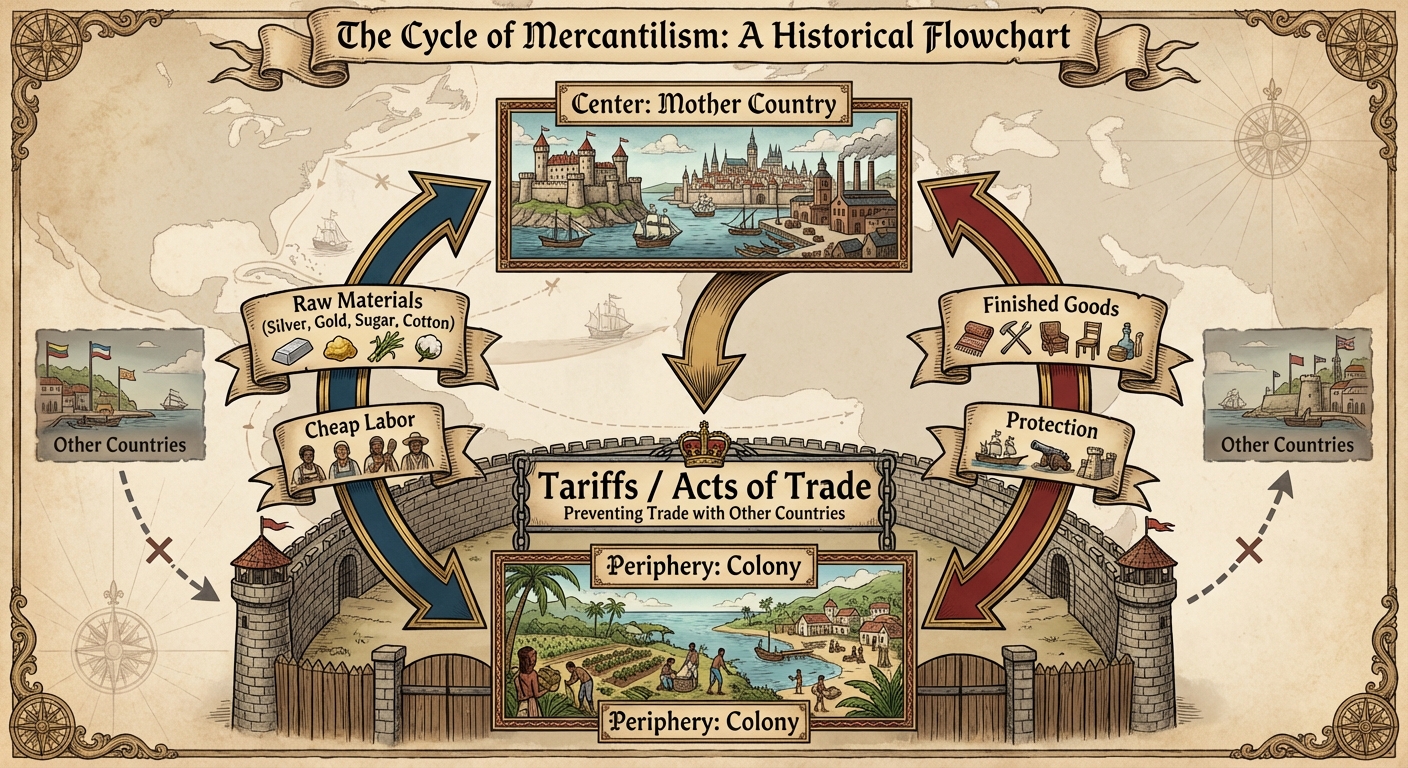
To consolidate power, European rulers (specifically in Britain, France, Spain, and the Netherlands) adopted specific economic strategies.
- Mercantilism: An economic theory suggesting that a nation's prosperity depends on its supply of capital (gold and silver). It emphasizes:
- Protectionism: High tariffs on imported goods.
- Favorable Balance of Trade: Exporting more than importing.
- Colonial Purpose: Colonies exist solely to provide raw materials to the mother country and serve as markets for finished goods.
- Joint-Stock Companies: To fund expensive and risky exploration without bankrupting the crown, investors pooled money to share both risk and profit. Generally, these companies were granted royal charters (monopolies) on trade in specific regions.
- British East India Company (EIC): Focused on India (cotton, tea, spices).
- Dutch East India Company (VOC): Controlled the Spice Islands (Indonesia); famous for high profitability.
Coerced Labor Systems
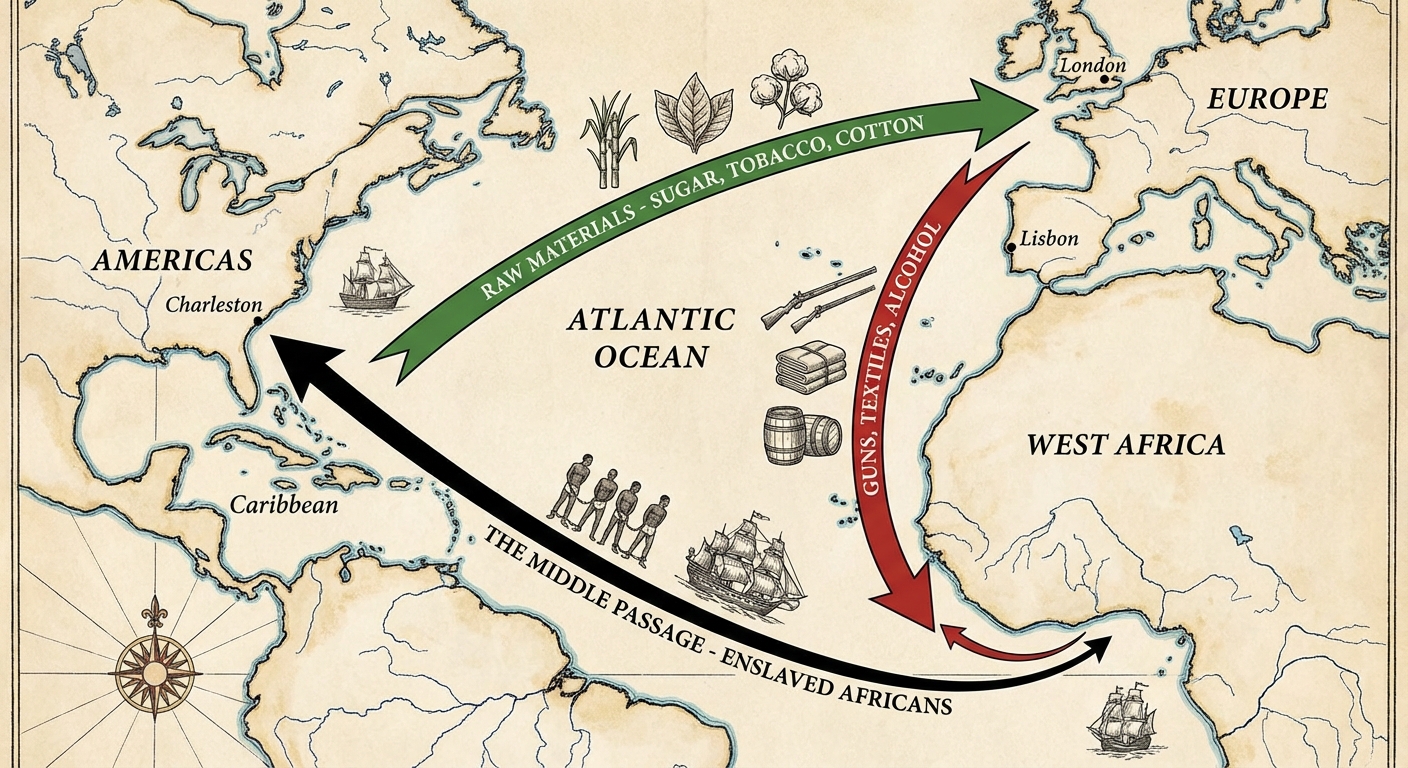
The demand for raw materials—specifically sugar, tobacco, and cotton in the Americas—led to a massive expansion of coerced labor.
| Labor System | Region Used | Key Characteristics |
|---|---|---|
| Chattel Slavery | Americas (esp. Caribbean/Brazil/US South) | Humans owned as property; hereditary; racially defined (post-1450). |
| Indentured Servitude | North America | Contracted labor for a set period (5–7 years) in exchange for passage; mostly poor Europeans initially. |
| Encomienda | Spanish America | Land grants given to Spanish settlers involved right to force indigenous labor; ostensibly for protection/Christianization. |
| Hacienda | Spanish America | Large plantation estates; utilized indigenous workers who were technically free but bound by debt (peonage). |
| Mit'a System | Peru (Incan adaption) | Originally an Incan public service duty; corrupted by Spanish to force men into dangerous silver mining (e.g., Potosi). |
Note: While the Atlantic Slave Trade is the most prominent, remember that peasant and artisan labor intensified in many regions, such as silk production in China and cotton weaving in India.
Internal and External Challenges to State Power
As empires expanded, they faced resistance from within and from colonized peoples. State expansion often encroached on local groups, leading to violent pushback.
Resistance in the Americas
- Pueblo Revolt (1680): Native American revolt against the Spanish in present-day New Mexico. Led by Popé, they successfully expelled the Spanish for over 10 years due to forced assimilation and religious suppression.
- Metacom’s War (King Philip’s War): The last major effort by the indigenous people of southern New England to drive out English settlers. It ended in the subjugation of the Wampanoag people.
- Maroon Societies: Communities of runaway slaves in the Caribbean and Brazil (e.g., Palmares in Brazil). They successfully maintained independence in harsh terrain.
Resistance in Africa
- Queen Ana Nzinga (Ndongo and Matamba): She fought against the Portuguese in Angola. To resist Portuguese slave raids and colonization, she allied with the Dutch and incited rebellion, ruling for decades as a powerful monarch.
Resistance in Eurasia
- Cossack Revolts: In Russia, runaway serfs and skilled fighters known as Cossacks often clashed with the Tsarist government.
- Pugachev Rebellion: A massive peasant uprising led by Yemelyan Pugachev against Catherine the Great. It failed and led to tighter control over serfs.
- Maratha Conflict: In India, the Hindu Marathas fought against the Muslim Mughal Empire. They eventually created the Maratha Empire, significantly weakening Mughal power.
Changing Social Hierarchies
The interaction of different cultures, religions, and ethnicities led to new social structures and the reordering of existing ones.
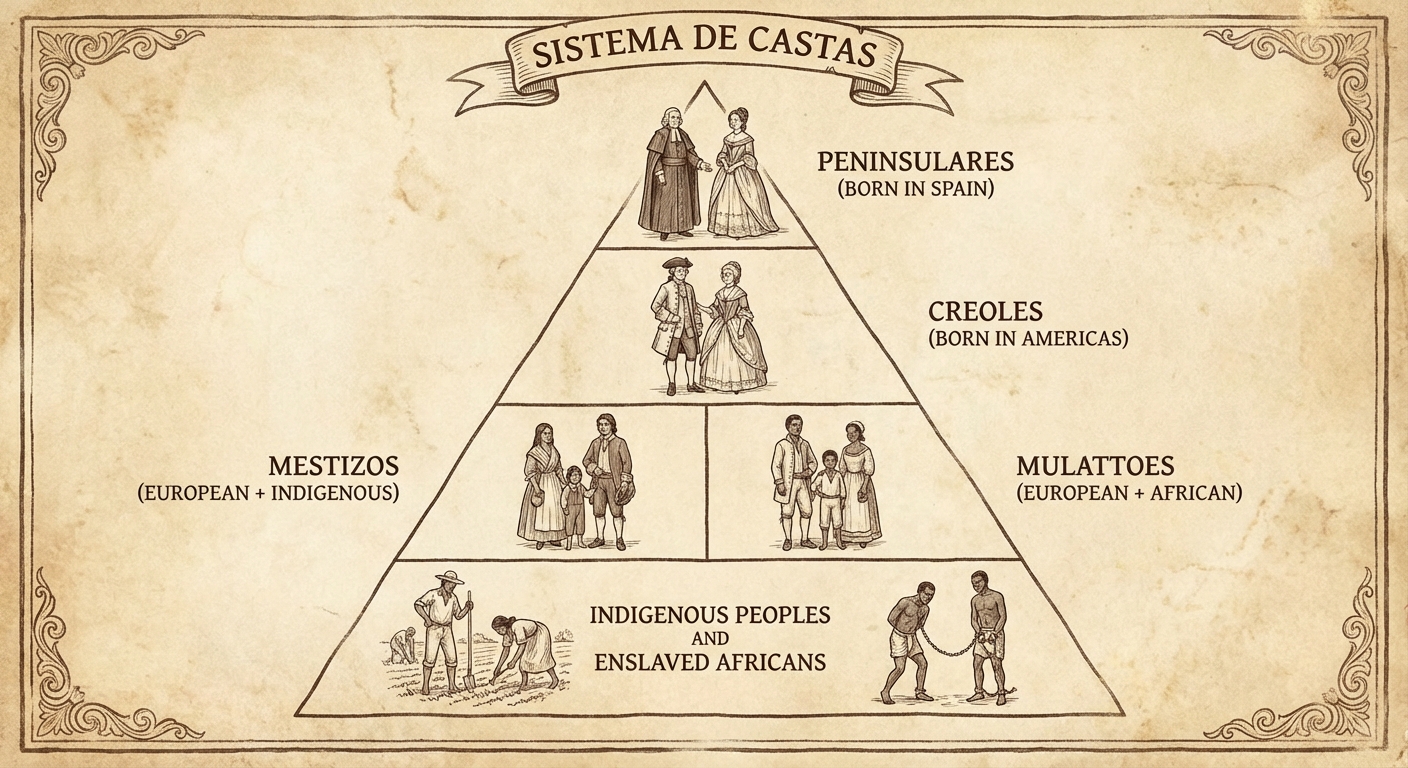
The Americas: The Casta System
In Latin America, the blending of indigenous, African, and European peoples necessitated a new classification system based on race and ancestry.
- Peninsulares: Born in Spain (Iberian Peninsula); held top government/church jobs.
- Creoles (Criollos): Spaniards born in the Americas; wealthy owners of haciendas and mines but barred from top positions.
- Castas: Mixed ancestry groups.
- Mestizos: European + Indigenous.
- Mulattoes: European + African.
- Indigenous / Enslaved Africans: Bottom of the hierarchy.
Europe: Nobility vs. Royalty
- Absolutism vs. Nobility: Monarchs like Louis XIV (France) sought to strip the old nobility of military power, forcing them to live at court (Versailles) to monitor them.
- The Gentry: In England and Netherlands, a wealthy commercial class (gentry) rose in status, sometimes surpassing the old land-based aristocracy.
Ottoman Empire
- Timar System: The Sultan granted land and tax revenues to soldiers in exchange for military service. As the Janissaries (slave soldiers) gained power, they rivaled the traditional landed aristocracy.
- Religious Tolerance: The Millet System allowed religious minorities (Jews, Christians) to govern their own affairs but treated them as second-class citizens (dhimmi).
Qing China
- Manchu vs. Han: The Qing Dynasty was founded by Manchus (from the north), not the majority Han Chinese. To enforce loyalty, men were required to wear the Queue (braided distinct hairstyle). Failure to do so was treason punishable by death.
Continuity and Change from 1450–1750
Continuities
- Patriarchy: Men continued to dominate political and family life across all major empires.
- Agriculture: Despite trade growth, most of the world's population remained subsistence farmers.
- Religion as Legitimacy: Rulers continued to use religious ideas (Divine Right, Mandate of Heaven, Shi'a Islam in Safavid Persia) to justify rule.
Changes
- Global Economy: For the first time, the Americas were integrated with Afro-Eurasia. Silver from the Americas became the global currency.
- Demographics: Populations in Africa grew (due to new crops like manioc/corn) despite the slave trade, while Amerindian populations collapsed due to disease.
- Labor: The scale of chattel slavery and the racialization of labor were unprecedented.
Common Mistakes & Pitfalls
Confusing Encomienda and Hacienda:
- Mistake: Thinking they are the same thing.
- Correction: Encomienda is a legal system granting labor rights (feudal-like). Hacienda is a physical place (a large estate/farm). The Hacienda system generally replaced the Encomienda system over time.
Indentured Servitude vs. Slavery:
- Mistake: Assuming they were treated the same or lasted the same time.
- Correction: Indentured servitude was a contract (temporary) and the children of servants were free. Chattel slavery was property (lifetime) and hereditary.
The Flow of Silver:
- Mistake: Thinking silver stayed in Spain.
- Correction: Spanish silver flowed out of Spain rapidly to pay for wars and into China to buy luxury goods. China was the terrifyingly large "silver sink" of the early modern world.
Misunderstanding the Mit'a:
- Mistake: Believing the Spanish invented the Mit'a.
- Correction: The Incas invented it as a reciprocal labor tax for the public good. The Spanish adopted and abused it for private gain (silver mining).