SAT Reading and Writing: Strategies for Expression of Ideas
Rhetorical Synthesis: Turning Notes into Narrative
Rhetorical Synthesis is a question type unique to the digital SAT. These questions assess your ability to utilize specific information to achieve a defined rhetorical goal. Instead of reading a long passage, you are presented with a series of bulleted notes containing facts, followed by a question that asks you to use the student's notes to accomplish a specific task.
The Structure of the Question
These questions follow a predictable three-part structure:
- The Context: A short intro stating, "While researching a topic, a student has taken the following notes."
- The Notes: A list of 4–5 bullet points containing facts, dates, names, or comparisons.
- The Prompt: The critical instruction telling you what the student wants to emphasize or present in the final sentence.
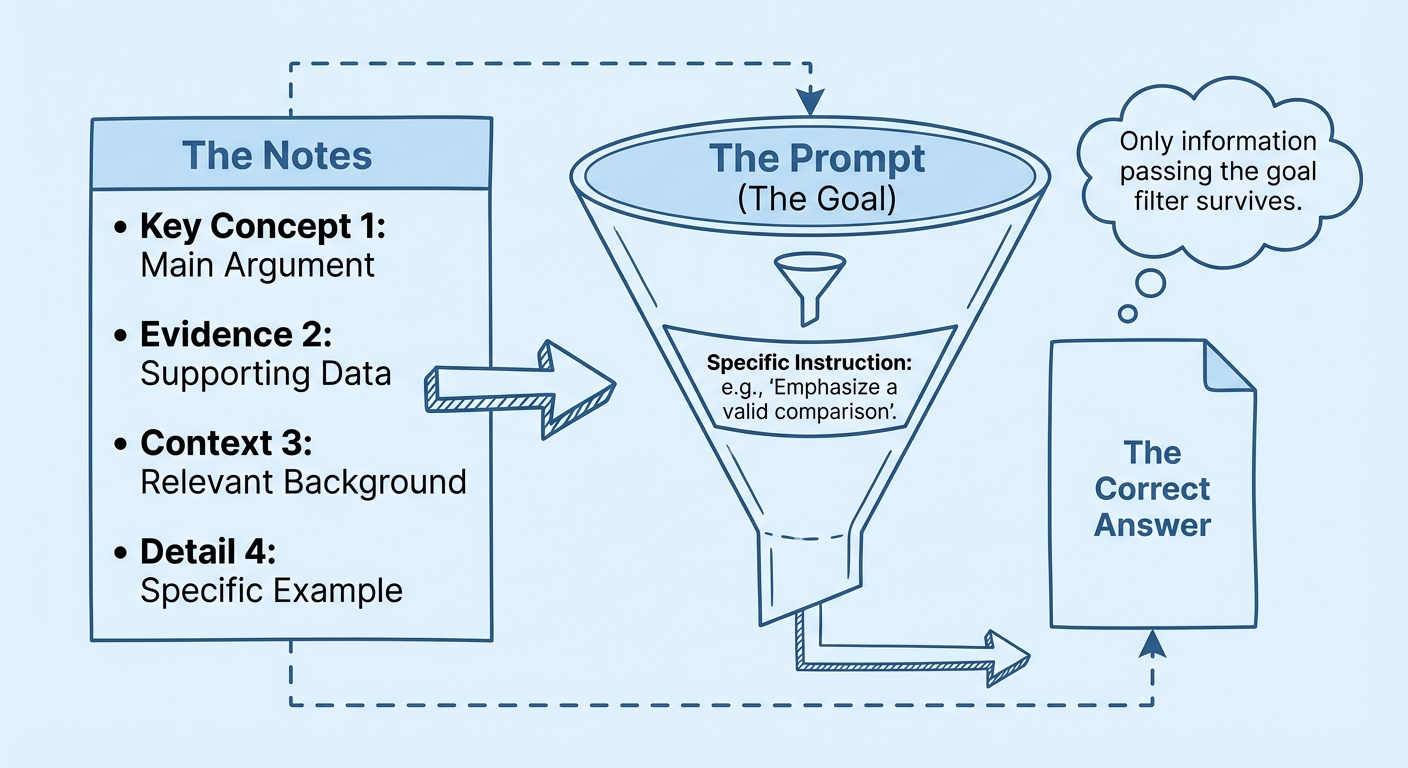
The Golden Rule: Answer the Goal
The most critical strategy for Rhetorical Synthesis is: Ignore the information that does not serve the specific goal stated in the prompt.
Most answer choices will be grammatically correct and factually accurate according to the bulleted notes. However, only one choice will actually satisfy the specific rhetorical task requested.
Common Rhetorical Goals
You will encounter several standard types of goals. Recognizing these patterns helps you filter the notes quickly.
- Generalization: The prompt asks to make a broad claim about a subject.
- Strategy: Look for summary words or an option that combines multiple details into a unified theme.
- Introduction: The prompt asks to introduce a person, work, or concept to an audience unfamiliar with it.
- Strategy: Look for definitions, titles, or basic identifying details (e.g., "biologist," "painter," "novel written in 1920").
- Comparison/Contrast: The prompt asks to emphasize a similarity or difference between two things.
- Strategy: Look for transition words like similarly, unlike, whereas, or both.
- Specific Example: The prompt asks to provide a specific example of a broader phenomenon.
- Strategy: Look for specific names, dates, or instances rather than broad statements.
Worked Example: Rhetorical Synthesis
The Notes:
- Zora Neale Hurston was an American author and anthropologist.
- She was a central figure of the Harlem Renaissance.
- Her most famous novel is Their Eyes Were Watching God (1937).
- She also collected folklore in the American South and Caribbean.
- Mules and Men (1935) is a collection of African American folklore.
The Prompt:
The student wants to emphasize Hurston's contributions to anthropology. Which choice most effectively uses relevant information from the notes to accomplish this goal?
Analysis:
- Choice A: Zora Neale Hurston, a central figure of the Harlem Renaissance, wrote the novel Their Eyes Were Watching God.
- Verdict: Incorrect. This emphasizes her literature/fiction, not anthropology.
- Choice B: In addition to writing novels, Hurston was an American author who lived during the Harlem Renaissance.
- Verdict: Incorrect. Too vague; doesn't mention specific anthropological work.
- Choice C: Hurston collected folklore in the South and Caribbean, publishing findings in Mules and Men.
- Verdict: Correct. This specifically cites her anthropological work (collecting folklore) and a non-fiction text.
Transitions: Connecting Arguments Logicallly
Transitions questions test your ability to understand the logical relationship between two sentences or clauses. You will see two sentences with a blank in the second one. Your task is to select the word or phrase that best bridges the gap between the ideas.
The Logic Test
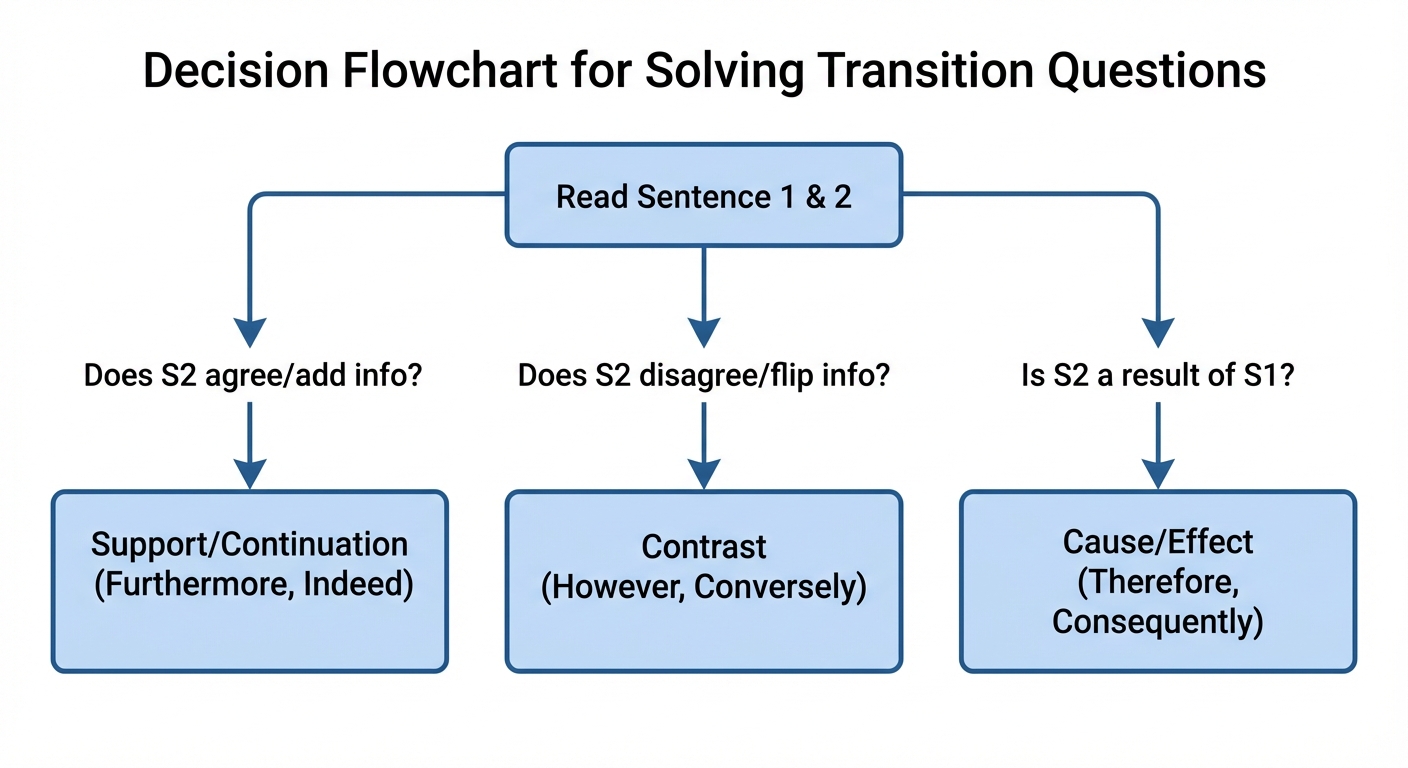
To solve these questions, ignore the answer choices initially. Read both sentences and determine the relationship between them yourself.
- Read Sentence 1: What is the main idea?
- Read Sentence 2: Does it agree? Disagree? Show a result? Show a sequence?
- Predict: Guess a simple transition word (e.g., "and," "but," "so").
The Three Major Categories
Almost all SAT transition questions fall into one of three logical buckets. Memorize these relationships.
| Category | Logical Function | Key Transition Words |
|---|---|---|
| Continuous / Addition | Sentence 2 continues, supports, or adds to Sentence 1. | Furthermore, Moreover, Additionally, Indeed, In fact, Similarly, Likewise, Also |
| Contrast / Reversal | Sentence 2 disagrees with, creates an exception to, or offers an alternative to Sentence 1. | However, Nevertheless, On the other hand, Conversely, Despite this, Stull, Alternatively, In contrast |
| Causation / Sequence | Sentence 2 is the result of Sentence 1, or follows it in time. | Therefore, Consequently, As a result, Thus, Hence, Subsequently, Then, Accordingly |
Common Pitfalls and Tricky Transitions
"In Fact" vs. "However"
Students often confuse "In fact" (or "Indeed") with contrast words.
- In fact / Indeed: These are emphatic transitions. They are used when Sentence 2 provides stronger evidence for Sentence 1, or validates the previous claim. They are Continuous, not Contrast.
"Alternatively" vs. "Instead"
- Alternatively: Offers a different option that could also be chosen (Option A exists; alternatively, you could choose implies Option B).
- Instead: Replaces the previous idea entirely (Option A did not happen; instead, Option B happened).
Worked Example: Transitions
Text:
Historical conservationists have long debated how to preserve the ruins of the ancient Colosseum. Some argue for a hands-off approach, allowing natural weathering to continue. , others advocate for active restoration to return the structure to its original appearance.
Analysis of Logic:
- Sentence 1 Idea: Some people want a "hands-off" approach (do nothing).
- Sentence 2 Idea: Others want "active restoration" (do a lot).
- Relationship: These are opposite viewpoints.
- Selection: We need a Contrast word.
Choices:
A) Furthermore (Addition - Incorrect)
B) Therefore (Causation - Incorrect)
C) However (Contrast - Correct)
D) For example (Illustration - Incorrect)
Common Mistakes & Pitfalls
Use this list to troubleshoot your practice errors in the Expression of Ideas section.
1. The "True but Wrong" Trap (Synthesis)
In Rhetorical Synthesis questions, never pick an answer just because the facts are true. If the prompt asks you to "introduce the scientist to a general audience," do not select the answer that discusses the specific chemical composition of their discovery, even if that fact is in the notes. Always prioritize the goal over the content.
2. Ignoring the "Blank" Placement (Transitions)
Sometimes the blank appears in the middle of a sentence rather than at the beginning. The logic remains the same: you are connecting the idea relative to the blank to the previous idea. Do not let the sentence structure distract you from the logical link.
3. Redundancy in Transitions
Occasionally, the text itself will already contain a transition word (e.g., "but" or "and"). If the text says "…and, _, the study failed," you cannot put a word like "furthermore" or "additionally" in the blank if it creates a redundant grammatical structure. You must strictly fit the logic into the blank provided.
4. Overthinking "Fancy" Vocabulary
The SAT does not reward you for choosing the most complex word. Words like "Notwithstandng" or "Concomitantly" are only correct if the logic dictates it. Often, simpler words like "Thus" or "still" are the correct answers. Focus on function, not flair.