Controlling the Administrative State: Bureaucratic Power and Accountability
Discretionary and Rule-Making Authority
The federal bureaucracy is often called the "fourth branch of government" because of its immense power to implement policy. While Congress passes laws, the bureaucracy typically decides the specifics of how those laws are enforced. This power stems from two major concepts: discretionary authority and rule-making authority.
What is Discretionary Authority?
Discretionary authority refers to the extent to which appointed bureaucrats can choose courses of action and make policies that are not spelled out in advance by laws.
When Congress passes legislation, it often lacks the time, specific expertise, or political will to write every detailed regulation required to enforce the law. Instead, Congress sets broad goals and major guidelines, then delegates the authority to specific agencies to fill in the gaps.
- The Logic: Congress members are generalists; bureaucrats are specialists. Congress trusts the Environmental Protection Agency (EPA) to know the specific chemical compounds associated with ‘clean air’ better than a Senator does.
- The Effect: Agencies act as quasi-legislators. When the Department of Transportation decides that all cars must have rear-view cameras by a certain date, that regulation has the force of law, even though Congress didn't vote on that specific camera requirement.
The Rule-Making Process
When agencies use their discretionary authority to create regulations, they engage in rule-making. This is a formal process often governed by the Administrative Procedure Act.
- Proposal: The agency proposes a new rule to address a legislative goal.
- Notice and Comment: The agency must publish the proposed rule in the Federal Register. They must allow time for the public, interest groups, and corporations to comment on the rule.
- Finalization: The agency reviews comments, makes adjustments, and publishes the final rule. It then carries the force of law.
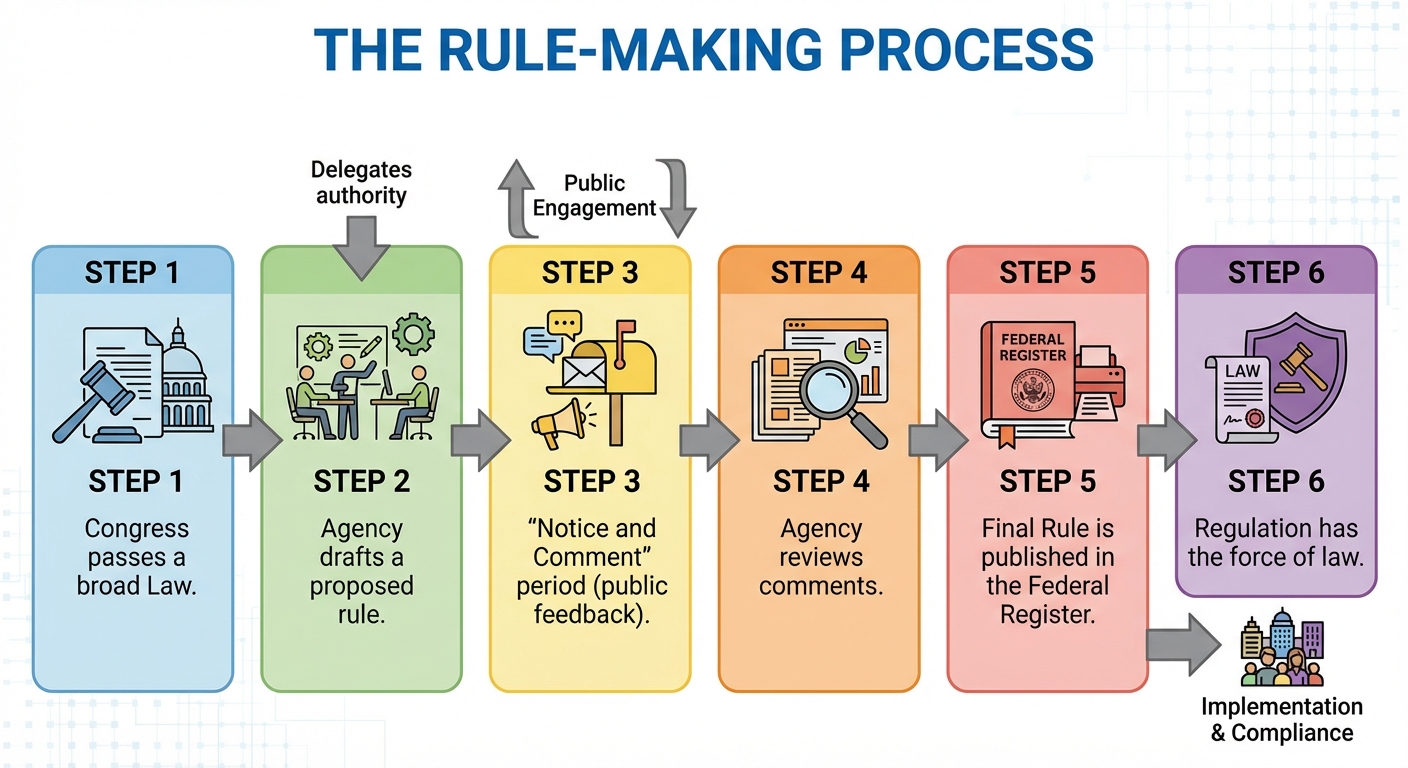
Real-World Example: The Clean Air Act
Scenario: Congress passes the Clean Air Act, mandating a reduction in automobile emissions to improve public health.
- Congressional Role: Setting the goal (reduce smog) and the timeline.
- Bureaucratic Discretion: The EPA determines exactly how much carbon monoxide a car is allowed to emit, what testing equipment must be used, and what the fines are for non-compliance.
Checks on the Bureaucracy
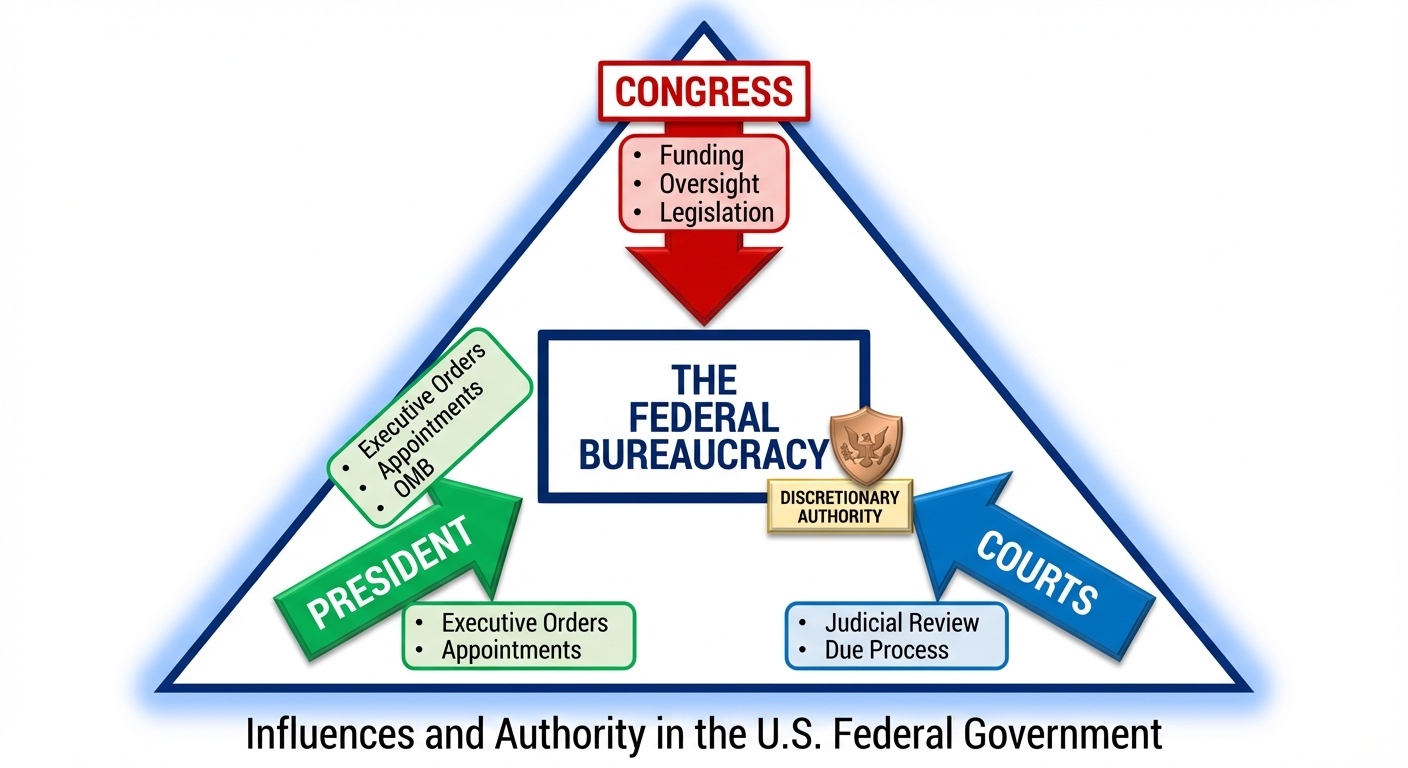
Because unelected bureaucrats hold significant power, the Constitution and political practice provide mechanisms for the three branches of government to hold agencies accountable. This ensures that delegated discretionary authority does not turn into authoritarian rule.
1. Congressional Checks (The Legislative Branch)
Congress creates the agencies and sustains them, meaning it holds the strongest tools for control. This is arguably the most frequently tested area of bureaucratic checks.
- Appropriations (Power of the Purse): The most effective check. Agencies cannot spend money unless Congress authorizes and appropriates it. If Congress disapproves of an agency's actions, it can cut their budget.
- Oversight Hearings: Standing committees hold hearings to question agency heads. This serves as a public spotlight on agency behavior.
- Police Patrol Oversight: Routine, proactive monitoring (less common).
- Fire Alarm Oversight: Reactive questioning that occurs when a scandal or problem arises (more common).
- Legislation: Congress can pass new laws that alter an agency's functions, restrict its jurisdiction, or even abolish the agency entirely.
- Senate Confirmation: The Senate must confirm presidential nominees for cabinet heads and top diplomatic posts.
2. Presidential Checks (The Executive Branch)
Although the bureaucracy falls under the Executive Branch, the President cannot strictly control the millions of civil servants. However, the President uses several tools to steer the ship:
- Appointments: The President appoints agency heads (Secretaries, Directors) who share their ideology and policy goals. While they cannot fire civil service employees easily, they can fire these top political appointees.
- Executive Orders: Directives that carry the force of law, instructing agencies on how to implement policy.
- The Office of Management and Budget (OMB): This is the President's primary arm for controlling the bureaucracy. The OMB reviews all agency budget requests before they go to Congress and ensures agency regulations align with the President's agenda.
- Reorganization: The President can attempt to reorganize agencies to streamline or shift priorities (though significant reorganization usually requires Congressional approval).
3. Judicial Checks (The Judicial Branch)
The courts ensure that agencies act within the Constitution and the law.
- Judicial Review: The courts can declare agency regulations unconstitutional.
- Due Process: Individuals or corporations can sue agencies if they feel a regulation is arbitrary, capricious, or exceeds the authority granted by Congress.
- Example: If the EPA creates a rule that destroys a business's value without a valid statutory basis, the Supreme Court can strike that rule down.
Comparative Analysis of Checks
| Branch | Primary Mechanism | Example in Action |
|---|---|---|
| Legislative | Funding & Oversight | The House Committee on Veterans' Affairs holds hearings on long wait times at VA hospitals and threatens to withhold administrative funding. |
| Executive | Appointments & Orders | The President issues an Executive Order instructing the Department of Homeland Security to shift resources toward border wall construction. |
| Judicial | Judicial Review | The Supreme Court rules that an OSHA mandate regarding vaccines exceeds the authority granted to the agency by Congress. |
Common Mistakes & Pitfalls
During the exam, students often conflate the powers of the branches regarding the bureaucracy. Avoid these common errors:
- Mistake: Thinking the President can fire anyone in the bureaucracy.
- Correction: The President can generally only fire political appointees (heads of agencies). Most bureaucrats are civil servants protected by the merit system (Pendleton Act) and cannot be fired for political reasons.
- Mistake: Believing agencies "pass laws."
- Correction: Agencies create regulations or rules. Only Congress passes laws (statutes). However, valid regulations have the force of law.
- Mistake: Thinking Congress creates the regulations.
- Correction: Congress passes the enabling legislation (broad goals); the Agency writes the specific regulations (details). If a question asks who decided the specific amount of tax on an import, it is likely the agency implementing the tariff law, not Congress itself.
- Mistake: Confusing "Appropriation" with "Authorization."
- Correction: Authorization says an agency can exist and spend money; Appropriation acts actually give them the specific dollar amount for that year.