AP English Language Unit 8: Mastering Style & Rhetoric
Stylistic Choices in Arguments
Definition and Concept
Style is the distinctive quality of speech or writing created by the selection and arrangement of words and figures of speech. In AP English Language, Style is not decorative jargon; it is the strategic method an author uses to appeal to an audience and achieve a purpose.
Unit 8 moves beyond what the author argues (content) to how they argue it (form). It focuses on the interplay between Diction (Word Choice) and Syntax (Sentence Structure).
The Stylistic Equation:
1. Diction (The Micro-Level)
Diction is the writer's deliberate choice of words. It is the foundation of voice and tone.
Note: Never write "The author uses diction" in an essay. That is like saying "The painter uses paint." Always qualify it with an adjective (e.g., "archaic diction," "clinical diction," "evocative diction").
Key Axes of Diction
- General vs. Specific:
- General: "The dog walked."
- Specific: "The mangy spaniel limped." (Evokes pathos/pity).
- Concrete vs. Abstract:
- Concrete: Tangible, physical language (e.g., "blood," "iron," "stale bread"). Generally creates stronger imagery.
- Abstract: Conceptual language (e.g., "democracy," "freedom," "evil"). Used for philosophical arguments.
- Denotation vs. Connotation:
- Denotation: The dictionary definition.
- Connotation: The emotional association.
- Example: "Plan" vs. "Scheme." Both mean a proposed arrangement, but "scheme" implies clearer deception or malice.
Describing Diction (Reference Table)
| Type | Description | Rhetorical Effect |
|---|---|---|
| Colloquial | Conversational, regional slang. | Creates intimacy, relatability, or lowers authority/pretension. |
| Pedantic | Overly scholarly, academic, precise. | Establishes ethos/expertise or creates distance/superiority. |
| Euphonious | Pleasant sounding (soft vowels). | Creates a soothing, harmonic, or reverent tone. |
| Cacophonous | Harsh sounding (hard consonants). | Creates tension, anger, or urgency. |
| Archaic | Old-fashioned vocabulary. | Suggests traditional wisdom or religious authority. |
2. Syntax (The Structural Level)
Syntax is the arrangement of words and phrases into sentences. While diction provides the bricks, syntax provides the blueprint. In Unit 8, you must analyze how sentence structure influences pacing and emphasis.
Sentence Types by Function
- Declarative: Makes a statement. (Assertive).
- Imperative: Issues a command. (Authoritative/Urgent).
- Interrogative: Asks a question. (Engaging/Contemplative).
- Exclamatory: Expresses strong emotion. (Passionate).
Sentence Structures by Arrangement
(These are high-value concepts for AP analysis)
A. The Periodic Sentence
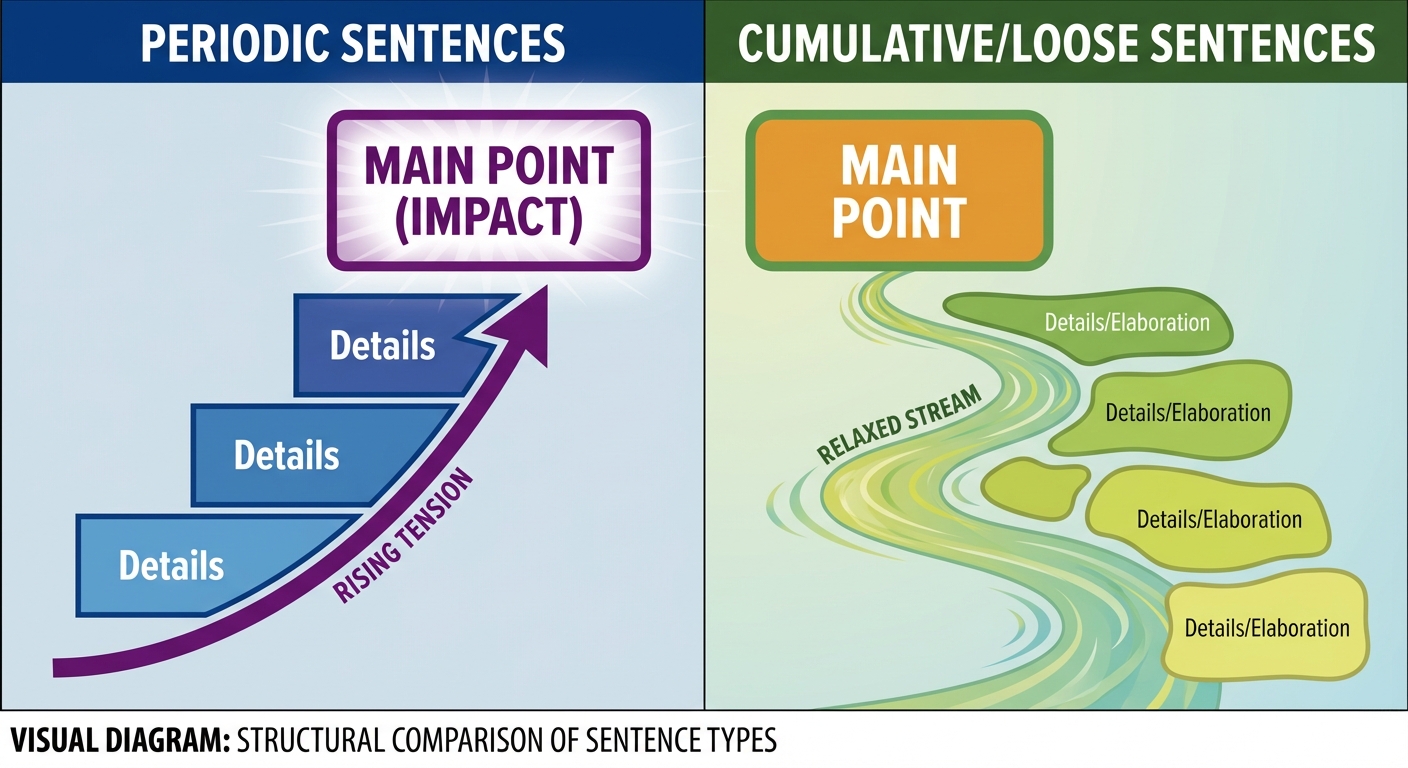
A sentence where the main clause (subject + verb) is withheld until the very end.
- Structure: [Dependent Clause] + [Dependent Clause] + [Main Clause].
- Example: "After days of wandering the scorched desert, parched and without hope, he finally found water."
- Rhetorical Effect: Creates suspense and emphasis. It forces the reader to hold the information in their mind before the meaning creates a "punch" at the end.
B. The Cumulative (Loose) Sentence
A sentence that begins with the main clause and is followed by modifying phrases.
- Structure: [Main Clause] + [Detail] + [Detail] + [Detail].
- Example: "He finally found water, stumbling toward the oasis, dropping his pack, and weeping with relief."
- Rhetorical Effect: Creates imagery and elaboration. It feels natural, conversational, or descriptive.
C. Telegraphic vs. Labyrinthine
- Telegraphic: Very short sentences (under 5 words). distinct pause. Used for sudden impact.
- Labyrinthine: Extremely long, complex sentences. Used to mirror the complexity of an idea or to overwhelm the reader.
3. Punctuation as Rhetoric
In Unit 8, specific punctuation marks are viewed as stylistic choices, not just grammatical necessities.
| Mark | Rhetorical Function |
|---|---|
| The Dash (—) | Indicated a sudden break in thought, an interruption, or a dramatic pause. distinct from a comma. conveys high energy or informality. |
| The Colon (:) | The "Introductory Finger." It signals that what follows proves, explains, or lists what came before. It creates anticipation. |
| The Semicolon (;) | Connects two independent clauses of equal weight. It suggests a close relationship or balance between two ideas. |
| Italics/Caps | Visual emphasis to dictate volume or stress to the reader. |
4. Modifiers and Prepositional Phrases
Unit 8 emphasizes how writers modify subjects to change perception.
Modification
Modifiers (adjectives, adverbs, phrases) allow writers to qualify arguments.
- Example: " Mistakes were made" (Passive, no responsibility) vs. "Reckless, avoidable mistakes were made by the administration." (Active, accusatory).
Prepositional Phrases
Using strings of prepositional phrases effects pacing.
- Example: "In the room, by the table, under the light…"
- Effect: Slows the reader down, forces attention to setting or detail.
5. Tone and Irony
Tone is the author's attitude toward the subject. Tone is the result of Diction + Syntax.
The Spectrum of Irony
Irony creates a discrepancy between expectation and reality. It is a sophisticated stylistic choice.
- Verbal Irony: Stating the opposite of what is meant (Sarcasm is a harsh form of this).
- Situational Irony: When outcomes are the opposite of expectations.
- Dramatic Irony: When the audience knows something the characters do not (more common in fiction/drama prompts).
Tone Complexity:
High-scoring essays often identify shifts in tone or complex tones. Avoid single-word descriptions like "happy" or "sad."
- Better: "Cautiously optimistic," "bitterly disillusioned," "detached and clinical."
6. Comparisons: Metaphor, Simile, and Analogy
Writers use comparisons to make abstract ideas concrete.
- Metaphor/Simile: Brief comparisons used for imagery.
- Analogy: A more extended comparison used for logical explanation. If an author uses an analogy, they are usually trying to simplify a complex concept for a lay audience.
7. Rhetorical Devices Mnemonics
To remember key syntax patterns for Unit 8, use PADS:
- P parallel Structure (Repetition of grammatical form for balance: "We shall pay any price, bear any burden…")
- A ntithesis (Juxtaposition of opposing ideas in parallel structure: "It was the best of times, it was the worst of times.")
- D ash (Used for dramatic interruption)
- S chemes (Changes in word order, like Anaphora or Inversion)
8. Common Mistakes & Pitfalls
❌ Mistake 1: "The author uses heavy diction."
Correction: Diction is always present. You must describe what kind of diction. Use adjectives like "archaic," "patriotic," or "visceral."
❌ Mistake 2: Confusing Tone with Mood.
Correction:
- Tone: The author's attitude (e.g., The author is angry).
- Mood: The atmosphere created for the reader (e.g., The scene is tense).
❌ Mistake 3: Identifying the device without the function.
Correction: Don't just say "The author uses a periodic sentence." You must say: "By using a periodic sentence that delays the main clause, the author builds anxiety in the reader, mirroring the chaos described in the text."
❌ Mistake 4: Ignoring the "Shift."
Correction: Authors rarely maintain one tone for an entire piece. Look for transition words (