Citizen Linkage, Representation, and Participation
Unit 4: Party and Electoral Systems and Citizen Organizations
This unit explores how citizens connect to their government (linkage institutions) and how political power is organized through elections and parties. In AP Comparative Government, you must understand Electoral Systems (the math/rules of voting) and Party Systems (how parties interact), as well as the difference between democratic Pluralism and authoritarian State Corporatism.
4.1 Electoral Systems and Rules
Electoral Systems are the specific rules that determine how votes are cast and converted into seats in the legislature. These rules are the primary driver of what the party system looks like in a country.
Major Types of Electoral Systems
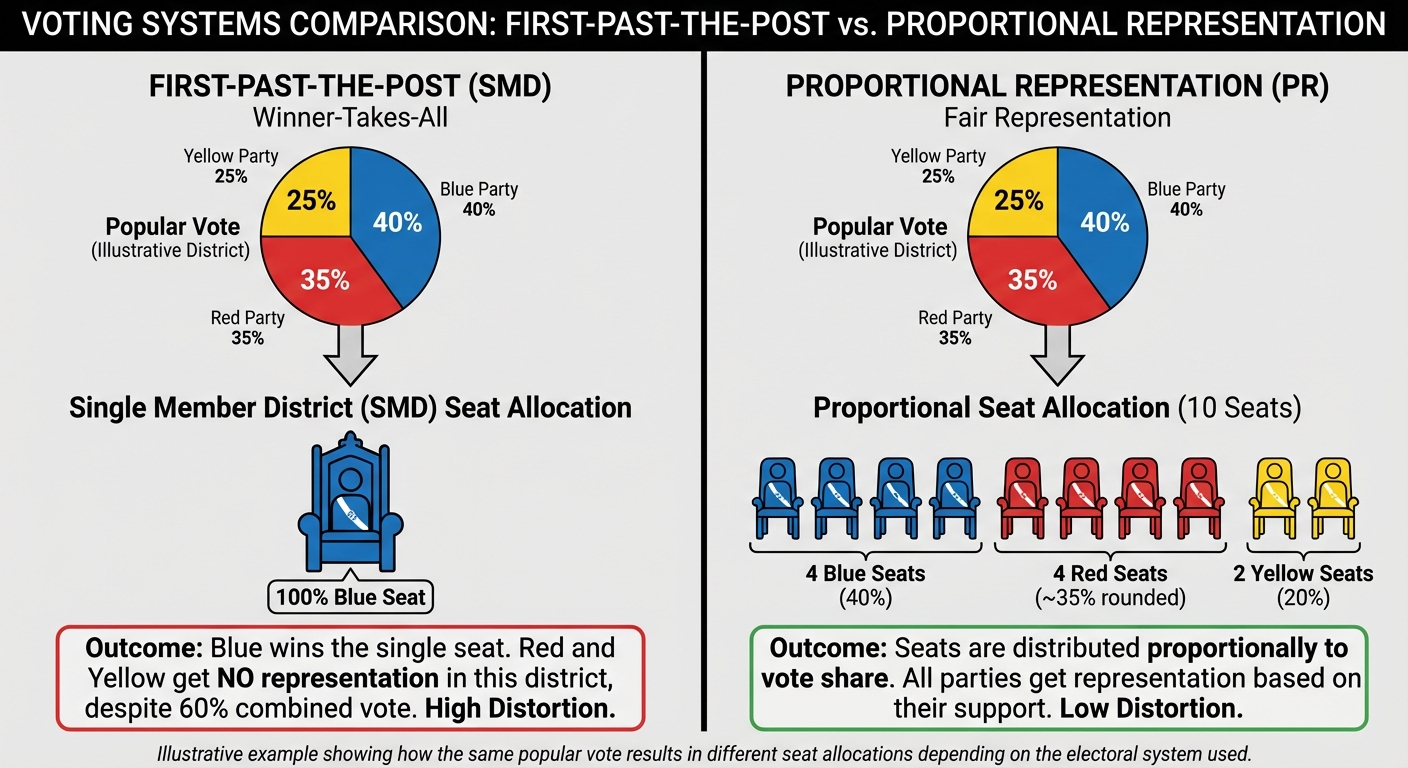
1. Single-Member District (SMD) / First-Past-The-Post (FPTP)
Also known as a Plurality system. The country is divided into geographic districts.
- The Rule: The candidate with the most votes wins the seat. They do not need a majority (>50\%), just a plurality (more than anyone else).
- Effect: Exaggerates the margin of victory for large parties; punishes small parties whose support is spread thinly.
- Implication (Duverger’s Law): SMD systems tend to create Two-Party Systems because people feel voting for a minor third party is a "wasted vote."
- Course Countries:
- United Kingdom: House of Commons (650 constituencies).
- Nigeria: House of Representatives and Senate.
- Iran: The Majles (mostly SMD, though some multi-member).
2. Proportional Representation (PR)
Divides the country into large multi-member districts (or one national district).
- The Rule: Voters vote for a political party, not a specific individual. Seats are awarded based on the percentage of the vote received.
- Thresholds: Most PR systems have a minimum percentage (e.g., 5% or 7%) required to get any seats to prevent extremist fragmentation.
- Effect: Increases the number of parties; forces coalition governments; better representation of women and minority groups.
- Course Countries:
- Russia: From 2007–2016, the Duma was 100% PR to exclude regional independents. (Now it is Mixed).
3. Mixed Systems
A combination of SMD and PR.
- The Rule: Voters usually get two ballots: one for a local representative (SMD) and one for a party (PR).
- Effect: Attempts to get the "best of both worlds"—local representation (SMD) plus overall fairness (PR).
- Course Countries:
- Mexico: The Chamber of Deputies (300 SMD + 200 PR).
- Russia: The State Duma (225 SMD + 225 PR).
Presidential Election Rules (Special Cases)
- Majority Runoff (Two-Round System): If no candidate wins a majority () in the first round, a second election is held between the top two candidates.
- Used in: Russia, Iran, Nigeria (sort of—see below).
- Nigeria’s Specific Rule: To win the presidency, a candidate must win the most votes AND at least 25% of the vote in 2/3rds of the states. This is a unique rule designed to ensure the president has legitimate national support, not just regional support.
4.2 Objectives of Election Rules
Why do countries choose specific rules? It depends on whether the regime is democratic or authoritarian.
Democratic Objectives
- Fairness & Legitimacy: Ensuring the government represents the will of the people.
- Stable Government: Systems like SMD (UK) prioritize government efficiency (single-party majority) over perfect representation.
- Proportionality: Systems like PR prioritize including minority voices over efficiency.
Authoritarian Objectives (Regime Survival)
Authoritarian regimes hold elections not to choose leaders, but to sustain power.
- Internal Legitimacy: To convince the population the government is valid.
- External Legitimacy: To avoid sanctions from the international community.
- Co-optation: To bring elites into the system so they don't rebel.
- Information Gathering: To see where opposition is strongest (so the state knows where to crackdown or distribute resources).
Comparison Table: Electoral Oversight
| Country | Organization | Integrity | Notes |
|---|---|---|---|
| Nigeria | INEC (Independent National Electoral Commission) | Making progress but struggles with logistics, violence, and corruption accusations. | Recent elections tested INEC's independence heavily. |
| Mexico | INE (National Electoral Institute) | High. Formerly the IFE. A crucial institution that transitioned Mexico from one-party rule to democracy. | Independent, autonomous, trusted. |
| Iran | Guardian Council | Low. The Council "vets" (disqualifies) reformist candidates before they even get on the ballot. | Elections are competitive only within the narrow circle of approved theocrats. |
| Russia | Central Election Commission | Low. Controlled by the executive; blocks true opposition candidates (like Navalny) on technicalities. | Used to rubber-stamp Putin's victories. |
4.3 Political Party Systems
A Party System refers to the number of parties that have a realistic chance of winning power. Do not confuse this with the Electoral System (the math).
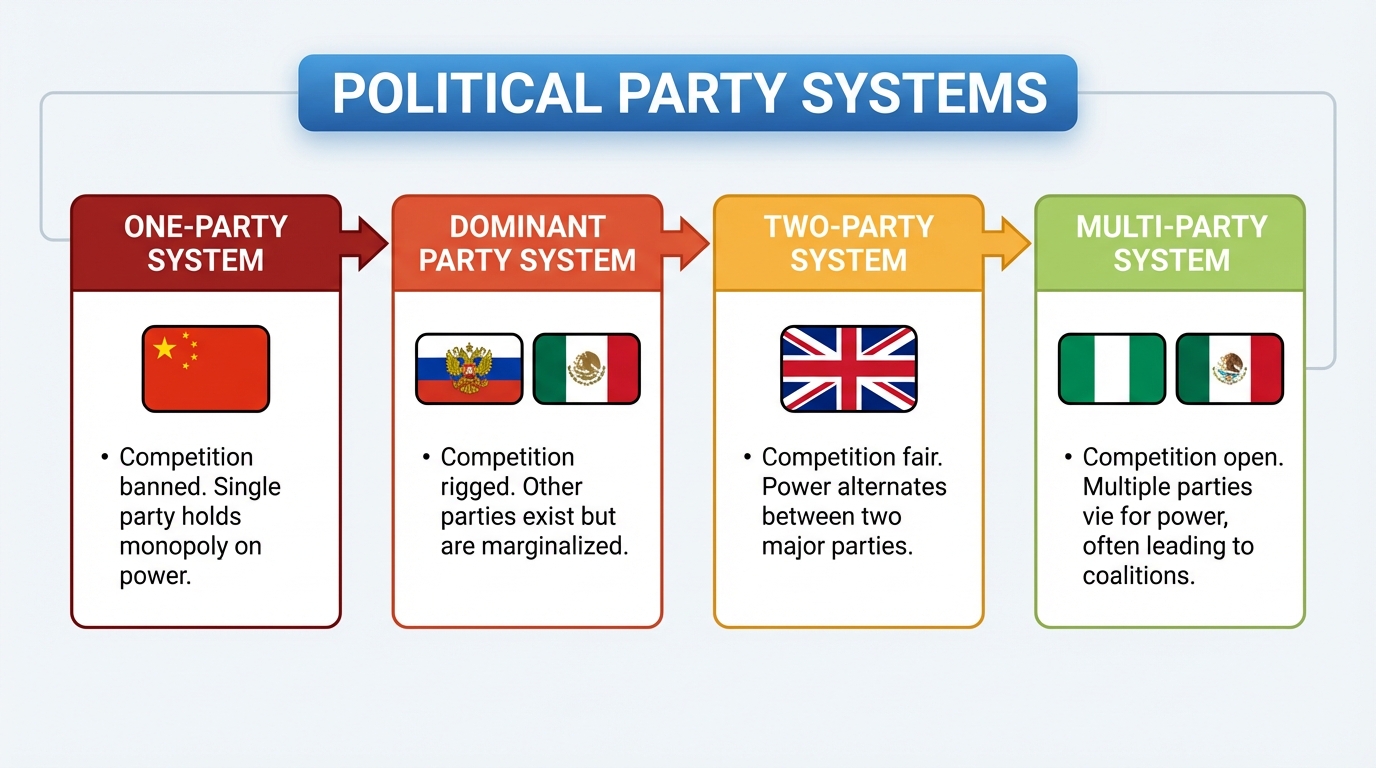
1. One-Party System
Only one party is legally allowed or constitutionally recognized to hold power.
- China (CCP): The Communist Party of China is enshrined in the constitution. There are 8 tiny "democratic parties," but they are subservient to the CCP and exist only for consultation, not competition.
2. Dominant Party System
Multiple parties exist and compete, but one party wins consecutively and unfairly tilts the playing field (media, funding, etc.).
- Russia (United Russia): The "Party of Power." It is a distinct catch-all party centered around Putin. Other parties (CPRF, LDPR) are often called "Systemic Opposition"—they pretend to oppose the government but actually vote with it to maintain the illusion of democracy.
- Mexico (PRI - Historic): For 71 years (1929–2000), the PRI was the dominant party. Since 2000, Mexico is a Multi-Party system (PRI, PAN, PRD, and now MORENA).
3. Two-Party System
Two major parties dominate, though minor parties exist.
- UK: Conservative (Tories) and Labour. Third parties (Lib Dems, SNP) win seats but rarely form the government (except the 2010 coalition).
4. Multi-Party System
More than two parties have a significant impact; coalitions are often required to govern.
- Nigeria: APC and PDP are the giants, but the Labour Party (Peter Obi) recently disrupted this, solidifying a multi-party dynamic.
- Mexico (Modern): Highly competitive between MORENA (Left-wing populist), PAN (Right-wing conservative), and PRI (Centrist/Catch-all).
Key Concept: Catch-All Parties
Parties that water down their ideology to appeal to the broadest possible range of voters (e.g., United Russia, PRI in Mexico, Conservative Party in UK).
4.4 Social Movements vs. Interest Groups
Students often confuse these two. The difference lies in organization and tactics.
Interest Groups
Formal organizations that work within the political system to influence policy. They focus on specific issues (e.g., environmental regulations, labor rights).
- Tactics: Lobbying, campaign donations, drafting legislation, testifying in parliament.
- Examples:
- UK: TUC (Trades Union Congress) - allied with Labour Party.
- Mexico: Coparmex (Employers' Confederation).
Social Movements
Loose, informal coalitions of citizens who operate outside established institutions, often demanding fundamental change.
- Tactics: Protests, marches, civil disobedience, social media campaigns.
- Examples:
- Iran: Green Movement (2009) demanded fair elections; Woman, Life, Freedom (2022) demanded an end to theocratic oppression.
- Nigeria: #EndSARS protested police brutality and corruption.
- Mexico: Zapatistas (EZLN) in Chiapas demanded indigenous rights.
- Russia: Navalny Protests (Anti-corruption foundation) - suppressed by the state.
4.5 Pluralism vs. Corporatism
This is the most technical concept in Unit 4. It describes how the state interacts with interest groups.
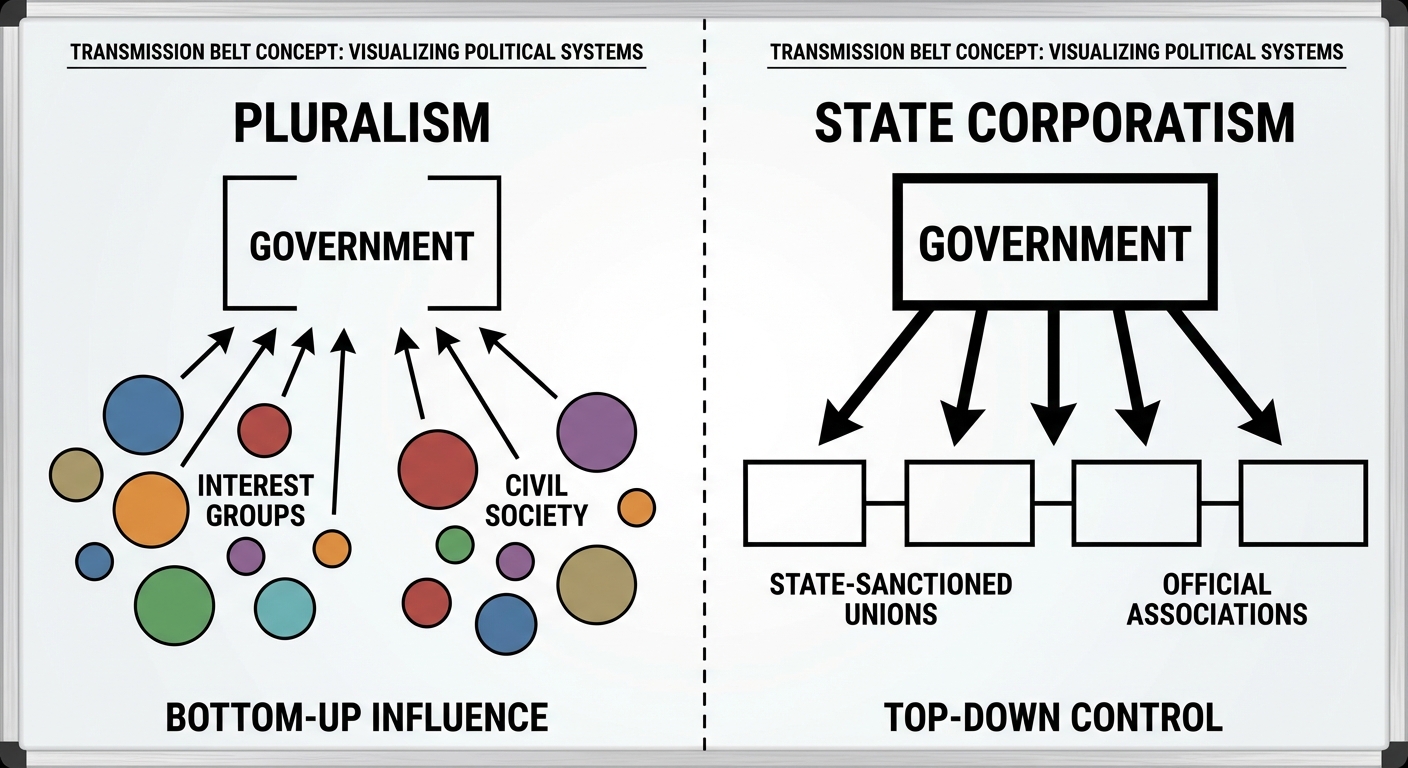
1. Pluralism (Democratic)
- The Theory: Many interest groups compete freely for influence. The government acts as a neutral referee. Groups form key linkages between people and the state.
- Key Feature: Groups are autonomous (independent) from the government.
- Countries: UK, Nigeria (mostly), Mexico (post-2000).
2. Corporatism (Two Types)
Corporatism is a system where the government limits the number of interest groups, recognizing only one for each sector (e.g., one national labor union, one national farmer group) and giving them a monopoly on representation in exchange for loyalty.
A. State Corporatism (Authoritarian)
- The State creates and controls the groups to minimize protest. The groups act as "Transmission Belts"—conveying state orders down to the people, rather than people's wishes up to the state.
- China: The All-China Federation of Trade Unions is the only legal union. It prevents strikes rather than organizing them.
- Russia & Iran: The state heavily regulates civil society (NGOs), labeling foreign-funded groups as "foreign agents."
B. Neo-Corporatism (Democratic)
- Used historically in parts of Europe (and sometimes the UK or Mexico). Business, Labor, and Government sit at a table to negotiate wages nationwide. It is consensual but less competitive than pluralism.
Common Mistakes & Pitfalls
Confusing "Majority" and "Plurality":
- Plurality: The most votes (even if it's only 25%).
- Majority: More than 50%.
- Correction: In the UK (SMD), MPs win by plurality. In Russia/Iran/Nigeria presidential races, a majority (runoff) system is used.
Assuming China has NO elections:
- Correction: China has direct elections at the local village level. However, above that level, elections are indirect (local reps choose county reps, who choose provincial reps, etc.), and the CCP vets all candidates.
Misunderstanding "Corporatism":
- Mistake: Thinking it means "rule by corporations/businesses."
- Correction: It comes from "Corpus" (body). It means the state organizes society into "organs" (labor, agriculture, industry) and controls/coordinates them. In China/Russia, it is a tool of authoritarian control.
Iran's Parties:
- Mistake: Thinking Iran has stable parties like the UK.
- Correction: Iran's parties are weak, fluid, and unstable. Politics is driven by loose factions (Conservatives/Hardliners vs. Reformists) rather than formal party machinery.
Duverger's Law Direction:
- Mistake: "Two-party systems create FPTP rules."
- Correction: It is the other way around. FPTP rules create Two-party systems (math forces consolidation).