Mastering Trigonometric Functions in AP Precalculus
Periodic Phenomena and the Unit Circle
Before diving into specific trigonometric functions, it is essential to understand the nature of periodic functions and the geometric foundation of trigonometry: the unit circle.
Understanding Periodicity
A function $f$ is periodic if there is a positive number $p$ such that $f(x + p) = f(x)$ for all $x$ in the domain. The smallest such positive value $p$ is called the fundamental period.
- Periodic Phenomena: Real-world examples include tides, the rotation of a Ferris wheel, sound waves, and heartbeats. The output values repeat in a regular cycle.
- Cycle: One complete repetition of the pattern.
The Unit Circle
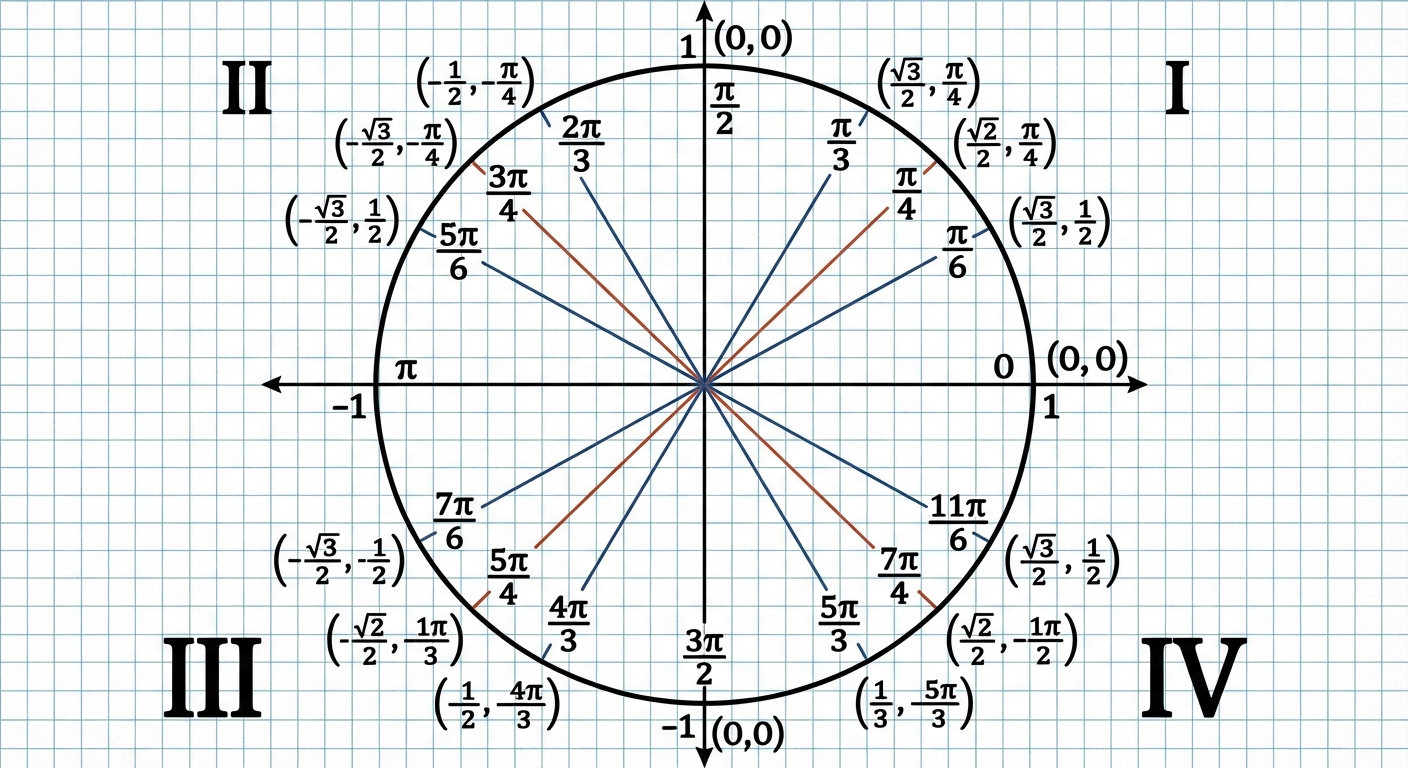
The Unit Circle is a circle centered at the origin $(0,0)$ with a radius of $r = 1$. The equation of the unit circle is:
In AP Precalculus, we define trigonometric functions based on the position of a point $P(x, y)$ on this circle corresponding to an angle $\theta$ (theta).
- Input ($\theta$): An angle in standard position (starting at the positive x-axis). Positive angles rotate counter-clockwise; negative angles rotate clockwise.
- Measurement: While degrees are used in geometry, calculus-based mathematics primarily uses radians. One full revolution is $2\pi$ radians.
- Arc Length: On the unit circle, the radian measure of an angle is equal to the length of the arc intercepted by that angle.
Sine, Cosine, and Tangent Functions
While you may remember SOH-CAH-TOA from geometry, AP Precalculus shifts the focus to functions defined by coordinates on the unit circle.
Definitions on the Coordinate Plane
For any real number $\theta$ representing an angle of rotation in radians, the point $P(x, y)$ on the unit circle is defined as:
- Cosine Function: The $x$-coordinate of the point.
- Sine Function: The $y$-coordinate of the point.
- Tangent Function: The ratio of the $y$-coordinate to the $x$-coordinate (which represents the slope of the terminal ray).
Signs in Quadrants (ASTC)
A helpful mnemonic to remember where functions are positive is "All Students Take Calculus":
| Quadrant | Positive Functions | Negative Functions |
|---|---|---|
| I (All) | $\sin, \cos, \tan$ | None |
| II (Students) | $\sin$ | $\cos, \tan$ |
| III (Take) | $\tan$ | $\sin, \cos$ |
| IV (Calculus) | $\cos$ | $\sin, \tan$ |
Pythagorean Identity
Because $x = \cos(\theta)$ and $y = \sin(\theta)$ satisfy the circle equation $x^2 + y^2 = 1$, we get the fundamental Pythagorean Identity:
Graphs of Sinusoidal Functions
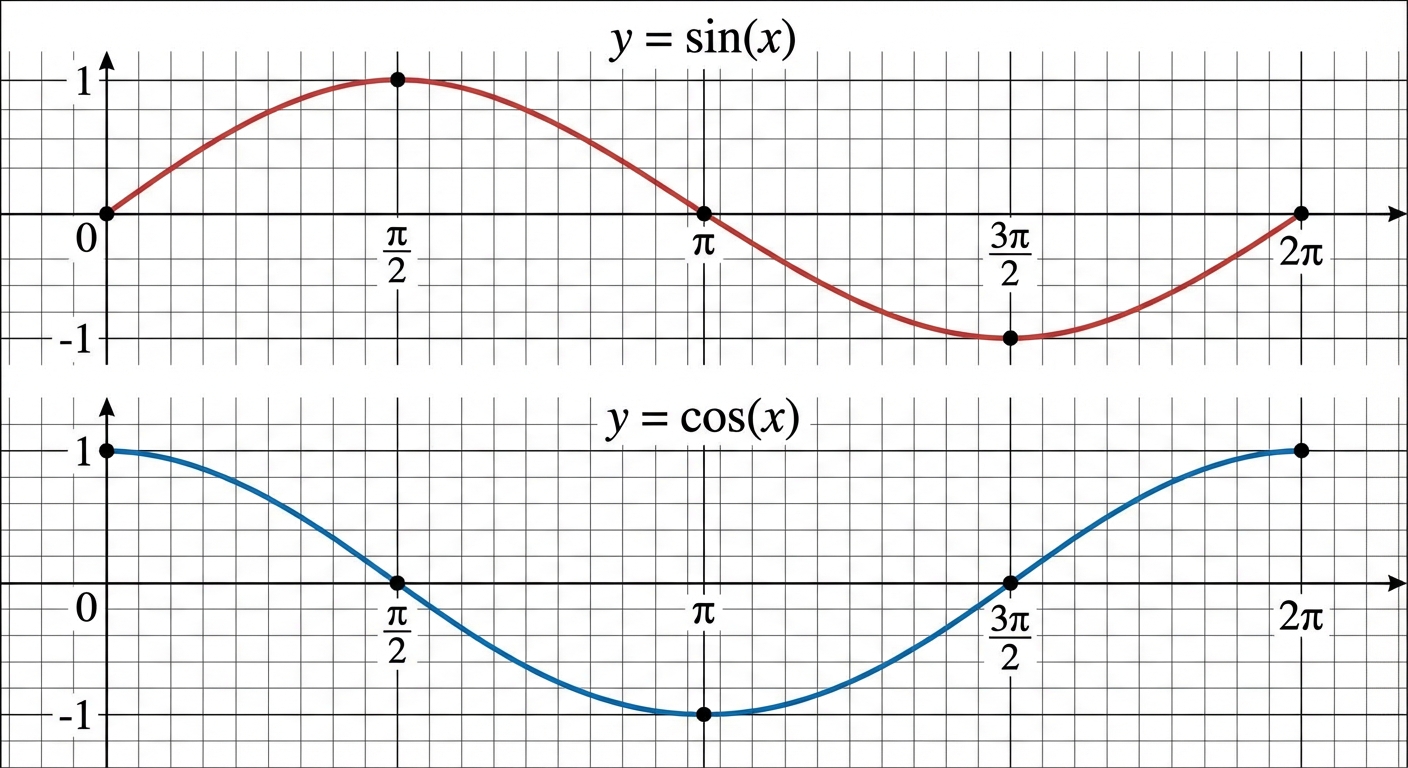
The graphs of sine and cosine are wave-shaped curves known as sinusoids. Understanding their parent functions is critical for analyzing transformations.
The Sine Graph ($y = \sin(x)$)
- Domain: $(-\infty, \infty)$
- Range: $[-1, 1]$
- Period: $2\pi$
- Symmetry: Odd function (symmetric about the origin). $\sin(-x) = -\sin(x)$.
- Intercepts: Passes through the origin $(0,0)$.
- Extrema: Maximum of 1 at $x = \frac{\pi}{2} + 2\pi k$; Minimum of -1 at $x = \frac{3\pi}{2} + 2\pi k$.
The Cosine Graph ($y = \cos(x)$)
- Domain: $(-\infty, \infty)$
- Range: $[-1, 1]$
- Period: $2\pi$
- Symmetry: Even function (symmetric about the y-axis). $\cos(-x) = \cos(x)$.
- Intercepts: y-intercept at $(0,1)$.
- Extrema: Starts at a maximum of 1 at $x=0$.
Concavity and Inflection Points
An often tested concept in AP Precalculus is identifying intervals of concavity:
- Concave Down: Where the graph opens downwards (like a frown). For $\sin(x)$, this occurs on $(0, \pi)$.
- Concave Up: Where the graph opens upwards (like a smile). For $\sin(x)$, this occurs on $(\pi, 2\pi)$.
- Inflection Points: Points where concavity changes. On sinusoidal graphs, inflection points occur at the midline.
Sinusoidal Function Transformations and Modeling
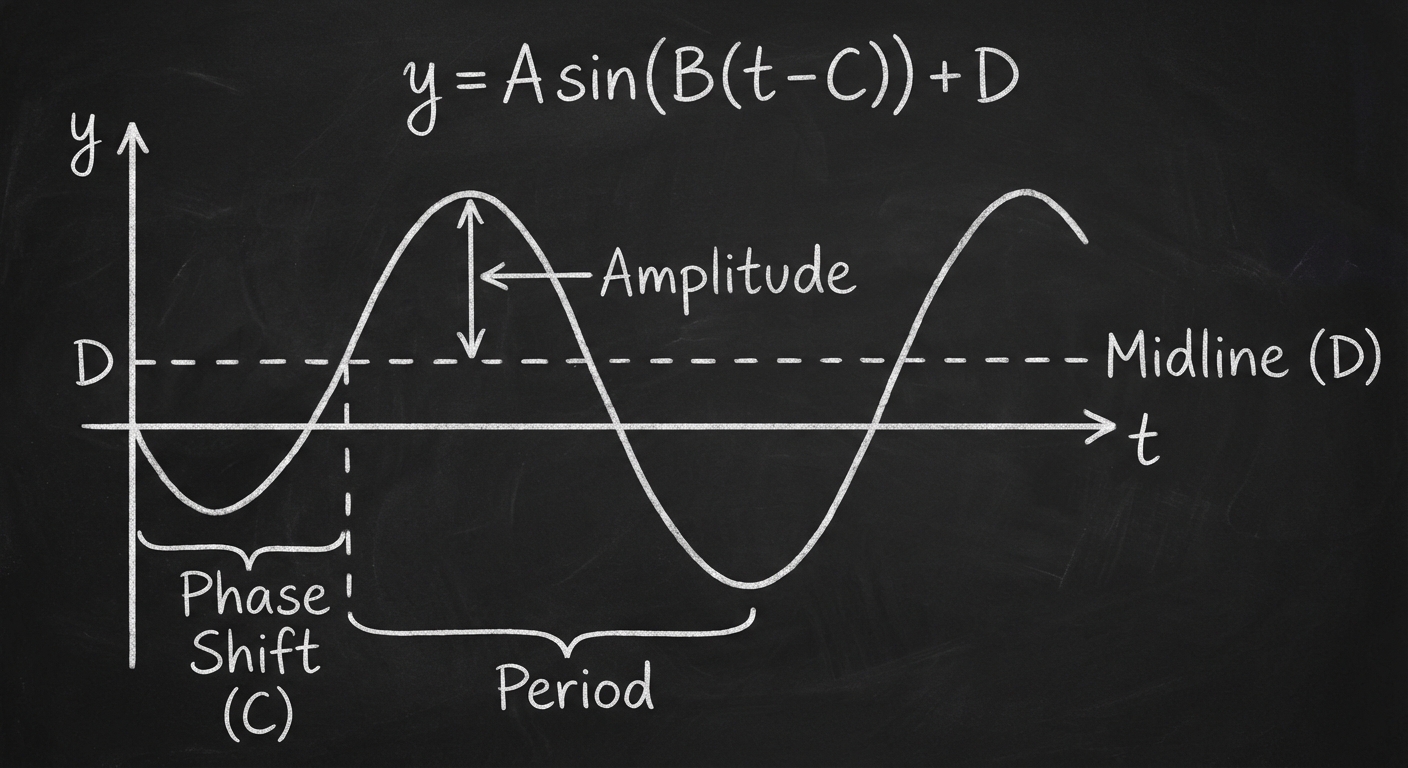
Most exam questions involve modeling data with a transformed function. The general standard form is:
Breaking Down the Parameters
Amplitude ($|a|$):
- Half the distance between the maximum and minimum values.
- Formula: $a = \frac{\text{Max} - \text{Min}}{2}$.
- Vertical stretch/compression factor.
Period ($P$) and Frequency ($b$):
- The parameter $b$ affects the horizontal stretch/compression.
- Formula relating Period and $b$: $P = \frac{2\pi}{|b|}$ (or $b = \frac{2\pi}{P}$).
- Note: If the variable is time $t$, $b$ is the angular frequency.
Vertical Shift / Midline ($d$):
- The horizontal axis of oscillation.
- Formula: $d = \frac{\text{Max} + \text{Min}}{2}$.
- Also known as the biological or physical average value over time.
Phase Shift ($c$):
- The horizontal shift of the graph.
- Crucial Step: You must factor out $b$ to see the true phase shift. If given $y = \sin(2x - \pi)$, rewrite as $y = \sin(2(x - \frac{\pi}{2}))$. The shift is $\frac{\pi}{2}$ right, not $\pi$.
- For sine, the "start" of the cycle is at the midline moving up.
- For cosine, the "start" of the cycle is at the maximum.
Example: Modeling a Ferris Wheel
Scenario: A Ferris wheel has a diameter of 40 meters. The center is 25 meters above the ground. It makes one full revolution every 10 minutes. At $t=0$, you are at the top (maximum height). Model your height $h(t)$ using a cosine function.
Solution Steps:
- Find Midline ($d$): The center is the midline. $d = 25$.
- Find Amplitude ($a$): Radius is half the diameter. $a = 20$.
- Find Frequency ($b$): Period $P = 10$. So $b = \frac{2\pi}{10} = \frac{\pi}{5}$.
- Determine Function Type & Shift:
- At $t=0$, we are at the Max. Cosine starts at a max. No phase shift is needed if we use positive cosine.
- Equation: $h(t) = 20 \cos(\frac{\pi}{5}t) + 25$.
Common Mistakes & Pitfalls
- Degrees vs. Radians Mode: This is the #1 error. AP Precalculus is almost exclusively in Radians. Check your calculator mode before every calculation.
- Incorrect Phase Shift: In an equation like $y = \sin(3x - 12)$, students often think the shift is 12. You MUST factor out the 3: $y = \sin(3(x - 4))$, so the shift is 4.
- Confusing Inverse Notation: $\sin^{-1}(x)$ is the inverse sine function (arcsin), NOT $\frac{1}{\sin(x)}$. The reciprocal is $\csc(x)$.
- Amplitude is Always Positive: In geometric terms, amplitude is a distance. Even if $a = -3$ in the equation (indicating a reflection), the amplitude is $|-3| = 3$.
- Tangent Domain Errors: Remembering that $\tan(\theta)$ is undefined when $\cos(\theta) = 0$ (vertical asymptotes at $\frac{\pi}{2}, \frac{3\pi}{2}, \dots$).