Comprehensive Guide to Properties of Fluids and Fluid Dynamics
Unit 8: Fluids
Welcome to Unit 8! This unit marks a shift from rigid body mechanics to the mechanics of materials that flow. In the 2024-2025 AP Physics 1 curriculum update, fluids were moved from AP Physics 2 to AP Physics 1. This unit covers how fluids behave at rest (hydrostatics) and in motion (fluid dynamics).
Density and Pressure
Before analyzing complex fluid behaviors, we must define the fundamental properties that describe fluids.
Density ()
Density is a measure of how much mass is contained in a given volume. Unlike mass, which depends on the amount of material, density is an intrinsic property of the material itself.
Where:
- (Greek letter rho) = Density ()
- = Mass ()
- = Volume ()
Key Standard Values:
- Water (fresh): or
- Air: (at sea level)
Pressure ()
Pressure is defined as the magnitude of the force acting perpendicular to a surface divided by the area over which the force is distributed. In fluids, pressure acts in all directions.
Where:
- = Pressure (Pascals, )
- = Force ()
- = Area ()
Units & Conversion Table:
| Unit | Symbol | Definition/Conversion |
|---|---|---|
| Pascal | Pa | (SI Unit) |
| Atmosphere | atm |
Fluids Statics: Fluids at Rest
When a fluid is not moving, the physics simplifies to the effects of gravity and the weight of the fluid itself.
Hydrostatic Pressure (Pressure at Depth)
The pressure increases as you go deeper into a fluid because of the weight of the fluid column above you pressing down.
Where:
- = Absolute pressure at depth
- = Pressure at the surface (usually atmospheric pressure, )
- = Density of the fluid
- = Acceleration due to gravity ()
- = Depth below the surface
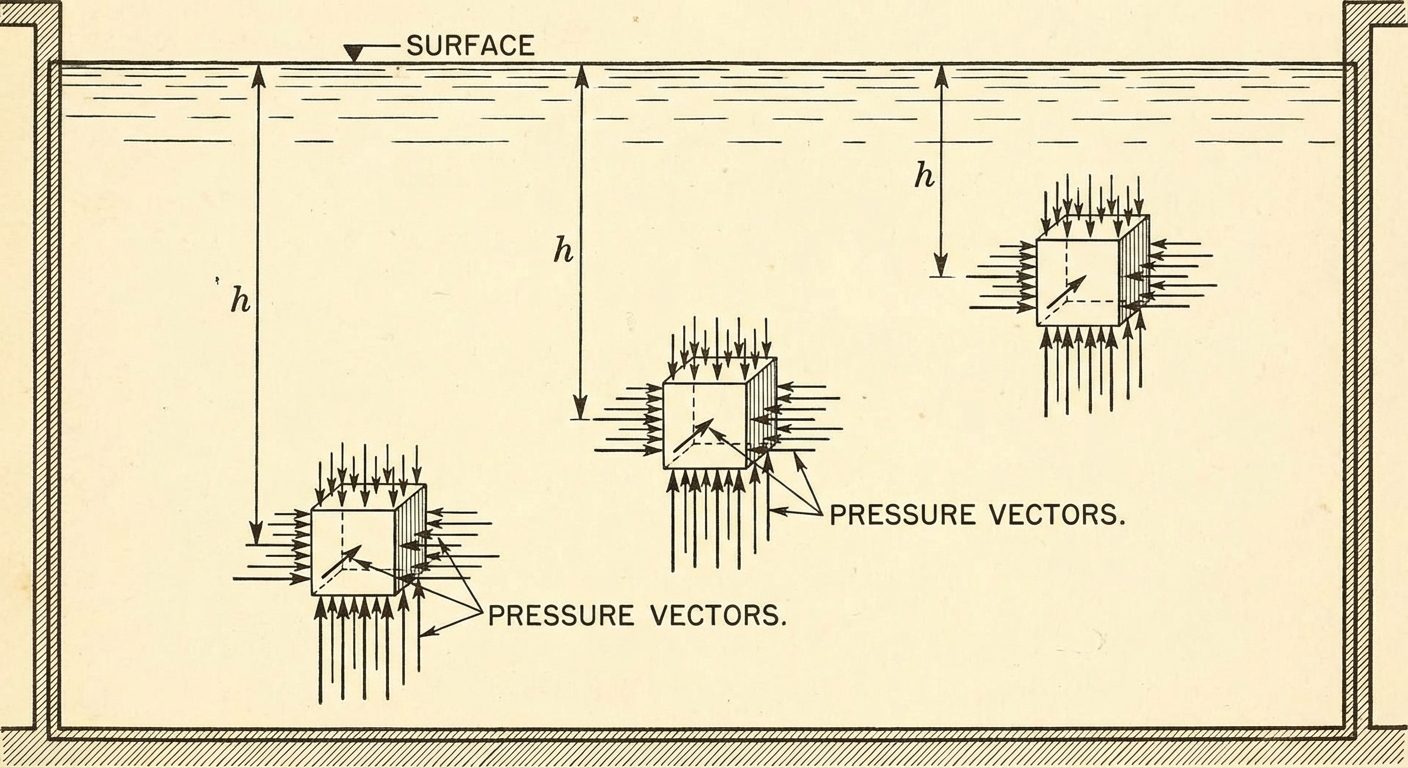
Absolute vs. Gauge Pressure
It is vital to distinguish between the total pressure and the pressure read by many instruments (gauges).
- Absolute Pressure (): The total pressure, including atmospheric pressure.
- Gauge Pressure (): The pressure relative to atmospheric pressure (i.e., how much more than the atmosphere is the pressure?).
Pascal’s Principle
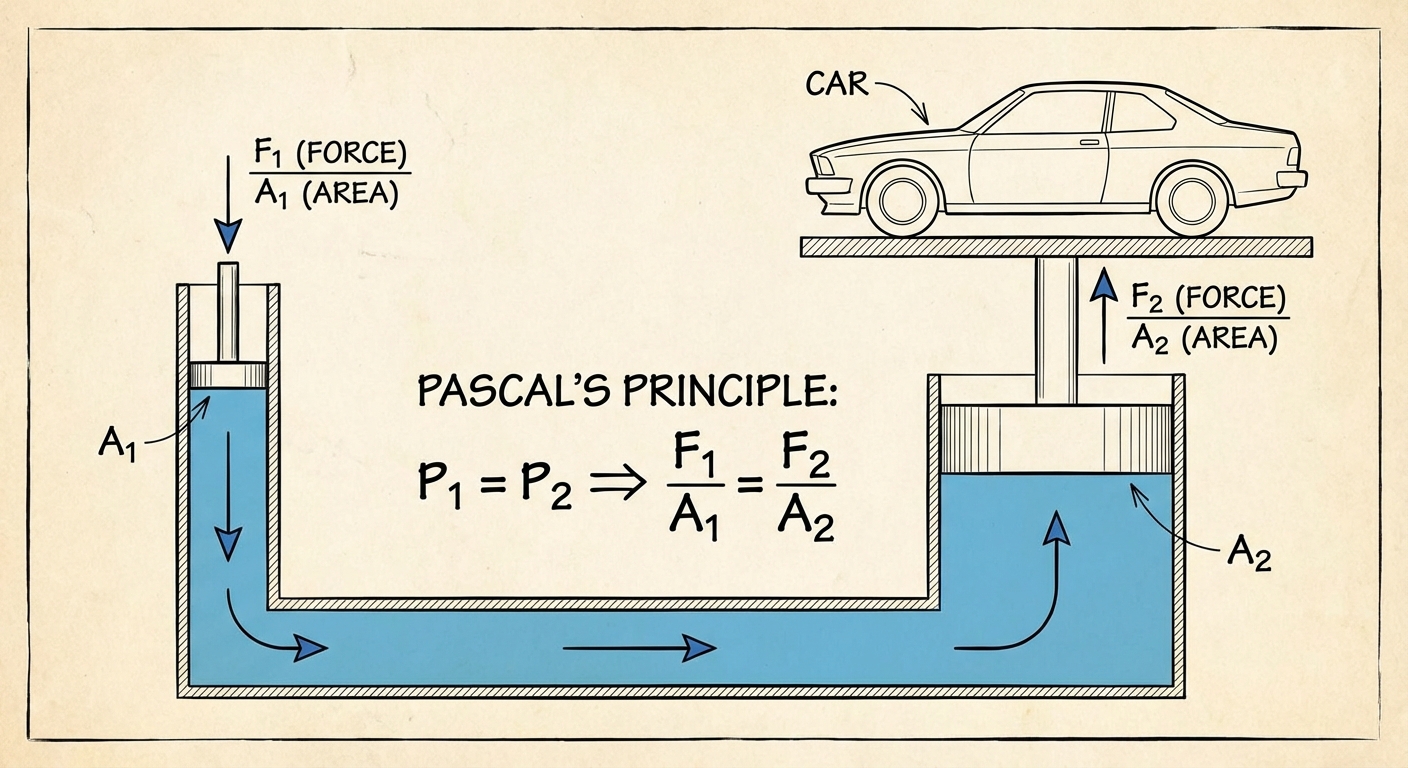
Pascal's Principle states that a change in pressure applied to an enclosed fluid is transmitted undiminished to every point of the fluid and to the walls of the container.
This is the operating principle behind hydraulic lifts (like car brakes or car lifts).
Because , a small force applied to a small area results in a large force exerted over a large area.
Buoyancy and Archimedes' Principle
Why do huge steel ships float while small pebbles sink? It comes down to the buoyant force.
The Buoyant Force ()
Fluids exert an upward force on any object immersed in them. This force arises because pressure increases with depth; the upward pressure on the bottom of an object is greater than the downward pressure on the top.
Archimedes' Principle
Archimedes' Principle states that the upward buoyant force on an object is equal to the weight of the fluid displaced by the object.
Crucial distinction:
- is the density of the fluid, not the object.
- is the volume of the part of the object underwater.
Floating vs. Sinking
To solve buoyancy problems, draw a Free Body Diagram (FBD).
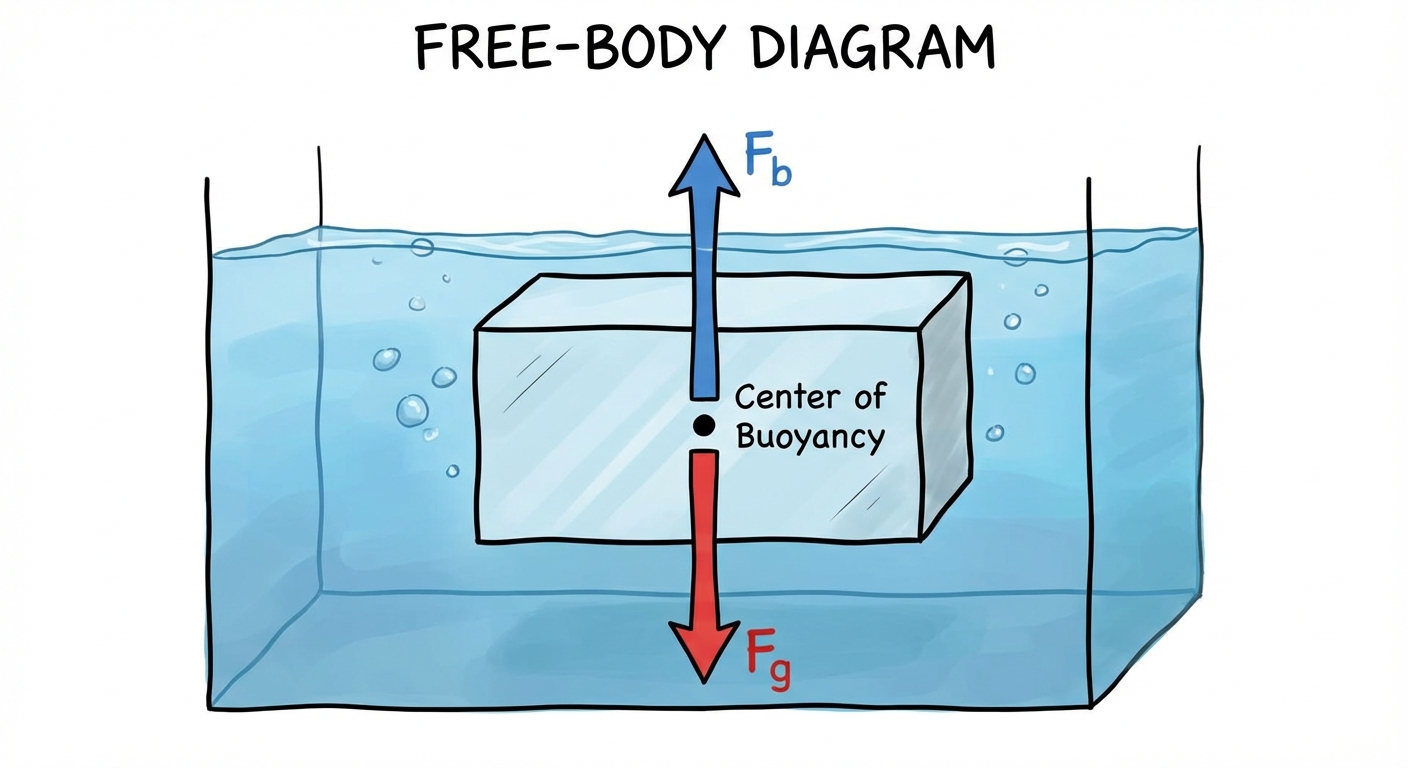
Sinking Object ():
- The object sinks to the bottom.
- Acceleration is downward, or it sits at the normal force at the bottom.
- .
Floating Object ():
- The object is in equilibrium on the surface ().
- .
- .
- This leads to a useful ratio: .
Fluid Dynamics: Fluids in Motion
When fluids move, the physics becomes dynamic. In AP Physics 1, we generally assume we are dealing with an Ideal Fluid to simplify calculations.
Properties of an Ideal Fluid
- Incompressible: The density is constant (works well for liquids, approx for gases).
- Non-viscous: No internal friction (like water, unlike honey).
- Laminar Flow: Smooth flow in layers; streamlines do not cross (no turbulence).
- Irrotational: particles do not rotate about their own axis.
1. The Continuity Equation (Conservation of Mass)
Because mass cannot be created or destroyed, the amount of fluid entering a pipe must equal the amount leaving it (assuming no leaks).
Flow Rate () is the volume of fluid passing a point per unit time:
Since flow rate is constant throughout a closed pipe:
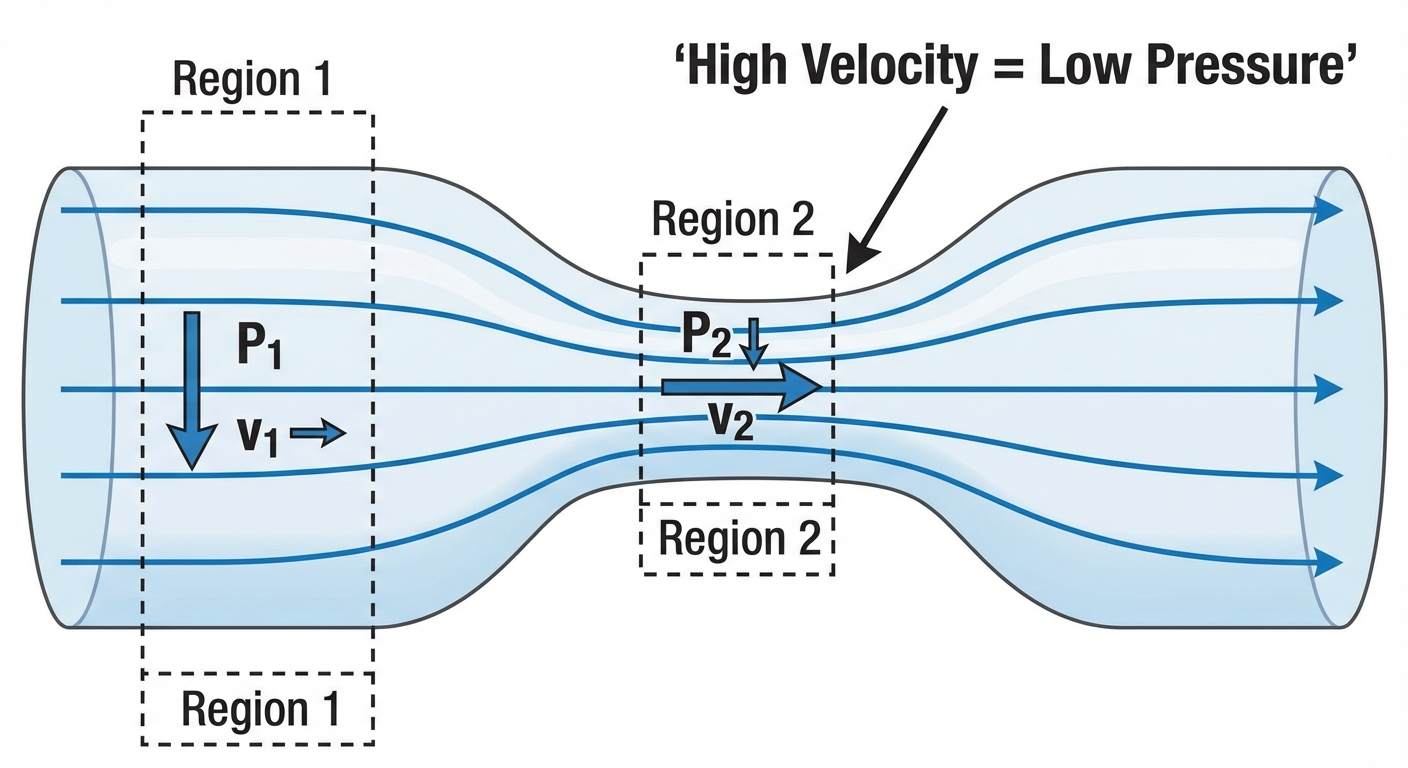
- Implication: If a pipe gets narrower ( decreases), the fluid must speed up ( increases).
2. Bernoulli’s Principle (Conservation of Energy)
Bernoulli’s Principle is essentially the conservation of energy equation rewritten for fluids. It relates pressure, flow speed, and height.
Terms breakdown:
- : Pressure energy (work done per unit volume)
- : Gravitational potential energy per unit volume
- : Kinetic energy per unit volume
The Venturi Effect:
Based on Bernoulli's equation, if the height is constant (), then:
- If velocity increases (at a constriction), Pressure decreases.
- This is counterintuitive! Fast-moving air creates low pressure (this is how airplane wings generate lift).
3. Torricelli’s Theorem
A specific application of Bernoulli’s equation. If you poke a hole in a tank at a depth below the surface, the speed of efflux (water shooting out) is:
(This assumes the top of the tank is open to the atmosphere and the tank is large enough that the water level drops slowly, so ).
Worked Example: The Submerged Cube
Problem: A cube of wood with density and volume is held fully submerged under water () by a string anchored to the bottom. What is the tension in the string?
Solution:
- Identify forces: Downward Gravity (), Downward Tension (), Upward Buoyancy ().
- Set up equilibrium:
- Solve for T:
- Calculate :
- Calculate (Fully submerged, so ):
- Final Calculation:
Common Mistakes & Exam Pitfalls
Confusing Depth () and Height ():
- In the hydrostatic formula (), is the depth measured down from the surface.
- In Bernoulli (), is the height measured up from a set reference point (usually the ground).
The "Mass" in Buoyancy:
- Students often calculate using the mass of the object.
- Correction: uses the density of the fluid and the volume displaced. The mass of the object is irrelevant for calculating (though it matters for net force).
Atmospheric Pressure:
- Forgetting to add () when asked for Total or Absolute pressure. If the problem asks for force on a window of a submarine, remember air pushes from the inside too!
Bernoulli Logic:
- Thinking "Squeeze the pipe -> Pressure goes up."
- Correction: When the pipe squeezes, velocity increases (Continuity). When velocity increases, pressure decreases (Bernoulli).
Units:
- Ensure density is in , not . Remember to multiply by 1000 to get .